Spotted wing drosophila (Drosophila suzukii) is a small invasive vinegar fly from East Asia that lays its eggs inside ripening, soft-skinned fruit such as raspberries, blackberries, blueberries, strawberries, cherries, grapes, elderberries and peaches. Unlike ordinary fruit flies, which only attack overripe or damaged fruit, the female has a saw-like egg-laying organ that cuts through the skin of healthy, ripening fruit. Tiny white larvae feed inside, and fruit turns soft, collapses and leaks within days. Manage spotted wing drosophila by monitoring with vinegar or yeast traps, harvesting every one to two days, picking up and destroying all overripe and fallen fruit, chilling harvested berries immediately, using fine insect netting over bushes, pruning for an open canopy, and, if needed, using labeled insecticides timed to ripening.
Spotted wing drosophila at a quick look
| Feature | Details |
|---|---|
| Scientific name | Drosophila suzukii |
| Origin | East Asia; found in the continental United States since 2008 and now widespread in North America and Europe |
| Adult size | 2 to 3 mm, tan with red eyes |
| Male mark | One dark spot near the tip of each wing |
| Female mark | No wing spots; large serrated ovipositor |
| Larvae | White, legless, up to 3.5 mm, inside fruit |
| Generation time | As little as 8 to 14 days in warm weather |
| Most damaged crops | Fall raspberries, blackberries, blueberries, day-neutral strawberries, cherries, elderberries, grapes |
| Peak activity | Mid to late summer and fall |
What is spotted wing drosophila?
Spotted wing drosophila is a close relative of the common fruit fly, but it is a serious pest because it attacks sound fruit rather than only rotting fruit. The Wikipedia article on Drosophila suzukii describes how it spread from Asia to California in 2008 and then rapidly across North America and Europe, causing large losses to berry and cherry growers. Females can lay hundreds of eggs during their lives, one to a few per fruit, and the short generation time means populations explode in late summer when fall raspberries, blackberries and late blueberries ripen. According to the University of Maine Cooperative Extension guide for home gardeners, frequent harvest and strict sanitation are the most important tools in small plantings.

How do you identify spotted wing drosophila?
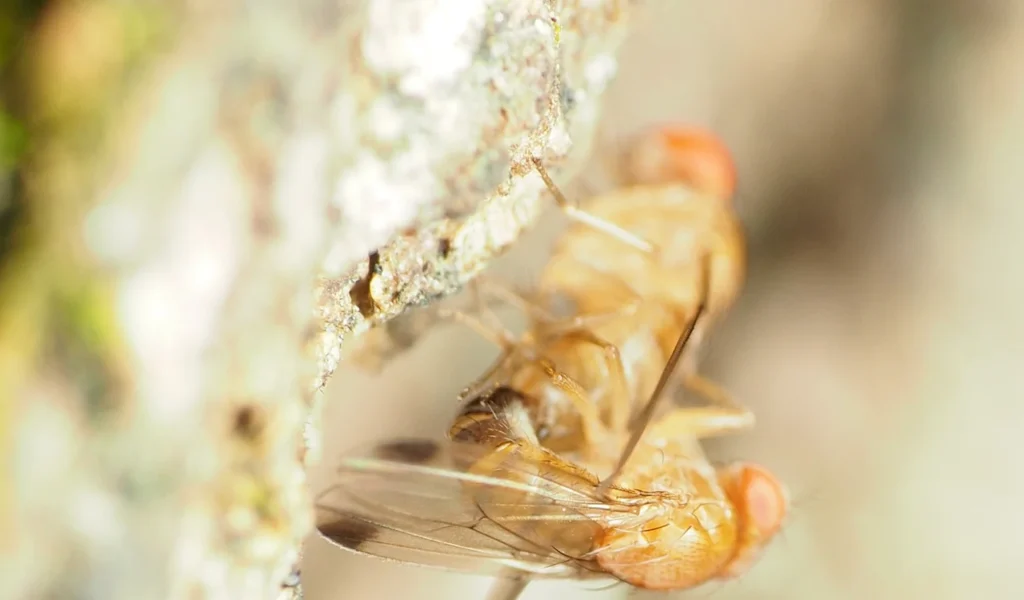
- Adults: small tan flies with red eyes, about the size of a common fruit fly. Males have a dark spot on the outer edge of each wing, visible with a hand lens or even the naked eye. Females lack spots but have a large, saw-toothed ovipositor, visible under magnification.
- Egg punctures: tiny pinholes or scars on fruit skin, sometimes with two thin white breathing filaments of the egg sticking out.
- Larvae: small white maggots inside fruit, often several per berry.
- Damage: soft, sunken spots, leaking juice, collapsing berries and early mold, often appearing a day or two after picking.
Common fruit flies found around compost and overripe fruit are usually other Drosophila species. Spotted wing drosophila stands out because larvae are found in firm, freshly ripened fruit on the plant.
How do you check fruit for larvae?
A simple salt test reveals larvae inside berries. Dissolve about one tablespoon of salt in a cup of warm water (roughly a quarter cup of salt per gallon), place a sample of berries in a shallow dish or zipper bag, cover them with the salt water, and gently crush them slightly. Wait 15 to 30 minutes, then look for small white larvae floating out of the fruit; a hand lens helps. Test a few berries from each picking. If you find larvae, tighten your harvest schedule and sanitation, and consider netting or sprays. The Michigan State University home garden guide to spotted wing drosophila describes this test and other monitoring methods in detail.
How do you trap spotted wing drosophila?
Traps help you know when flies arrive so you can start intensive management, though they rarely catch enough flies to protect fruit on their own.
- Use a clear or red plastic cup or container with a lid, and punch ten or more 3/16-inch holes around the upper sides, leaving a section without holes for pouring.
- Add an inch or two of apple cider vinegar with a drop of unscented dish soap, or a yeast-sugar bait made from one tablespoon of yeast and four tablespoons of sugar in 12 ounces of water.
- Hang traps in the shade inside the plant canopy, near ripening fruit, starting when the first fruit begins to color.
- Check weekly, pour the liquid through a fine strainer, and look for spotted-wing males with a hand lens. Replace the bait each week.
Once you catch spotted wing drosophila, assume fruit is at risk and begin protection.
How do you protect fruit without spraying?
- Harvest often. Pick ripe fruit every one to two days, and do not leave ripe or overripe berries on the plant.
- Remove all damaged and fallen fruit. Collect it in a sealed plastic bag and leave it in the sun for a few days, freeze it, or put it in the trash. Do not compost infested fruit, which can produce more flies.
- Chill fruit immediately. Refrigerating harvested berries at or below 34°F to 40°F slows or stops larval development. Freeze fruit you will not eat within a couple of days.
- Use exclusion netting. Fine insect netting with a mesh of 1 mm or smaller (about 80 grams per square meter), installed after pollination and sealed at the base, keeps flies away from fruit. It works well over blueberry bushes and small raspberry plantings.
- Prune and thin. Open canopies are drier and less shaded, which the flies dislike. Thin raspberry and blackberry canes, keep rows narrow and control weeds.
- Mulch with weed fabric. Some research shows that weed fabric under plants raises temperatures and reduces larvae surviving in fallen fruit.
- Choose earlier varieties. Early-ripening strawberries, blueberries and summer-bearing raspberries usually finish before populations peak, while fall-bearing raspberries and late blueberries suffer the most.

Safety note: If you use insecticides on fruit, choose products labeled for that crop, follow the label rate and pre-harvest interval, and never spray open flowers or while bees are foraging. Keep sprays away from children and pets. Rules on pesticide use vary by location; check with your local extension office.
Which fruits does spotted wing drosophila attack?
| Fruit | Risk level | Notes |
|---|---|---|
| Fall raspberries and blackberries | Very high | Ripen when flies peak; netting and daily picking are key |
| Summer raspberries | High | Later pickings often infested |
| Blueberries | High for mid and late varieties | Netting works well on bushes |
| Day-neutral and everbearing strawberries | High | June-bearing crops usually escape |
| Cherries | High, especially sweet cherries | Late varieties most at risk |
| Elderberries, grapes, figs | Moderate to high | Thin-skinned grapes most affected |
| Peaches, plums, apricots | Low to moderate | Mostly overripe or cracked fruit |
| Wild hosts | Varies | Wild brambles, honeysuckle, buckthorn and pokeweed keep populations going nearby |
Spotted wing drosophila on raspberries and blackberries
Brambles are the most heavily damaged crop, particularly fall-bearing raspberries that ripen in August and September. Pick every day or every other day during peak season, cool berries immediately, and cover plantings with fine netting supported on hoops or a frame. Thin canes to improve airflow and sunlight, and keep rows no wider than 18 inches. Remove wild brambles near your planting if practical. See raspberries in pots and raspberry companion plants for growing tips, and blackberry trellis ideas for open canopy training.
Spotted wing drosophila on blueberries
Early and midseason blueberries often escape serious damage, while late-ripening varieties are frequently infested. Blueberry bushes are easy to net: build a simple frame of posts or PVC hoops, drape fine netting over it after bloom, and secure the base with pins or boards. The netting also keeps birds off. Harvest ripe berries every two to three days and refrigerate them quickly. See growing blueberry bushes and the best soil for blueberries.
Spotted wing drosophila on strawberries and cherries
June-bearing strawberries generally ripen before populations build, but everbearing and day-neutral strawberries that fruit through summer and fall are often infested. Pick frequently, remove overripe berries and consider low tunnels covered with netting. Sweet cherries, especially later varieties, are attacked as fruit colors; pick promptly when ripe and remove fruit left on the tree after harvest. See cherry fruit trees and planting bare root strawberries.
When should you use insecticides?
Insecticides are a last resort in home gardens but may be needed for heavy infestations in fall raspberries or late blueberries if netting is not practical. Sprays only work when timed to protect ripening fruit, usually from first fruit color through harvest, and must be reapplied often because new fruit ripens constantly and rain washes residues away. Options labeled for home use in many areas include spinosad, which is allowed in organic gardening, and pyrethrins, sometimes with neem. Always follow the label for the crop, rate, interval and pre-harvest interval, which tells you how many days to wait between spraying and picking. Spray in the evening when bees are not foraging, and never spray open flowers. Rotate products with different modes of action to slow resistance. Contact your local extension office for current recommendations, since registrations differ by state and country.
What attracts spotted wing drosophila?
The flies are drawn to fermenting fruit odors, shaded humid sites and ripening soft fruit. Gardens with uncollected fallen fruit, dense unpruned canes, nearby wild brambles or compost piles with fruit scraps support larger populations. The flies are most active at moderate temperatures between about 60°F and 80°F and are less active in hot, dry conditions above 90°F. Adults survive winter in protected sites and populations build gradually through summer, reaching peaks in late summer and fall.
Spotted wing drosophila life cycle
Adult females lay eggs just under the skin of ripening fruit. Eggs hatch within one to three days, and larvae feed inside the fruit for about five to seven days, then pupate inside the fruit or drop to the soil. New adults emerge after a few days to two weeks, and females begin laying eggs within a day or two. In warm weather the full cycle can take as little as eight to fourteen days, allowing ten or more generations in a season in mild climates. Adults overwinter in sheltered places such as woodland edges, and winter-form adults are darker and more cold-tolerant. This rapid life cycle is why weekly harvests are not enough: a few days of neglect lets a new generation emerge.
Is it safe to eat fruit with spotted wing drosophila larvae?
Accidentally eating larvae is not harmful to people, and most of us have eaten fruit fly larvae in fresh produce at some point. However, infested fruit spoils quickly, becomes mushy and may mold, so it is unpleasant to eat. Sort berries after harvest, discard soft or leaking ones, and refrigerate or freeze the rest promptly. Infested fruit can still be used for jam or juice if processed immediately, but quality will be lower.
Natural enemies of spotted wing drosophila
Native predators such as spiders, ants, earwigs, minute pirate bugs and ground beetles eat some larvae and pupae, especially in fallen fruit, but do not control outbreaks. Researchers have studied small parasitic wasps from the fly’s native range, and some, such as Ganaspis kimorum (formerly Ganaspis brasiliensis), have been approved for release in parts of the United States and Europe. Biological control may reduce populations over time, but home gardeners should still rely on harvest timing, sanitation and netting. Avoid broad-spectrum sprays when you can, because they kill predators of other pests as well.
Common mistakes with spotted wing drosophila
- Waiting to harvest until most of the fruit is ripe, which gives females days to lay eggs in ripe fruit.
- Leaving fallen or overripe fruit on the ground or in compost piles, which breeds the next generation.
- Using netting that is too coarse; bird netting does not keep flies out.
- Relying only on traps; they warn you about flies but do not protect fruit.
- Leaving berries at room temperature after picking, which lets eggs hatch and larvae grow.
- Spraying without checking the pre-harvest interval, which can leave residues on fruit you are about to eat.
A season plan for berry growers
- Spring: prune brambles and blueberries for open canopies, lay weed fabric or mulch, and plan netting frames.
- Early fruit color: hang traps, install netting after pollination and start the salt test on a few berries.
- Harvest: pick every one to two days, chill berries right away, and remove every damaged or fallen fruit.
- Late season: keep picking until the crop ends, strip remaining fruit and destroy it.
- Winter: review which varieties were hit and consider earlier-ripening replacements.
For other garden pests and plant diseases, browse our complete plant pests and diseases library.
Free printable: the Year-Round Garden & Preserving Planner
Planting dates for 24 crops, monthly tasks, blanching times, canning safety numbers and a winter storage chart in one 8-page PDF. Enter your email to download it instantly and get our seasonal garden newsletter.
No spam. Unsubscribe any time. We never sell your email.
Spotted wing drosophila FAQ
Why are there worms in my raspberries?
Small white larvae in fresh raspberries are usually spotted wing drosophila; use the salt test to confirm.
Does spotted wing drosophila attack apples?
Rarely; firm-skinned fruits like apples and pears are not suitable unless damaged.
Can I freeze berries with larvae?
Yes, freezing kills larvae, and berries are safe to use in cooking.
Will bird netting keep spotted wing drosophila out?
No. You need fine insect netting with 1 mm or smaller mesh.
How do I tell spotted wing drosophila from regular fruit flies?
Males have a dark spot on each wing tip, and larvae are found in firm, fresh fruit.
Does spotted wing drosophila survive winter?
Yes, adults overwinter in sheltered places and populations rebuild each summer.
References used in this guide: University of Maine Cooperative Extension, What Home Gardeners Need to Know About Spotted Wing Drosophila; Michigan State University, Spotted Wing Drosophila in the Home Garden; Wikipedia, Drosophila suzukii.