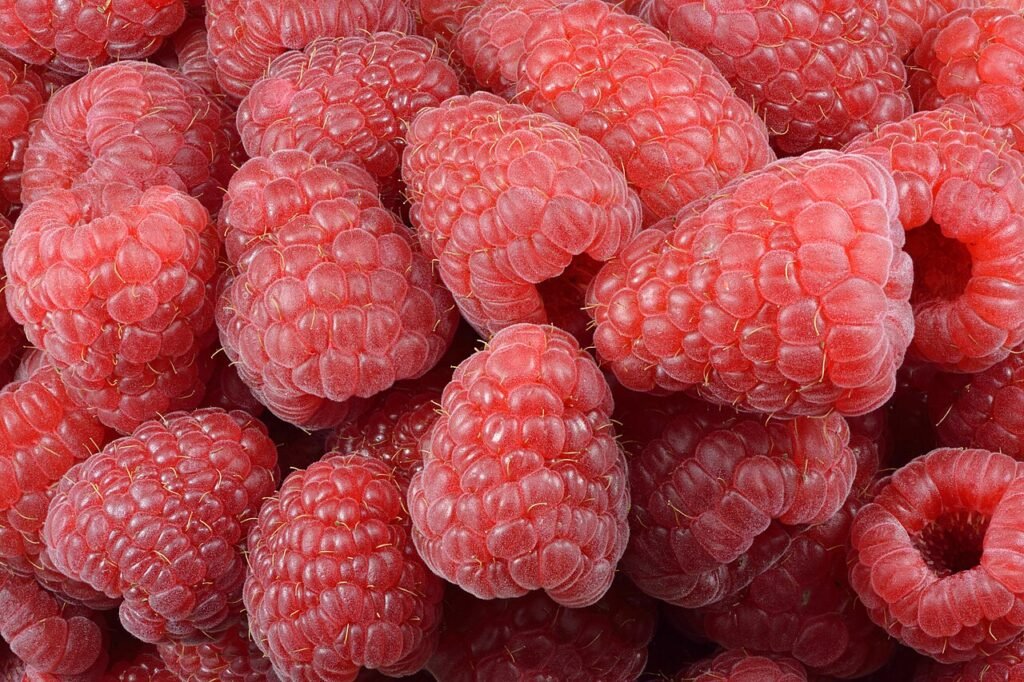
Raspberries are one of the most rewarding fruits for a home garden: a small patch gives pints of sweet berries that are expensive and fragile in stores. Plants send up new canes each year from a long-lived root system, so a patch can produce for 10 years or more. The main things to learn are which type you have, because it decides how you prune, and how to keep the patch in bounds. This page covers when to plant, spacing, support, pruning, problems and harvest.
Raspberry at a glance
| Type | Fruit |
|---|---|
| Season | Perennial |
| Sun | Full sun |
| Plant spacing | 30 in |
| Row spacing | 96 in |
| Per square foot | 1 |
| Seed depth | 2 in |
| Days to maturity | Light crop year 2; full crop from year 3 |
| How to start | Plant bare-root canes in early spring as soon as the soil can be worked, or potted plants any time from spring to early fall. |
| Water | 1.25 in per week |
These are the same numbers our plant spacing, square foot and harvest date calculators use. See every crop in the plant database.
When to plant raspberry
Plant bare-root canes in early spring as soon as the soil can be worked, or potted plants any time from spring to early fall. Raspberries prefer cool summers and are hardy in roughly zones 3 to 9 depending on the variety. Do not expect a big crop the first year; plants produce lightly in year two and fully from year three.
Find your last frost with the frost dates by ZIP code tool and check your zone with the growing zone finder.
How to plant raspberry
- Pick the right site. Choose full sun and well-drained soil with a pH of about 5.5 to 6.5. Raspberries rot in soggy ground, so use a raised bed or ridge if drainage is poor.
- Avoid risky spots. Do not plant where tomatoes, potatoes, peppers or eggplant grew recently, because these share a root disease.
- Plant shallow. Set canes about 2 inches deep at the spacing in the table above, with rows far enough apart to walk between. Cut the cane back to about 6 inches after planting.
- Add support. A simple two-wire trellis keeps canes upright, improves airflow and makes picking easier.
- Know your type. Summer-bearing raspberries fruit on two-year-old canes; everbearing (fall-bearing) types fruit on first-year canes and can be mowed down each winter.
Caring for raspberry
Water about 1 to 1.5 inches a week, especially while the fruit is forming. Mulch with 3 to 4 inches of straw or wood chips to hold moisture and suppress weeds. The garden watering calculator turns this into gallons for your row.
Feed with compost or a balanced fertilizer in early spring. For summer-bearing types, cut the canes that fruited down to the ground right after harvest and thin new canes to about 4 to 6 per foot of row. For everbearing types, cut all canes to the ground in late winter for one fall crop, or keep the tips for a small summer crop as well. Remove suckers that pop up outside the row.
Companion plants
| Grow nearby | Garlic, chives, onions, marigolds, tansy, fruit trees |
|---|---|
| Keep apart | Tomatoes, potatoes, peppers, eggplant and blackberries (shared diseases) |
Garlic and onions are said to help deter some pests, and flowers nearby draw pollinators. Keep raspberries away from the nightshade family and from wild brambles, which can spread disease. Check other pairings with the companion plant finder.
Common problems
| Problem | What you see | What to do |
|---|---|---|
| Spotted-wing drosophila | Soft, collapsing berries with tiny white larvae | Pick all ripe fruit often, chill it quickly, remove overripe berries and consider fine netting. See the pest identifier. |
| Cane borers and aphids | Wilting cane tips or clusters of small insects | Cut off and bin wilting tips below the damage and rinse aphids off with water. |
| Gray mold on fruit | Fuzzy gray rot on berries in wet weather | Thin canes for airflow, pick often and remove rotting fruit. |
| Root rot | Plants wilt and canes die in wet soil | Improve drainage, plant in raised beds and avoid overwatering. See the overwatering checker. |
| Spreading suckers | New canes appear far from the row | Mow or dig out suckers outside the row, and use a root barrier or keep rows narrow. |
Not sure what you are looking at? The plant problem identifier ranks likely causes from the symptoms you see.
When and how to harvest
Berries are ready when they turn fully red (or gold, black or purple for other types) and release from the plant with a gentle tug. Berries that need force are not ripe. Pick every 1 to 2 days in the harvest window, which lasts about 3 to 4 weeks for summer-bearing types and from late summer until frost for everbearing types.
Raspberries are fragile and do not ripen after picking. Pick into shallow containers, refrigerate unwashed and eat within 2 to 3 days, or freeze in a single layer on a tray before bagging. Use the harvest date calculator to plan.
Plan your raspberry
- Plant spacing calculator: how many plants fit your bed
- Planting calendar: sowing and transplant dates for your frost dates
- Frost dates by ZIP code: your last spring and first fall frost
- Harvest date calculator: when your crop will be ready
Frequently asked questions
How far apart should I plant raspberry plants?
Space raspberry plants 30 inches apart in rows 96 inches apart. In a square foot garden, plant 1 per square foot.
How deep do I plant raspberry canes?
Plant raspberry canes about 2 inches deep, with the roots spread out and the crown just below the soil surface.
How long do raspberry plants take to grow?
Raspberry canes planted in spring give a light crop in year two and a full crop from year three. Everbearing types can fruit in the first fall.
How much water do raspberry plants need?
About 1.25 inches of water a week, from rain and watering combined. Water about 1 to 1.5 inches a week, and keep the soil evenly moist while fruit forms.
Do raspberries come back every year?
Yes. The roots are perennial and send up new canes each year, so a well-kept patch can produce for 10 years or more.
When should I prune raspberries?
It depends on the type. Cut summer-bearing canes to the ground right after they fruit; cut everbearing canes to the ground in late winter for a fall crop.