Creeping Charlie (ground ivy, Glechoma hederacea) is a perennial mint-family weed that spreads by creeping stems that root at every node. It thrives in damp shade, so lasting control means thickening the lawn, improving light and drainage, and, if you use herbicide, treating in fall when the plant is storing energy in its roots. Expect repeat treatments; extension sources call it very difficult to control.
How do you identify creeping Charlie?
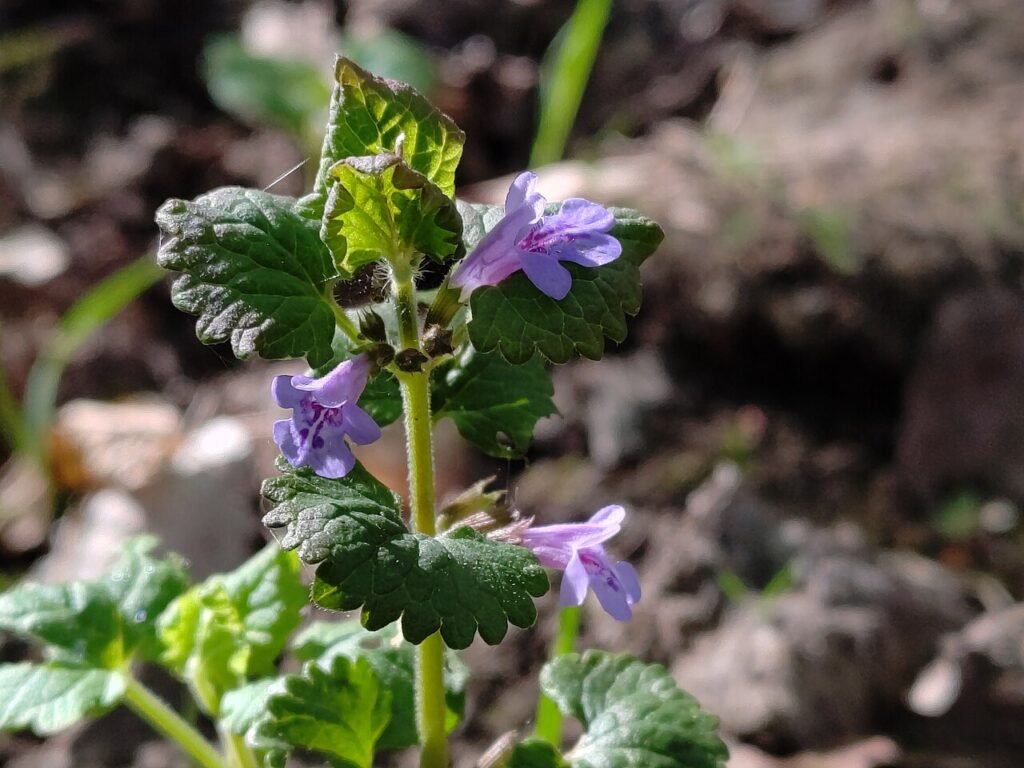
- Rounded to kidney-shaped leaves with scalloped edges, in opposite pairs on square stems (University of Minnesota, University of Wisconsin).
- A minty smell when crushed or mowed.
- Small purple-blue trumpet-shaped flowers in clusters at the leaf joints in spring; UMass gives April to June.
- Evergreen mats that spread 1 to 3 feet and stand up to about 1 foot tall (Minnesota).
- Often confused with henbit, common mallow, heal-all and purple deadnettle.
How does it spread and where does it grow?
Minnesota says it spreads mainly by stolons that root at the nodes, and also by rhizomes and seed, with four seeds per flower. UMass says the roots are shallow and it prefers damp, rich soil and tolerates shade, which lets it outcompete grass by shading it. Large mats can point to compaction, poor drainage or low fertility (Minnesota).
What works to control it?
| Method | What the sources say |
|---|---|
| Hand removal | Fine for small patches because roots are shallow (UMass); remove all root and shoot parts and repeat (Minnesota). Wisconsin warns it rarely removes the whole stem system, and any pulled pieces can re-root |
| Dense lawn | The best prevention: adapted grass, adequate fertilizing, proper mowing and irrigation (UMass, Minnesota). Wisconsin suggests mowing 2 to 3 inches, overseeding in fall and using shade-tolerant turf under trees |
| Change the site | Improve drainage, water less often, prune trees for light, or replace turf with shade groundcovers (Wisconsin) |
| Reseed after clearing | Reseed bare areas left after hand removal (UMass) |
Which herbicides work, and when?
The sources differ on products. Minnesota says triclopyr-based postemergence herbicides are effective and 2,4-D is not very effective. Wisconsin names triclopyr or sulfentrazone, often sold in combination with 2,4-D, mecoprop or dicamba, and also mentions an iron-based (Fe-HEDTA) herbicide as an alternative. UMass names no active ingredients.
On timing they largely agree on fall. Minnesota and UMass say fall (early fall may be best, UMass) with spring as a backup, and Wisconsin recommends mid to late autumn after the first frost with a second application the next spring while plants bloom. UMass and Wisconsin both advise no mowing for a few days before and after, and no rain for 24 hours. Wisconsin gives 65 to 82°F (about 18 to 28°C) and low wind. These are for lawns; Wisconsin says not to use them in vegetable or flower gardens, where hand-pulling or hoeing is recommended. Follow the label and confirm the product lists ground ivy.
Does borax kill creeping Charlie?
Wisconsin says research from the University of Wisconsin and Iowa State found borax typically ineffective. It notes borax can injure turf and other plants, boron persists in soil, and soil type and pH make safe dosing hard to determine, so it does not recommend it.
Is it good for anything? Minnesota notes bees forage on it in April and May when few flowers are open, but says it is not a heavy honey source and diverse flowers are better. Browse the weed library and the fall lawn fertilizer calculator to plan lawn recovery.
Free printable: the Year-Round Garden & Preserving Planner
Planting dates for 24 crops, monthly tasks, blanching times, canning safety numbers and a winter storage chart in one 8-page PDF. Enter your email to download it instantly and get our seasonal garden newsletter.
No spam. Unsubscribe any time. We never sell your email.
Frequently asked questions
Why is creeping Charlie so hard to kill?
Every node on a creeping stem can root, so leftover pieces regrow; sources say control often needs repeat treatments over several years.
When is the best time to treat it?
Fall, when the plant sends energy to its roots, with a spring follow-up if needed.
Should I use borax?
Wisconsin does not recommend it, citing poor results and a risk of harming turf and plants.
Reviewed November 2026. Sources: University of Minnesota Extension: Creeping Charlie; UMass Amherst: Ground ivy in lawns; University of Wisconsin Extension: Controlling creeping Charlie