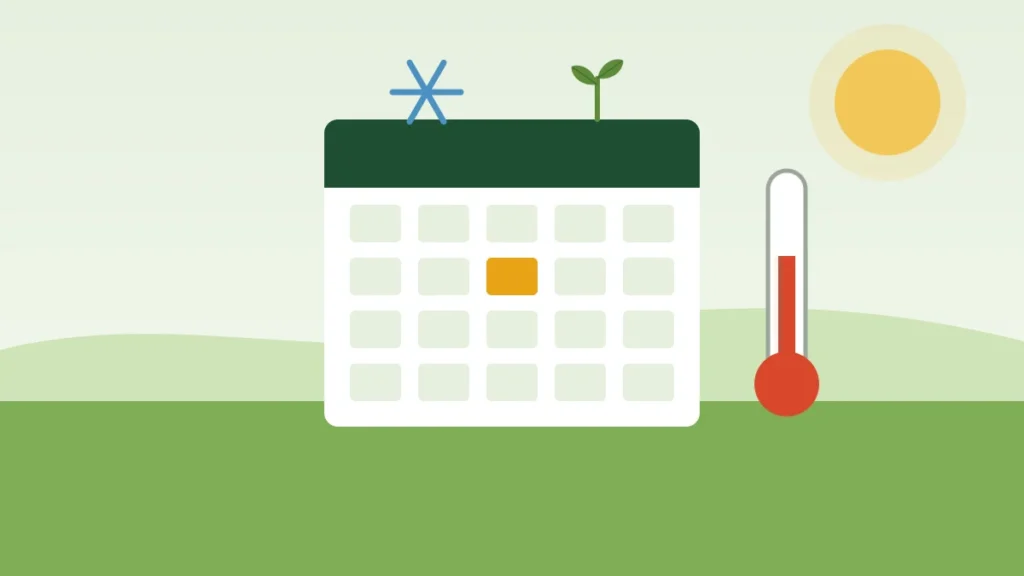
Ask an experienced gardener when to plant tomatoes, and the answer will almost always start with the same phrase: “after your last frost.” Frost dates are the backbone of every planting calendar. They tell you when the growing season begins and ends, when to start seeds indoors, when tender plants can safely go outside, and how late you can still sow a fall crop.
Yet frost dates are widely misunderstood. They are averages, not guarantees. They are not the same as hardiness zones. And the date for your town may not match the conditions in your own backyard. This guide explains what frost dates really mean, how to find yours, and how to use them to plan a whole year in the garden.
What is a frost date?
Gardeners use two key dates:
- The average last spring frost, after which frost becomes increasingly unlikely as spring turns to summer.
- The average first fall frost, when cold nights begin to return at the end of the season.
The time between them is your frost-free growing season. In parts of the far north it can be under 100 days; along the Gulf Coast and in much of California, frost may be rare or absent altogether.
These dates are calculated from decades of weather records. In the United States, many frost-date estimates are based on long-term station data such as NOAA’s U.S. Climate Normals, which summarize weather at thousands of stations over 30-year periods.
Average does not mean guaranteed
This is the most important thing to understand about frost dates. An average last frost date is roughly the point at which frost later in spring is about as likely as not. In some years, the last frost comes two or three weeks before the average. In others, it comes a week or two after.
That is why many frost date sources also give dates at different probabilities, such as the date after which there is only a 10 percent chance of frost. Choosing a later, lower-risk date for frost-tender crops is a simple way to avoid losing them. Our frost date tool includes a safety margin option that does exactly this, pushing back planting dates for tender crops by a week or two.
Frost dates are not the same as hardiness zones
Many gardeners use their USDA zone as a shorthand for planting time, but the two measure different things. The USDA Plant Hardiness Zone Map is based on the average coldest winter temperature. It is designed to tell you which perennial plants will survive your winters, not when to plant vegetables.
Two places in the same zone can have frost dates weeks apart. A coastal town and an inland valley might share a zone because their coldest winter nights are similar, yet the valley could get frost much later in spring. For annual vegetables, your frost dates matter far more than your zone. The growing zone finder explains what your zone does and does not tell you.
How to find your frost dates
- Your state Cooperative Extension service. Most publish frost dates or planting calendars by county or region, tuned to local conditions.
- A frost date lookup by ZIP code. Many seed companies and gardening sites offer one, using records from the nearest weather station.
- NOAA climate data. Long-term records for individual weather stations are available through NOAA’s Climate Normals.
- Local gardeners. Garden clubs, community gardens and experienced neighbors often know how local conditions differ from official records.
- Your own notes. After a few seasons of recording the actual last and first frost in your garden, your records become the most accurate source of all.
When you use a weather station’s data, pick one that is close to your garden and similar in elevation. A station on a hilltop, at an airport, in a city center or beside a large lake can differ noticeably from a garden only a few miles away.
Why your garden may differ: microclimates
Cold air is heavier than warm air. On clear, still nights, it flows downhill and pools in low spots, much like water. Gardens in valleys, hollows and the bottom of slopes can get frost on nights when gardens just uphill stay clear. These frost pockets can have last spring frosts a week or more later than the surrounding area.
Other spots stay warmer. Gardens near south-facing walls, paving, large bodies of water, or in the middle of a town often stay a few degrees warmer at night. If frost consistently arrives earlier or later in your garden than the published date, adjust the dates you plan with to match your experience.
How to use your frost dates: spring
Once you know your average last spring frost, the spring planting schedule falls into place:
| Timing | What to do |
|---|---|
| 10 to 8 weeks before | Start onions, peppers, eggplant and parsley indoors |
| 8 to 6 weeks before | Start tomatoes, broccoli, cabbage and cauliflower indoors |
| 6 to 4 weeks before | Sow peas, spinach and radishes outdoors as soon as the soil can be worked |
| 4 to 2 weeks before | Plant potatoes and onion sets; sow lettuce, carrots and beets |
| 2 weeks before to last frost | Transplant broccoli, cabbage and kale; harden off warm-season seedlings |
| 1 to 2 weeks after | Plant tomatoes and basil; sow beans, corn, cucumbers and squash |
| 2 to 4 weeks after | Plant peppers, eggplant, sweet potatoes and okra, which like warmer soil |
The planting calendar turns your own dates into a full crop-by-crop schedule, and the seed starting calculator gives exact indoor sowing dates. Our guide on when to start seeds indoors covers the indoor part in detail.
Soil temperature matters too. Beans, corn and squash need warm soil to germinate, and seeds can rot in cold, wet ground even after the frost date has passed. In a cold spring, wait a little longer for warm-season crops.
How to use your frost dates: fall
Fall planning works in reverse. Instead of counting forward from the last spring frost, count back from the first fall frost:
- Find the crop’s days to maturity on the seed packet.
- Add about two weeks, because growth slows as days shorten in late summer and fall.
- Count back that many days from your first fall frost. That is roughly the last sensible sowing date.
Frost-tender crops such as beans, cucumbers and squash need to finish before frost, so they need a little extra margin. Frost-tolerant crops such as kale, spinach, carrots, radishes and lettuce can be sown later, because they keep growing through light frosts, and several taste sweeter after a chill. The frost date tool calculates last sowing dates for common fall crops, and the harvest date calculator shows when any planting should be ready.
The first fall frost is also the signal for other jobs, such as planting garlic and spring bulbs. See our guides to planting garlic in fall and fall garden prep.
Frost, freeze and hard freeze
Not all cold nights are equal:
- Light frost forms when temperatures at plant level fall to around 32°F, usually on clear, calm nights. It damages tender plants such as basil, tomatoes, peppers, squash and beans, but barely affects cool-season crops.
- Hard freeze is commonly described as several hours at around 28°F or below. It kills most tender plants and can damage hardier ones.
Many cool-season crops are surprisingly tough. Kale, collards, Brussels sprouts, spinach, carrots, parsnips and leeks often survive temperatures in the low 20s°F, especially under row cover. Frost is most likely on clear, still nights, because heat radiates away from the ground with no cloud cover to hold it in.
Protecting plants from an unexpected frost
Averages cannot predict any particular night, so keep an eye on the forecast in spring and fall, and keep protection on hand:
- Floating row cover laid over plants or hoops traps heat from the ground and can add several degrees of protection.
- Old sheets, blankets or buckets work in a pinch. Cover plants in the evening and remove covers in the morning. Avoid plastic touching leaves directly.
- Cloches and cold frames protect individual plants or small beds and extend the season by weeks.
- Water before a frost. Moist soil holds and releases more heat than dry soil.
- Harvest before a hard freeze. Pick tender crops such as tomatoes and peppers. Full-size green tomatoes often ripen indoors.
Extending your season
You can effectively lengthen your frost-free season with a little equipment. Low tunnels covered with plastic warm soil earlier in spring and protect greens late into fall. Black plastic mulch laid a week or two before planting warms soil for heat-loving crops. Walls of water around tomato plants store heat by day and release it at night. In short-season regions especially, these techniques can add weeks of harvest at both ends of the year.
Keep a frost diary
The most useful thing you can do is keep your own records. Each year, note the date of the last spring frost and the first fall frost in your garden, which plants were damaged, and how the season felt overall. Within a few years, you will know whether your garden runs ahead of or behind the published averages, and you can plan with real confidence. A simple note in the same notebook as your planting dates is enough.
Putting it all together
Once you have your two frost dates, every other planning decision becomes easier. Enter them into the frost date tool to see your season length and key windows, the planting calendar for a crop-by-crop schedule, and the gardening calendar for a month-by-month list of jobs. Together, they turn two dates into a whole year’s plan.
Frost-hardy and frost-tender crops
Knowing which crops tolerate frost tells you how much flexibility you have around the dates.
| Group | Crops | Frost tolerance |
|---|---|---|
| Very hardy | Kale, collards, spinach, garlic, onions, leeks, parsnips | Tolerate hard frosts, often into the low 20s°F |
| Hardy | Peas, cabbage, broccoli, Brussels sprouts, carrots, radishes, turnips | Tolerate light frosts |
| Half-hardy | Lettuce, beets, Swiss chard, potatoes, cauliflower | Tolerate brief light frost; protect in hard frost |
| Tender | Tomatoes, beans, corn, cucumbers, squash, basil | Damaged or killed by frost |
| Very tender | Peppers, eggplant, melons, okra, sweet potatoes | Need warm soil and nights well above freezing |
Hardy crops can go out weeks before the last frost and keep producing well after the first fall frost. Tender and very tender crops depend entirely on the frost-free window, which is why they need the most careful timing.
How frost dates vary across the country
Frost dates shift a great deal from north to south and with elevation. Very broadly, northern states and high elevations often see their last spring frost in May or even early June, with first fall frosts in September. Much of the mid-Atlantic, lower Midwest and Pacific Northwest sees the last frost around April, and the first fall frost in October or later. Across much of the South, last frosts come in March or earlier, and along the Gulf Coast, southern Florida and coastal California, frost is occasional or rare.
These are only broad patterns. Two towns a short drive apart can differ by weeks, especially where hills, valleys or large bodies of water are involved, which is why local frost dates are always worth looking up.
What frost dates mean for your season length
The number of frost-free days between your two dates decides which crops and varieties you can grow. In a short season of around 100 to 120 days, choose fast-maturing varieties, start warm-season crops indoors and lean on cool-season crops. In a long season of 200 days or more, you have room for successions, a full fall garden and long-season crops such as melons and sweet potatoes. Compare each crop’s days to maturity with your season length before you buy seed.
Sources and further reading
These university Extension and government resources informed this guide and are useful for going deeper. Recommendations can vary by region, so your local Cooperative Extension office is always a good next step.
- Starting Seeds Indoors, Clemson Cooperative Extension
- Vegetable Garden Planning, University of Maryland Extension
Frequently asked questions
What is my last frost date?
It is the average date of the last spring frost where you live, based on long-term weather records. Find it through your state Cooperative Extension service, a ZIP code frost date lookup, or NOAA climate data for a nearby station.
Can it still frost after the last frost date?
Yes. The date is an average, so frost after it happens in many years. Watch the forecast and protect tender plants on cold nights.
Is my frost date the same as my growing zone?
No. Hardiness zones are based on winter low temperatures and help choose perennials. Frost dates mark the start and end of the growing season and guide when to plant vegetables.
When should I plant tomatoes outside?
About one to two weeks after your average last spring frost, once nights stay reliably above about 50°F and the soil has warmed.
What temperature kills plants?
Tender plants such as tomatoes and basil are damaged by frost around 32°F. Many cool-season crops tolerate light frost, and some survive into the low 20s°F, especially with row cover.
How do I find my first fall frost date?
Use the same sources as for spring: your Cooperative Extension service, a ZIP code frost date lookup, or NOAA station records. Most sources give both dates together.