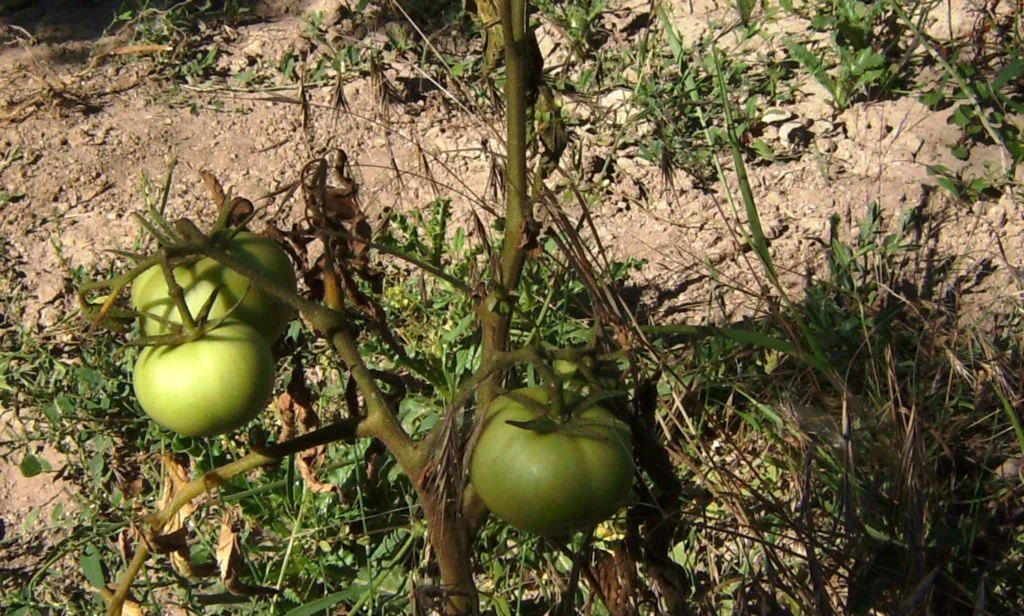
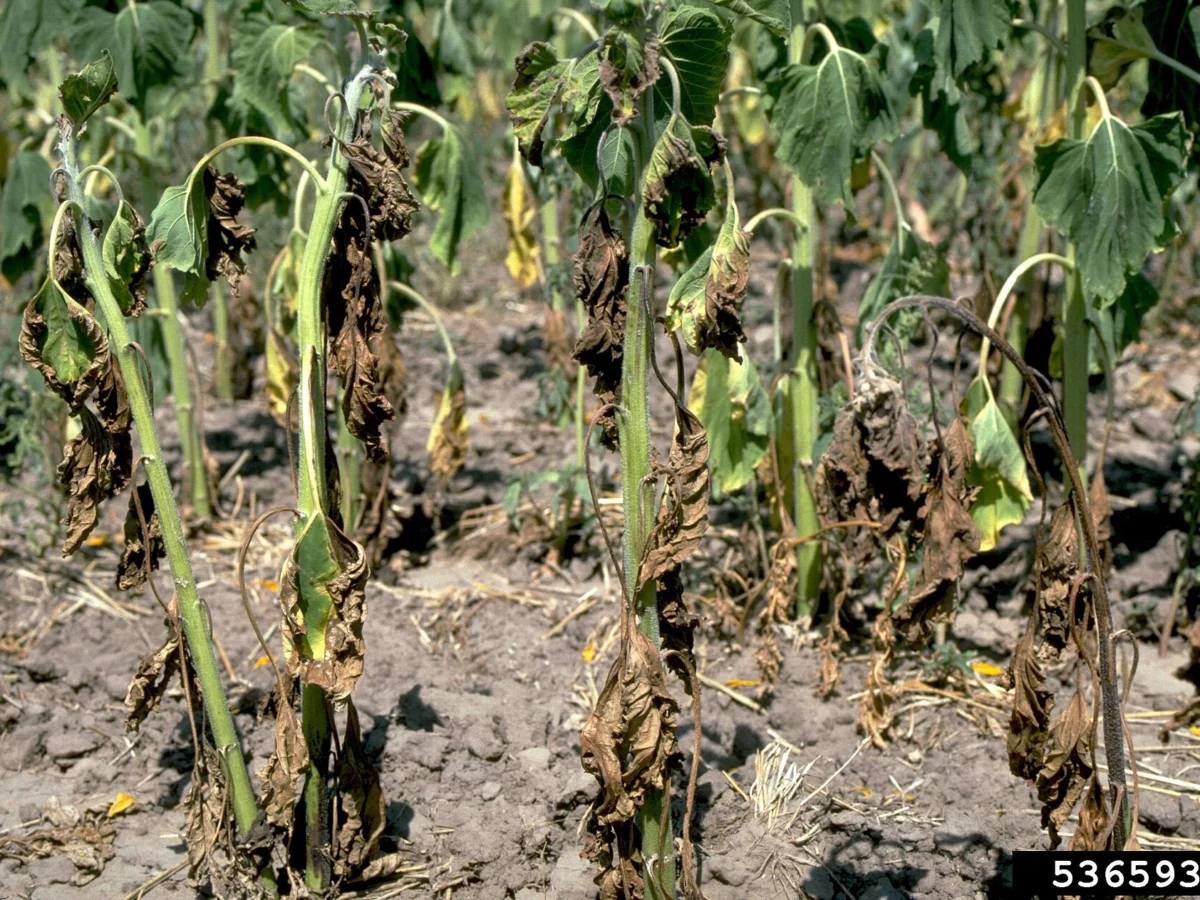
Fusarium wilt and Verticillium wilt are soil-borne fungal diseases that invade plant roots and block the water-conducting tissue (xylem), causing leaves to yellow, wilt and die, often on one side of the plant or one branch first, and showing brown streaks inside the lower stem when it is cut lengthwise. Fusarium wilt favors hot weather and warm, sandy soils; Verticillium wilt favors cooler weather and affects a much wider range of plants, including tomatoes, potatoes, eggplant, strawberries, raspberries, maples and redbuds. Neither can be cured once a plant is infected. Manage them by planting resistant varieties (look for “F” and “V” codes on tomato labels), removing and destroying infected plants, rotating crops away from susceptible hosts for several years, improving soil health and drainage, and avoiding root injury.
Fusarium vs Verticillium wilt compared
| Feature | Fusarium wilt | Verticillium wilt |
|---|---|---|
| Cause | Fusarium oxysporum (host-specific forms, e.g. f. sp. lycopersici on tomato) | Verticillium dahliae and V. albo-atrum |
| Temperature | Warm to hot (soil 80 to 90°F) | Cool to moderate (about 70 to 75°F) |
| Soil | Light, sandy, acidic soils | Wide range; heavier and cooler soils |
| Host range | Narrow: each form attacks one crop or group | Very broad: over 300 species |
| Typical first sign | Yellowing of lower leaves, often on one side of a leaf or plant | V-shaped yellow wedges at leaf edges, then browning |
| Inside stem | Dark brown streaks in the vascular tissue | Lighter tan to brown streaks |
| Survival in soil | Many years as spores | Many years as microsclerotia |
| Resistance code on tomatoes | F, FF or F1, F2, F3 (races) | V |
What are Fusarium wilt and Verticillium wilt?
Both are vascular wilt diseases. The fungi live in the soil, enter through root tips and small wounds, and grow into the xylem, the plant’s plumbing. The plant responds by blocking the vessels, and the fungi produce toxins, so water cannot reach the leaves and they wilt even in moist soil. The Wikipedia article on Fusarium wilt explains that Fusarium oxysporum exists as many host-specific forms, so the strain that attacks tomatoes does not attack bananas or melons, while the Wikipedia article on Verticillium wilt notes that Verticillium species infect hundreds of plants, including vegetables, fruit, ornamentals and trees. The University of Minnesota Extension guide to Fusarium wilt stresses that once the fungus is in the soil, it persists for many years, which is why resistant varieties are so important.

How do you recognize vascular wilt?
- Wilting in the heat of the day that recovers at night at first, then becomes permanent.
- Yellowing of older, lower leaves, often on one side of the leaf, one side of the plant or a single branch.
- V-shaped yellow or brown wedges at the leaf margins (more typical of Verticillium).
- Brown streaking inside the stem: cut a lower stem lengthwise or across near the soil line and look for dark brown discoloration in the ring of tissue just under the bark.
- Stunting and reduced, small fruit.
- Gradual decline over weeks, unlike the rapid collapse of bacterial wilt or the sudden wilt of squash vine borer.
Several problems cause wilting. Root rot, drought, vine borers, bacterial wilt and walnut toxicity can all look similar. See root rot, squash vine borer and cucumber beetles and bacterial wilt, or use the plant problem identifier. For a firm diagnosis, send a sample to your local plant diagnostic lab.
Which plants are affected?
| Plant group | Fusarium wilt | Verticillium wilt |
|---|---|---|
| Tomatoes | Common in warm regions | Common in cooler regions |
| Potatoes, eggplant, peppers | Some forms | Very susceptible (especially eggplant and potatoes) |
| Cucurbits | Watermelon, cantaloupe and cucumber forms | Some melons |
| Beans, peas | Common pea and bean wilts | Occasional |
| Strawberries and raspberries | Fusarium wilt of strawberry in some areas | Very susceptible |
| Flowers | Asters, carnations, gladiolus, basil | Dahlias, chrysanthemums, snapdragons, sunflowers |
| Trees and shrubs | Mimosa (silk tree), palms | Maples, redbud, smoke tree, catalpa, ash, elm, olive, roses |
| Resistant groups | — | Grasses, corn, most conifers, oaks, apples, pears, birch |
How do these wilts spread?
Both fungi survive in soil for many years, Fusarium as thick-walled spores and Verticillium as tiny black resting structures called microsclerotia. They move with infected soil on tools, boots and equipment, in water running across the garden, on infected transplants, seed potatoes and nursery stock, and in compost made from infected plants. Root-knot nematodes increase infection by wounding roots. Once established, the fungus builds up each time a susceptible crop is grown, which is why repeatedly planting tomatoes, potatoes or eggplant in the same bed often leads to worsening wilt.
What should you do with infected plants?
- Confirm the diagnosis by checking for brown streaks inside the lower stem, or send a sample to a diagnostic lab.
- Remove infected plants, roots and all, and bag them for the trash. Do not compost them.
- Clean tools and stakes with a dilute bleach solution after handling infected plants.
- Note the location so you can plan rotation and resistant varieties for that bed.
- Keep remaining plants healthy with steady watering and moderate feeding, which can help mildly affected plants produce a crop despite infection. Use the garden watering calculator.
No fungicide cures vascular wilt in home gardens, because the fungus is inside the plant’s water-conducting tissue and protected in the soil.
How do you prevent Fusarium and Verticillium wilt?
- Plant resistant varieties. Tomato labels and catalogs list resistance codes: V for Verticillium, F or FF (F1, F2, F3) for Fusarium races, N for nematodes. Varieties marked “VFFN” or similar are a good choice in affected gardens.
- Rotate crops: avoid tomatoes, potatoes, eggplant, peppers and strawberries in the same spot for four years or more where Verticillium is present. Use the crop rotation checker to plan.
- Grow non-host crops such as corn, beans, grasses and brassicas in infested beds between susceptible crops.
- Buy certified disease-free seed potatoes, strawberry plants and raspberry canes.
- Improve soil health with compost; raise the pH of acidic soils toward 6.5 to 7, which suppresses Fusarium. See how to test soil pH.
- Use nitrate rather than ammonium nitrogen, which can suppress Fusarium.
- Avoid root injury from deep cultivation, and control root-knot nematodes.
- Grow in containers or raised beds with fresh soil if the garden is heavily infested.
Plant health note: Buy certified disease-free seed potatoes, strawberry plants and raspberry canes from licensed nurseries, and do not move soil or plants from infested gardens to new areas. When solarizing soil, secure the plastic well and dispose of it responsibly afterward.
Can you get rid of wilt fungi in the soil?
It is very difficult to eliminate them completely. Soil solarization, covering moist, tilled soil with clear plastic for four to six weeks during the hottest part of summer, can raise soil temperatures high enough to kill many fungal propagules in the top few inches and is most effective in hot, sunny climates. Long rotations with non-host crops gradually reduce populations. Adding compost and growing cover crops such as broccoli residue (for Verticillium) or grasses improves soil biology that competes with the pathogens. Chemical soil fumigants are not appropriate for home gardens. For most gardeners, resistant varieties and rotation are the practical answer.
Verticillium wilt in trees and shrubs
In landscapes, Verticillium wilt commonly affects maples, redbuds, smoke trees, catalpas, ash, elms and roses. Symptoms include sudden wilting and scorch of leaves on one or more branches, often in midsummer, with olive-green to brown streaks in the sapwood when a branch is cut. Some trees recover partly or wall off the infection; others decline over several years. Prune out dead branches below the discolored wood, disinfect tools between cuts, water deeply during drought and avoid high-nitrogen fertilizer. When replacing a tree lost to Verticillium, choose a resistant species such as oak, birch, honeylocust, sycamore, ginkgo or a conifer. The UMass Extension fact sheet on Verticillium wilt notes the wide host range and long survival in soil that make rotation and resistance central to management.
Wilt and companion planting
Verticillium wilt is a key reason to avoid planting raspberries and strawberries where tomatoes, potatoes, eggplant or peppers recently grew, and vice versa. See raspberry companion plants for more on planning around shared diseases.
You can find guides to related pests and diseases in our plant pests and diseases hub.
Free printable: the Year-Round Garden & Preserving Planner
Planting dates for 24 crops, monthly tasks, blanching times, canning safety numbers and a winter storage chart in one 8-page PDF. Enter your email to download it instantly and get our seasonal garden newsletter.
No spam. Unsubscribe any time. We never sell your email.
Fusarium and Verticillium FAQ
Can a plant recover from Fusarium or Verticillium wilt?
No. Infected plants usually decline; some produce a small crop if kept well watered.
How long do wilt fungi live in soil?
Often 5 to 10 years or more, which is why long rotations and resistant varieties are needed.
What do the letters VFN on tomato labels mean?
Resistance to Verticillium wilt (V), Fusarium wilt (F) and root-knot nematodes (N).
Can I compost wilted tomato plants?
No; bag them for the trash so the fungus does not spread through compost.
Is there a spray for Fusarium wilt?
No effective home-garden spray exists; prevention is key.
Do wilts spread to other plants?
Verticillium spreads to many plant types; Fusarium forms are specific to particular crops.
How do you read tomato disease resistance codes?
| Code | Resistance to |
|---|---|
| V | Verticillium wilt |
| F or F1 | Fusarium wilt race 1 |
| FF or F2 | Fusarium wilt races 1 and 2 |
| F3 | Fusarium wilt race 3 |
| N | Root-knot nematodes |
| T or TMV | Tobacco mosaic virus |
| TSWV | Tomato spotted wilt virus |
| EB, LB | Early blight tolerance, late blight resistance |
Many popular hybrids, such as Celebrity, Better Boy, Big Beef and Early Girl, carry V and F resistance. Most heirlooms do not, so if wilt has been a problem in your garden, either choose resistant hybrids for the affected beds or grow heirlooms in containers with fresh potting mix. Grafted tomatoes, in which an heirloom is joined onto a vigorous, disease-resistant rootstock, are another way to grow favorite varieties in infested soil.
Is it Fusarium wilt or bacterial wilt?
Bacterial wilt of cucurbits, spread by cucumber beetles, causes rapid wilting of whole vines and produces sticky strands of ooze when a cut stem is pulled apart slowly. Southern bacterial wilt of tomatoes, common in the hot, humid South, causes sudden wilting without yellowing and milky ooze from cut stems placed in water. Fusarium and Verticillium wilts usually progress more slowly, start with yellowing of lower leaves and show brown streaks in the stem. A plant diagnostic lab can confirm which one you have, which matters because management differs.
Can you grow tomatoes in soil with Fusarium or Verticillium?
Yes, with the right approach. Choose varieties with V and F resistance codes, rotate tomatoes with corn, beans, brassicas or grasses for several years, add compost to build healthy soil biology, and keep plants evenly watered so they are not stressed. If you love heirlooms that lack resistance, grow them in large containers or raised beds filled with fresh, clean soil, or buy grafted plants on resistant rootstock. Many gardeners with infested soil still harvest excellent crops by combining these steps.
Keeping a garden map of where wilt has appeared helps you plan these rotations year after year.
Patience and planning, rather than sprays, are the gardener’s best tools against these persistent soil-borne diseases.
Do fertilizers affect wilt diseases?
Yes. Fusarium wilt tends to be worse in acidic soils with high ammonium nitrogen and low calcium, so liming acidic soils toward neutral and using nitrate forms of nitrogen can help suppress it. Excess nitrogen of any kind produces soft growth that is more susceptible to many diseases. Base feeding on a soil test and the garden fertilizer calculator.
Above all, resistant varieties remain the single most effective defense.
Plan rotations early, choose resistant seed, and keep soil healthy.
Sources: University of Minnesota Extension, Fusarium Wilt; UMass Extension, Verticillium Wilt; University of Maryland Extension, Fusarium Wilt of Tomatoes in the Home Garden.
Reading the symptoms and picking resistant varieties
Utah State University Extension’s page on Fusarium and Verticillium wilts of vegetables stresses that cutting a stem to look for brown vascular tissue cannot distinguish the two diseases. The clues are in the pattern. Fusarium symptoms appear several weeks after infection, so young plants can be infected unnoticed; wilting may affect only one side of the plant, plants may perk up on cooler evenings, and older foliage yellows and dies first. Verticillium starts on the lower leaves, which turn yellow then brown, and the ideal infection temperature is 70 to 85°F (21 to 30°C) in wet soil. On tomato, look for a V-shaped lesion on leaf margins; on eggplant, leaf edges roll inward.
| Seed-packet code | Resistance |
|---|---|
| V | Verticillium wilt |
| F1 | Fusarium wilt race 1 |
| F2 | Fusarium wilt races 1 and 2 |
| F3 | Fusarium wilt races 1, 2 and 3 |
Neither disease can be cured once a plant is infected, and both survive in soil for multiple years (Fusarium as mycelium or chlamydospores, Verticillium as microsclerotia). USU’s management list is prevention: use disease-free seed and transplants, rotate crops, remove plant residue at season’s end, clean soil from shoes and tools, and soak pots and trays in a 10 to 15 percent bleach solution for 30 to 60 minutes, then rinse. Resistant rootstocks such as Maxifort can be grafted in tomatoes, and mustard-family cover crops may help as biofumigants, though research is ongoing. Our plant problem identifier can help confirm what you are seeing.
Safety and legal note: Bleach and other soil treatments can irritate skin and eyes and damage plants: wear gloves and goggles, never mix bleach with other cleaners, and rinse equipment well. Do not move infected soil or plants to other sites. Rules on pesticide, fumigant and plant-disease reporting vary by country and region.
Reviewed October 2026. Sources: Utah State University Extension, Fusarium and Verticillium Wilts of Vegetables