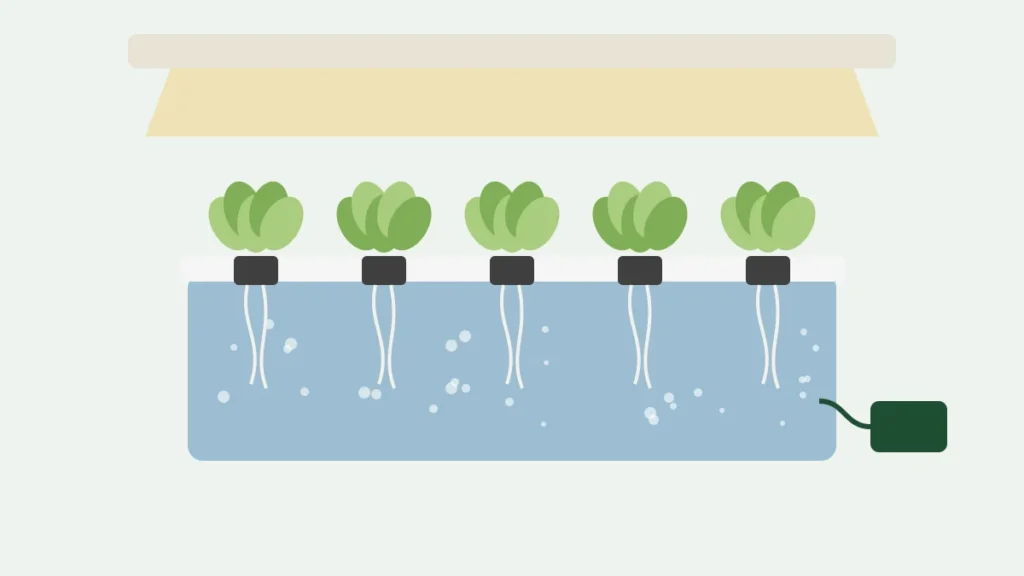
Hydroponics lets you grow fresh lettuce, herbs and greens without any soil at all, indoors and all year round. Plants grow with their roots in water containing dissolved nutrients, under a sunny window or a grow light. It can sound technical, but a simple hydroponic garden for lettuce and basil can be built from a storage bin, an aquarium air pump and some net pots, and it is a rewarding project for beginners, apartment dwellers and anyone who wants salad in winter.
This guide explains how hydroponics works, the main types of systems and which is best for beginners, what you can grow, how to manage nutrients, pH and light, and how to build a simple deep water culture system step by step.
What is hydroponics?
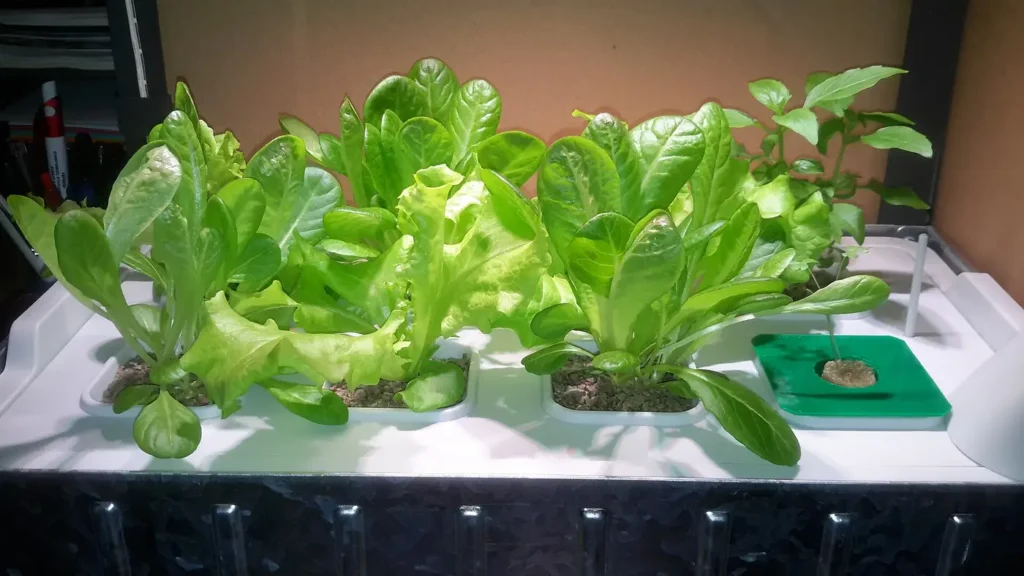
Hydroponics is a way of growing plants with their roots in a nutrient-rich water solution instead of soil. In soil, roots search for water and nutrients; in hydroponics, everything the plant needs is delivered directly to the roots. Plants are usually held in net pots filled with an inert growing medium such as rockwool, clay pebbles or coco coir, which supports them but provides no nutrients.
Benefits
- No soil: clean, indoor growing with no weeding.
- Year-round harvests indoors under lights.
- Efficient water use: recirculating systems lose far less water than watering soil.
- Fast growth for leafy greens and herbs when conditions are right.
- Small spaces: a countertop or closet corner is enough.
Drawbacks
- Setup cost for lights, pumps and containers.
- Electricity for lights and pumps.
- More monitoring: nutrient levels, pH and water temperature need regular checks.
- Little room for error: without soil as a buffer, problems such as pump failure affect plants quickly.
Types of hydroponic systems
University of Florida IFAS Extension’s overview of hydroponic production methods compares the basic systems, including deep water culture, nutrient film technique, ebb and flow, aeroponics and aquaponics.
| System | How it works | Difficulty | Best for |
|---|---|---|---|
| Kratky (passive) | Plants sit over a still nutrient solution; no pumps; roots get air as the water level drops | Easiest | Lettuce, herbs |
| Deep water culture (DWC) | Roots hang in an aerated nutrient solution; an air pump bubbles oxygen through it | Easy | Lettuce, basil, chard, kale |
| Wick system | A wick draws solution up into the growing medium | Easy | Small herbs |
| Nutrient film technique (NFT) | A thin film of solution flows along sloped channels past the roots | Moderate | Lettuce and other greens |
| Ebb and flow (flood and drain) | A tray is flooded with solution on a timer, then drained | Moderate | Herbs, greens, small fruiting plants |
| Drip system | Solution is dripped onto the growing medium around each plant | Moderate | Larger plants such as tomatoes and cucumbers |
| Aeroponics | Roots hang in air and are misted with solution | Advanced | Greens and herbs in vertical towers |
| Aquaponics | Fish waste feeds plants, and plants clean the water | Advanced | Greens and herbs, with fish |
The UF/IFAS overview describes deep water culture as easy to set up and operate and ideal for beginners, with low energy use, and notes that it can be built from affordable buckets or bins, air pumps (fish tank bubblers work well) and net pots. Nutrient film technique uses a thin film of nutrient water flowing through sloped channels that roots hang into.
What can you grow hydroponically?
| Crop | Ease | Notes |
|---|---|---|
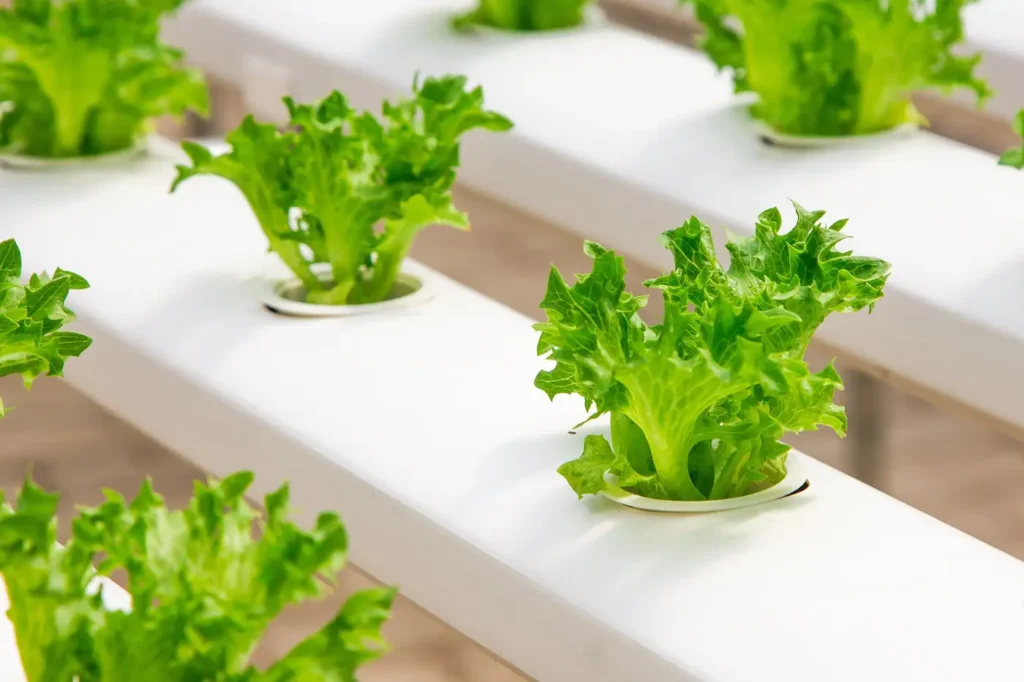
| Lettuce and salad greens | Easiest | The classic hydroponic crop; quick and compact |
| Basil, mint, parsley, cilantro, chives | Easy | Fast and productive under lights |
| Kale, chard, spinach, bok choy | Easy | Spinach prefers cooler water |
| Strawberries | Moderate | Need good light and some support |
| Cherry tomatoes, peppers, cucumbers | Harder | Need strong light, larger systems, support and pollination indoors |
| Root crops such as carrots and potatoes | Not practical | Better grown in soil |
For a first system, start with lettuce and herbs. The USDA SARE program’s guide to growing leafy greens hydroponically (PDF) covers system types, crop timelines and nutrient solutions for lettuce, greens and herbs. Our guide to starting an herb garden covers herbs grown in soil and indoors.
What you need
- A container or reservoir: an opaque plastic storage bin or bucket. Opaque matters, because light in the water encourages algae.
- A lid or floating raft with holes to hold net pots.
- Net pots sized for the holes.
- Growing medium: rockwool cubes, clay pebbles or coco coir.
- An air pump, air line and air stone for deep water culture.
- Hydroponic nutrients: a complete fertilizer made for hydroponics. Garden fertilizers are not a substitute, because they may lack nutrients plants normally get from soil.
- A pH test kit or meter, plus pH up and down solutions.
- An EC or TDS meter to measure nutrient strength (optional but helpful).
- Light: a bright, south-facing window, or an LED grow light on a timer.
How to build a simple deep water culture system
- Prepare the lid. Cut holes in the lid of an opaque storage bin to fit your net pots, spacing them about 6 to 8 inches apart for lettuce.
- Add the air stone. Place an air stone in the bottom of the bin and run the air line out to an aquarium air pump placed above the water level.
- Mix the nutrient solution. Fill the bin with water and add hydroponic nutrients according to the label for leafy greens.
- Adjust the pH to the range recommended for your crop, typically slightly acidic for most leafy greens and herbs.
- Start seedlings. Sow seeds in rockwool cubes or plugs kept moist until roots appear at the bottom.
- Transplant seedlings, cube and all, into net pots, packing clay pebbles around them, and set the pots in the lid so the bottom of each pot touches the water.
- Turn on the pump and the light, and run the light on a timer.
- Monitor water level, pH and nutrient strength regularly, and top up as plants drink.
Starting seedlings indoors follows the same principles as for soil gardens; see our guide on starting seeds indoors.
Managing nutrients, pH and EC
Getting the solution right is the core skill in hydroponics. Penn State Extension’s guide to hydroponic nutrient solution programs and recipes goes into detail for those who want to mix their own.
| What to check | Why it matters | How often |
|---|---|---|
| pH | Nutrients are only available to roots within a certain pH range | Every few days |
| EC or TDS (nutrient strength) | Too weak starves plants; too strong burns roots | Every few days |
| Water level | Roots must stay in contact with the solution (except Kratky) | Daily to every few days |
| Water temperature | Warm water holds less oxygen and encourages root rot | Weekly, more in summer |
| Full solution change | Nutrients become unbalanced over time | Every 2 to 3 weeks, or as the nutrient label advises |
Follow your nutrient brand’s guidance for target ranges, since products differ. Leafy greens generally prefer a slightly acidic solution and a moderate nutrient strength.
Light and temperature
- Light: leafy greens and herbs need bright light. A south-facing window may be enough in summer, but most indoor systems need an LED grow light, usually run 14 to 16 hours a day on a timer and kept close to the plants as the manufacturer recommends.
- Air temperature: most leafy greens and herbs grow best in the 60s and low 70s Fahrenheit; lettuce bolts and turns bitter when it is too warm.
- Water temperature: keep the solution cool, roughly room temperature or a little below. Warm water holds less oxygen, which can lead to root rot.
Troubleshooting
| Problem | Likely cause | Fix |
|---|---|---|
| Brown, slimy roots with a bad smell | Root rot from low oxygen or warm water | Check the air pump, cool the water, clean the system |
| Green algae in the reservoir | Light reaching the water | Use opaque containers; cover gaps |
| Yellow leaves | Nutrient strength or pH out of range | Check pH and EC; change the solution |
| Brown, crispy leaf edges | Nutrient solution too strong | Dilute with fresh water |
| Tall, pale, floppy seedlings | Too little light | Move the light closer or increase hours |
| Lettuce bolting or bitter | Too warm | Cool the room and the water |
| Aphids, spider mites, fungus gnats | Pests brought in from outside | Rinse plants; sticky traps for gnats |
For leaf problems in general, the yellow leaf identifier can help narrow down causes.
Is hydroponics cheaper than buying produce?
It depends on your setup. A simple homemade deep water culture bin is inexpensive, while countertop kits and vertical tower systems cost much more. Ongoing costs include nutrients, growing media, seeds and electricity for lights and pumps. Most home growers do it for freshness, flavor and the pleasure of year-round harvests, rather than to save money. The garden cost calculator helps you compare costs.
Hydroponics vs. soil gardening
| Hydroponics | Soil garden | |
|---|---|---|
| Space | Countertop to closet | Beds, containers or yard |
| Season | Year-round indoors | Weather-dependent |
| Best crops | Greens and herbs | Almost everything |
| Inputs | Nutrients, electricity, equipment | Compost, water, sun |
| Maintenance | Regular monitoring | Weeding and watering |
Many gardeners use both: hydroponic greens and herbs indoors in winter, and a soil garden outdoors in summer. See our guide to starting a vegetable garden for the outdoor side, and small garden ideas for tight spaces.
A sample lettuce timeline in a deep water culture system
| Week | What happens |
|---|---|
| Week 1 | Sow seeds in moist rockwool cubes; keep them warm and humid |
| Weeks 2 to 3 | Seedlings develop true leaves and roots poke out of the cubes; transplant into net pots |
| Weeks 3 to 6 | Rapid leaf growth; check pH and nutrient strength every few days; top up water |
| Weeks 5 to 8 | Start harvesting outer leaves, or cut whole heads, depending on the variety |
Timing varies with variety, light and temperature. Loose-leaf lettuces are generally the fastest and most forgiving. Sow a few new seeds every week or two for a continuous supply.
Keeping your system clean
- Clean the reservoir between crops with warm water and a mild cleaner, then rinse thoroughly.
- Replace or sterilize growing media between crops; clay pebbles can be washed and reused.
- Keep the area tidy: fallen leaves in the reservoir rot and encourage disease.
- Check the air pump and air stone regularly; a clogged stone reduces oxygen.
- Inspect new plants brought indoors for pests before placing them near your system.
Safety tips
- Keep electrical equipment such as pumps, timers and lights away from splashes, and use a grounded outlet with a GFCI where possible.
- Store nutrients and pH adjusters out of reach of children and pets, and follow label directions.
- Use food-safe containers for growing edible crops.
Growing herbs and greens year-round
One of the biggest rewards of a home hydroponic garden is fresh food through winter. Plan a simple rotation: start a new batch of lettuce every one to two weeks, keep a few long-lived herbs such as basil, mint and chives growing continuously, and replace plants as they slow down or bolt. Grouping crops with similar needs in the same system makes nutrient and pH management simpler, since leafy greens and most herbs share similar requirements.
Frequently asked questions
What is the easiest hydroponic system for beginners?
The Kratky method and deep water culture are the easiest. Deep water culture uses a container of aerated nutrient solution with plants held above it in net pots.
What grows best in hydroponics?
Lettuce, salad greens and herbs such as basil, mint and parsley grow best and fastest in simple home systems.
Do hydroponic plants need sunlight?
They need bright light, either from a sunny window or, more reliably, from an LED grow light run 14 to 16 hours a day.
Can I use regular fertilizer in hydroponics?
Use a complete fertilizer formulated for hydroponics. Garden fertilizers may lack nutrients that plants would normally get from soil.
How often should I change hydroponic water?
Top up the water as plants drink it, and change the whole solution every two to three weeks or as your nutrient label recommends.
Why are my hydroponic roots turning brown?
Brown, slimy, smelly roots usually mean root rot from low oxygen or warm water. Check the air pump, cool the water and clean the system.
Is hydroponic food healthy?
Yes. Hydroponically grown vegetables and herbs are just as nutritious as soil-grown ones when plants receive a complete nutrient solution.