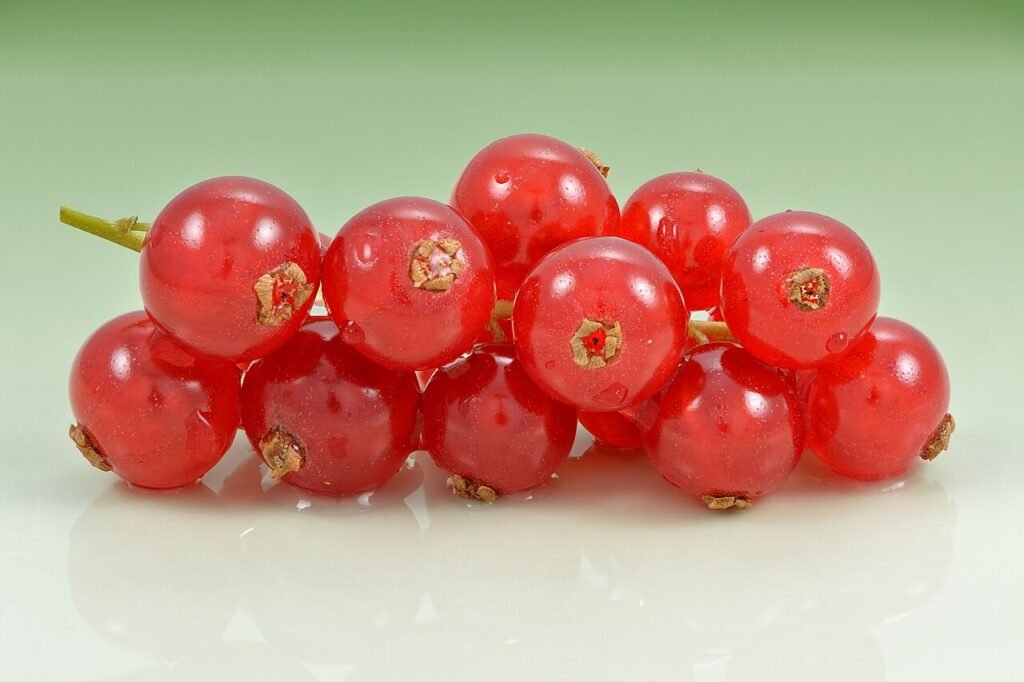
Currants are hardy, self-fruitful berry shrubs that thrive in cool, moist, well-drained sites. Iowa State University Extension says three to four plants should supply an average family, and that fruit forms on two- and three-year-old shoots. This page covers planting, pruning, harvest and the white pine blister rust issue.
Currant at a glance
| Type | Fruit |
|---|---|
| Season | Perennial |
| Sun | Full sun |
| Plant spacing | 54 in |
| Row spacing | 84 in |
| Per square foot | 1 |
| Seed depth | At surface |
| Days to maturity | Ripens over 2–3 weeks |
| How to start | Plant in early spring. |
| Water | 1 in per week |
These are the same numbers our plant spacing, square foot and harvest date calculators use. See every crop in the plant database.
When to plant currant
Plant in early spring. Cut shoots back to 6 to 10 inches before planting and set plants slightly deeper than they grew in the nursery. Use the frost dates by ZIP code and your growing zone.
How to plant currant
- Choose partial to full sun.
- Pick a cool, moist, well-drained site. Avoid poorly drained, wet soils and hot, dry sites.
- Space 4 to 5 feet apart in the row and 6 to 8 feet between rows; use the plant spacing calculator.
- Mulch 2 to 4 inches deep, replacing it each year.
Caring for currant
Prune from late winter to early April, before growth starts. Iowa State’s schedule: year 1, keep 6 to 8 healthy shoots; year 2, keep 4 to 5 one-year-old shoots and 3 to 4 two-year-old canes; from year 3, keep 3 to 4 shoots each of one-, two- and three-year-old wood. Mature plants carry 9 to 12 shoots, and all four-year-old shoots are removed because they bear little fruit. See the garden watering calculator.
Companion plants
| Grow nearby | Other berry shrubs such as gooseberries |
|---|---|
| Keep apart | Hot, dry sites and wet, poorly drained soil |
Choose sites with good air movement to limit powdery mildew. Check other pairings with the companion plant finder.
Common problems
| Problem | What you see | What to do |
|---|---|---|
| White pine blister rust | Needs both a currant (Ribes) and white pine to complete its life cycle | It causes little harm to currants but is often deadly to white pines. Black currants are very susceptible, and several states restrict planting them, so check local rules before planting. |
| Powdery mildew | White coating on leaves | Choose sites with good air movement. See the pest identifier. |
Not sure what you are looking at? The plant problem identifier ranks likely causes from the symptoms you see.
When and how to harvest
Currants ripen over 2 to 3 weeks. For jams and jellies, pick when well colored but still firm. Pick whole clusters (strigs), then strip the berries. Fruit keeps about 2 weeks refrigerated at 35 to 40°F.
Plan your currant
- Plant spacing calculator: how many plants fit your bed
- Planting calendar: sowing and transplant dates for your frost dates
- Frost dates by ZIP code: your last spring and first fall frost
- Harvest date calculator: when your crop will be ready
Frequently asked questions
How far apart should I plant currants?
Space currants 54 inches apart in rows 84 inches apart. In a square foot garden, plant 1 per square foot.
How deep do I plant currant plants?
Set currants slightly deeper than in the nursery, 4 to 5 feet apart, after cutting shoots back to 6 to 10 inches.
How long do currants take to grow?
Currants ripen over about 2 to 3 weeks; fruit forms on two- and three-year-old shoots.
How much water do currants need?
About 1 inch of water a week, from rain and watering combined. Keep the soil cool and moist, with 2 to 4 inches of mulch.
How many currant plants do I need?
Iowa State says three to four plants should supply an average family; plants are self-fruitful.
Can I grow black currants everywhere?
No. Black currants are very susceptible to white pine blister rust, and several states ban planting them, so check local rules.
How do I store currants?
About 2 weeks refrigerated at 35 to 40°F.