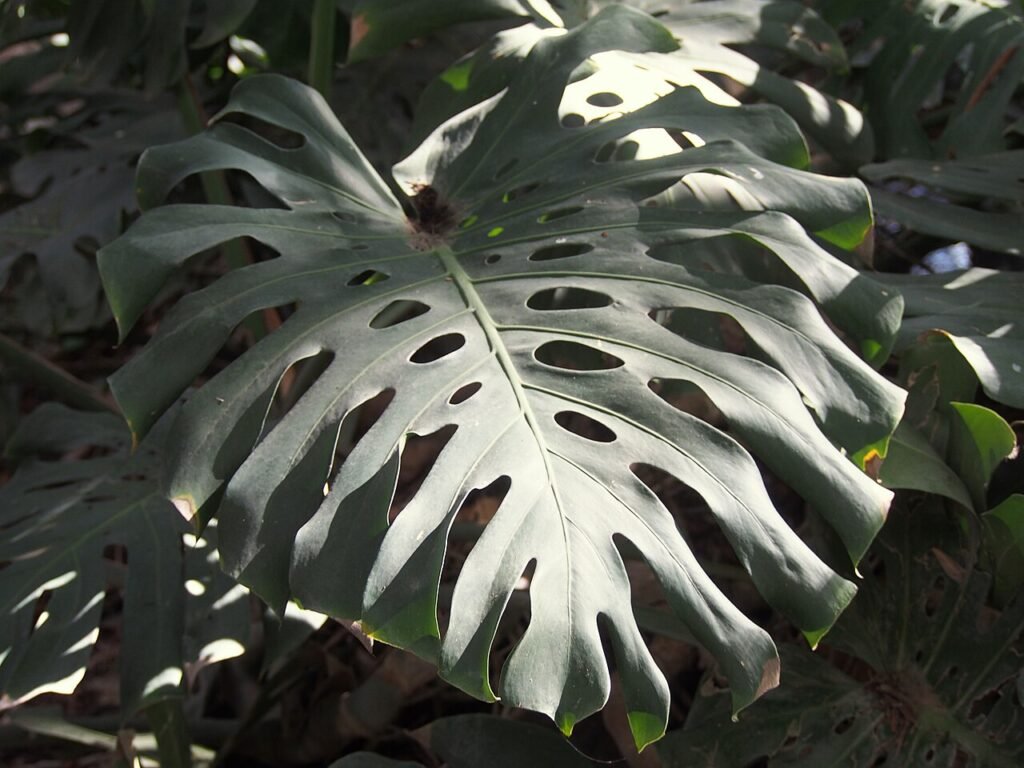
Monstera deliciosa, the Swiss cheese plant, is a climbing aroid with large leaves that develop splits and holes as they mature. Penn State Extension says it reaches 6 to 8 feet indoors and needs sturdy support, with leaves a foot or more across; UConn lists leaves up to 36 inches wide and hardiness in zones 10 to 12. All parts are toxic if eaten (except fully ripe fruit, which is rarely seen indoors) because of calcium oxalate crystals, and handling can irritate skin (Penn State, Wisconsin).
Monstera (Swiss Cheese Plant) at a glance
| Type | Houseplant |
|---|---|
| Season | Perennial |
| Sun | Bright indirect light |
| Plant spacing | 24 in |
| Row spacing | 24 in |
| Per square foot | 1 per 4 sq ft |
| Seed depth | At surface |
| Days to maturity | Cuttings any time of year; leaves split as they mature |
| How to start | Give monstera bright light without sudden direct sun, a well-draining soilless mix and a moss pole, water thoroughly then let the top 1–2 inches dry, and keep it away from pets and children because it is toxic |
| Water | 1 in per week |
These are the same numbers our plant spacing, square foot and harvest date calculators use. See every crop in the plant database.
When to plant monstera
Monstera is a year-round houseplant; feed from spring through fall (Wisconsin) and propagate from stem cuttings any time of year. UConn says it can go outdoors in summer in a semi-sheltered spot if temperatures stay above 45°F, while Wisconsin says never let it fall below 50°F, because frost kills it. Use your frost dates to time the move, and acclimate it gradually to avoid sunburn.
How to plant monstera
- Light: sources differ. Penn State says bright indirect light near a sunny window and to avoid direct sun; UConn says partial shade with 3 to 6 hours of direct sun; Wisconsin says bright light in summer and direct sun in winter. All agree on gradual acclimation, because large leaves burn easily, and that low light causes leggy growth and prevents leaf splits.
- Soil: a well-draining soilless mix rich in organic matter, pH 6.0 to 8.0 (Penn State); charcoal, bark or perlite can be added.
- Temperature and humidity: 60 to 85°F, away from cold drafts, with humidity above 50% (Penn State). Low humidity causes brown leaf edges.
- Support: a moss stick, trellis, bamboo stake or sphagnum-wrapped board; attach the plant gently by its aerial roots or stalk. Leaves typically grow much larger once vines attach (UConn).
Caring for monstera
Watering: water thoroughly, then let the top 1 to 2 inches of soil dry (Penn State); UConn says the top 2 to 3 inches. Water the moss support too, so aerial roots can take up moisture and nutrients, and water less in winter. If leaves “sweat,” the medium is too wet (Wisconsin). Overwatering can cause root rot. See the garden watering calculator and the overwatering checker.
Feeding: balanced houseplant fertilizer every 2 weeks in the growing season and monthly in winter (Penn State); UConn warns that it is sensitive to high soil salts, which can burn it. Repot only when roots reach the bottom and sides of the pot, increasing pot size gradually (UConn).
Pests and problems: watch for scale, aphids, mealybugs, spider mites, thrips and fungus gnats; wipe dusty leaves. UConn also lists bacterial leaf spot, anthracnose and root and stem rot. See the pest identifier and the yellow leaf identifier.
Companion plants
| Grow nearby | Moss poles, trellises and large decorative pots in bright rooms |
|---|---|
| Keep apart | Soggy soil, cold drafts below 50°F, and homes with pets or small children |
Wear gloves when handling because of possible contact dermatitis. Check other pairings with the companion plant finder.
Common problems
| Problem | What you see | What to do |
|---|---|---|
| No leaf splits | Leaves stay whole | Likely juvenile leaves, which are uncut until maturity, or too little light (Penn State, Wisconsin). |
| Leggy growth | Long gaps between small leaves | Low light; move it to a brighter spot and give it a support. |
| Brown leaf edges | Crispy brown margins | Low humidity; raise humidity above about 50% (Wisconsin, Penn State). |
| Root rot or sweating leaves | Droplets on leaves, wilting, mushy roots | The medium is too wet; reduce watering and use a well-draining mix. See the overwatering checker. |
Not sure what you are looking at? The plant problem identifier ranks likely causes from the symptoms you see.
When and how to harvest
This is an ornamental plant. Propagate by air layering or stem cuttings: take 3 to 5 inches below a node with as many aerial roots as possible (UConn), or cut just below an aerial root and pot the tip (Wisconsin). Seed is possible but seedlings grow slowly. Safety: unripe fruit contains calcium oxalate crystals that cause immediate, painful throat irritation; keep the plant away from pets and children.
Plan your monstera
- Plant spacing calculator: how many plants fit your bed
- Planting calendar: sowing and transplant dates for your frost dates
- Frost dates by ZIP code: your last spring and first fall frost
- Harvest date calculator: when your crop will be ready
Frequently asked questions
How far apart should I plant monsteras?
Space monsteras 24 inches apart in rows 24 inches apart. In a square foot garden, plant 1 per 4 sq ft.
How deep do I plant monstera plant?
Repot at the same depth; UConn says to bury vines with aerial roots 2 to 3 inches below the first node while keeping growing tips above soil.
How long do monsteras take to grow?
Cuttings can be taken any time of year; leaves split as they mature.
How much water do monsteras need?
About 1 inch of water a week, from rain and watering combined. Water thoroughly, then let the top 1-2 inches dry out.
Why doesn't my monstera have splits?
Young leaves are uncut until maturity, and low light also prevents splits.
Is monstera toxic to cats and dogs?
Yes, all parts are toxic if eaten because of calcium oxalate crystals.
Does monstera need a moss pole?
It needs sturdy support, and leaves typically grow much larger once vines attach.