An arch or arbor is one of the quickest ways to give a garden structure and a sense of arrival. Set over a path or gate, it frames the view beyond and invites you to walk through. Covered in climbing roses, clematis or beans, it adds height, color and fragrance in a tiny footprint. And in a vegetable garden, an arch between two beds can be one of the most productive growing spaces you have.
This guide explains the difference between arches, arbors and pergolas, how to choose the right size and material, where to place one, the best plants to grow over it, how to install it so it stays standing for years, and ideas for using arches in flower and vegetable gardens.
Arch, arbor or pergola?
The words are often used interchangeably, but there are differences:
| Structure | What it is | Typical use |
|---|---|---|
| Arch | A curved or pointed frame, usually narrow, over a path or opening | Entrances, paths, between beds |
| Arbor | A freestanding structure, often with a flat or curved top and side panels, sometimes with a built-in bench | Garden entrances, seating nooks |
| Pergola | A larger structure of posts and overhead beams covering an area | Shading patios and seating areas |
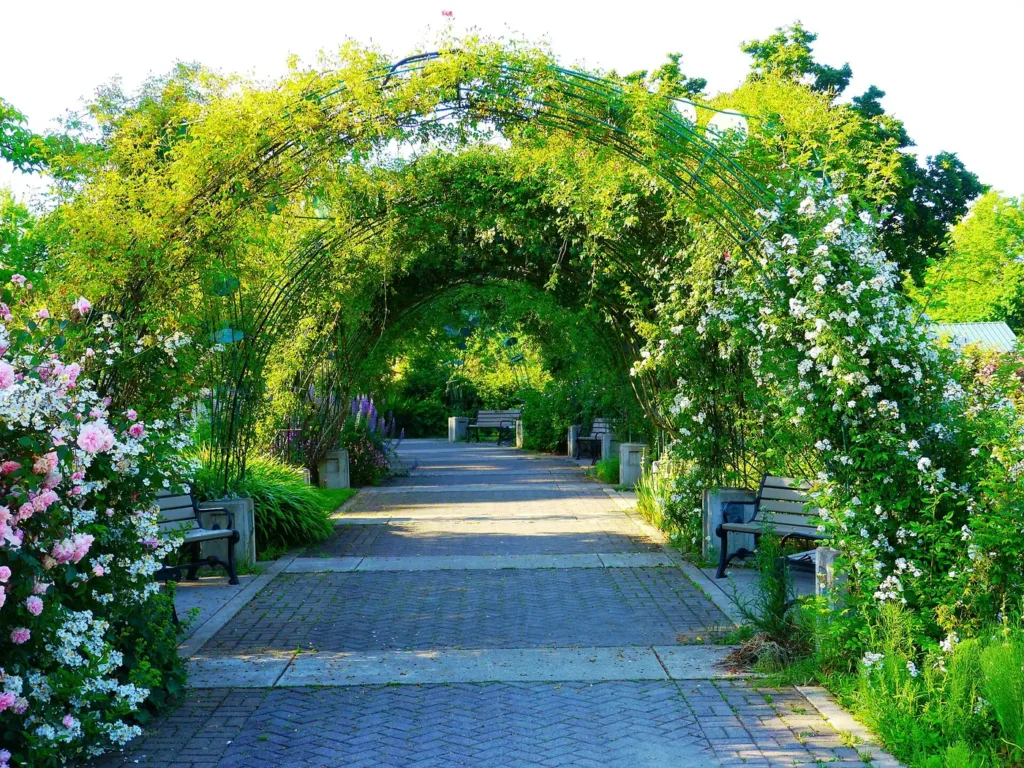
| Tunnel | A series of arches joined to form a covered walkway | Long paths, productive vegetable tunnels |
Why add an arch or arbor?
- Structure: a strong vertical feature that holds the garden together, even in winter.
- A focal point: draws the eye and leads people through the garden.
- Growing space: climbing plants use height instead of ground.
- Division: marks the transition between garden areas, such as from lawn to vegetable garden.
- Shade and fragrance: especially when covered in roses, honeysuckle or jasmine.
Choosing a material
| Material | Look | Lifespan | Notes |
|---|---|---|---|
| Cedar or redwood | Natural, warm | Long | Rot-resistant; weathers to silver-gray |
| Pressure-treated wood | Natural, can be painted | Long | Affordable and durable |
| Metal (steel, wrought iron) | Elegant, slim | Very long if coated | Strong but thin; good for roses |
| Aluminum | Lightweight, modern | Long | Must be anchored firmly |
| Vinyl | Clean, white | Long | Low maintenance; less natural looking |
| Livestock (cattle) panel | Rustic, practical | Long | Cheap, strong, bends into a perfect vegetable arch |
| Bamboo or willow | Rustic, cottage | Short | Best for annual climbers |
Whatever you choose, match the strength to the plant. Mature climbing roses, wisteria and grape vines become very heavy, while annual sweet peas and morning glories are light.
Choosing the right size
- Height: allow at least 7 feet of clearance inside, so tall people can walk through once plants grow and hang down. Many arches are 7 to 8 feet tall overall.
- Width: a path arch should be at least as wide as the path, plus room for plants on each side; 4 feet inside is comfortable for one person, wider for a wheelbarrow.
- Depth: deeper arbors with side panels give climbers more to cling to and make a stronger statement.
- Scale: a small arch can look lost in a large garden; a heavy arbor can overwhelm a tiny yard.
Where to place an arch
- At an entrance: the gate into a garden, front yard or vegetable plot.
- Over a path to mark a transition or frame a view.
- At the end of a path as a destination, perhaps with a bench beneath.
- Between two raised beds as a growing tunnel.
- Against a wall or fence as a backdrop for a seat or statue.
Consider the sun: most flowering climbers and all fruiting vegetables need at least six hours of direct sun. The sunlight requirement finder helps you check.
The best plants for arches and arbors
Flowering climbers
| Plant | Type | Notes |
|---|---|---|
| Climbing and rambling roses | Woody | The classic arch plant; choose disease-resistant, repeat-flowering varieties |
| Clematis | Woody perennial | Many types; grow through roses for a double display |
| Honeysuckle | Woody | Fragrant; choose native or non-invasive species |
| Climbing hydrangea | Woody | Slow to start; tolerates shade; needs a very strong support |
| Wisteria | Woody | Spectacular but extremely heavy and vigorous; only for sturdy pergolas |
| Sweet peas | Annual | Fragrant; cool-season |
| Morning glory, moonflower | Annual | Fast summer cover; may self-seed heavily |
| Climbing nasturtium | Annual | Edible flowers, quick and easy |
Our rose garden guide covers choosing and training climbing roses. Train canes as horizontally as possible across the arch to encourage more flowering side shoots.
Edible climbers
| Crop | Notes |
|---|---|
| Pole and runner beans | Fast, productive and pretty; runner beans have red or white flowers |
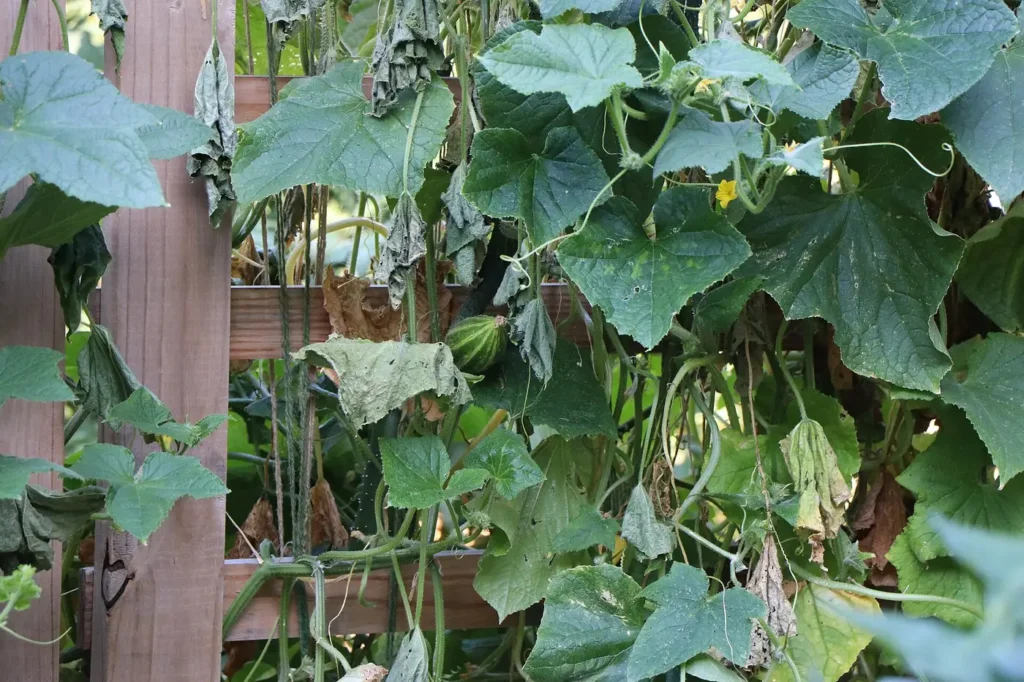
| Cucumbers | Fruit hangs inside the arch, straight and easy to pick |
| Small winter squash and gourds | Need a strong arch; choose small-fruited varieties |
| Peas | Cool-season; need fine netting on the arch |
| Grapes | Perennial; need strong support and annual pruning |
| Hardy kiwi | Vigorous perennial for large, sturdy arbors |
| Malabar spinach | Heat-loving edible climber |
The vegetable garden arch
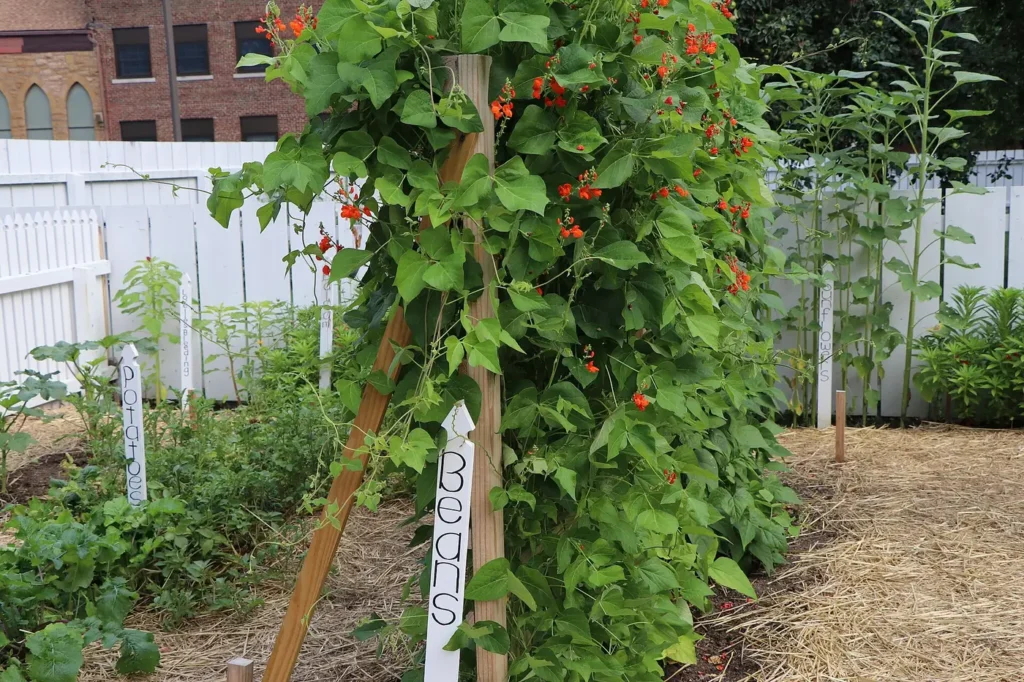
A livestock panel bent into an arch between two raised beds is one of the most useful structures in a vegetable garden. University of Wisconsin–Madison Extension’s guide to trellising, staking and caging explains how supporting vine crops maximizes yield and makes care easier, and Nebraska Extension’s guide to vertical gardening notes that an arch or arbor can support cucumbers or gourds, with shade-tolerant crops such as lettuce growing in the shade beneath.
How to build a cattle panel arch
- Place two raised beds parallel to each other, with a path between them about 4 to 5 feet wide.
- Drive T-posts or sturdy stakes at the inside corners of each bed where the panel ends will sit.
- Bend a 16-foot livestock panel into an arch (two people make this much easier), and set each end just inside a bed.
- Fasten the panel ends securely to the posts with wire or heavy-duty ties.
- Check the height: the panel’s length and the path width determine the arch height; a narrower base gives a taller arch.
- Plant climbers at the base on both sides and guide their first tendrils onto the panel.
Wear gloves, since cut panel ends are sharp. Our guides to garden trellis ideas and raised garden bed ideas show more ways to grow upward, and Virginia Tech Extension’s publication on vertical gardening using trellises, stakes and cages covers support options in depth.
How to install an arch or arbor
- Call 811 before digging post holes in the US, so underground utilities are marked.
- Mark the position with stakes, checking it is centered over the path and square to it.
- Anchor it firmly. A plant-covered arch acts like a sail in the wind. Set wooden posts deep in the ground, typically a couple of feet or more, and use concrete or the manufacturer’s anchors for metal arches.
- Check it is level and plumb with a spirit level before the concrete sets or the soil is firmed.
- Add supports for climbers: wires, mesh or trellis panels on the sides give plants something to grip.
- Plant climbers a little away from the base of each post, about 12 inches or so, where the soil is less dry, and lean them toward the structure.
Planting and training climbers
- Prepare the soil with compost; the base of a post is often dry and poor. The compost calculator works out how much.
- Water well while climbers establish, and mulch around the base.
- Tie in young stems loosely with soft ties until they grip on their own.
- Spread stems out across the frame rather than letting them bunch at the top.
- Combine plants: a climbing rose with a clematis, or perennial climbers with annual sweet peas while they establish.
- Prune each year: remove dead and tangled growth and keep the walkway clear.
Arch and arbor ideas
- Rose-covered entrance arch over a front gate, the classic cottage garden look. See our cottage garden guide.
- Arbor with a built-in bench for a shady, scented seat.
- Vegetable tunnel of several cattle panel arches covered in beans, cucumbers and squash.
- Arch at the end of a path framing a view or a focal point such as a birdbath.
- Moon gate or circular opening in a hedge or wall for a dramatic entrance.
- Arch between garden rooms to separate the vegetable garden from the flower garden or lawn.
- Rustic branch arch made from flexible willow or hazel stems for annual climbers.
- Arch in a potager at the center or entrance; see our potager guide.
Arches, fences and garden structure
Arches work best as part of a garden’s framework of paths, edges and boundaries. An arch set into a fence or hedge makes a natural gateway; see our garden fence ideas and garden edging ideas for related structure, and our backyard garden ideas for how arches fit into a whole-yard plan.
Arches for small gardens and patios
Even a tiny garden can have an arch. A slim metal arch over a narrow side path, a freestanding arch set into a pair of large containers, or an arbor bench tucked against a fence adds height without taking up ground space. In containers, use pots at least 18 inches across, filled with a quality potting mix, and choose moderate climbers such as clematis, climbing nasturtiums, sweet peas or a compact climbing rose rather than vigorous vines. Water containers often, since climbers in pots dry out quickly in summer. Our small garden ideas include more ways to grow vertically in tight spaces, and the container garden planner helps with pot sizes.
Budget arch ideas
- Livestock panel arches are one of the cheapest strong options and last for many years.
- Bent rebar or electrical conduit makes simple hoops for light annual climbers.
- Willow or hazel stems can be bent and tied into rustic arches for a season or two.
- Salvaged materials such as old ladders, doors or wrought-iron railings make characterful arbors.
- Annual climbers grown from seed, such as beans and morning glories, cover an arch quickly for very little money while slower perennial climbers establish.
Maintenance
| Task | When |
|---|---|
| Check anchors and fixings | Each spring and after storms |
| Treat or paint wooden arches | Every few years, as needed |
| Prune and tie in climbers | According to the plant, usually late winter or after flowering |
| Remove spent annual vines | Fall |
| Clear the walkway | Throughout the growing season |
Common mistakes
- Too low: plants hang down and block the path.
- Too flimsy for a heavy climber such as wisteria or a mature rose.
- Poorly anchored, so the structure leans or blows over in a storm.
- Planting right at the base of a post, where soil is dry and poor.
- Choosing an overly vigorous climber for a small arch.
- Placing a vegetable arch in shade.
Frequently asked questions
What is the difference between an arch and an arbor?
An arch is a curved frame over a path or opening. An arbor is usually a more substantial freestanding structure, often with side panels and sometimes a built-in bench.
How tall should a garden arch be?
Allow at least 7 feet of headroom inside so people can walk through once climbing plants grow and hang down.
What are the best plants for a garden arch?
Climbing roses and clematis are classic choices. Honeysuckle, sweet peas and climbing nasturtiums are also popular, and pole beans, cucumbers and small squash make productive edible arches.
How do I make a cattle panel arch?
Bend a 16-foot livestock panel into an arch between two raised beds about 4 to 5 feet apart, and fasten the ends securely to T-posts or stakes.
How do I stop a garden arch from blowing over?
Set posts deeply, use concrete or ground anchors, and check fixings each spring and after storms, since plant-covered arches catch a lot of wind.
Can I grow vegetables over an arch?
Yes. Pole beans, cucumbers, peas, small squash and gourds all grow well over sturdy arches in full sun.
Is wisteria good for a garden arch?
Only for very sturdy structures. Wisteria becomes extremely heavy and vigorous, so it is better suited to strong pergolas than lightweight arches.
Can I put a garden arch in a container?
Yes. Set each leg of a freestanding arch into a large, heavy container at least 18 inches across, and grow moderate climbers such as clematis or sweet peas.
What is the cheapest way to make a garden arch?
A livestock panel bent between two raised beds or stakes is inexpensive and very strong. For light annual climbers, bent conduit or willow stems also work.