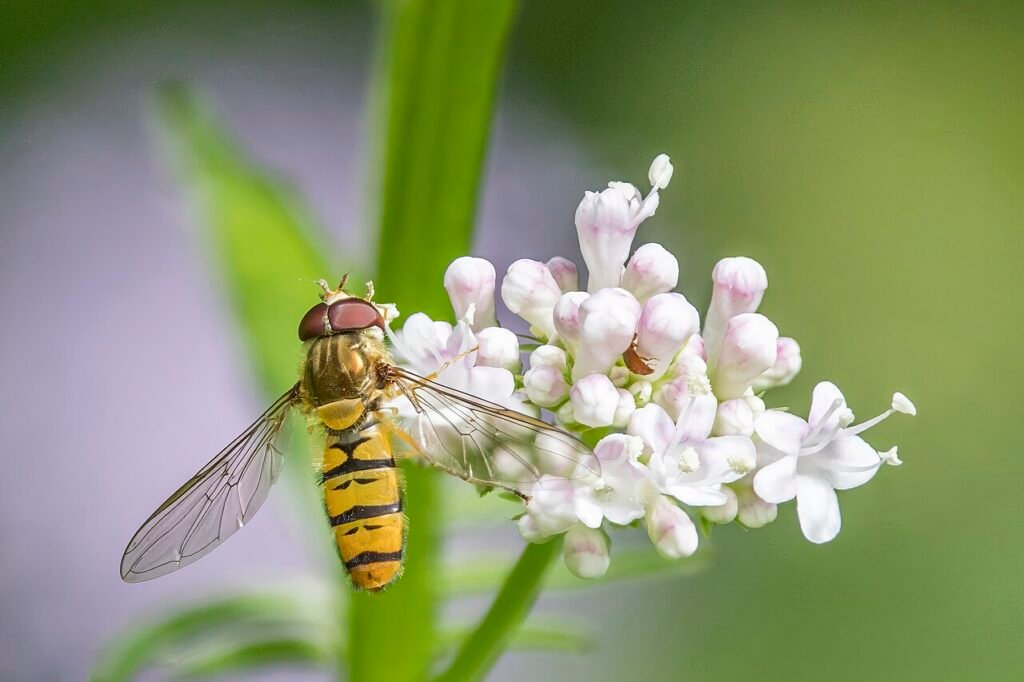
Hover flies (syrphid flies) look like small bees or wasps but are harmless flies that pollinate flowers as adults, while their legless larvae eat aphids. To keep them, grow small-flowered plants such as alyssum, dill and coriander, tolerate a few aphids, and avoid broad-spectrum insecticides.
How do you tell a hover fly from a bee or wasp?
- Wings: hover flies have one pair of wings, while bees and wasps have two pairs (University of Illinois).
- Antennae: short, while bees and wasps have longer, elbowed antennae (Illinois, Wisconsin).
- Flight: adults can hover in place, which bees and wasps cannot do (Illinois).
- Size and color: about 1/4 to 3/4 inch long, often with black and yellow stripes on the abdomen (Illinois, Wisconsin).
- No sting: Illinois says syrphid flies cannot sting or bite, and Cornell notes they have no stinger.
What do hover fly larvae look like and eat?
The larvae are small, legless, slug-like maggots that taper toward the head, creamy-white, green, yellow or brown, and they move over plants hunting prey (Wisconsin, Cornell). Cornell gives them as about 12 mm long with a translucent body. Their main prey is aphids, but they also eat mealybugs, scale insects, thrips and the eggs of small soft-bodied insects (Illinois). Both Illinois and Cornell say a larva can eat up to 400 aphids during its development, and Illinois adds 20 to 30 aphids a day. Cornell says that when larvae are abundant they may reduce aphid populations by 70 to 100%, but the page does not give the underlying data, so treat that figure cautiously. Wisconsin notes hover flies can be effective in gardens but are most noticeable later in the season, after aphids have already built up, and that their effect may be overlooked because they are less conspicuous than lady beetles.
What is the life cycle?
| Stage | What the sources say |
|---|---|
| Eggs | Tiny white eggs laid singly on leaves near aphids; hatch in about 2 to 3 days |
| Larva | 7 to 10 days (Illinois); 2 to 3 weeks (Wisconsin); 1 to 3 weeks (Cornell) |
| Pupa | About 10 days (Illinois); adults emerge in 1 to 2 weeks (Wisconsin, Cornell) |
| Generations | Five to seven per year (Wisconsin, Cornell) |
| Overwintering | As pupae (Wisconsin); most species in leaf litter (Cornell) |
Adults feed on nectar and pollen, and Cornell says females need pollen to produce viable eggs. Females lay several hundred eggs through midsummer (Wisconsin).
How do you attract hover flies?
- Grow small flowers. Illinois and Wisconsin name Queen Anne’s lace, sweet alyssum, coriander, dill and other small-flowered herbs; Wisconsin adds wild mustard and weedy borders or mixed plantings that also have aphids.
- Keep nectar and pollen available. Cornell recommends pollen- and nectar-producing plants near gardens and managing hedgerows and other vegetation, which can provide alternative prey, wind shelter and overwintering habitat.
- Avoid broad-spectrum insecticides. Cornell says most commercial insecticides are not compatible with syrphid flies. It also notes that herbicides can reduce the flowers adults depend on.
- Leave some leaf litter, where most species overwinter (Cornell).
Use the companion plant finder to choose small-flowered herbs and flowers, and the pest identifier before you reach for a spray. Related reading: lady beetles and green lacewings.
Are hover flies pollinators too?
Yes. Illinois describes adults as important pollinators that visit garden flowers, and Cornell says they are efficient pollinators, noting that because they do not provision nests some species range farther and carry pollen longer distances than bees. Cornell says the only commercially available species in the US is Episyrphus balteatus, so for most gardeners, habitat is the practical route.
Free printable: the Year-Round Garden & Preserving Planner
Planting dates for 24 crops, monthly tasks, blanching times, canning safety numbers and a winter storage chart in one 8-page PDF. Enter your email to download it instantly and get our seasonal garden newsletter.
No spam. Unsubscribe any time. We never sell your email.
Frequently asked questions
Do hover flies sting?
No. They are flies, not bees or wasps. Illinois says flies cannot sting or bite.
Are the maggots on my plants pests?
Slug-like, legless maggots among aphids may be hover fly larvae, which are predators. Check before removing them.
Why are there hover flies on my flowers but still aphids?
They often appear after aphids have built up (Wisconsin), so aphid numbers may lag behind them for a while.
Reviewed November 2026. Sources: University of Wisconsin Extension: Hover, flower or syrphid flies; University of Illinois Extension: Syrphid (hover) flies; Cornell: Hover fly biocontrol fact sheet