Green lacewings are delicate, pale green insects whose larvae, called aphid lions, eat aphids, mites and many other soft-bodied pests. Recognize the stalked eggs and the spiny, alligator-shaped larvae so you do not remove them, feed the adults with nectar and pollen, and avoid broad-spectrum insecticides.
What do green lacewings look like at each stage?
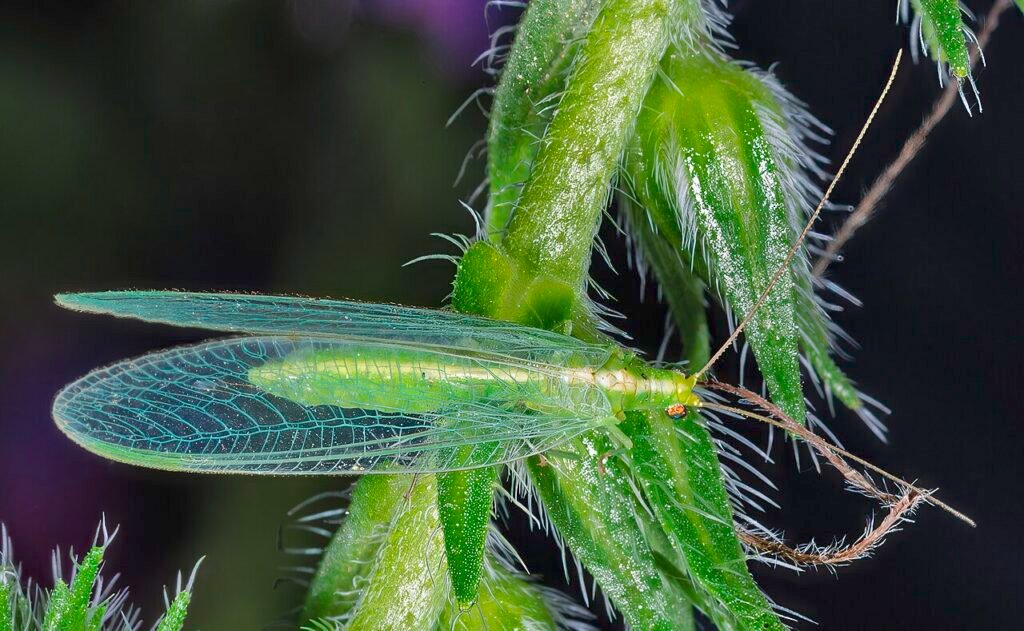
- Adults: slender, pale green bodies with golden eyes and long, transparent, net-veined wings. University of Maryland gives wings of about 1/2 to 3/4 inch; Utah State gives green lacewings as 12 to 20 mm long. Brown lacewings are smaller, about 5 to 7.5 mm (Utah State).
- Eggs: green ovals laid singly on the tip of a hair-like stalk, usually on leaves or twigs, often near aphids or mites. Minnesota gives the stalk as about 3/8 inch long and Utah State as about 1/2 inch.
- Larvae (aphid lions): alligator-shaped, spindle-shaped larvae that are yellow to brown or gray, with spines along the sides and long, curved mandibles (Maryland, Minnesota). Utah State says they reach about 9.5 mm when full grown.
- Cocoons: larvae spin a round silken cocoon attached to vegetation before becoming adults (Minnesota).
What do lacewings eat?
Minnesota says each larva can consume 200 or more aphids or pest eggs per week, and lists aphids, caterpillars, leafhoppers, psyllids, whiteflies, thrips, spider mites, insect eggs and even spiders as prey. Utah State adds mealybugs and says the larvae inject paralyzing venom. Adults mostly do not hunt: they feed on honeydew, pollen and nectar (Minnesota, Utah State). Hatchling larvae eat anything they can overpower, including their siblings (Maryland), and because lacewings are generalists they can also eat other beneficial insects such as parasitized aphid mummies or immature lady beetles, though how much this matters is uncertain (Minnesota).
How long is the life cycle?
| Stage | What the sources say |
|---|---|
| Egg hatch | Depends on temperature: 2 to 3 days at 95°F (35°C), about 4 days at 77°F (25°C), 6 to 7 days at 68°F (20°C) (Minnesota); 4 to 5 days (Utah State) |
| Larva | About 2 to 3 weeks, three growth stages |
| Pupa | About 5 to 8 days in a cocoon (Minnesota); adults emerge after 5 to 7 days (Utah State) |
| Adult life | 1 to 3 months (Minnesota); about 5 to 6 weeks (Utah State) |
| Eggs per female | Several hundred (Minnesota); over 200 (Utah State) |
| Generations | At least two per year (Utah State) |
In temperate regions, adults can overwinter in dry, dark places such as leaf litter and structures (Minnesota).
How do you attract and keep lacewings?
- Provide nectar and pollen all season. Utah State recommends long-blooming plants and species that flower at different times, including native flowering species.
- Tolerate some prey. Females lay eggs where aphids and other prey will be available for the larvae (Minnesota, Utah State).
- Avoid broad-spectrum insecticides, which kill beneficial insects (Utah State).
- Watch ants. Maryland says ants foraging on plants are a major predator of lacewing eggs and larvae.
Use the companion plant finder to pick flowers that bloom through the season, and the pest identifier to check what is attacking your plants before you spray.
Should you buy lacewing eggs?
Maryland says green lacewings are the most common commercially available beneficial and that eggs or larvae should be spread evenly around infested plants to reduce cannibalism. Minnesota notes that for greenhouse control a predator-to-prey ratio of 1:3 to 1:5 gave good to excellent results. None of the pages evaluates garden releases the way Missouri Extension does for lady beetles, so treat releases as optional and build habitat first. See our guide to lady beetles for the evidence on releases.
Free printable: the Year-Round Garden & Preserving Planner
Planting dates for 24 crops, monthly tasks, blanching times, canning safety numbers and a winter storage chart in one 8-page PDF. Enter your email to download it instantly and get our seasonal garden newsletter.
No spam. Unsubscribe any time. We never sell your email.
Frequently asked questions
What are aphid lions?
They are green lacewing larvae: spiny, alligator-shaped predators with large curved jaws that eat aphids and other small pests.
Do adult lacewings eat aphids?
Mostly no. Adult green lacewings feed on nectar, pollen and honeydew; the larvae do the hunting.
What are the tiny white stalks on my leaves?
They may be lacewing eggs, each laid on its own hair-like stalk. Leave them alone, because the larvae that hatch are beneficial.
Reviewed November 2026. Sources: University of Maryland Extension: Lacewings; University of Minnesota VegEdge: Green lacewing; Utah State University Extension: Lacewings and antlions