
Quick answer: The safest way to companion-plant fennel is to grow it in its own accessible patch or container near other crops, rather than tightly mixing roots. Fennel flowers support beneficial insects such as hoverflies and parasitic wasps, but fennel can become tall and self-seed. There is evidence for some allelopathic effects, yet it is not accurate to claim that one fennel plant poisons every neighbor. Keep sensitive seedlings and crowded vegetables outside the immediate root area.
Fennel (Foeniculum vulgare) is an aromatic member of the carrot family, Apiaceae. Its fine leaves, tall yellow flower umbels and distinctive seeds make it useful to cooks and insects. On companion-planting sites, fennel is often portrayed as uniquely hostile: some lists say it cannot grow beside anything. That simplifies an interaction involving chemical compounds, sunlight, plant size and soil processes into a rule without clear distance or conditions.
What kind of fennel do you have?
Herb fennel is typically grown for leaves and seeds and may form a tall, branching plant. Florence fennel or bulb fennel is cultivated for the swollen leaf bases, which need sufficient space and well-managed growth for a tender harvest. Bronze fennel is commonly grown ornamentally for its foliage. These forms share a botanical background, but a seed-producing ornamental can be managed differently from a bulb crop harvested before flowering.
Check the plant label before planning a shared vegetable bed. University of Wisconsin Extension describes fennel’s landscape use, flower umbels and tendency to become a prominent part of mixed borders. It can be a useful structural plant but should not be crammed into a low leafy vegetable patch.
Best neighbors for fennel: function, not folklore
| Nearby plant | Why it may fit | Placement | Risk to manage |
|---|---|---|---|
| Calendula | Adds a contrasting flower season | Separate sunny border | Overcrowding |
| Native meadow flowers | Supply bloom resources before and after fennel | Insectary strip | Choose local noninvasive species |
| Dill | Also attracts beneficial insects when flowering | Adjacent but distinct herb patch | Similar pests and swallowtail caterpillars |
| Parsley or cilantro | Other Apiaceae flowering resources | Independent planting pockets | Climate and flowering times differ |
| Lettuce and greens | May benefit from nearby beneficial insects | Separate accessible vegetable bed | Potential root competition, allelopathy uncertainty |
| Tomatoes and peppers | Can coexist in the broader garden | Not interplanted at roots | Reported sensitivity to fennel chemicals |
There is a distinction between nearby and interplanted. A fennel patch on the far side of a path may support insects visiting lettuce without competing directly for its root space. That usually offers more reliable management than forcing everything into a four-foot bed.
Fennel as a flowering insectary plant
When fennel bolts or is allowed to flower, its small yellow umbels provide nectar and pollen resources that certain beneficial insects can use. Penn State Extension identifies fennel, dill and cilantro as flowering herbs that can encourage beneficial insects including hoverflies, lacewings and parasitoid wasps near garden vegetables.
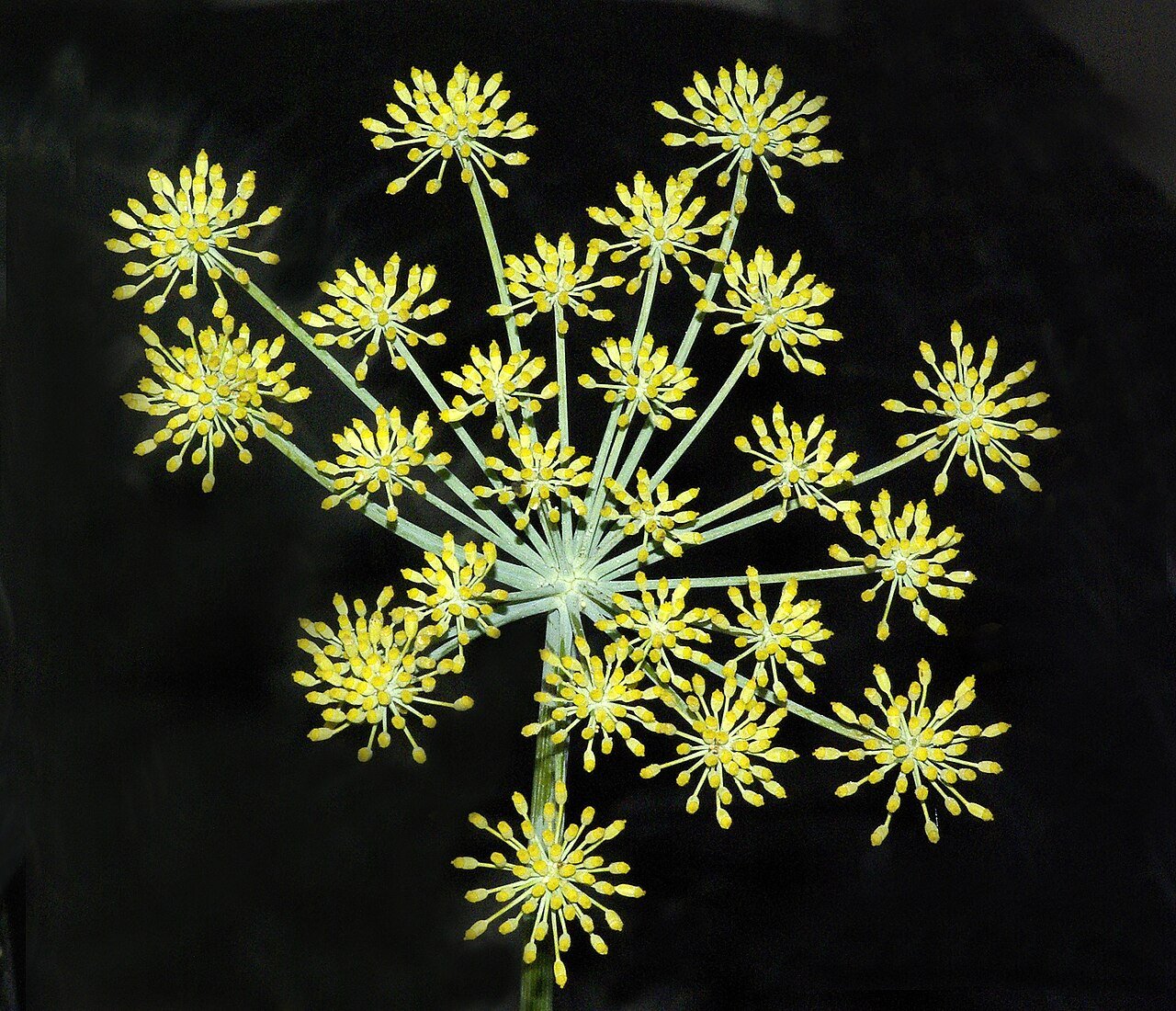
That does not prove fennel will eliminate aphids or caterpillars in every garden. Insects need suitable habitat, and they may or may not move from the flower strip to the particular infested crop. Use flowering plants as one component of integrated pest management alongside inspection, plant health and appropriate pest-specific measures.
Fennel is also a host plant for some swallowtail butterfly caterpillars. Allowing these larvae to feed can be a legitimate wildlife-gardening goal, but they do consume foliage. If leaves or bulbs are the harvest priority, decide how much feeding to tolerate rather than calling the caterpillars automatically beneficial or harmful.
Is fennel allelopathic?
Allelopathy refers to chemical effects of one plant on the growth or germination of another. Some fennel compounds can inhibit the growth of certain other plants in tested conditions. However, the strength of an effect varies with compound concentration, growth stage, soil organisms, moisture and the plant receiving it. It is difficult to convert laboratory observations into a universal backyard spacing rule.
A 2026 response from University of Maryland Extension notes that fennel and dill can show some allelopathy, but a plant or two separated by a few feet is unlikely to cause a major problem in many landscapes. It identifies uncertainty around practical exposure levels and distances, while cautioning that members of the nightshade family may be sensitive in some situations.
This is a more useful position than “fennel must always be planted alone” or “fennel harms nothing.” Give it space, monitor neighbors and avoid depositing large amounts of fresh fennel plant residues on a sensitive seedbed until they have decomposed appropriately.
Can fennel grow with tomatoes, peppers, eggplants and potatoes?
These are all nightshade crops, but they have different canopies and cultivation needs. A tall fennel plant can shade a pepper or a tomato seedling. An eggplant may need regular flea beetle monitoring and access around its leaves. A potato bed requires hilling and digging, which does not combine well with a long-lived herb patch.
For these reasons, keep fennel in a separate bed edge or container instead of in the same planting hole or directly between the vegetables. A few feet of separation can often make care simpler, although no specific minimum separation is proven for all cultivars and conditions. Compare the dedicated pepper, eggplant and potato planting guides for their growth requirements.
Fennel and dill: useful garden insects, different harvest patterns
Both fennel and dill have flower umbels, attract certain insects and can self-seed if left to mature. But dill is often used as an annual herb, while herb fennel may persist for longer depending on variety and climate. Combining the two can give a continuous supply of aromatic leaves, provided you understand their seasonal growth habits and do not overcrowd a small bed.
Both may host swallowtail caterpillars. A gardener focused on butterflies might choose to grow more of the herbs and tolerate larvae. A gardener needing a steady kitchen harvest might maintain separate plants, protecting some foliage for eating while leaving others to support wildlife.
A realistic fennel border design
Step 1: Choose a sunny location along a path, not at the center of a crowded vegetable bed. Allow room for tall flowering stems and for a person to reach the plant for harvest.
See it in practice: This fennel-growing tutorial illustrates the plant's growth and care after you've considered how much space it needs in a mixed herb border.
Video: Growing Fennel by Garden Manager.
Step 2: Place fennel at one end of a mixed herb border, with a gap before lower crops that need light and moisture. A large container can help confine roots, but it must be sufficiently deep and well drained.
Step 3: Put vegetables in separate root zones. Where available, use a narrow path as a simple buffer. Grow flowers with compatible heights and climates alongside, but avoid creating a permanent tangle of stems.
Step 4: Decide whether you are growing for leaves, bulbs, seeds or insects. Harvest bulb fennel on time; if you want flowers and seeds, allow a designated plant to mature. Cut flower stalks before viable seeds form if self-seeding is unwanted.
Step 5: Observe the next season. If seedlings emerge in unwanted areas, remove them early. A self-seeding herb may be troublesome in some climates and a manageable seasonal flower in others; follow local invasive-species advice.
Plan spacing using GardenVoila’s plant spacing calculator and compare broader research-backed companion strategies.
Common fennel companion planting mistakes
- Expecting all fennel types to stay small: mature flower stalks may be tall.
- Relying on chemical folklore: allelopathy varies by conditions and partner.
- Letting fennel self-seed uncontrolled: remove mature seedheads where necessary.
- Crowding a bulb fennel harvest: dense roots and shade reduce practical bed space.
- Assuming every insect is a pest: some insects attracted to fennel flowers help suppress other pests.
- Planting against a tomato stem: allow separate access and roots.
Free printable: the Year-Round Garden & Preserving Planner
Planting dates for 24 crops, monthly tasks, blanching times, canning safety numbers and a winter storage chart in one 8-page PDF. Enter your email to download it instantly and get our seasonal garden newsletter.
No spam. Unsubscribe any time. We never sell your email.
Frequently asked questions
What grows best next to fennel?
Locally adapted flowers or other herbs in adjacent, well-spaced planting zones make sensible neighbors. The best companion is one that does not compete directly for light and roots.
Does fennel kill nearby plants?
No blanket statement is justified. Fennel can have allelopathic effects on some species under some conditions, but a few plants separated in an ordinary garden do not necessarily harm everything nearby.
Should fennel be planted in a pot?
A pot is a practical option when you need to limit root competition or self-seeding, provided it is large enough for the cultivar.
Does fennel attract butterflies?
Its foliage can be used by certain swallowtail caterpillars, and flowers attract insects. Selection of suitable native host plants may add further local wildlife value.
Is dill a good companion for fennel?
They can be grown near one another with sufficient space. Manage the similar potential for self-seeding and decide which plants are allowed to flower.
The bottom line
Fennel is best treated as a distinct herb or flowering-insectary plant with space to mature. Grow it near a vegetable garden for flower resources if you wish, but do not force it into every mixed planting. That design respects the evidence on allelopathy while retaining fennel’s culinary and ecological uses.
Research and further reading
- University of Wisconsin Extension: Fennel
- Penn State Extension: Herbs as plant companions
- University of Maryland Extension: Fennel and dill allelopathy
Featured photo: Acabashi / Wikimedia Commons, CC BY-SA 4.0. Resized for web display.


