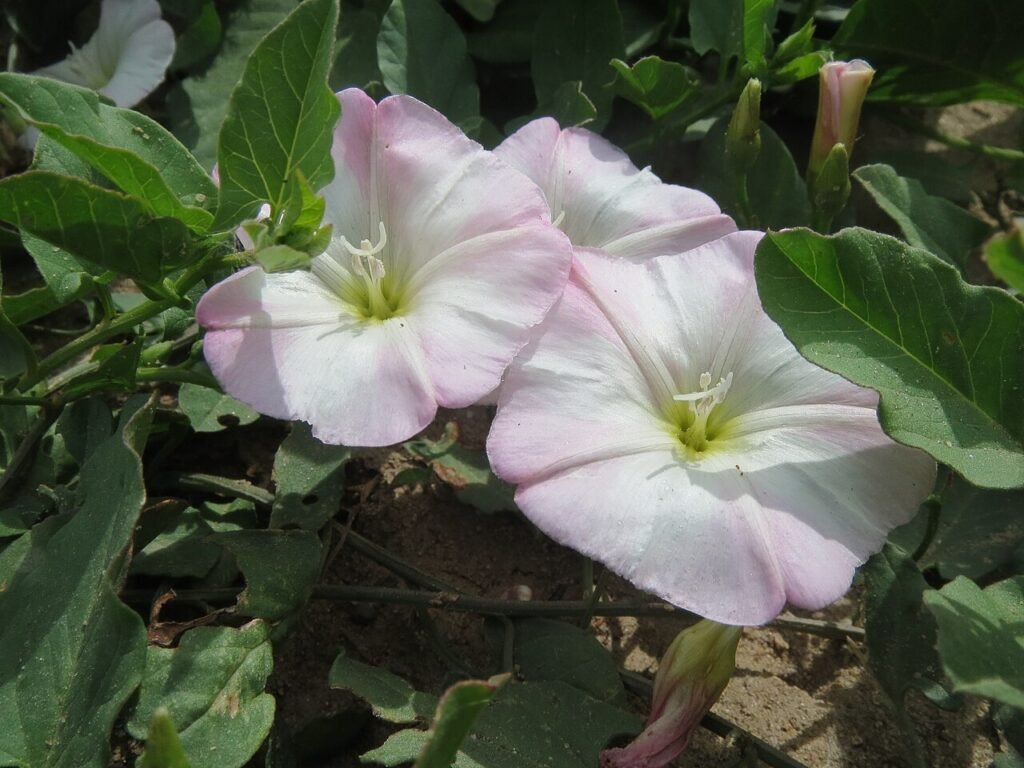
Field bindweed (Convolvulus arvensis) is a perennial vine with arrowhead leaves and white or pink trumpet flowers. It is hard to remove because its roots can reach 20 feet deep and tiny root pieces regrow, while its seeds can last for decades. Start early, remove top growth again and again, and expect to keep at it for several seasons.
How do you identify field bindweed?
- Leaves: arrowhead-shaped, 1/2 to 2 inches long, with larger leaves at the base of the stem (UC IPM).
- Flowers: white to pink trumpets, 1 to 1 1/2 inches wide, blooming through summer.
- Growth: trails along the ground unless it finds a fence, shrub or other support to climb.
- Seedlings: the first two leaves are nearly square with a shallow notch. Plants growing from roots lack these seed leaves.
- Look-alike: ornamental morning glory (Ipomoea) has larger flowers, about 2 inches across, in white, blue or purple, with heart-shaped leaves and thicker stems (UC IPM).
Why is bindweed so hard to kill?
| Trait | What the sources say |
|---|---|
| Root depth | 20 feet or more (UC IPM, Colorado State); more than 15 feet (Illinois Extension) |
| Regrowth from pieces | Root or rhizome fragments as short as 2 inches can form new plants (UC IPM) |
| Lateral spread | One plant can spread more than 10 feet across in a season (UC IPM) |
| Seed life | Up to 60 years (UC IPM), up to 50 (Illinois), about 20 (Colorado State) |
| Seeds per plant | About 550 on average (UC IPM) |
The sources disagree on how long seeds last, so plan on years rather than one season. Illinois Extension also notes that the thin, single roots usually snap well above their full depth when you pull.
How do you get rid of bindweed in a garden?
- Catch it young. UC IPM says seedlings are easy to control by cultivation for only about 3 to 4 weeks after germination, because perennial buds then form. Control new patches while they are small.
- Remove top growth repeatedly. UC IPM suggests hoeing or cultivating every 2 to 3 weeks, but says this is only partly effective on established stands. Colorado State says hand-pulling rarely kills an established plant, though repeated pulling weakens the roots.
- Exclude light. UC IPM suggests landscape fabric, black plastic or cardboard with overlapped edges and no gaps; holes cut for plants let bindweed through. Light exclusion may take more than 3 years, and complete death can take 3 to 5 years. Watch the soil after you remove the cover, because buried seed can sprout. Estimate what you need with our mulch calculator.
- Shade and compete. Dense planting and shade from shrubs and trees reduce its growth (UC IPM). Colorado State suggests overplanting the area to outcompete it. Use the plant spacing calculator to plan close, even spacing.
- Keep it from fruiting. Preventing seed production is key, since seed can last for decades.
- Use clean soil and stock. Make sure any topsoil you bring in has no roots, rhizomes or seeds (UC IPM).
Herbicides: UC IPM describes pre-emergent products that stop seedlings but do not kill established plants, and glyphosate used on actively growing, unstressed bindweed, with repeat treatments because it has no residual effect. Colorado State says late summer to early fall is the most effective time and that control takes several applications over years. For lawns, both sources point to 2,4-D or dicamba products. UC IPM warns that some products are restricted to licensed applicators and that label details change, so always read the current product label and local rules before you apply anything, and keep sprays off plants you want to keep.
For the wider picture, see how to control garden weeds and purslane, a very different annual weed.
Free printable: the Year-Round Garden & Preserving Planner
Planting dates for 24 crops, monthly tasks, blanching times, canning safety numbers and a winter storage chart in one 8-page PDF. Enter your email to download it instantly and get our seasonal garden newsletter.
No spam. Unsubscribe any time. We never sell your email.
Frequently asked questions
Can I just pull bindweed?
Pulling alone rarely kills it, because the thin root snaps and fragments regrow. Repeated pulling weakens the roots, and seedlings can be removed while they are young.
Will tilling get rid of bindweed?
No. Root pieces as short as 2 inches can regrow, so tilling can spread it. Cultivation helps only when repeated, and works best on seedlings.
Is bindweed the same as morning glory?
No. Ornamental morning glory has larger flowers (about 2 inches), heart-shaped leaves and thicker stems, according to UC IPM.
Reviewed November 2026. Sources: UC IPM: Field bindweed; University of Illinois Extension: Managing bindweed; Colorado State University PlantTalk: Controlling bindweed