Spider mites are tiny arachnids, barely visible to the naked eye, that suck the contents of leaf cells, leaving fine yellow or white speckling (stippling), bronzed or dusty-looking leaves and, in heavy infestations, fine silky webbing over leaves and shoot tips. They thrive in hot, dry, dusty conditions and on stressed plants, and they explode in numbers after broad-spectrum insecticides kill their natural predators. To control them, hose plants down regularly, especially leaf undersides, raise humidity around houseplants, keep plants well watered, release or protect predatory mites, and if needed use insecticidal soap, horticultural oil or a miticide labeled for your plant, repeated every five to seven days to catch new hatches.
Spider mite quick facts
| Feature | Details |
|---|---|
| Type of pest | Mite (an arachnid, related to spiders), not an insect |
| Most common species | Two-spotted spider mite (Tetranychus urticae) |
| Size | About 1/50 inch (0.4 to 0.5 mm) |
| Colors | Pale yellow-green with two dark spots; red or orange forms in fall and winter |
| Damage | Stippled, bronzed, dry leaves; webbing; leaf drop |
| Favored conditions | Hot, dry, dusty; indoor heating; drought-stressed plants |
| Life cycle | Egg to adult in as little as 5 to 7 days in hot weather |
| Common hosts | Beans, tomatoes, cucumbers, melons, strawberries, roses, raspberries, houseplants, conifers |
What are spider mites?
Spider mites belong to the family Tetranychidae. They have eight legs as adults, like spiders, and many species spin fine silk, which gives them their name. The two-spotted spider mite attacks hundreds of plant species, from vegetables and fruit to ornamentals and houseplants, and the Wikipedia article on Tetranychus urticae describes it as one of the most damaging plant-feeding mites worldwide, notorious for rapidly developing resistance to pesticides. Other common species include the spruce spider mite, which attacks conifers in cool weather, and the southern red mite on azaleas and camellias.
The University of Minnesota Extension guide to spider mites notes that they are most troublesome during hot, dry weather and that keeping plants well watered helps them tolerate mite feeding.
How do you know if you have spider mites?
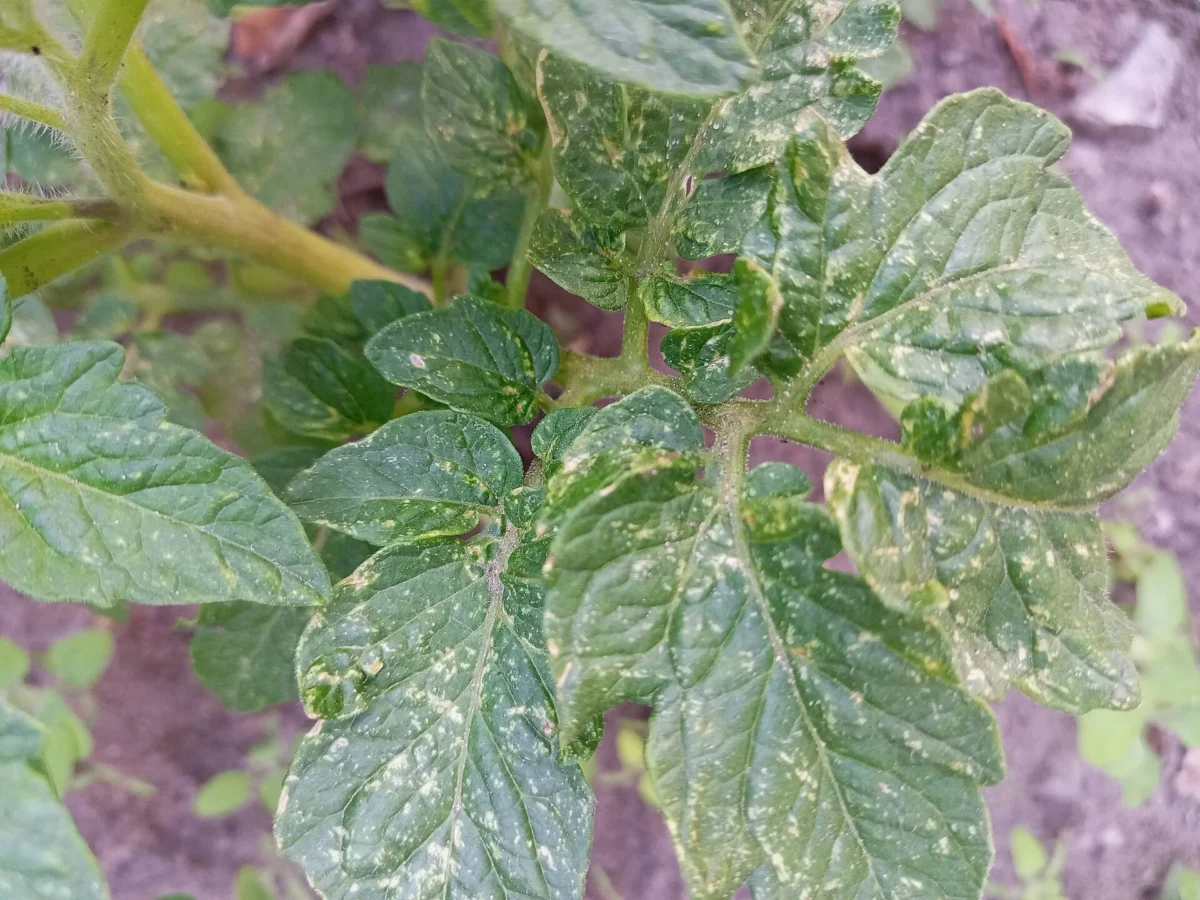
- Stippling: tiny pale dots on the upper leaf surface where mites have fed underneath.
- Bronzing or dusty-looking leaves that later turn yellow, dry and fall.
- Fine webbing between leaves, on leaf undersides and over shoot tips in heavier infestations.
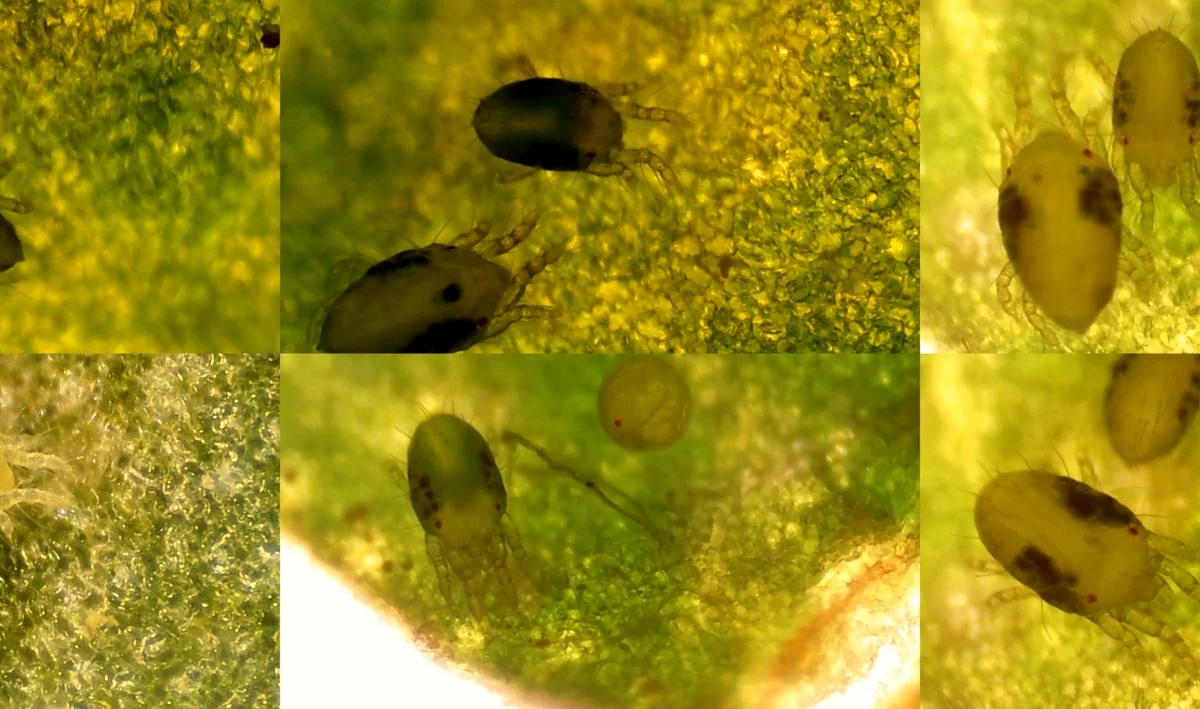
- Moving specks on leaf undersides, often near the midrib, along with round, translucent eggs and white cast skins.
- Damage starting low on dusty plants near paths or on the hot, sunny side of a plant.
The white paper test
Hold a sheet of white paper under a suspect branch and tap the branch sharply. Wait a few seconds: if tiny specks start moving across the paper and leave faint streaks when crushed, you have mites. Green or yellow streaks usually mean plant-feeding spider mites; red streaks can be spider mites or harmless predatory mites, which move much faster. A 10x hand lens makes identification much easier. The pest identifier can also help.
What damage do spider mites cause?
The Montana State University fact sheet on two-spotted spider mites describes how feeding produces the characteristic stippled, then bronzed leaves and how webbing builds up as populations grow.
Each mite punctures leaf cells and sucks out the contents, including chlorophyll. Light infestations cause only cosmetic stippling, but large populations reduce photosynthesis, leading to yellowing, leaf drop, smaller fruit and, in severe cases, plant death. Beans, cucumbers, melons and tomatoes can lose much of their foliage in midsummer heat, and houseplants such as palms, ivy, scheffleras and crotons often decline in winter when indoor heating dries the air. On conifers, spruce spider mites cause needles to turn gray or brown in spring and fall.
Why do spider mites get worse in hot, dry weather?
Mites develop much faster in heat: at around 80 to 90°F the two-spotted spider mite can complete a generation in as little as five to seven days, and each female lays about 100 or more eggs. Dry air helps them too, because the moisture in humid air and on wet leaves slows their development, and many of their natural enemies prefer humidity. Drought-stressed plants also have more concentrated nutrients in their leaves, which makes them better food for mites. Dust from roads and paths settles on leaves and interferes with predators. All of this explains why mites flare up in midsummer and indoors in winter.
How do you get rid of spider mites?
- Hose them off. A strong spray of water to the undersides of leaves every few days dislodges mites, destroys webbing and raises humidity. This alone can control light infestations outdoors.
- Water plants deeply. Well-watered plants tolerate feeding better. Use the garden watering calculator to plan irrigation during heat waves.
- Prune heavily infested shoots and bag them for the trash, especially early in an outbreak.
- Use insecticidal soap or horticultural oil. These kill mites on contact. Thorough coverage of leaf undersides is essential, and because they do not kill all eggs, repeat every five to seven days for at least three applications. See neem oil spray for a related option.
- Protect and release predatory mites. Species such as Phytoseiulus persimilis and Neoseiulus californicus eat spider mites and their eggs. They are sold for gardens and greenhouses and work best when released early, in humid conditions, and where no residual pesticides remain.
- Use a miticide as a last resort. Products labeled specifically for mites can help in severe cases, but mites quickly develop resistance, so rotate products with different modes of action and follow labels exactly.
Which natural enemies eat spider mites?
| Predator | Notes |
|---|---|
| Predatory mites (Phytoseiidae) | Fast-moving, pear-shaped, often orange or tan; the most important natural control |
| Spider mite destroyer lady beetle (Stethorus) | Tiny black lady beetle specializing in mites |
| Six-spotted thrips | Predatory thrips that feed on mite eggs |
| Minute pirate bugs | Feed on mites, thrips and aphids |
| Lacewing larvae | General predators that include mites in their diet |
The single most important step in protecting these allies is to avoid broad-spectrum insecticides, such as pyrethroids, carbaryl and some systemic products, which often trigger spider mite outbreaks by killing predators while leaving mites largely unaffected.
Pesticide label note: Use only miticides, soaps and oils labeled for your plant and for mites, and follow the label exactly. Rotate products with different modes of action to slow resistance, observe pre-harvest intervals on edible crops, and avoid spraying open flowers when bees are active.
How do you get rid of spider mites on houseplants?
Indoors, spider mites thrive in warm, dry winter air. Isolate affected plants, then rinse them thoroughly in the shower or sink, paying special attention to leaf undersides, and wipe leaves with a damp cloth. Repeat weekly. Raise humidity with a humidifier or pebble trays and keep plants away from heating vents. For persistent infestations, apply an insecticidal soap or horticultural oil labeled for indoor plants every five to seven days for several weeks. Badly infested, low-value plants are often better discarded to protect the rest of your collection. Check new plants carefully before bringing them home.
Which plants are most affected?
| Plant group | Examples | When mites peak |
|---|---|---|
| Vegetables | Beans, tomatoes, cucumbers, melons, eggplant, squash | Midsummer heat and drought |
| Fruit | Strawberries, raspberries, apples, pears, citrus | Summer |
| Ornamentals | Roses, marigolds, impatiens, burning bush, hydrangea | Summer |
| Conifers | Spruce, arborvitae, juniper (spruce spider mite) | Cool weather in spring and fall |
| Houseplants | Palms, ivy, schefflera, croton, calathea, citrus | Winter heating season |
How do you prevent spider mites?
- Keep plants well watered and mulched, especially during heat waves; the mulch calculator helps size mulch.
- Reduce dust by mulching paths and occasionally rinsing foliage.
- Avoid broad-spectrum insecticides that kill mite predators.
- Do not overfeed nitrogen, which can increase mite reproduction.
- Inspect regularly during hot, dry weather, particularly beans, cucumbers and tomatoes.
- Quarantine new houseplants for a couple of weeks.
- Clean up heavily infested plant debris at the end of the season, since mites overwinter in debris and weeds.
Spider mites vs other pests
| Sign | Spider mites | Thrips | Lace bugs |
|---|---|---|---|
| Leaf damage | Fine stippling, bronzing | Silvery streaks with black specks | Coarse white stippling |
| Underside clue | Webbing, tiny moving dots | Slender, fast insects | Dark varnish-like spots, lacy-winged bugs |
| Webbing | Often | No | No |
Dealing with more than one problem? Our plant pests and diseases guide lists every insect and disease we cover, organized by symptom.
Free printable: the Year-Round Garden & Preserving Planner
Planting dates for 24 crops, monthly tasks, blanching times, canning safety numbers and a winter storage chart in one 8-page PDF. Enter your email to download it instantly and get our seasonal garden newsletter.
No spam. Unsubscribe any time. We never sell your email.
Spider mite FAQ
What kills spider mites instantly?
A strong water spray removes many at once; insecticidal soap or oil kills those it contacts, but eggs survive, so repeat treatments.
Can spider mites live in soil?
They live mainly on leaves, though they can overwinter in plant debris and on weeds near the soil.
Do spider mites bite humans?
No, they feed only on plants.
Why do spider mites keep coming back?
Eggs survive many treatments, hot dry conditions favor them, and pesticides may have killed their predators.
Does neem oil kill spider mites?
Neem oil kills mites it coats and needs repeat applications every five to seven days.
Are red spider mites the same as clover mites?
No; clover mites are a different, nuisance species that invades homes but rarely harms garden plants.
How does the spider mite life cycle work?
Spider mites pass through five stages: egg, six-legged larva, two eight-legged nymph stages and adult. Females lay round, translucent eggs on leaf undersides, often within the webbing. In hot weather the whole cycle can take less than a week, and because a single female lays dozens to more than a hundred eggs over her few weeks of life, populations can multiply tenfold or more in a couple of weeks. In fall, two-spotted spider mites turn orange-red and shelter in plant debris, bark crevices and weeds, then become active again when temperatures rise in spring. Indoors and in greenhouses they breed all year.
| Temperature | Approximate egg-to-adult time |
|---|---|
| About 60°F | 3 weeks or more |
| About 70°F | About 2 weeks |
| About 80 to 90°F | As little as 5 to 7 days |
This is why timing matters: start checking susceptible plants weekly as soon as summer heat arrives, and treat early, while you see only a few stippled leaves rather than webbing across the plant.
How do you use predatory mites successfully?
- Release early, at the first sign of stippling, rather than when plants are covered in webbing.
- Choose the right species: Phytoseiulus persimilis works fast in moderate temperatures and humidity; Neoseiulus californicus tolerates heat and lower humidity and can persist when prey is scarce; Mesoseiulus longipes suits hot, dry conditions.
- Avoid residual pesticides for several weeks before release, including many insecticides and some miticides.
- Raise humidity with a light misting or by watering paths on hot days, which helps predators establish.
- Distribute them evenly on the most infested leaves, and release again if needed after two to three weeks.
Predatory mites are especially useful in greenhouses, high tunnels and on indoor plants, where conditions are easier to manage.
Do spider mites affect vegetable yields?
Yes, when infestations are heavy. Beans and cucumbers can lose much of their leaf area in a few weeks of hot, dry weather, which reduces pod set and fruit size. Tomatoes may drop leaves, exposing fruit to sunscald. Strawberries weakened by mites produce smaller berries the following year. Catching mites early, keeping plants watered and hosing foliage during heat waves usually prevents serious yield loss in home gardens. For other tomato issues, see common tomato problems, and for distinguishing watering stress from pest damage, see overwatering vs underwatering.
With early detection, regular water sprays and a garden that welcomes predatory mites and lady beetles, most gardeners can keep spider mites below damaging levels without ever reaching for a miticide.
Keep a simple note of when mites first appear each year; they tend to return at the same point in summer, so next season you can start water sprays and predator releases just before the outbreak begins.
References: University of Minnesota Extension, Spider Mites; Montana State University, Two-Spotted Spider Mite; Wikipedia, Tetranychus urticae.
Identifying and washing off spider mites
University of Minnesota Extension’s managing spider mites on houseplants says the common houseplant pest is the two-spotted spider mite, about 1/50 inch (0.5 mm) long, oval with eight legs, in colours from translucent green to brown or orange-red, with two dark spots visible under 10 to 15x magnification. Spider mites are arachnids, not insects, related to spiders and ticks, and prefer warm, dry, low-humidity conditions. Feeding leaves yellow spots or a stippled look, and webbing may be present.
- Water: wash foliage with a soft cloth or a forceful spray of lukewarm water; repeating reduces the population.
- Soap and oil: insecticidal soap and horticultural oil are both effective.
- Isolate: keep new plants apart for a few weeks and move infested plants to a cooler room away from healthy ones.
- Water correctly: water when the top half inch of soil is dry, keeping soil moist but not saturated.
- Severe cases: discard the plant after covering it with a plastic bag to prevent spread.
Read labels carefully if you use pyrethrin or permethrin products. See our plant problem identifier to separate mite damage from other stippling.
Safety and legal note: Indoor use of insecticides is risky around children, pets and food: use only products labelled for indoor plants, ventilate rooms and keep pets away until dry. Rules vary by country and region.
Reviewed October 2026. Sources: University of Minnesota Extension, Managing spider mites on houseplants