
Zinnias are one of the easiest and most rewarding flowers to grow from seed. They sprout in days, bloom in about two months, and keep flowering until frost, especially if you cut them for bouquets. Getting the timing right is the main thing: zinnias love heat and sulk in cold soil.
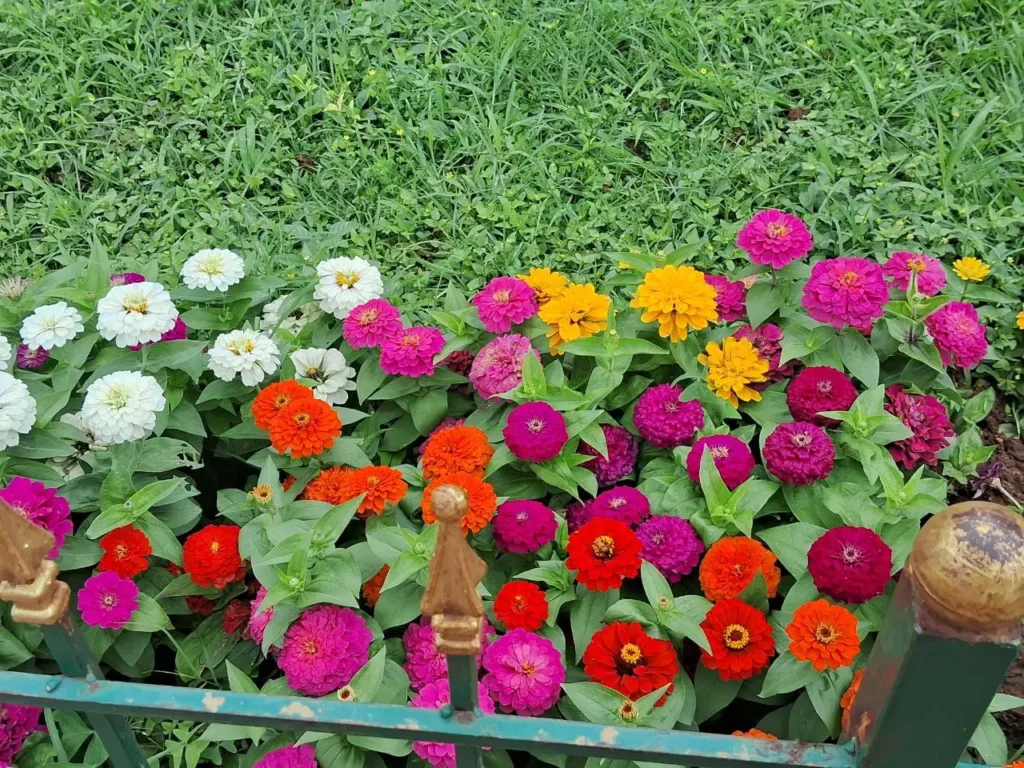
When to plant zinnia seeds
- Outdoors: sow after your last spring frost, once the soil has warmed to at least 60°F and nights stay above 50°F. In most areas that is mid-spring to early summer.
- Indoors: start seeds four to six weeks before the last frost if you want earlier flowers. Zinnias dislike root disturbance, so sow in individual cells or small pots and transplant carefully.
- Succession sowing: sow a new batch every two to three weeks until about ten weeks before your first fall frost for nonstop blooms.
Find your dates with the frost date tool and the seed starting calculator.
Where to plant zinnias
- Full sun: at least six to eight hours of direct sun.
- Well-drained soil: average garden soil with some compost is ideal. Rich soil gives lots of leaves.
- Good airflow: crowded zinnias are prone to powdery mildew.
How to plant zinnia seeds
- Prepare the bed by loosening the soil and raking it smooth.
- Sow seeds 1/4 inch deep, about 2 to 3 inches apart.
- Cover lightly, firm and water with a gentle spray.
- Keep the soil moist; seedlings appear in four to seven days in warm weather.
- Thin seedlings to their final spacing when they have two sets of true leaves.
| Zinnia type | Height | Final spacing |
|---|---|---|
| Dwarf and bedding (Profusion, Zahara, Thumbelina) | 8 to 18 inches | 6 to 12 inches |
| Medium (Cactus, Queen Lime) | 2 to 3 feet | 9 to 12 inches |
| Tall cutting (Benary’s Giant, State Fair) | 3 to 4 feet | 12 to 18 inches |
Caring for zinnias
- Water at the base about an inch a week, keeping leaves dry.
- Pinch young plants once they are 8 to 12 inches tall, cutting the main stem just above a set of leaves. You will get many more, longer stems.
- Feed lightly once or twice with a balanced fertilizer, or not at all in good soil.
- Cut or deadhead often. Zinnias are cut-and-come-again flowers: the more you cut, the more they bloom.
- Stake tall varieties in windy spots.
Preventing powdery mildew
Zinnias are classic powdery mildew hosts by late summer. Choose resistant series such as Profusion, Zahara and many newer cutting varieties, space plants well and water at the base. See our guide to powdery mildew for treatment.
Cutting zinnias for bouquets
Use the “wiggle test”: hold the stem about 8 inches below the flower and shake gently. If the stem stays stiff, the flower is ready; if it droops, wait a few days. Cut in the cool morning and put stems straight into water. Zinnias last about a week in a vase; our tips on how to keep cut flowers fresh help them last longer, and they are a backbone of any cut flower garden.
Saving zinnia seeds
Let a few flowers dry completely on the plant until the heads are brown and crisp. Pull the petals apart: the seeds are the arrow-shaped pieces at their base. Dry and store them in a paper envelope. Seed from hybrids may not grow true to the parent. For general sowing advice, see our beginner’s guide to planting seeds.
Best zinnia varieties to grow from seed
| Variety or series | Height | Best for |
|---|---|---|
| ‘Benary’s Giant’ | 3 to 4 feet | Cut flowers with big, dahlia-like blooms |
| ‘State Fair’ | 3 to 4 feet | Huge flowers, old-fashioned look |
| ‘Queen Lime’ and ‘Queen Red Lime’ | 2 to 3 feet | Unusual chartreuse and dusky tones for bouquets |
| ‘Oklahoma’ | 2.5 to 3 feet | Smaller blooms, good mildew tolerance |
| Profusion and Zahara series | 12 to 18 inches | Borders and containers; excellent disease resistance |
| ‘Thumbelina’ | 6 to 8 inches | Edging and kids’ gardens |
Common zinnia problems
- Powdery mildew: white powder on leaves in late summer. Space plants widely, water at the base and choose resistant series. See our powdery mildew guide.
- Bacterial and fungal leaf spot: brown spots, worse in wet weather. Remove spotted leaves and avoid overhead watering.
- Japanese beetles: hand-pick into soapy water in the morning.
- Slow germination: soil is too cold. Wait until it reaches 70°F.
Succession sowing for flowers until frost
Zinnias bloom about 60 to 70 days from seed, and the first plantings can look tired by late summer. For nonstop cut flowers, sow a new short row every three to four weeks from late spring until about 10 weeks before your first fall frost. Each new batch replaces older, mildew-prone plants with fresh, vigorous ones, and the bed stays colorful right up to the first frost.
Zinnias are also a favorite of butterflies and bees, so a long row of mixed colors doubles as a pollinator strip for the whole season.
Growing zinnias in pots
Compact types such as the Profusion, Zahara and ‘Thumbelina’ series do best in containers. Use a pot at least 10 to 12 inches wide with drainage holes, fill it with quality potting mix and sow a few seeds a quarter inch deep, thinning to two or three plants. Give pots at least six hours of sun, water when the top inch of mix is dry and feed every two to three weeks with a balanced liquid fertilizer. Taller cutting varieties can be grown in large tubs but may need a small stake.
What university trials say about sowing zinnias
Zinnias have a reputation for being easy, and the research agrees, with some useful detail. The Clemson Cooperative Extension recommends seed be covered with about a quarter inch (6 mm) of soil, thinned to between 8 and 24 inches (20 to 60 cm) apart depending on the variety, and expects bloom roughly 8 to 12 weeks after sowing. That 8 to 12 week window is worth writing on your calendar, because it tells you when to expect the first flowers and, working backwards, how late you can sow and still get a good show before autumn.
The University of Illinois Extension notes that zinnias grow readily from direct seeding and that the author has had good results sowing straight into the garden early in the season. For an earlier start the same source suggests sowing seed indoors several weeks before the last frost. The Utah State trial paper gives a specific schedule for growers who start indoors: sow one or two seeds per cell about four weeks before the last frost and thin to one seedling per cell. For direct seeding it says to sow after the last frost at two to three seeds per foot and thin once the first true leaves have appeared. You can look up your own date with our frost dates tool.
Heat helps: germination temperature
Zinnia is a warm-season annual, and the Utah State paper reports germination in 3 to 5 days at a soil temperature of 80 to 85 degrees F (27 to 29 C). After the seedlings emerged, it recommends reducing the heat to about 70 degrees F (21 C). The practical lesson is that zinnias sown into cold, wet spring soil will sit and sulk, or rot. Wait until the ground has properly warmed, or sow indoors on a warm shelf and move the tray to a cooler, brighter spot as soon as the seedlings emerge.
Spacing: how close is too close?
Spacing depends on what you are growing. The Utah State paper says general spacing is 9 by 9 or 12 by 12 inches (23 or 30 cm), with small-flowered series such as Mexican, Queen and Zinderella suited to closer spacing and large series such as Benary’s Giant, California and Dahlia needing more room. In its field trial, seed was sown 6 inches apart, thinned to 12 inches, with 24 inches between rows. It also recommends beds 3 to 5 feet wide so you can reach the middle without stepping on the soil. Clemson gives a wider range, up to 24 inches, for the biggest plants. Crowded zinnias grow tall and thin, and the dense foliage stays damp, which sets up powdery mildew, so resist the urge to leave every seedling.
Pinching for more flowers
Pinching is the single most useful trick for cut-flower growers. The Utah State paper advises pinching when plants are 8 to 12 inches (20 to 30 cm) tall by removing the top 3 to 4 inches (7 to 10 cm). This encourages side branching, more blooms and longer stems. It feels wrong to cut off a healthy plant, but the plant responds with several stems instead of one. Clemson also lists pinching as a way to make zinnias bushier.
Support, watering and feeding
Tall zinnias can flop in wind and rain. The Utah State paper describes horizontal netting suspended between 4 foot stakes, installed at planting and raised as the plants grow, before buds form, so the leaves sit below the netting and the flower stems grow through it. For water, it says to irrigate two to three times a week while plants establish, then once a week for established plants, applying 1 to 1.5 inches (2.5 to 4 cm) per event. The Illinois article, meanwhile, calls zinnias relatively maintenance free and extremely drought tolerant, so there is no need to water daily once they are growing well. For fertility, the Utah State paper suggests about 1 inch of low-salt compost before planting, applying nitrogen in two parts, and repeating a soil test every two years. A basic soil test is a better guide than guessing, and our soil calculator can help you work out how much compost or amended soil a bed needs.
Powdery mildew and other problems
Powdery mildew, a white or gray powder on the leaves, is the main disease. Illinois Extension says full-sun sites usually keep foliage dry enough to limit infection and that new varieties have excellent resistance, a point Clemson repeats when it recommends choosing mildew-resistant varieties. Utah State recommends controlling early infections, and says copper fungicide may be used if needed. Always read and follow the product label before using any fungicide.
The Utah State paper also lists aphids (treat with insecticidal soap or oils and avoid broad-spectrum insecticides that harm natural predators), western flower thrips, and twospotted spider mites, which cause stippling and webbing. Controlling weeds and keeping plants adequately watered reduces mite and thrips pressure. It lists root, stem and crown rots too, which you avoid with well-drained soil or raised beds and by removing infected plants.
Cutting zinnias at the right moment
For long vase life, timing matters. The Utah State paper says to harvest when blooms have at least two full rows of expanded outer petals and the upper stem is mostly stiff, and to cut in the cool part of the day, 2 to 4 nodes below the bloom. It states a target stem length of at least 12 inches, with 18 to 24 inches preferred. It adds one tablespoon of household bleach per gallon of water in the storage bucket and says not to store cut stems below 40 degrees F (4 C). Vase life is about 7 to 10 days for most varieties in that trial, and the Illinois article says most varieties last about a week, sometimes up to two. Cutting also encourages more flowers, as with deadheading, which the Illinois article says helps ensure a season of flowers.
Which zinnias help pollinators?
If you are growing for butterflies and bees, the choice of flower form matters. Illinois Extension says pollinators, especially butterflies, are attracted to zinnias, but double-flowered varieties have little or no pollinator value because they lack functional reproductive parts, while single-flowered varieties provide pollen and nectar. The article explains that most common garden varieties derive from Zinnia angustifolia, which is generally single-flowered, or Zinnia elegans, which is generally double-flowered. In the Utah State trial, State Fair gave the highest yield with the fewest culls and Benary’s Giant produced long stems with a good yield, which makes them solid choices for cutting.
Safety and legal note: Read and follow the label of any fungicide or insecticide, and keep chemicals away from children and pets. Wear gloves when using bleach in cut-flower water and never mix it with other cleaners. Do not eat ornamental flowers unless you are sure they were grown for food. Rules on pesticide use vary by region.
Sources and further reading
- Growing and maintaining cut flowers in your garden, Michigan State University Extension
- Starting Seeds Indoors, Clemson Cooperative Extension
- Powdery Mildew on Ornamentals, UC Statewide IPM Program
Free printable: the Year-Round Garden & Preserving Planner
Planting dates for 24 crops, monthly tasks, blanching times, canning safety numbers and a winter storage chart in one 8-page PDF. Enter your email to download it instantly and get our seasonal garden newsletter.
No spam. Unsubscribe any time. We never sell your email.
Frequently asked questions
When should I plant zinnia seeds?
Outdoors after the last frost, once soil is at least 60°F. You can also start them indoors four to six weeks earlier in individual cells.
How deep do you plant zinnia seeds?
About 1/4 inch deep, then thin to 6 to 18 inches apart depending on the variety.
How long do zinnias take to bloom from seed?
About 60 to 70 days from sowing, sometimes sooner for dwarf types in hot weather.
Do zinnias come back every year?
No, they are annuals, though they sometimes self-seed. Save seeds or sow new ones each spring.
Reviewed October 2026. Sources: Clemson Cooperative Extension, how to grow zinnias, Utah State University Extension, zinnia cut-flower production, University of Illinois Extension, zinnias
