
Quick answer: The most useful companions for a peach tree are flowering plants and manageable herbs outside its mulched root zone, not a dense living carpet around the trunk. Peach trees need sunlight, low weed competition, access for pruning and fruit thinning, and a good water supply as fruit develops. A border of regionally adapted flowers may support beneficial insects, while a weed-free mulch zone around a young tree is more reliably helpful than planting more crops directly over its roots.
Companion-planting lists often recommend garlic, chives, nasturtiums, marigolds or even strawberries around fruit trees. The problem is that they rarely specify whether the tree is newly planted or mature, how far the companions should sit from its roots, or whether a companion’s supposed insect-repelling effect has been tested. With peaches, those omitted details matter. Trees can lose growth and fruit size when grass and other vegetation compete for water and nutrients. This guide builds a workable peach-tree planting plan around the tree’s needs.
Peach-tree needs determine companion choices
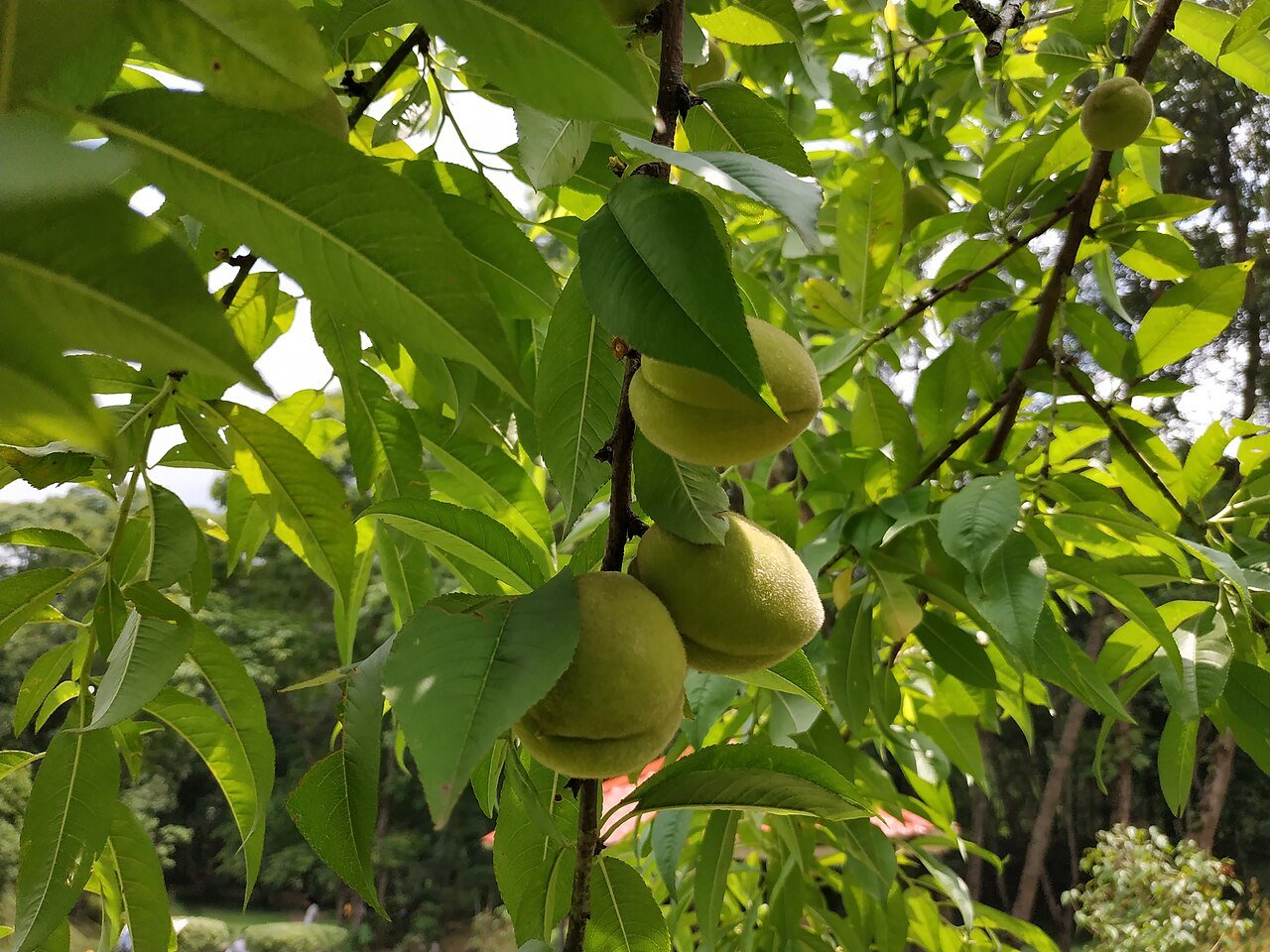
A peach (Prunus persica) is a deciduous, fruiting tree grown in sunny, well-drained conditions. Unlike many apple cultivars, most commonly grown peach cultivars are self-fruitful, so a second different peach is not ordinarily required for fruit set. Site suitability, cold injury to blossoms, pruning, thinning, water and pests often matter far more than a nearby companion plant.
University of Massachusetts Extension notes that grass and other competing vegetation reduce peach growth and fruit size. It recommends mulching, careful water management, fruit thinning and appropriate orchard care. A companion that interferes with these tasks is a poor choice regardless of its appealing flowers.
The central principle is to treat the peach as a perennial fruit tree with expanding roots, not as a vegetable transplant whose surrounding soil can be replanted and dug every few months.
Peach tree companion planting chart
| Potential neighbor | Why it could work | Recommended position | Caution |
|---|---|---|---|
| Native flowering perennials | Provide nectar and pollen beyond peach bloom | Separate sunny strip along orchard edge | Select noninvasive plants suited to region |
| Sweet alyssum | Small flowers visited by beneficial insects | Sunlit border or container | May be shaded by mature tree canopy |
| Calendula | Seasonal flowers and visible garden diversity | Outside maintained root zone | Do not interfere with dropped-fruit cleanup |
| Chives | Compact edible herb and blossoms | Well-spaced herb border | Not a proven peach-leaf-curl remedy |
| Thyme | Low-growing culinary herb | Sunny, free-draining border | Too dry a site for young peaches may be unsuitable |
| Strawberries | Another fruit harvest in nearby space | Separate bed or pathside strip | Can form competitive surface root mat |
| Grass or vigorous groundcovers | Little benefit directly around young trunk | Keep beyond established mulched ring | Competition for water and nutrients |
These pairings are location and management suggestions, not a claim that a controlled experiment proved every species improves peach yield. For the most reliable results, protect the peach’s root zone and use the wider garden for flowers and edible herbs.
Flowers that fit around peach trees
A flowering strip beyond the tree’s mulched area can provide seasonal color and resources for many insects. Useful choices vary widely with the region: a plant that flowers throughout a mild coastal winter may not survive a cold inland climate, and a plant that flourishes in a wet garden may struggle in an irrigated, sunny orchard.
Look for a sequence of flowering periods. A peach usually blooms for a relatively short season, while insects need resources before and after that bloom. A native meadow-style border can offer continuity without requiring additional irrigation right against the trunk. Do not plant tall flowers where they shade low, fruiting limbs or obstruct the spray and pruning access you may need.
Flowers are a habitat measure, not a promise that pests will disappear. If you have recurring problems with peach leaf curl, borers or brown rot, use a specific disease or insect management program. A ring of attractive flowers does not replace those measures.
Can garlic or chives prevent peach-tree pests?
Chives and garlic produce aromatic compounds and can be worthwhile culinary crops. But a strong smell does not establish that the living plant will repel peach tree borers, prevent fungal disease or protect ripening fruit. Such claims commonly come from unsourced companion lists rather than trials that measure pest outcomes around peach trees.
If you want chives, place them at the edge of the planting where they receive enough sunlight and you can harvest them without digging into the peach’s immediate root zone. Garlic usually requires planting and harvesting that disturb the soil more than a clumping perennial herb does. A separate vegetable bed is often easier to manage.
For general evidence around claimed repellent pairings, see GardenVoila’s companion-planting guide.
Strawberries under peach trees: attractive but demanding
The idea of strawberries under a peach tree sounds efficient: harvest a ground crop while the tree grows overhead. Yet the arrangement changes with the tree’s age. A newly planted peach needs space for its roots and protection from competition. A mature peach casts seasonal shade and its roots extend beyond the trunk. Strawberries require regular care, water and runner management.
Rather than planting strawberry runners right against the peach, put them in a separate sunny strip or a raised bed outside the mulched area. This gives you fruit without disturbing tree roots whenever you renew strawberry plants. Strawberry and peach harvests may also overlap with birds and other wildlife feeding in the space; maintaining access will make both crops easier to protect.
What not to plant close to a peach trunk
Turf grass and aggressive groundcovers
Grass competes strongly with young fruit trees. Utah State University Extension summarizes research on root-zone vegetation and recommends a managed area free of competing plants, particularly while trees establish. A mulch ring can conserve moisture and reduce weeds, provided it is not piled against bark.
Vigorous shrubs and climbing vines
A large shrub planted against the peach will create shade and root competition, and vines that wrap around branches interfere with annual pruning. Keep ornamental shrubs in a separate planting zone and allow space for the peach canopy to spread.
Deep-digging root crops
Potatoes and other crops that need hilling or major digging are awkward neighbors in a permanent orchard bed. The harvest operation can damage tree roots or irrigation lines. If the goal is a mixed edible garden, put these crops beyond the maintained tree area.
Plants that prevent airflow or cleanup
Some peach diseases persist in infected fruit and tissues. A dense understory can make it difficult to spot dropped fruit or inspect the base for damage. Keep enough bare or mulched accessible ground that you can remove debris and examine the trunk throughout the growing season.
How to create a simple peach companion layout
Step 1: Choose the tree first. Select a peach cultivar and rootstock suited to your local climate, chilling conditions and available space. A patio dwarf requires a different layout from a large in-ground tree. Account for the eventual canopy, not just the size of the nursery tree.
Step 2: Establish a weed-free, mulched zone. Remove nearby turf or weeds carefully without damaging roots, then apply an appropriate layer of organic mulch. Keep the root flare and trunk uncovered. The size of the ring depends on age and conditions; increasing the maintained area as the tree grows can reduce competition.
Step 3: Protect access. Leave a path for a ladder or picking basket, depending on canopy size. Avoid permanent raised edging where it would prevent tools, water or fruit harvest.
Step 4: Add flowers separately. Place low, regionally adapted flowers on a sunny outer edge. If the canopy will shade that edge later, choose another location rather than squeezing shade-intolerant flowers under the tree.
Step 5: Separate irrigation needs. Young peaches need regular water during establishment; fruiting trees may need extra water during dry spells. A dry-loving rosemary or thyme border should not dictate the tree’s irrigation schedule, and heavy watering for thirsty annuals should not keep the trunk base soggy.
For general garden layout, GardenVoila offers a raised-bed planner and a watering calculator. Use tree-specific spacing advice for the final orchard design.
Peach tree pruning, thinning and mulch matter more than secret pairings
Peaches bear fruit on shoots of the appropriate age, so pruning affects light penetration, fruiting wood and access. Heavy crops often need thinning for acceptable fruit size and branch protection. The UMass peach guide emphasizes hand thinning and the importance of moisture, especially in the weeks before harvest.
See it in practice: This NC State Extension demonstration shows early peach-tree pruning, which is easier when nearby companion plants do not block the canopy or trunk.
Video: Pruning a Two-Year Old Peach Tree by NC State Extension.
Check local timing before pruning; winter temperatures, bacterial diseases and frost risk influence the safest season. GardenVoila’s peach pruning guide explains timing, and the peach leaf curl guide addresses a common fungal disease. Neither problem is solved by planting marigolds nearby.
Avoid common peach companion-planting mistakes
- Assuming companions improve pollination: most peach cultivars are self-fruitful, so pollination requirements differ from apples.
- Covering the trunk with mulch: keep bark clear to reduce rot and pest risks.
- Planting grass to the base: this increases competition with young trees.
- Ignoring canopy shade: an annual herb that thrives in year one may not have enough sun in year four.
- Using herbs as pesticides: aromatic leaves are not proven peach pest control.
- Blocking pruning and fruit collection: leave safe access around the tree.
Free printable: the Year-Round Garden & Preserving Planner
Planting dates for 24 crops, monthly tasks, blanching times, canning safety numbers and a winter storage chart in one 8-page PDF. Enter your email to download it instantly and get our seasonal garden newsletter.
No spam. Unsubscribe any time. We never sell your email.
Frequently asked questions
What is the best thing to plant under a peach tree?
A suitably maintained organic mulch is often the most useful cover under a young tree. Add optional flowers farther away, rather than filling the immediate root zone with crops.
Can I plant marigolds around my peach tree?
Yes, at an accessible sunny edge, but do not rely on marigolds to prevent peach pests or disease.
Do peach trees need a companion tree for fruit?
Most common peach cultivars are self-fruitful. Check the exact variety and local pollination guidance rather than applying the rules for apples or pears.
Will garlic protect a peach tree from insects?
No reliable general evidence supports garlic as a replacement for pest-specific control around peach trees. Grow garlic as its own crop if space permits.
Can strawberries and peaches share a garden?
Yes, with separate zones that allow each crop enough sun, water and root space. Avoid a dense strawberry mat next to a young peach trunk.
Final takeaway
Plant flowers and compact herbs around the peach-growing area, not as a competing mass at its trunk. Prioritize soil, mulch, light, pruning, thinning and access. A companion planting is successful when it makes the orchard easier to maintain and provides a second useful crop or habitat feature without sacrificing peaches.
Research and further reading
- UMass Extension: Peaches—growing, mulch, thinning and management
- Utah State Extension: Managing competing vegetation around fruit trees
- Illinois Extension: Fruit tree care
- University of Maryland Extension: Mulching trees
Featured photo: Harry Van den Bulck / Wikimedia Commons, CC BY-SA 4.0. Resized for web display.


