Peach leaf curl is a fungal disease caused by Taphrina deformans that makes new peach and nectarine leaves pucker, thicken and turn red or purple in spring, then fade to a powdery gray and drop. Once you see it, it is too late to spray that season; the infection happened at bud swell. Prevent it with a fungicide application after leaves fall in autumn or before buds swell in late winter, or plant resistant varieties. This guide covers symptoms, the disease cycle, spray timing, resistant varieties, non-chemical prevention and how to help a tree recover.
Peach leaf curl: cause, signs and control
| Cause | Fungus Taphrina deformans |
|---|---|
| Hosts | Peaches and nectarines (rarely almonds) |
| Infection period | Cool, wet weather as buds swell and open in late winter and early spring |
| Symptoms | Thick, puckered, red to purple new leaves that later turn gray and fall |
| Treatment once seen | No cure that season; support the tree |
| Prevention | Fungicide after leaf fall or before bud swell; resistant varieties |
What does peach leaf curl look like?
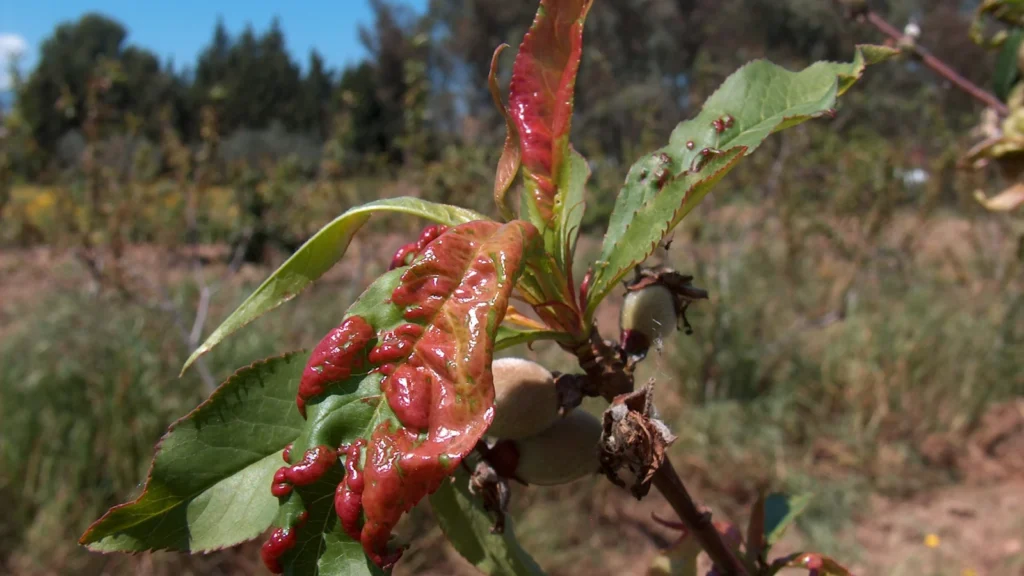
Symptoms appear on the first leaves of spring. The Pacific Northwest Plant Disease Management Handbook (PNW Handbooks) describes the first infected leaves as yellow to reddish, thickened and crisp. As they expand they become deformed, puckered and thicker than normal, with bright red or purple puckered areas that may develop a dusty white spore coating. Within a few weeks the leaves yellow, brown and drop. Twigs are occasionally distorted, and some fruit may have reddish growths on the surface. West Virginia University Extension adds that exposed fruit becomes prone to sunburn after leaves are lost, and that fruit symptoms are rare but can cause corky, cracked spots.

Curled peach leaves have other causes too, including aphids, drought and herbicide drift. Our parent guide to peach tree leaves curling, yellowing and with holes helps you tell them apart, and the yellow leaf identifier can narrow it down. Aphid curl tends to be sticky with insects underneath, while leaf curl thickens and reddens the leaf and appears in a cluster of new growth.
What causes peach leaf curl?
The fungus survives on bark, twigs and around buds. West Virginia University Extension explains that spores overwinter in bark crevices and around buds, and that in spring yeast-like cells wash onto swelling buds and emerging leaves, then change to a filamentous form that penetrates the leaf. Prolonged cool, humid weather favors infection, while warm weather after bud swell paired with rapid leaf growth rarely allows it. The Oregon and Washington handbook is more specific: leaf infection needs more than about 12.5 hours of wetness when temperatures are below 61°F, trees that stay wet for two or more days show the heaviest infection, and symptoms may not appear if temperatures stay above 69°F after infection. Leaf susceptibility runs from bud break to petal fall. The University of California IPM program says the disease is favored by cool, wet spring weather and is especially serious on low-chilling varieties.
Symptoms show up about two weeks after the leaves emerge. Once leaves have fully expanded and the weather warms, new infections stop, which is why the disease seems to disappear by early summer. The PNW Handbook warns that repeated defoliation can kill trees in two to three years.
Can you treat peach leaf curl after it appears?
No spray will cure leaves that are already infected. Spraying once symptoms show only wastes product. West Virginia University advises deferring active management until late in the season. Instead, help the tree recover:
- Water during dry spells so the tree can push a healthy second flush of leaves.
- Feed lightly with nitrogen in spring to support regrowth; see our fruit tree fertilizer guide.
- Thin the fruit more heavily than usual, because a defoliated tree cannot ripen a full crop. WVU recommends exactly this in severe seasons, along with irrigation and extra nitrogen to maintain vigor.
- Rake up fallen leaves to keep the area tidy, although spores on bark are the main source of next year’s infection. WVU says pruning infected areas is not proven effective, but fall pruning before fungicide application can reduce overwintering spores and the amount of fungicide needed.
When should you spray for peach leaf curl?
Timing is everything. Extension sources agree on the principle but give regional schedules:
- Late fall, after about 90 percent of leaves have dropped. WVU recommends this timing, especially after notably wet winters or high disease pressure. UC IPM suggests a spray in late November or early December, after most leaves have fallen and before significant fall and winter rain.
- Late winter, before buds begin to swell. This is the traditional delayed-dormant timing. In western Oregon the PNW Handbook recommends two applications, at about 50 percent leaf fall (late October) and at delayed dormant (late February, before floral buds open); east of the Cascades and in low-rainfall areas a single delayed-dormant application should be effective.
- Extra applications in wet years. UC IPM says to add a treatment in January or early February if December is very wet, and a pre-bloom treatment at bud swell if February is very wet.
Once buds have opened and pink is showing, it is too late. Cover the whole tree, including every bud and branch, and spray on a calm, dry day. WVU also points out that in 2017 an unusually warm February in the Mid-Atlantic advanced bud swell and infection, and growers who sprayed at that stage controlled the disease, so track your tree’s buds instead of relying on the calendar. Track your local frost timing with the frost dates by ZIP code tool.
Which fungicides control peach leaf curl?
Home-garden products used for leaf curl include fixed copper fungicides and, in some states, chlorothalonil, ziram or lime sulfur. The university sources above list many commercial products and per-acre rates that are not for home use, and registrations change from year to year and differ by state. Check the label and your local extension service for what is permitted on peaches in your state. For copper specifics, see our copper fungicide guide. UC IPM says that one dormant or delayed-dormant copper application is usually enough, with an additional application in high-rainfall areas or where leaf curl is increasing. It also notes that to avoid resistance, growers should not make more than one application of certain fungicide groups in a row.
Pesticide label note: The pesticide label is the law. Use only products registered for peaches and nectarines in your state, and follow the label for rate, timing, protective equipment and pre-harvest interval. Read more on the EPA pesticide labels page. Keep sprays away from water, children and pets, and never mix products unless the labels allow it.
Which peach varieties resist leaf curl?
Most popular peaches, including Redhaven and Elberta types, are susceptible. The PNW Handbook lists these as curl resistant: Autumn Rose, August Etter, Avalon, Avalon Pride, Charlotte, Early Charlotte, Early Crawford, Frost, Indian Free, Kreibich, Muir, Nanaimo, Oregon Curl Free and Q-1-8. It adds that Redhaven and its derivatives are tolerant in some regions but very susceptible in the Pacific Northwest. WVU names Frost, Avalon and Mary Jane as tolerant, and calls resistant varieties the best option for backyard growers. Both sources caution that even resistant varieties can be susceptible in their first few years and may benefit from preventive treatment, and in very wet years some leaves may still curl. Nectarines are generally susceptible; see nectarine tree.
Why wet winters and warm Februaries matter
Peach leaf curl is a weather-driven disease, which is why two orchards in the same region can have very different years. A mild winter that triggers early bud swell followed by cool, rainy days gives the fungus its window, while a dry spring or a rapid warm-up can skip an entire season. The practical lesson is to watch your own buds: when the first swelling appears and rain is in the forecast, the delayed-dormant spray window is closing. If your tree is in a rain shadow, under an eave or under a clear rain cover, spores have much less water to infect with.
Leaf curl on nectarines and almonds
Nectarines are the same species as peaches and are just as susceptible, so use the same timing and the same cover for both. Almonds can occasionally be affected, but the damage is usually less severe. Apricots, plums and cherries are not hosts of this particular fungus, although stone fruit share other problems such as brown rot and shot-hole disease. If you grow peaches and nectarines together, treat them as one group in your spray plan and keep notes by tree so you can see which varieties handle wet years best.
Record-keeping tips
Write down the date leaves dropped, the date and product of every spray, the date buds started to swell and the first date you saw curled leaves. Over two or three seasons, those notes tell you whether your timing works, whether a resistant variety is paying off, and whether a particular tree needs removal. Remove trees that are repeatedly defoliated and replace them with a resistant variety rather than spending year after year on sprays.
How do you prevent peach leaf curl without chemicals?
- Plant resistant varieties.
- Grow peaches in a sunny, airy spot where branches dry quickly after rain.
- Use rain protection. For small or container trees, such as a dwarf peach tree, keep the tree under a roof overhang or temporary rain cover from late winter until leaves expand, since spores need rain to infect buds.
- Prune to an open center so air moves through the canopy; see when to prune peach trees.
- Clean up fallen leaves and prunings in fall.
Is peach leaf curl harmful to people or the fruit?
The fungus does not harm people, and unaffected fruit is safe to eat. The damage is to the tree: repeated severe attacks year after year weaken it, reduce fruit and can shorten its life. For general peach care, see our peach tree guide, and for variety ideas see white peaches.
A seasonal plan for leaf curl
- Autumn, as leaves fall: rake and remove fallen leaves; prune out dead wood.
- After about 90 percent leaf drop: apply a labeled fungicide to the whole tree if leaf curl was a problem or the season is wet.
- Midwinter: watch the weather; wet spells call for a second spray where recommended locally.
- Late winter, before bud swell: apply the delayed-dormant spray; do not wait for pink buds.
- Spring: if curl appears anyway, water, feed lightly and thin fruit.
- Summer: expect a second flush of healthy leaves; keep the tree watered.
Safety and legal note: Fungicides are regulated, and products and uses vary by state and country. Always follow the label for protective equipment, rates, re-entry intervals and pre-harvest intervals, and keep sprays away from water, children and pets.
Free printable: the Year-Round Garden & Preserving Planner
Planting dates for 24 crops, monthly tasks, blanching times, canning safety numbers and a winter storage chart in one 8-page PDF. Enter your email to download it instantly and get our seasonal garden newsletter.
No spam. Unsubscribe any time. We never sell your email.
Frequently asked questions
Should I remove leaves with peach leaf curl?
You can pick off badly infected leaves on small trees, but it is not necessary. The tree will drop them and grow new, healthy leaves.
You can pick off badly infected leaves on small trees, but it is not necessary. The tree will drop them and grow new, healthy leaves.
Will my peach tree recover from leaf curl?
Usually yes. Healthy trees push a second set of leaves by early summer. Water and feed lightly to help.
Usually yes. Healthy trees push a second set of leaves by early summer. Water and feed lightly to help.
Can I spray for leaf curl in spring?
Not once buds have opened. Spray in late fall after leaf drop or in late winter before bud swell.
Not once buds have opened. Spray in late fall after leaf drop or in late winter before bud swell.
Does peach leaf curl spread to other trees?
It affects peaches and nectarines, and very rarely almonds. It does not spread to apples, pears or cherries.
It affects peaches and nectarines, and very rarely almonds. It does not spread to apples, pears or cherries.
Is baking soda effective for peach leaf curl?
There is no good evidence it prevents leaf curl. Use resistant varieties or a registered dormant fungicide.
There is no good evidence it prevents leaf curl. Use resistant varieties or a registered dormant fungicide.
Can leaf curl kill a peach tree?
Repeated severe defoliation can kill trees in a few years, according to PNW Handbooks, and weakened trees are more vulnerable to other problems.
Repeated severe defoliation can kill trees in a few years, according to PNW Handbooks, and weakened trees are more vulnerable to other problems.
This article is part of our fruit trees guide, which groups all our fruit growing advice by crop.
Reviewed October 2026. Fact-checked against: Pacific Northwest Plant Disease Management Handbook, Peach Leaf Curl; West Virginia University Extension, Peach Leaf Curl; UC Statewide IPM Program, Peach Leaf Curl; US EPA, Pesticide Labels.