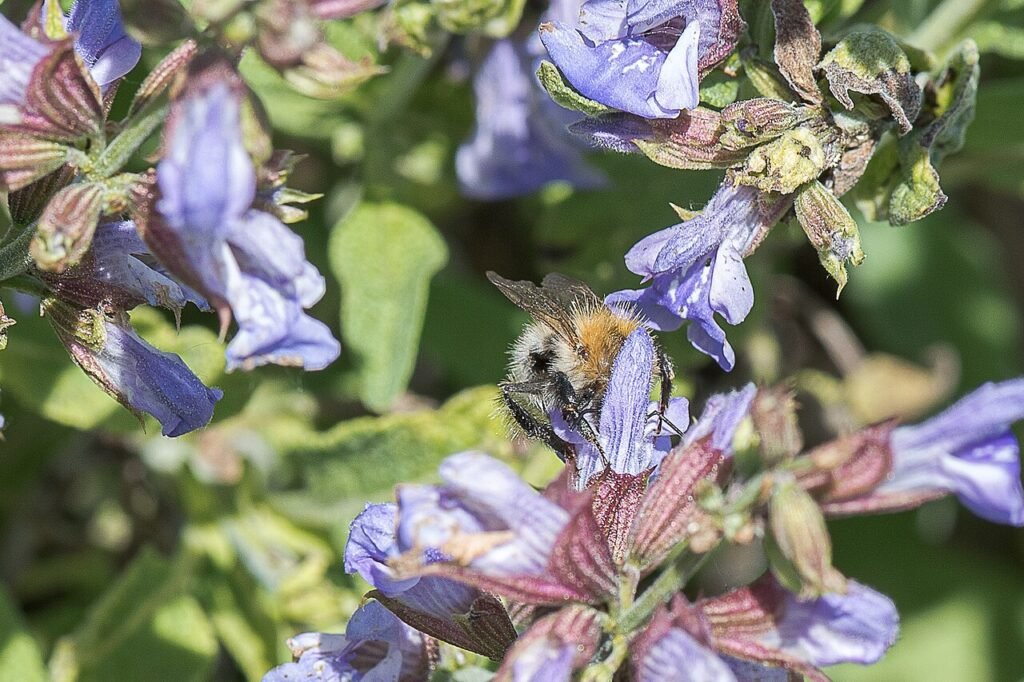
Quick answer: The most practical sage companions are thyme, rosemary, lavender and oregano in a sunny, freely draining herb garden, provided you allow their mature woody crowns to spread. Some seasonal flowers also fit a nearby border. Plants that demand constantly moist soil, such as tender basil and mint, are often easier to maintain in separate pots. No living sage plant should be treated as a guaranteed insect repellent.
“Sage” can refer to many plants in the genus Salvia. This guide focuses on culinary or common sage, Salvia officinalis, the aromatic herb used in cooking. Its preferred conditions are different from those of moisture-loving annual greens. A useful companion plan respects those cultural requirements instead of grouping herbs just because they smell strong or belong to the same family.
What culinary sage needs to thrive
Common sage prefers generous sunlight, well-drained soil and space for air to circulate around its leaves. Excessive moisture at the crown, heavy fertility and overcrowding can lead to weak growth or disease problems. The University of Minnesota Extension herb guide groups sage with herbs that tolerate heat and drier soils once established, while cautioning against soggy sites and overly rich growing media.
Sage often becomes a semi-woody shrub after several seasons. Its foliage can spread beyond the original transplant’s footprint, particularly in mild climates. A tightly planted “herb spiral” that looks balanced on day one may hide the central stems after a year. Allow room for cutting sprigs, removing damaged growth and evaluating drainage.
A sage companion chart based on growing conditions
| Potential partner | Shared benefit | Placement | What to watch |
|---|---|---|---|
| Thyme | Sun and relatively sharp drainage | Low sunny edge of sage border | Spreading cultivars can cover stems |
| Rosemary | Generally similar dry-herb management | Separate roomy pocket | Rosemary may mature much larger |
| Lavender | Sunny, well-drained soil and flowering interest | Adjacent border with air gap | Climate hardiness differs by cultivar |
| Oregano | Another hardy culinary herb | Perimeter or container | Can spread aggressively |
| Calendula | Seasonal flowers and insect resources | Open border beyond woody crowns | Different watering and seeding patterns |
| Basil | Convenient culinary harvest | Separate watered pot or annual patch | Usually needs more frequent moisture |
| Mint | Another aromatic harvest | Separate contained pot | Spreading roots and moisture needs |
Thyme: the easy foreground herb
Thyme provides a lower layer in a sunny culinary border. It can occupy the front edge while sage forms the taller center, as long as the thyme does not creep over the sage’s woody base. Both like soil that drains well and do not need lavish fertilizer under suitable conditions.

Look at the actual thyme cultivar before planting. Creeping types can cover a larger area than upright culinary thyme; some may be used as walkable ornamentals while others form dense mats. Keep a small gap for access and don’t treat a living groundcover as weed-free mulch beneath every shrub.
Rosemary and sage: similar preferences, different size
Rosemary and sage can be natural neighbors in a Mediterranean-style garden. The important variable is rosemary’s eventual height and width. Some rosemary varieties become significant shrubs, potentially shading a sage that began at the same size.
Grow both where you can prune without stepping on neighboring roots. They may require winter protection in colder regions, and not every sage or rosemary cultivar has identical hardiness. A pot arrangement gives more flexibility when one plant needs to move to shelter and the other can remain outdoors. See our rosemary companion guide.
Lavender: attractive, provided the soil drains
Lavender and sage can provide contrasting leaf shape and blooms. Their broadly similar preference for sun and good drainage makes the pairing easier than combining sage with wetland plants. But lavender dislikes prolonged wet conditions, so a soggy bed that damages lavender is also a warning sign for sage.
Keep both plants open around their crowns and follow local species-specific care. In humid climates, generous spacing is particularly useful. Our lavender companion planting guide explains how to accommodate thyme, rosemary and seasonal flowers in separate irrigated zones.
Oregano and flowering companions
Oregano is another culinary herb that can share a sunny border. However, vigorous forms may spread through rhizomes or creeping shoots. Once it establishes beneath sage stems, pulling it out may disturb sage roots. A separate planted pocket or container keeps maintenance easy.
Flowering sage can attract bees and other visitors. Adding calendula or locally adapted flowering plants beyond the woody herb bed increases the variety of blooms across the season. There is no need to squeeze them directly under sage leaves. Choose flowers for local soils, climate and bloom periods, not for unsupported claims that one species makes all insect pests disappear.
Why basil and mint are often better nearby than interplanted
Basil is a fast-growing tender herb that often needs regular moisture for leafy harvests. Sage prefers a more restrained watering pattern once established. Grouping the two in one small container makes it difficult to water appropriately, especially when summer weather changes.
Mint is more vigorous underground and can spread across a bed. Even though both are in the mint family, they are not necessarily good roommates. A mint pot beside the herb border provides culinary access without turning sage’s root space into a struggle. Compare the basil companion planting guide for maintenance differences.
Can sage grow next to cabbage, carrots or tomatoes?
Sage can share a larger garden with vegetable crops; physical separation does not prevent it from being part of a diverse planting. The concern is often moisture and mature size. Cabbage and tomatoes may need more water and soil fertility than established sage, and a tall tomato cage can shade a small sage bush.
Some companion charts claim sage always repels cabbage moths or carrot flies. A plant containing aromatic oils is not proof that its odor will protect neighboring vegetables in a field. Monitor actual pests and use appropriate barriers, rotation, sanitation or other evidence-based approaches. Our cabbage companion guide explains why row covers often provide more reliable protection from caterpillars.
How to keep sage productive and avoid woody, crowded stems
Harvest young leafy shoots regularly but avoid cutting deeply into old woody stems without active growth. Sage can decline if dense foliage remains wet or if it is allowed to become a tangled, unpruned clump. Selectively cut back soft growth, maintaining a shape that allows light and air into the plant. Time more extensive trimming for your climate and cultivar; do not prune hard immediately before severe freezing weather.
Watch this growing technique: This sage-specific growing lesson demonstrates watering, pruning and harvesting; those tasks determine how much room a nearby plant can reasonably occupy.
Video: Sage Growing Guide: Plant, Care, Prune, Harvest, & Dry, ReSprout.
Water new plants until their roots are established. Afterward, check the soil rather than watering every herb daily. Container-grown sage may need more frequent checking because pots dry out faster. Avoid heavy feeding that creates lush, weak growth at the expense of concentrated culinary foliage.
A small but practical herb-bed layout
In a sunny six-foot herb border, put a single sage plant in an accessible central pocket, with thyme at the front and either rosemary or lavender farther apart along one end. Maintain gaps for mature crowns and a clear pathway for harvesting. Keep moisture-demanding basil in a separate pot or irrigated patch next to the bed.
For patios, give each woody herb an appropriately sized container with drainage rather than packing all the herbs into one decorative barrel. The GardenVoila plant-spacing calculator helps visualize the different mature widths, but horticultural spacing should follow cultivar dimensions.
Free printable: the Year-Round Garden & Preserving Planner
Planting dates for 24 crops, monthly tasks, blanching times, canning safety numbers and a winter storage chart in one 8-page PDF. Enter your email to download it instantly and get our seasonal garden newsletter.
No spam. Unsubscribe any time. We never sell your email.
Frequently asked questions
What grows well with sage?
Thyme, rosemary, lavender and oregano are generally compatible in sunny, draining herb borders when spaced for adult size.
Can sage and basil share a planter?
They can grow near one another, but their watering preferences make separate containers easier to manage.
Is sage good for cabbage pests?
There is insufficient evidence that growing sage beside cabbage reliably controls caterpillars. Use monitoring and appropriate protection measures.
Will sage survive winter?
Hardiness varies by cultivar, climate, drainage and exposure; check region-specific guidance.
References and further reading
- University of Minnesota Extension — Growing herbs
- Penn State Extension — Growing herbs in the garden
- GardenVoila — Companion planting: what actually works
Featured photograph: Flocci Nivis · Wikimedia Commons · CC BY 4.0. Resized for web.


