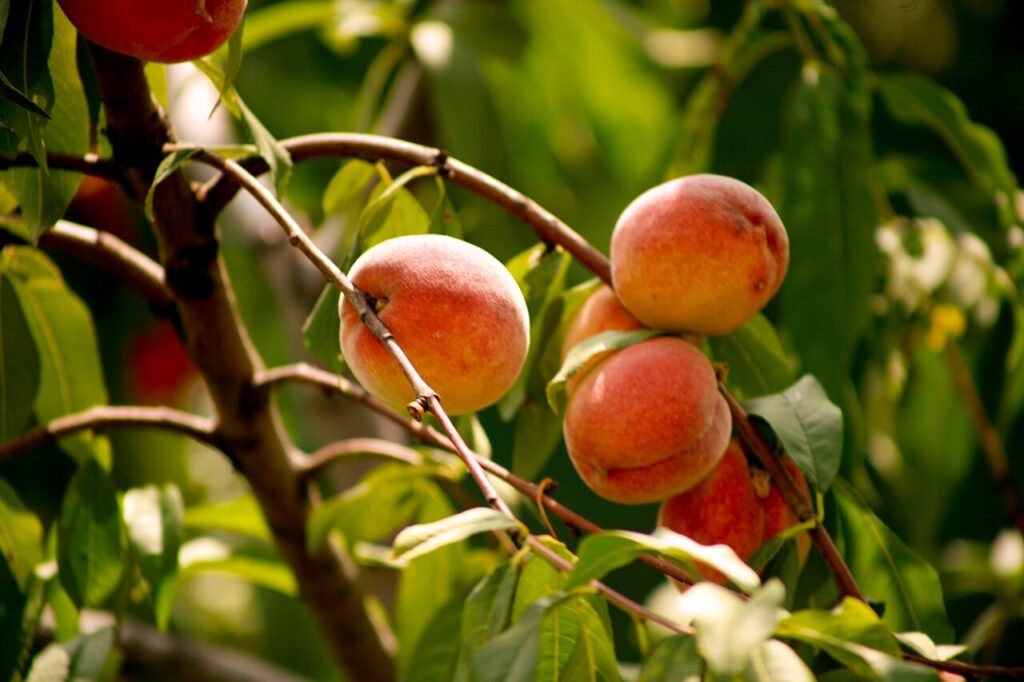
Peach trees (Prunus persica) are productive stone fruit trees with one big weakness: early blossom that late spring freezes can wipe out. Utah State Extension puts a typical tree at about 20 feet wide and 15 feet tall, with full sun (at least 8 hours) and well-drained soil, and says late spring freezes are the main cause of crop loss. Oklahoma State notes that bearing begins in year 3 and full production arrives by year 5.
Peach at a glance
| Type | Fruit |
|---|---|
| Season | Perennial |
| Sun | Full sun |
| Plant spacing | 168 in |
| Row spacing | 168 in |
| Per square foot | 1 per 100 sq ft |
| Seed depth | At surface |
| Days to maturity | Bearing begins in year 3, full production by year 5 |
| How to start | Plant a peach tree while dormant in full sun with good air drainage, keep the graft union above the soil, head it back to about 30 inches, train it to an open center, and thin fruit to about 6 inches apart |
| Water | 1 in per week |
These are the same numbers our plant spacing, square foot and harvest date calculators use. See every crop in the plant database.
When to plant peach
Utah State says to plant in early spring or fall, since summer planting is stressful; Oklahoma State plants bare-root trees in February to early March while they are dormant. Prune when dormant, usually February or March (Utah), or mid-February to early March (Clemson). Check your growing zone and your frost dates; chill-hour needs vary by cultivar (500 to 1,050 hours for the Utah-recommended cultivars).
How to plant peach
- Site: full sun, ideally a higher spot or gentle slope so cold air drains away; avoid low frost pockets (Oklahoma State) and the south or west side of buildings, which can bloom early (Utah).
- Soil: well-drained loam or sandy loam; improve heavy clay with organic matter or raised beds, and avoid lawns.
- Spacing: 12 to 16 feet apart (Utah); Oklahoma State gives 12 to 18 feet within rows. See the plant spacing calculator.
- Planting depth: plant at the same depth as in the nursery and keep the graft union above soil; deep planting causes poor growth or death. Dig holes for potted trees twice the root ball width.
- At planting: head the tree back to about 28 to 30 inches (Utah, Clemson).
Caring for peach
Watering: Utah State suggests about 30 inches of water per season; established trees get a deep soaking (18 to 24 inches deep) every 7 to 14 days using drip or soaker hoses rather than sprinklers. Water thoroughly after planting to remove air pockets. See the garden watering calculator.
Feeding: young trees should add 18 to 24 inches of new shoot growth a year; skip nitrogen if growth exceeds 24 inches. Test soil every 3 to 4 years.
Pruning: train to an open, vase-shaped center with 3 to 5 evenly spaced scaffold limbs (Clemson: 3 or 4, with wide crotch angles over 45 degrees). Prune yearly, because fruit grows on last year’s wood; keep fruiting wood about pencil-diameter and 12 to 18 inches long, and avoid heavy pruning, which reduces crop size (Clemson).
Thinning: hand-thin about four weeks after full bloom, spacing peaches about 6 inches apart on each limb (Clemson); Utah says thin to 1 to 3 fruit per lateral when fruit is golf-ball size. Excess fruit can break branches.
Pests and diseases: Utah lists coryneum blight (shot hole), cytospora canker, powdery mildew, peach twig borer, greater peachtree borer, aphids, spider mites, earwigs and gummosis, plus crown and root rots from overwatering or poor drainage and iron chlorosis on high-pH soil. Oklahoma State adds bacterial leaf spot and peach leaf curl. Follow product labels for any spray, and see the pest identifier.
Companion plants
| Grow nearby | Full sun, deep well-drained soil and open ground with good cold-air drainage; keep a 3 to 4 foot weed-free strip around young trunks (Oklahoma State) |
|---|---|
| Keep apart | Lawns, low frost pockets, the warm south or west side of buildings, and wet soil |
Most cultivars are self-fruitful; ‘J.H. Hale’ needs a different cultivar nearby (Utah). Check other pairings with the companion plant finder.
Common problems
| Problem | What you see | What to do |
|---|---|---|
| Blossoms or fruit lost to frost | No crop after a late spring freeze | Late spring freezes are the main cause of crop loss; choose a late-blooming cultivar and a site that drains cold air. |
| Broken branches | Limbs snap under heavy crops | Thin fruit to about 6 inches apart, about four weeks after full bloom. |
| Gum oozing from branches | Sap ooze, wilting or trunk damage | Gummosis, borers and root rots all cause this; improve drainage, avoid overwatering and see the pest identifier. |
Not sure what you are looking at? The plant problem identifier ranks likely causes from the symptoms you see.
When and how to harvest
Pick when the fruit changes color and is ripe for best flavor; Utah State says early cultivars ripen from mid-July into September, and expect 1 to 6 bushels per tree once mature. Store in a cool place for up to 2 weeks. Trees begin bearing in year 3 and reach full production by year 5 (Oklahoma State).
Plan your peach
- Plant spacing calculator: how many plants fit your bed
- Planting calendar: sowing and transplant dates for your frost dates
- Frost dates by ZIP code: your last spring and first fall frost
- Harvest date calculator: when your crop will be ready
Frequently asked questions
How far apart should I plant peaches?
Space peaches 168 inches apart in rows 168 inches apart. In a square foot garden, plant 1 per 100 sq ft.
How deep do I plant peach tree?
Plant at the same depth as in the nursery, with the graft union above soil.
How long do peaches take to grow?
Trees begin bearing in year 3 and reach full production by year 5; early cultivars ripen mid-July into September.
How much water do peaches need?
About 1 inch of water a week, from rain and watering combined. About 30 inches per season; deep soak every 7-14 days when established.
How far apart do I plant peach trees?
12 to 16 feet apart (Utah State); Oklahoma State gives 12 to 18 feet.
When do I thin peaches?
About four weeks after full bloom, spacing fruit about 6 inches apart on each limb.
Do I need two peach trees?
Most cultivars are self-fruitful; ‘J.H. Hale’ needs a different cultivar nearby.