Tomatoes are the crop most home gardeners start with, and for good reason. A few plants can fill a kitchen counter all summer, and a tomato picked ripe from your own vine tastes nothing like a supermarket one. They are also easy to get wrong. Planted too early, watered unevenly or crowded together, they stall, crack or catch disease. This guide covers the whole season: choosing a type, timing, planting, spacing, watering, harvest and ripening, with tools to work out the numbers for your own bed.
Everything here follows advice from US university extension services, which is the best source for how tomatoes behave in real home gardens. Your local county extension office can turn it into exact dates for your area, and the frost-date tool on this site gets you most of the way there.
Choose the right type of tomato
Two growth habits matter more than variety names, because they decide how you space, support and harvest the plants.
| Type | How it grows | Best for |
|---|---|---|
| Determinate (bush) | Grows to a set size, sets most fruit over a few weeks, then slows | Containers, small beds, and gardeners who want a batch to cook or preserve at once |
| Indeterminate (vining) | Keeps growing and fruiting until frost, often reaching 6 feet or more | Steady harvests all season, with a trellis, tall cage or stakes |
Beyond habit, think about how you will use the fruit. Paste types such as Roma have dense, meaty flesh and are the usual choice for sauce. Beefsteak types are large and slicing-friendly but need a long, warm season. Cherry types ripen early and heavily and are the most forgiving for beginners. The seed packet or plant tag lists days to maturity, and that number should be shorter than your frost-free season. See the plant database for typical spacing, depth and days to maturity.
Many gardeners also choose between hybrids and heirlooms. Hybrids often carry built-in resistance to common diseases, shown as letters on the tag, while heirlooms are valued for flavor but can be more fragile. Neither is better in every garden, and growing one of each is a good way to learn what suits your site.
When to plant tomatoes
Tomatoes are warm-season plants, and frost kills them. Extension guidance is consistent: set transplants outdoors only after the danger of frost has passed and the soil has warmed, with soil above about 60°F as a common benchmark. Planting earlier rarely gives you earlier tomatoes, because cold soil stunts roots and the plants stall until it warms.
- Starting from seed: sow indoors roughly 6 to 8 weeks before your last spring frost.
- Buying transplants: shop in the weeks before planting out and choose stocky, dark green plants without flowers or fruit already set.
- Hardening off: over about a week, move plants outside for a few hours a day and lengthen the time gradually. Skipping this step is a common cause of sunscald and transplant shock.
Work out your own dates with the frost date tool and the seed starting calculator, then check your result against your local extension calendar.
Where and how to plant
Sun and site
Tomatoes want full sun, which means at least 6 to 8 hours of direct light a day. Less sun means fewer, later fruit. Pick a spot with good air movement and avoid planting in the same bed where tomatoes, peppers, eggplant or potatoes grew the last year or two, since they share soil-borne diseases. Not sure how much light a spot gets? Try the sunlight requirement finder.
Soil
Tomatoes do best in well-drained soil rich in organic matter. University of Georgia Extension gives a target pH range of 6.2 to 6.8 and recommends a soil test through your county office to see what your soil actually needs, including whether lime is useful. Mixing compost into the bed before planting helps almost every soil type. Use the compost calculator or the raised bed soil calculator to work out how much to buy.
Planting depth
Tomatoes are unusual because they root along buried stem. Plant them deeper than they grew in the pot, with the lower leaves removed and only the top set of leaves above ground. Oklahoma State Extension suggests holes about 3 to 4 inches deep, filled with water before planting and the soil packed loosely around the roots. Remove pots or bands carefully, and loosen the root ball if it is tightly wound. Water in well after planting.
Spacing and support
Crowded tomatoes hold moisture on their leaves, which invites disease, and they are harder to harvest. Spacing depends on the type and how you train the plants. Extension sources describe in-row spacing from about 2 to 4 feet, and the plant database lists 24 inches between plants and 48 inches between rows as a typical starting point for staked plants. Caged or sprawling plants need more room, tightly trained single-stem plants can go closer.
- Cages suit determinate and shorter plants. Oklahoma State Extension notes that caged tomatoes do not need pruning.
- Stakes and trellises suit indeterminate plants, which you tie up as they grow.
- Pruning is optional but useful for staked plants. Our guide to pruning tomato plants covers which shoots to remove.
Put support in at planting time, not later, so you do not damage roots. To work out how many plants fit your bed, try the plant spacing calculator or the garden row calculator.
Watering and mulch
Consistent moisture is the single biggest factor in tomato success. University of Georgia Extension puts the need at roughly 1 to 2 inches of water a week, depending on soil type, and Iowa State Extension stresses even watering especially while fruit develops. When soil swings from dry to soaked, fruit can crack and the blossom ends can rot.
- Water deeply a couple of times a week rather than lightly every day.
- Water in the morning and apply it to the soil, not over the leaves. Wet foliage encourages disease.
- Spread a few inches of mulch once the soil has warmed. It slows evaporation, keeps soil temperature steadier and reduces soil splash onto the lower leaves.
- Containers dry out much faster than beds and may need water daily in hot weather.
The garden watering calculator and the drip irrigation calculator help you plan for your bed size. Not sure whether you are giving too much? Try the overwatering checker.
Feeding
Tomatoes are hungry plants, but more fertilizer is not better. Too much nitrogen gives lush leaves and few fruit. The safest approach is to follow your soil test, work compost into the bed before planting, and then follow the directions on any fertilizer label you use. If lower leaves turn yellow early in the season, check watering and soil first, because those are more common causes than a missing nutrient. The yellow leaf identifier walks through the likely causes.
Growing tomatoes in containers
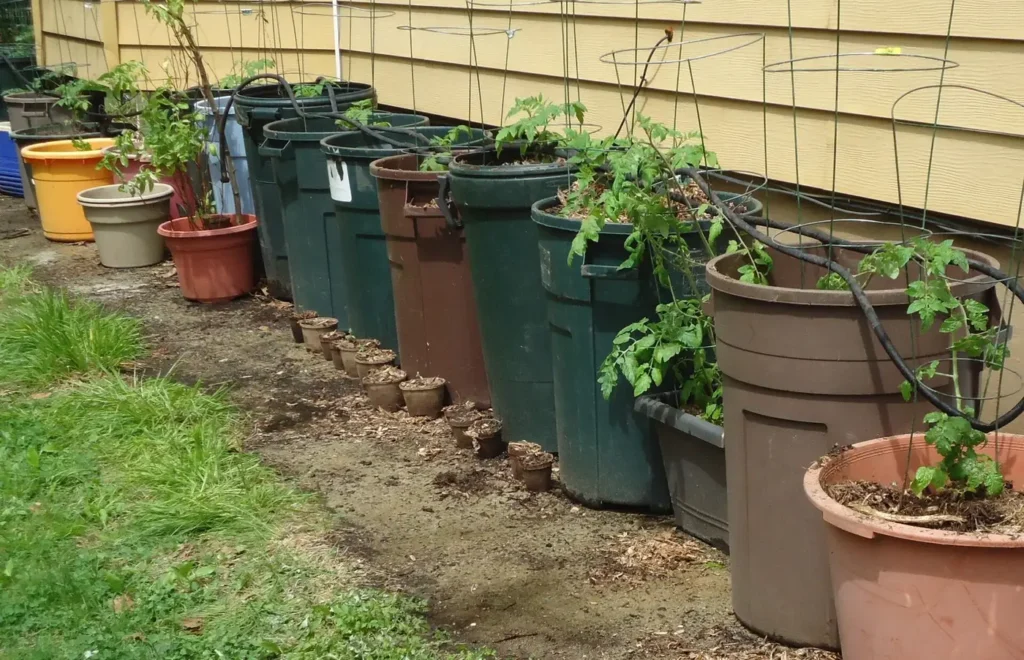
Tomatoes grow well in pots if the pot is large enough. Many extension guides suggest at least a 5-gallon container for a full-size plant, with drainage holes and fresh potting mix rather than garden soil. Choose determinate or compact varieties for small pots, add a cage or stake at planting, and check moisture daily. Our container garden planner and the guide to container vegetable gardening cover pot sizes and layouts.
Common tomato problems
Most tomato troubles come from a handful of causes: uneven watering, crowded plants, cold nights and wet leaves. Cultural fixes such as spacing, mulch, morning watering and rotating beds prevent more problems than anything you can spray. Our guide to common tomato problems explains leaf spots, blossom end rot, cracking and curling, and the plant problem identifier narrows down a specific symptom. If you decide a product is needed, follow the label exactly, since label directions are legal requirements.
When and how to harvest
Most varieties take about 60 to 85 days from transplanting to ripe fruit, though small cherry types are faster and big beefsteaks slower. Pick tomatoes when they are fully colored and slightly soft to a gentle squeeze. Use the harvest date calculator to estimate when your first fruit should ripen.
- Ripening off the vine: University of Georgia Extension notes that fruit picked at the mature green stage can ripen indoors at around 70°F. This is useful when frost is coming.
- Storing: Iowa State Extension says ripe tomatoes keep at room temperature for about 5 to 6 days, so pick what you will use that week.
- End of season: before the first frost, harvest all mature green and ripening fruit, since frost damages the plants and fruit alike.
How many tomato plants do you need?
A common rule of thumb is two to three plants per person for fresh eating, and more if you plan to make sauce or preserve. Yield varies widely with variety, weather and care, so treat any number as a planning estimate rather than a promise. The vegetable garden planner and the seed quantity calculator help you scale a bed to your household.
Temperature, flowering and fruit set
Ohio State University Extension’s Growing Tomatoes in the Home Garden gives numbers worth knowing. Blossoms drop without setting fruit when nights fall below 55°F (13°C) in early spring, or when days exceed 90°F (32°C) and nights stay above 75°F (24°C) in summer. Fruit ripens best at 68 to 77°F (20 to 25°C), and red colour does not form above 86°F (30°C), so fruit in a heatwave can turn yellowish-orange. Fruit takes about 40 to 50 days from set to mature green, and days to maturity on a seed packet are counted from transplanting, not sowing.
Planting details that raise yield
- Transplants: choose plants with 4 to 6 true leaves and pencil-thick stems, free of blossoms, fruit, pests and disease.
- Soil pH: the ideal range is 6.5 to 6.8; lime raises pH and elemental sulfur lowers it, but changes can take 3 to 6 months.
- Light: 6 to 8 hours of direct sun daily.
- Staked plants: 2 ft (60 cm) apart in the row, 3 to 4 ft between rows, with stakes at least 8 ft tall driven about 1 ft deep. Keep one main stem.
- Caged plants: 2.5 to 3 ft apart, 4 to 5 ft between rows; cage openings at least 6 by 6 inches. Caged plants do not need sucker removal.
- Water: about 1 to 1.5 inches (25 to 38 mm) per week in the morning, by soaker hose or drip; mulch with 2 to 3 inches of organic material in early June once soil warms.
- Topping: about a month before first fall frost, remove the top 4 inches of indeterminate plants so energy goes into ripening.
Feeding without overdoing it
Ohio State suggests a phosphorus-rich starter solution at transplanting, about 1 cup per plant, and 2 to 3 pounds of complete fertiliser per 100 square feet worked into the top 6 inches before planting, or whatever a soil test recommends, followed by a nitrogen sidedressing after the first fruit cluster sets. Excess nitrogen causes heavy vines with little fruit; too little gives slow growth and low yield. The same source warns never to use fertilisers containing herbicides in a vegetable garden. Staked plants can yield 8 to 10 pounds or more each.
Reading the disorders correctly
| Symptom | Cause (Ohio State) |
|---|---|
| Dry, sunken black patch at blossom end | Blossom-end rot: calcium shortage linked to cold soil, pH imbalance, water stress or excess nitrogen; most common on early fruit |
| Splits and cracks | Heavy water uptake after a dry spell, often in ripening fruit |
| Puckered, scarred blossom end | Catfacing: cool, cloudy weather at bloom, or herbicide damage |
Uneven watering is behind both blossom-end rot and cracking, which is why a steady, mulched, drip-watered bed solves most of them. Mature green tomatoes ripen indoors at 60 to 65°F; ripe ones keep 1 to 2 weeks at 50 to 55°F, and refrigeration ruins flavour and texture. Time your planting with the frost dates tool.
Safety and legal note: Read every fertiliser and pesticide label, and never use lawn products containing weed killers in a vegetable bed. Wash tomatoes before eating, and test soil for lead near old buildings or roads before growing food. Tomato leaves and stems are toxic if eaten. Rules on pesticide use vary by country and region.
A note on food safety
Tomatoes belong to the nightshade family. Eat the ripe fruit only, since the leaves and stems of tomato plants are not food. Wash tomatoes before eating, and follow current USDA guidance if you plan to can or preserve them, as safe processing depends on tested recipes.
Sources and further reading
For advice tailored to your soil and climate, your local Cooperative Extension office is always a good next step.
- Georgia Home Grown Tomatoes, University of Georgia Extension
- Growing Tomatoes in the Home Garden, Iowa State University Extension
- Growing Tomatoes in the Home Garden, Oklahoma State University Extension
Free printable: the Year-Round Garden & Preserving Planner
Planting dates for 24 crops, monthly tasks, blanching times, canning safety numbers and a winter storage chart in one 8-page PDF. Enter your email to download it instantly and get our seasonal garden newsletter.
No spam. Unsubscribe any time. We never sell your email.
Frequently asked questions
When can I plant tomatoes outside?
After the danger of frost has passed and the soil has warmed, with about 60°F soil a common benchmark. For most of the US that is a few weeks after the last spring frost date.
How far apart should tomato plants be?
Extension sources suggest about 2 to 4 feet between plants, depending on the type and support. Staked plants can sit closer than sprawling or caged ones.
How much water do tomatoes need?
Roughly 1 to 2 inches a week including rain, depending on soil type. Water deeply and regularly rather than lightly and often.
Should I bury the stem when planting?
Yes. Tomatoes grow roots along buried stem, so planting deeper than the pot level gives a stronger root system. Remove the lower leaves and bury that part of the stem.
Why are my tomatoes cracking?
Cracks usually follow a dry spell broken by heavy watering or rain. Steady watering and mulch reduce the swings.
Can green tomatoes ripen indoors?
Fruit picked at the mature green stage can ripen indoors at about 70°F. Fruit that is small, hard and dark green when picked will not ripen well.
Can I grow tomatoes in a pot?
Yes. Use a container of at least 5 gallons with drainage holes, fresh potting mix and a cage or stake, and expect to water daily in hot weather.
Photo: Tomwsulcer, CC0, via Wikimedia Commons
