
Quick answer: An asparagus companion should not compete with asparagus crowns or interfere with cutting spears and managing ferns. A separate flowering border, accessible paths and, in larger plantings, a managed between-row cover crop are more reliable than densely interplanting tomatoes, strawberries or herbs over the crowns. Keep the asparagus row weed-free and allow the mature fern canopy to develop after harvest.
Most vegetable-garden companion charts treat every plant as though it grows for one season. Asparagus (Asparagus officinalis) is different: a healthy planting can occupy the same ground for many years. Its underground crowns store the resources needed to produce next spring’s shoots. A neighbor that seems harmless at planting time could gradually establish roots in the asparagus row and make future weeding difficult.
Why an asparagus bed needs a different companion plan
Asparagus is harvested in early spring while shoots are young. After the cutting season, its shoots develop into tall, airy ferns that replenish carbohydrates for the following year. The ferns are not disposable weeds; cutting them prematurely can weaken future crops. University of Minnesota Extension emphasizes weed control, moisture, crown protection and letting the foliage grow after harvest.
Unlike an annual bed that can be dug over after harvest, an asparagus patch is a permanent root zone. That makes it poor space for potatoes, vigorous groundcovers or any plant that needs to be pulled or divided deeply every season. Companion planting here should help you manage the edges rather than fill every square inch.
Asparagus companion planting comparison
| Potential neighbor | Best use | Where to grow it | Watch for |
|---|---|---|---|
| Sweet alyssum | Small flowers used by beneficial insects | Sunny border outside the crowns | Will struggle beneath dense mature ferns |
| Calendula | Seasonal blooms and insect habitat | End of the bed or nearby container | Self-seeding may complicate weed control |
| Chives | Perennial culinary herb and flowers | Separate pathside clump | Avoid digging around asparagus roots to divide clumps |
| Lettuce | Early spring harvest from nearby space | Adjacent annual row, not above asparagus crowns | Mature ferns cast shade later |
| Tomatoes | Another crop in a larger garden | Separate summer vegetable bed | Competing roots and lost access if intertwined |
| Strawberries | Fruit harvest | Separate perennial bed | Runners can colonize asparagus rows |
| Managed grass/cover crop | Control erosion in large plantings | Between widely separated rows | Must not invade the asparagus crown zone |
What makes a good asparagus neighbor?
A good neighbor stays in its assigned place and leaves asparagus tasks easy: cutting spears without trampling stems, removing weeds before they establish, watering the crowns, and tending the ferns after harvest. Flowering companions are particularly useful when grown in a separate border where they can receive sun throughout the season. The function is garden diversity, not a claim that blossoms magically increase spear size.
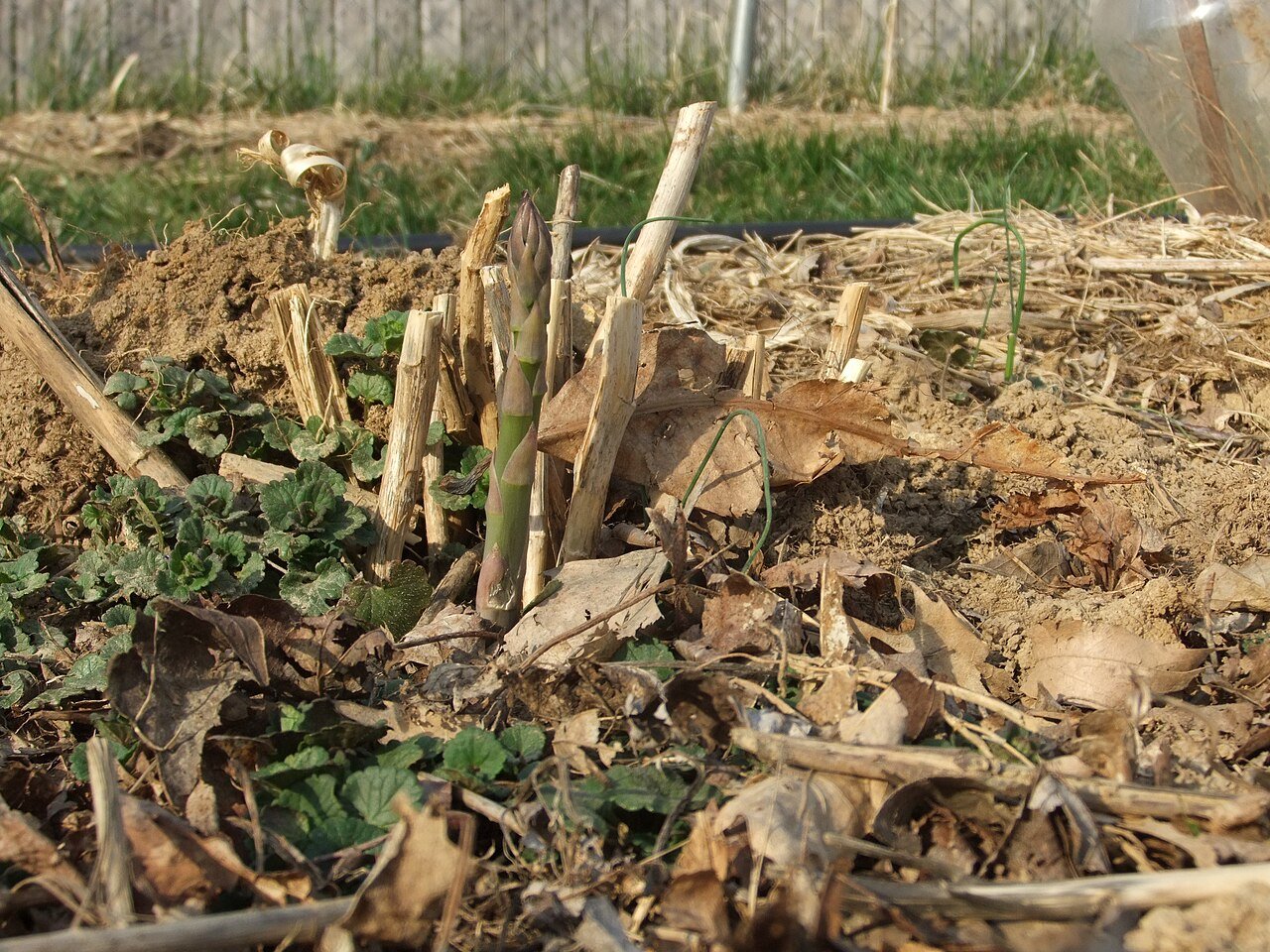
Asparagus has both shallow feeder roots and deeper storage roots. Hoeing too deeply damages crowns and young shoots, so establishing a perennial companion inside the asparagus row creates a conflict: the neighbor eventually needs thinning, lifting or division. Gardeners often get a healthier planting by mulching access paths and keeping the crop row free of other permanent roots.
Should you plant tomatoes beside asparagus?
You will see a popular claim that asparagus repels tomato nematodes and tomatoes repel asparagus beetles. Those claims are often repeated as a mutual-protection rule without clear field evidence for a home garden. Tomatoes also need large root volumes and supports that can become difficult to remove without damaging nearby asparagus.
If you have room, there is no need to ban tomatoes from the whole garden. Position them in an annual bed across a path from asparagus and give them full sun. If you want to test a closer arrangement, retain enough separation to manage each crop independently, and do not treat any single herb or tomato plant as a replacement for beetle monitoring.
Read the tomato companion guide for the tomato’s disease and spacing needs. The relevant question is not whether two plant names are listed as “friends”; it is whether their harvest cycles and root systems can coexist.
Strawberries and asparagus: why separate beds are easier
Strawberries can spread by runners, forming a dense rooted mat. That is productive in a well-managed strawberry patch, but a poor outcome in an asparagus row that needs clear emerging-spears access. Strawberry beds also undergo renewal and runner thinning; those operations can disturb crowns if they are interwoven.
Use a nearby strawberry row with its own mulch, watering line and renewal schedule. It can share the wider orchard or vegetable garden without sharing asparagus roots. The strawberry companion guide explains the separate issue of runner management and fruit rot.
Flowering herbs along the border
Chives, calendula and alyssum can be grown along an accessible perimeter rather than under ferns. The benefits are straightforward: more bloom types, another edible herb and visually defined edges. Some flowers offer nectar or pollen used by beneficial insects, but the effect on asparagus beetle damage will vary with local insects and habitat.
Do not plant chives so close that digging to divide the clump risks asparagus roots. A pot or narrow raised border is a simple way to maintain the association without creating a tangled underground planting. If a flower self-seeds into the crowns, remove the young volunteers while they are small.
Weed control beats a dense living mulch
Weeds draw on soil moisture and nutrients intended for the crop. University of Minnesota Extension’s weed-management review explains why perennial weeds are especially difficult in asparagus: the planting cannot be repeatedly tilled, and control windows are narrow. Hand removal is often safest inside the rows.
Straw and leaf mulch can help suppress weeds but may keep soil cool in spring, delaying emergence. Pull mulch back from rows as soil warms when local conditions require it. Some larger farms grow managed cover crops between separate asparagus rows, but this is not a license to plant aggressive grass directly over crowns.
How to establish an asparagus bed and protect the crowns
Choose a sunny, well-drained, weed-free position and prepare the soil before setting crowns or seedlings. The full-sized fern canopy should not shade a nearby crop that needs summer sunlight. Mark rows so emerging shoots are never mistaken for weeds or damaged during spring bed preparation.
Watch this growing technique: The University of Maine Cooperative Extension demonstrates crown placement. Watch the planting process before deciding how close any companion may come.
Video: Planting Asparagus, The University of Maine.
After establishment, follow the harvest schedule suitable for the age of the planting. Newly planted asparagus needs time to build reserves; extensive harvesting too early can weaken it. During harvest, cut or snap spears according to recommended practice and avoid digging deeply around crowns. Then allow the ferns to develop and remain healthy until they naturally die back.
Keep a watering route available even when the ferns are tall. In dry weather, consistent water supports the growing crowns. The University of Minnesota growing guide discusses weekly water needs and cautions about deep cultivation. Use the GardenVoila watering calculator as a planning aid, adjusting for soil, weather and plant maturity.
An asparagus bed layout for a home garden
For a narrow home bed, make asparagus the only crop within the central growing row. Add a reachable path along one side, and place small flowering plants along the opposite outer boundary or in pots. If you have a second annual vegetable bed, grow spring greens or summer tomatoes there rather than interweaving roots.
In a larger garden, establish asparagus rows with enough separation for both mature fern size and harvesting access. Between-row vegetation may be managed differently from the crown strip. The goal is a design you can keep weeded for years, not a crowded first-year photograph.
Free printable: the Year-Round Garden & Preserving Planner
Planting dates for 24 crops, monthly tasks, blanching times, canning safety numbers and a winter storage chart in one 8-page PDF. Enter your email to download it instantly and get our seasonal garden newsletter.
No spam. Unsubscribe any time. We never sell your email.
Frequently asked questions
Is tomato a good asparagus companion?
It can grow nearby with space, but the classic pest-repelling claims are not a substitute for evidence-based monitoring. A separate bed is usually simpler.
Can strawberries grow under asparagus ferns?
They may survive in some settings but compete for root space and need runner management. Dedicated beds are more practical.
Should I grow flowers between asparagus crowns?
Keep the crowns accessible and weed-free. Grow flowers at the edges or in containers rather than forcing permanent roots into the row.
Is asparagus better with mulch or a living groundcover?
For the immediate crop row, weed control is important. Mulch and inter-row covers each have applications, but the correct choice depends on climate and spacing.
References and related guidance
- University of Minnesota Extension — Growing asparagus
- University of Minnesota Extension — Weed management in asparagus
- GardenVoila — Plant-spacing calculator
Featured photograph: Vmenkov · Wikimedia Commons · CC BY-SA 3.0. Resized for web.


