
Quick answer: The most practical companions for lemon, lime and orange trees are compact flowering plants in a separate nearby border, not crops planted tightly against the trunk. Citrus roots need water, nutrients and oxygen, and young trees are especially vulnerable to turf-grass and weed competition. Keep the immediate root and trunk area accessible, choose flowers for your climate and avoid plants requiring frequent digging or excessive irrigation.
Many “citrus guild” diagrams show a fruit tree surrounded by a dense carpet of herbs, flowers and vegetables. But an orange tree in a humid subtropical garden, a lemon planted in dry California soil and a dwarf lime in a pot do not share identical environmental needs. The term companion plant should describe a useful, manageable neighbor—not suggest that planting basil automatically cures citrus leaf miner or that marigolds replace disease care.
Why citrus needs a separate root and trunk zone
Citrus roots spread beyond the trunk and often beyond the canopy edge. Turf grass and vigorous weeds compete for nutrients and irrigation, particularly while trees establish. UF/IFAS citrus landscape guidance recommends removing sod and weeds beneath the tree, especially near the trunk. Its lemon-growing guide advises keeping an area around the trunk grass-free to prevent mower injury and root competition.
Because trunk and root rot can be serious problems, irrigation should not continually wet the bark. Mulch practices vary by region: some Florida Extension material is cautious about mulching citrus, while other university guidance recommends it when managed correctly and kept well away from the trunk. Follow your local climate and disease guidance, not a universal mound of mulch placed against the trunk.
Citrus companion plants compared
| Neighbor | Potential role | Placement | Primary caution |
|---|---|---|---|
| Native flowering perennials | Provide insect resources beyond citrus blossom time | Sunny border outside tree root zone | Verify local climate and invasiveness |
| Sweet alyssum | Small flowers for certain beneficial insects | Bright perimeter strip | May struggle in deep canopy shade |
| Calendula | Seasonal flowers | Separate annual flowerbed | Do not block pruning/harvest access |
| Chives | Compact edible herb and blossoms | Outer edge or independent container | Not proven control for citrus leaf miner |
| Basil | Convenient warm-season culinary herb | Separate irrigated patch or pot | Water and light needs may differ |
| Rosemary or thyme | Low-water aromatic herbs in sunny climates | Separate dry border, not same wet zone | Drainage and irrigation incompatibilities |
| Turf or aggressive groundcover | Little advantage by young citrus roots | Keep away from trunk zone | Competition, disease and mower damage |
Flowers for a citrus pollinator border
Citrus blossoms can attract insects, but pollination requirements differ among citrus types and cultivars. Some can produce fruit without cross-pollination, while others benefit from particular pollination conditions. A flower border is therefore best considered a way to support the wider insect community, not a guarantee of greater citrus yield.
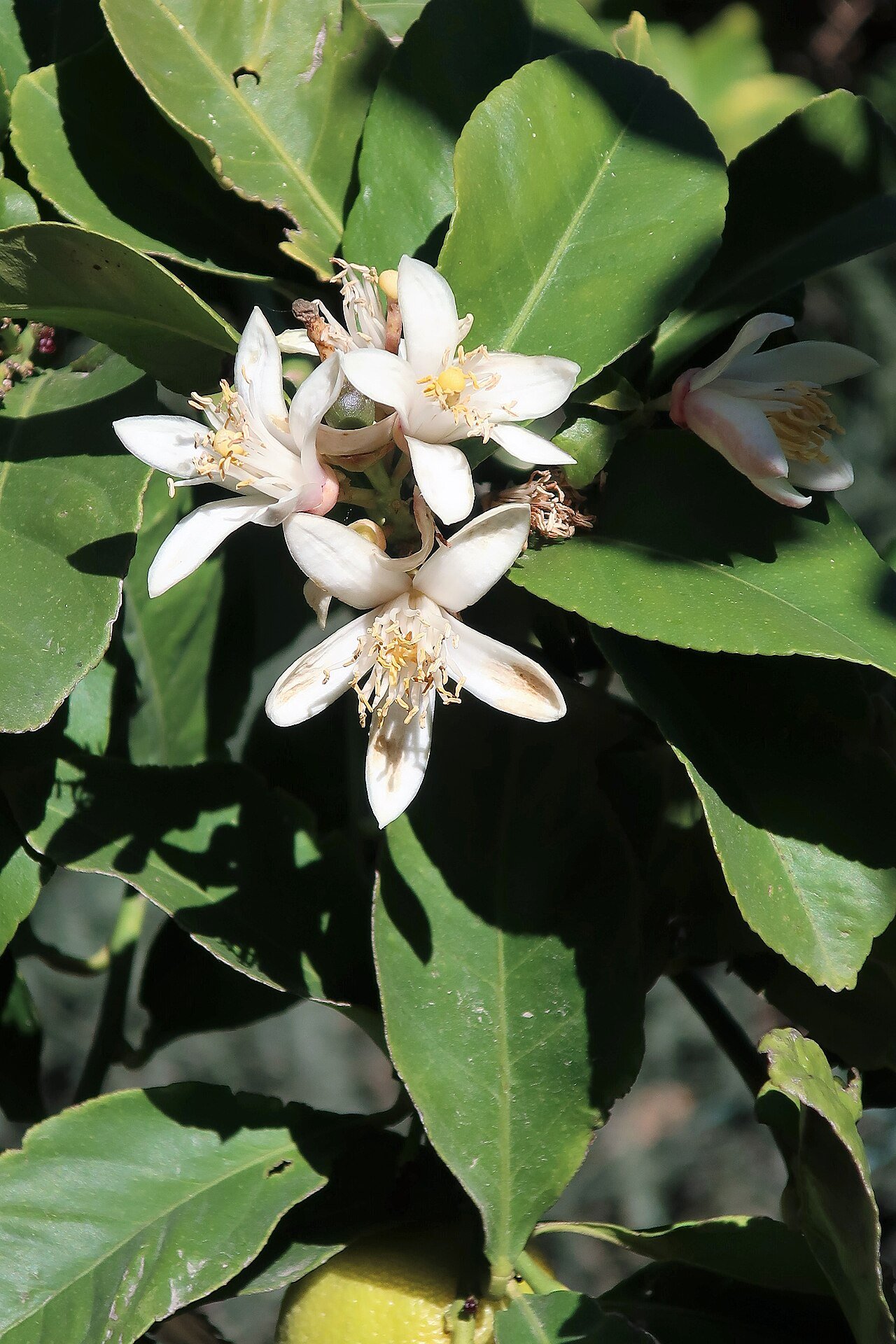
Choose flowers that open outside the citrus bloom season as well as during it, avoiding species that are invasive in your region. Place them in sunlit zones where the tree won’t shade them heavily. Dense growth beneath the canopy can obstruct fallen-fruit cleanup and monitoring for pests.
If you wish to support helpful insects throughout the year, include a range of locally adapted flowering plants, protect nesting habitat where practical and avoid unnecessary pesticide use when plants are blooming. Monitor the tree’s actual pests instead of relying on the presence of flowers alone.
Can basil, rosemary, chives and lavender grow beside citrus?
Yes—nearby is often easier than interplanted. Basil likes warmth and regular moisture for tender leaves. Rosemary, thyme and lavender often prefer sharper drainage and less frequent watering after establishment. Chives can form modest clumps. All can be grown in separate beds or pots near a citrus tree when local climate permits.
Do not put drought-adapted herbs inside a constantly irrigated citrus basin just to satisfy a companion chart. If watering one group harms the other, separate the root zones. Try the basil companion guide and lavender companion guide for crop-specific conditions.
Can you plant vegetables beneath orange or lemon trees?
It depends on sunlight, root competition, irrigation and how close the vegetable bed is to the trunk. A young citrus tree may initially leave sunny open space that eventually becomes shaded as the canopy expands. The area around its roots should remain accessible for watering, fertilizing and trunk monitoring.
For leafy vegetables or radishes, a separate raised bed outside the tree’s immediate root zone usually offers greater control. Tomatoes and peppers may require sun and irrigation patterns that conflict with the tree’s space and care. Root vegetables that need deep digging can damage fine roots or irrigation tubing.
A fruit tree in a large yard can share the landscape with vegetables without the crops sharing the same planting hole. Separating zones is not a failure of companion planting; it is a functional design.
Citrus mulching: why some guides disagree
Extension recommendations can differ because climate and disease risks differ. UF/IFAS lemon-growing guidance describes appropriate mulching while keeping material away from the trunk; the broader UF/IFAS citrus landscape guide emphasizes caution with mulches and trunk moisture. University of California IPM warns that deep planting and standing water against the trunk encourage root and crown disease.
In every case, avoid piling wet organic matter against the trunk, burying the graft union or creating a permanently soggy basin. Keep weeds controlled and follow a watering plan for your soil and weather. The best ground treatment is the one that protects roots without increasing disease risk.
A simple citrus companion planting layout
Step 1: Assess the tree. Identify whether it is a dwarf container citrus, young in-ground sapling or mature spreading tree. Account for the full root and canopy footprint.
Step 2: Preserve an open trunk area. Remove competing grass and weeds near the trunk without damaging roots. Keep irrigation off bark as much as practical.
Step 3: Create a separate flower strip. Put native flowering plants, alyssum or calendula along a sunny path or bed edge. Do not bury the citrus root zone under a thick mat of living roots.
Step 4: Add culinary herbs in their own pockets. Use a container for rosemary or basil when their watering needs differ from the citrus. This also makes it easier to change the layout as the tree grows.
Step 5: Maintain access. Leave enough room for picking citrus, inspecting leaves, managing irrigation and removing fallen fruit.
Use GardenVoila’s watering calculator for an estimate, then adapt it to local conditions and tree age. For related fruit-tree design ideas, see the apple tree guild and peach companion guides—but remember their climate and disease requirements differ from citrus.
Citrus pests are not solved by magical companion plants
Common citrus problems include leaf miners, scales, mites, root diseases and nutrient deficiencies, depending on location. Their causes vary. A fragrant herb planted beneath the tree should not replace pest identification or proper treatment.
For example, if young leaves are distorted by mines, identify citrus leafminer and follow GardenVoila’s citrus leafminer guide rather than assuming that a ring of chives will deter the larvae. For yellow leaves, check irrigation, soil nutrition and environmental stresses before assuming an insect is responsible.
Free printable: the Year-Round Garden & Preserving Planner
Planting dates for 24 crops, monthly tasks, blanching times, canning safety numbers and a winter storage chart in one 8-page PDF. Enter your email to download it instantly and get our seasonal garden newsletter.
No spam. Unsubscribe any time. We never sell your email.
Frequently asked questions
What plants are good near a lemon tree?
Compact flowers in a separate sunny border and appropriately grown culinary herbs in pots can fit well. Keep the trunk and main root area free of aggressive competition.
Can citrus grow with lavender?
They can occupy adjacent soil zones or separate pots. Their water and drainage needs may differ, so avoid forcing them into the same saturated root area.
Do marigolds repel citrus pests?
There is no reliable universal evidence that a few marigolds control all citrus pests. They may be useful flowers, but tree-specific monitoring and management remain essential.
Should I plant groundcovers under orange trees?
Be cautious, especially near young trees. Grass and vigorous groundcovers can compete for water and nutrients. Manage the orchard floor according to climate and local citrus Extension advice.
Do citrus trees need pollinator companions?
Requirements differ by cultivar; many citrus varieties fruit without a separate pollenizer. Choose companions for overall habitat and site fit rather than assuming a nearby herb is required for fruit set.
The bottom line
Keep citrus companion planting simple: protect the tree’s roots, trunk, light and irrigation first. Put optional flowering plants in a nearby border and herbs in their own suitable soil. Healthy citrus depends more on site, cultivar, water and pest management than on a supposedly perfect companion combination.
Research and further reading
- UF/IFAS: Citrus culture in the home landscape
- UF/IFAS: Lemon growing in the Florida landscape
- University of California IPM: Planting citrus
- University of Maryland Extension: Growing dwarf citrus
Featured photo: Jeevan Jose / Wikimedia Commons, CC BY-SA 4.0. Resized for web display.


