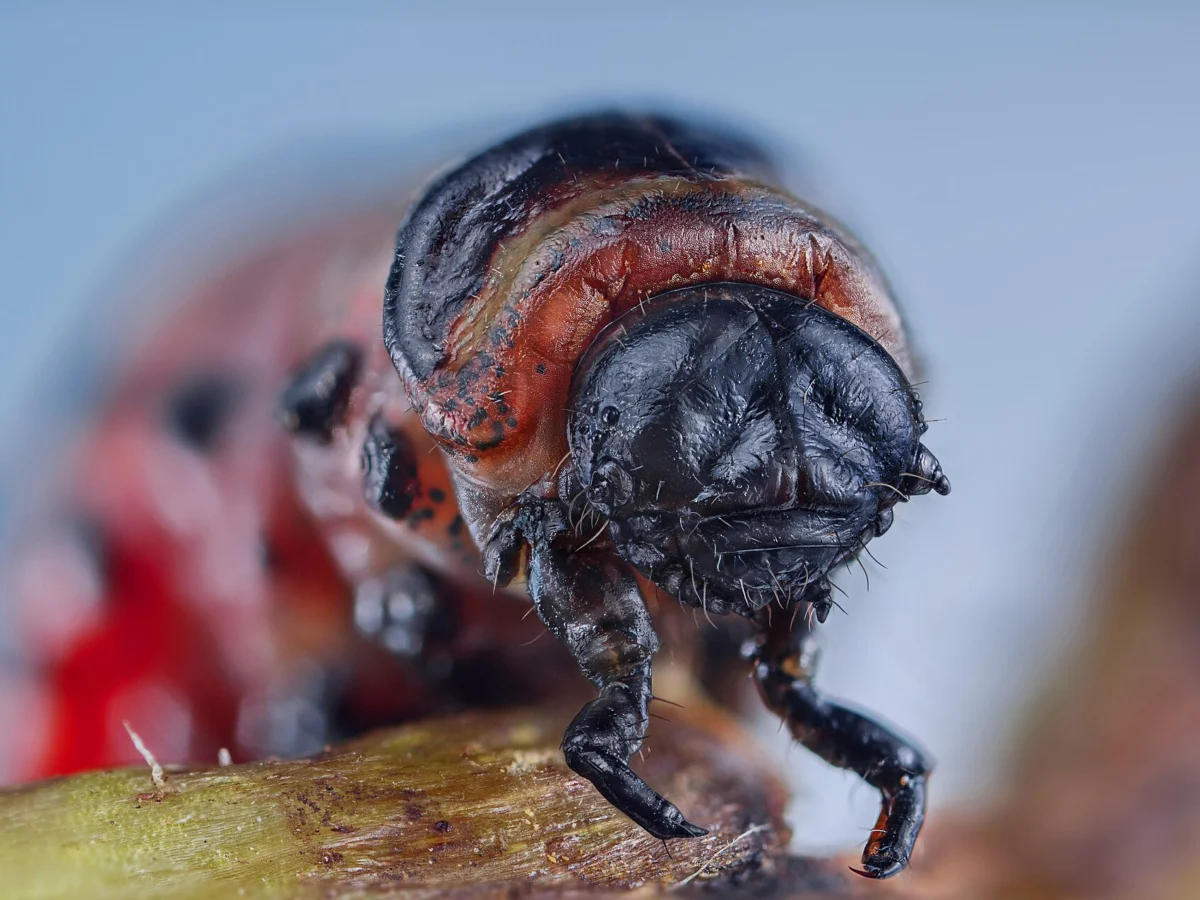
The Colorado potato beetle is a rounded, yellow-orange beetle with ten black stripes on its wing covers that, along with its humpbacked red-orange larvae, can strip potato, eggplant and tomato plants of their leaves. It is famous for developing resistance to almost every insecticide used against it, so home gardeners get the best results from non-chemical methods: rotate potatoes as far as possible from last year’s planting, cover young plants with row cover, handpick adults, larvae and the clusters of yellow-orange eggs on leaf undersides every few days, mulch with straw, and, when needed, use a spinosad or Bacillus thuringiensis var. tenebrionis product labeled for young larvae.
Colorado potato beetle profile
| Stage | Appearance | Where |
|---|---|---|
| Eggs | Bright yellow-orange, oval, in clusters of about 20 to 40, standing on end | Undersides of leaves |
| Young larvae | Dark red with black heads, soft and humpbacked | Feeding together near hatched eggs |
| Older larvae | Orange-pink with two rows of black spots on each side, up to 1/2 inch | Throughout the plant, eating leaves |
| Pupae | Orange, in the soil | A few inches deep |
| Adults | About 3/8 inch, dome-shaped, yellow-orange with ten black stripes | On foliage; overwinter in soil |
What is the Colorado potato beetle?
The Colorado potato beetle, Leptinotarsa decemlineata, originally fed on wild buffalo bur in the Rocky Mountain region. When settlers began growing potatoes across North America in the 1800s, it switched hosts and spread rapidly east, then to Europe and Asia. The Wikipedia article on the Colorado potato beetle recounts this history and its notorious ability to develop resistance to insecticides, sometimes within a few years of a new product’s introduction. The University of Minnesota Extension guide to the Colorado potato beetle explains that both adults and larvae feed on leaves and that larvae cause most of the defoliation.
What damage does the Colorado potato beetle cause?
- Chewed, ragged leaves that can be stripped down to bare stems.
- Reduced tuber yields: potatoes can tolerate some early leaf loss, but heavy defoliation during tuber bulking, around flowering, cuts yields sharply.
- Dead or stunted eggplants, which are especially attractive and less tolerant than potatoes.
- Damage to tomatoes and peppers in some areas, though these are less preferred.
- Black, sticky frass on leaves where larvae feed.
What is the Colorado potato beetle life cycle?
Adults spend the winter buried several inches deep in the soil of fields and gardens where potatoes or related plants grew, or in nearby hedgerows. In spring, as soil warms, they emerge and walk or fly to the nearest potatoes, often arriving just as plants break the surface. Females can lay hundreds of eggs over several weeks in clusters on leaf undersides. Eggs hatch in four to ten days, and larvae feed for two to three weeks, growing through four stages before dropping to the soil to pupate. New adults emerge about one to two weeks later. There are one to three generations a year depending on climate, and summer adults of the last generation burrow into the soil to overwinter.
| Timing | Stage | What to do |
|---|---|---|
| Spring emergence | Overwintered adults walk in | Rotate; row covers; trench barriers; handpick |
| Late spring | Egg clusters | Crush eggs on leaf undersides |
| Early summer | Young larvae | Handpick; Bt-tenebrionis or spinosad if needed |
| Midsummer | New adults; second generation | Continue checks; straw mulch |
| Fall | Adults burrow to overwinter | Clean up vines; plan next year’s rotation |
How do you get rid of Colorado potato beetles?
- Handpick every few days. Shake or pick adults and larvae into a bucket of soapy water. Hold the bucket under the plant, because adults drop when disturbed.
- Crush egg masses. Turn over leaves and squash the bright yellow-orange clusters, or remove the leaf.
- Vacuum. A handheld or shop vacuum removes many beetles and larvae from plants quickly in larger plantings.
- Use targeted products on young larvae. Spinosad products and Bacillus thuringiensis var. tenebrionis (also called san diego) work best on small larvae. Neem-based products can reduce feeding. Follow labels and rotate products to slow resistance.
- Protect natural enemies by avoiding broad-spectrum insecticides, which rarely work well against this beetle anyway.

How do you prevent Colorado potato beetles?
The University of Illinois Extension guide to Colorado potato beetle emphasizes crop rotation, early detection and handpicking as the foundation of control in home gardens.
- Rotate as far as possible. Overwintered adults often walk to the nearest potatoes, so planting at least a few hundred feet from last year’s potato, tomato or eggplant bed, if you have space, can delay infestation significantly.
- Use row covers on potatoes and eggplants from planting until late spring, or all season for eggplants, which need no pollination by insects for fruit set in most varieties but benefit from occasional uncovering in bloom.
- Mulch with straw after plants emerge. Studies have found that a thick straw mulch reduces beetle numbers, likely by making it harder for adults to find plants and by sheltering predators.
- Dig trench barriers: a plastic-lined trench around the potato patch traps walking adults in spring.
- Plant early-maturing varieties so tubers bulk up before beetle populations peak.
- Remove volunteer potatoes and nightshade weeds that feed beetles between seasons.
- Clean up vines after harvest.
Label note: Use only insecticides labeled for Colorado potato beetle on your crop, follow the label and pre-harvest interval, and rotate products with different modes of action to slow resistance. Apply spinosad and other bee-toxic products in the evening, and never spray flowering plants when bees are present.
Which natural enemies eat Colorado potato beetles?
| Natural enemy | How it helps |
|---|---|
| Spined soldier bug | Predatory stink bug that spears larvae and adults |
| Two-spotted stink bug | Feeds on larvae |
| Lady beetles | Eat eggs and young larvae |
| Ground beetles | Eat larvae and pupae in the soil; favored by straw mulch |
| Tachinid flies | Parasitize larvae and adults |
| Edovum puttleri | Tiny wasp that parasitizes eggs |
| Birds and toads | Eat adults and larvae |
Natural enemies rarely keep this beetle below damaging levels on their own, but they help, especially when combined with handpicking and mulch.
How much damage can potatoes tolerate?
Potatoes are surprisingly tolerant early in the season. Plants can lose a fair amount of leaf area before flowering without much effect on yield, but defoliation during and after flowering, when tubers are bulking up, reduces yields significantly. Late in the season, as plants naturally die back, damage matters little. That means your efforts are most valuable from emergence through flowering. Eggplants are much less tolerant at all stages and are often the first crop beetles destroy. See how to grow tomatoes for nightshade care and the harvest date calculator to estimate when potatoes will mature.
Why is the Colorado potato beetle so hard to kill?
This beetle has developed resistance to more than 50 insecticides worldwide, including several major chemical classes, through a combination of rapid reproduction, multiple generations and a biology adapted to detoxifying plant chemicals from the nightshade family. Commercial growers use careful rotations of insecticides with different modes of action. For home gardeners, that history is a strong argument for physical and cultural methods, which beetles cannot become resistant to.
Colorado potato beetle on eggplants and tomatoes
Eggplants are a favorite host, sometimes preferred over potatoes. Young eggplant transplants can be killed in days, so cover them with row cover at planting and keep them covered until plants are large and flowering. Tomatoes are less preferred but can be attacked when beetle numbers are high or potatoes are not available. For other pests on these crops, see our guides to tomato hornworms and flea beetles.
Still not sure what you are looking at? Compare symptoms in the plant pests and diseases library.
Free printable: the Year-Round Garden & Preserving Planner
Planting dates for 24 crops, monthly tasks, blanching times, canning safety numbers and a winter storage chart in one 8-page PDF. Enter your email to download it instantly and get our seasonal garden newsletter.
No spam. Unsubscribe any time. We never sell your email.
Colorado potato beetle FAQ
What do Colorado potato beetle eggs look like?
Clusters of 20 to 40 bright yellow-orange, oval eggs standing upright on leaf undersides.
What is the fastest way to kill potato beetles?
Knocking them into soapy water; vacuuming works well for larger numbers.
Do Colorado potato beetles bite?
No, they are harmless to people and pets.
Does neem oil kill potato beetles?
Neem can reduce feeding and affect young larvae, but it rarely gives full control.
Where do potato beetles come from?
Adults overwinter in the soil and emerge in spring to find potatoes.
Do potato beetles eat peppers?
Occasionally, but peppers are much less preferred than potatoes and eggplant.
Which potato varieties suffer less from potato beetles?
No common potato variety is truly resistant, but early-maturing varieties such as Irish Cobbler, Norland, Yukon Gold and Caribe often escape the worst damage because tubers bulk up before beetle populations peak in midsummer. Varieties with dense, hairy foliage, and some wild-relative-derived lines bred for resistance, are less attractive to feeding beetles but are not widely available. Combining an early variety with rotation, row covers early in the season and straw mulch gives the best results in home gardens.
How do you build a trench barrier?
Overwintered adults often walk rather than fly to new potato plantings in spring, especially when it is cool. A trench barrier exploits this. Dig a V-shaped trench about 12 inches deep and wide around the potato patch, with steep sides, and line it with black plastic. Adults that fall in struggle to climb the slippery plastic and die in the sun or can be collected. Research in the northeastern US found that plastic-lined trenches could capture a large share of walking beetles in spring. Trenches work best in combination with rotation, since they mainly stop beetles arriving from last year’s planting area.
Can you compost potato vines with beetles on them?
It is safer not to. Larvae drop to the soil to pupate, and adults can survive in cool compost piles. Bag heavily infested vines for the trash after harvest, or bury them deeply away from future potato beds. Clean, beetle-free vines can be composted in a hot pile. Also pick up all tubers at harvest, since volunteer potatoes the following spring feed emerging beetles.
Are Colorado potato beetles found everywhere?
They are found across most of North America, Europe and parts of Asia, wherever potatoes are grown, except for a few areas such as parts of the Pacific Northwest, Florida and some northern regions, where they are uncommon. In some countries, including the United Kingdom, the beetle is a notifiable quarantine pest, and any suspected sighting must be reported to plant health authorities.
When should you start checking for potato beetles?
Start as soon as potato shoots break through the soil in spring, and check every two or three days until plants flower. Overwintered adults arrive early and lay eggs within days, so finding and removing the first adults and egg clusters prevents the first generation of larvae, which are responsible for most of the defoliation. In warm regions, keep checking through summer for the second and third generations. A ten-minute walk along the rows with a bucket of soapy water a few times a week is usually enough for a home garden.
Do potato beetles affect the potatoes themselves?
No. The beetles and larvae feed only on leaves, so the tubers are safe to eat even from heavily attacked plants. The effect is on yield: fewer leaves mean less energy to grow tubers, so badly defoliated plants produce fewer and smaller potatoes. Protecting the foliage through flowering protects the harvest.
Persistence is what beats this beetle. Rotate, cover young plants, and keep checking and handpicking through flowering, and your potatoes and eggplants will come through with plenty of foliage left to feed a good harvest.
Record where you grew potatoes, tomatoes and eggplant each year so you can plan rotations that keep emerging beetles as far as possible from new plantings.
Key references: University of Minnesota Extension, Colorado Potato Beetle; University of Illinois Extension, Colorado Potato Beetle; Wikipedia, Colorado potato beetle.
Potato beetle biology, thresholds and rotation distances
University of Minnesota Extension’s Colorado potato beetle page says adults overwinter 5 to 10 inches underground, then females lay clusters of 10 to 30 eggs on leaf undersides, up to 350 eggs over several weeks. Larvae can finish development in about 10 days in the mid-80s°F but may take over a month near 60°F. Adults are about 3/8 inch long, with 10 narrow black stripes; young larvae are brick red with black heads, older ones pink to salmon with two rows of dark spots. Fourth-instar larvae cause up to 75 percent of feeding damage, and potatoes tolerate about 30 percent defoliation before flowering but only about 10 percent once tubers begin sizing up.
- Handpick adults in spring and crush eggs; drop beetles into soapy water.
- Rotate: skipping potatoes for a year helps if no potatoes are grown within roughly a quarter to half a mile, since beetles travel poorly before temperatures reach 70°F.
- Early varieties maturing in under 80 days can avoid much midsummer damage.
- Mulch between plants can interfere with the life cycle; thick straw reduced beetle numbers in Minnesota trials.
- Row cover: place before beetles appear and remove when heat and humidity rise.
- Biologicals: Bt and neem work best on small larvae before populations peak; spinosad resistance is present on some farms.
The beetle has documented resistance to over 50 insecticide active ingredients, which is why non-chemical control comes first. Our harvest date calculator can help choose an early variety.
Safety and legal note: Wash potatoes thoroughly and discard any with green skin or sprouts, which contain solanine. Spray any pesticide only as labelled, keep it off flowering plants and away from waterways. Rules on pesticide use vary by country and region.
Reviewed October 2026. Sources: University of Minnesota Extension, Colorado potato beetle