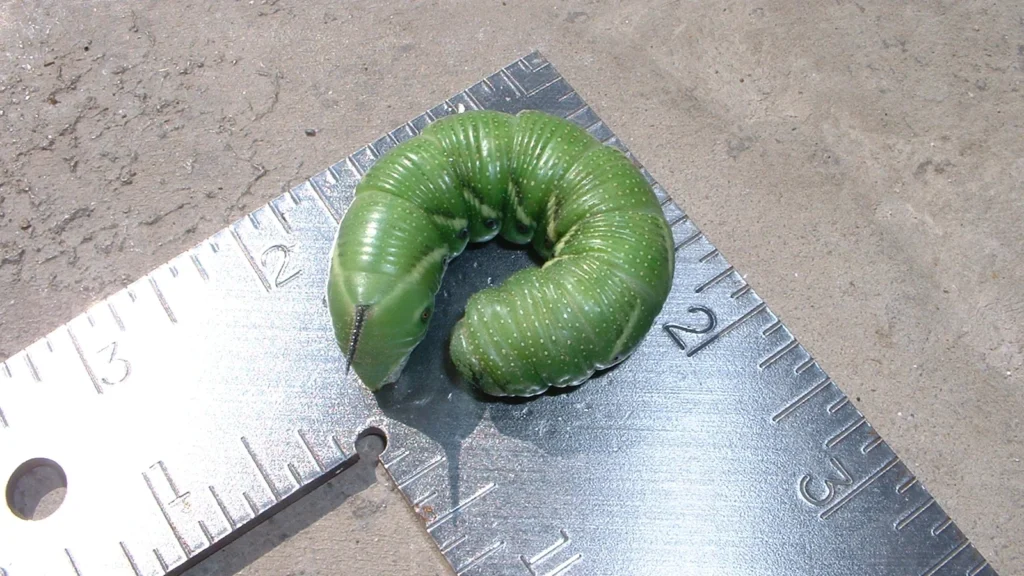
Tomato hornworms are large, bright green caterpillars, up to 4 inches long, with white V-shaped stripes and a pointed “horn” on the rear end, that can strip the leaves from tomato, pepper, eggplant and potato plants in a few days. Their camouflage makes them hard to spot, so look for chewed leaves at the top of plants, bare stems and dark green droppings (frass) on leaves below. The best control in home gardens is to handpick them, ideally at dusk or with a UV flashlight at night, when they glow; leave any hornworms covered in white cocoons, which are parasitic wasps that will kill them; till the soil in fall; and, for young caterpillars, use a Bacillus thuringiensis (Bt) spray labeled for caterpillars.
Hornworm identification
| Feature | Tomato hornworm | Tobacco hornworm |
|---|---|---|
| Scientific name | Manduca quinquemaculata | Manduca sexta |
| Side markings | Eight white V-shaped (chevron) marks | Seven white diagonal stripes |
| Horn | Dark blue to black | Red |
| Size | Up to about 4 inches | Up to about 4 inches |
| Adult | Five-spotted hawk moth | Carolina sphinx moth |
| Common region | More common in the North | More common in the South |
| Hosts | Tomato, pepper, eggplant, potato, tobacco and related nightshades | |
What are tomato hornworms?
Tomato hornworms are the larvae of large hawk moths, also called sphinx moths or hummingbird moths because adults hover at flowers at dusk. The Wikipedia article on Manduca quinquemaculata describes the life cycle and notes that the closely related tobacco hornworm is often found on tomatoes too. Both cause the same damage and are managed the same way. The UMass Extension fact sheet on tomato hornworm notes that a few hornworms can defoliate plants quickly because the large late-stage caterpillars eat far more than younger ones.

How do you find tomato hornworms?
- Look for missing leaves at the top of the plant and stems stripped bare.
- Find the frass: dark green to black, barrel-shaped droppings on leaves and the ground below. Look straight up from the frass to find the caterpillar.
- Search in the early morning or evening, when hornworms feed on the outside of the plant.
- Use a UV (black light) flashlight at night: hornworms glow pale green under ultraviolet light and are easy to spot.
- Spray the plant with water: hornworms often thrash or move when sprayed, revealing themselves.
- Check fruit: large hornworms sometimes chew into green tomatoes.
What is the hornworm life cycle?
Hornworms overwinter as large brown pupae, about two inches long with a jug-handle-like tongue case, buried 3 to 4 inches deep in the soil. Moths emerge in late spring or early summer, feed on flower nectar at dusk and lay single, round, pale green eggs on the undersides of tomato leaves. Eggs hatch in about a week, and caterpillars feed for three to four weeks, growing through five stages. Most of the damage happens in the last week or two, when they are largest. They then drop to the soil to pupate. There are one to two generations a year in the North and more in the South.
| Stage | Where | Duration |
|---|---|---|
| Egg | Underside of leaves | About 5 to 7 days |
| Caterpillar | On plant | About 3 to 4 weeks |
| Pupa | 3 to 4 inches deep in soil | About 2 to 3 weeks in summer; all winter for the last generation |
| Moth | Flying at dusk, visiting flowers | Several weeks |
How do you get rid of tomato hornworms?
- Handpick them. This is the simplest and most effective method in home gardens. Pick caterpillars off and drop them into soapy water, or feed them to chickens. They do not sting or bite, though they may thrash.
- Check daily during peak season, usually midsummer, because hornworms grow so fast that a small caterpillar can become a major problem in a few days.
- Leave parasitized hornworms: caterpillars with white, rice-like cocoons on their backs are hosting braconid wasps. They stop feeding soon and will die, releasing a new generation of wasps that attack other hornworms.
- Use Bt for young caterpillars. Bacillus thuringiensis var. kurstaki is a bacterial insecticide that kills caterpillars that eat treated leaves, while being harmless to people, pets, bees and most beneficial insects. It works best on small caterpillars; reapply after rain.
- Use spinosad products labeled for caterpillars on tomatoes if needed, applied in the evening to avoid bees.
- Till the soil in fall or spring to destroy overwintering pupae; tilling can kill a large proportion of them.

What are the white things on a hornworm?
The Virginia Cooperative Extension guide to hornworms in home gardens advises leaving parasitized hornworms in place so the wasps can complete their development.
Those white, rice-like structures are cocoons of a tiny parasitic wasp, Cotesia congregata. The female wasp lays eggs inside young hornworms, the larvae feed inside, then chew their way out and spin cocoons on the caterpillar’s back. The hornworm stops feeding and eventually dies. Leave these caterpillars in the garden, or move them to an out-of-the-way plant, so the next generation of wasps can emerge and parasitize more hornworms. These wasps are harmless to people.
Label note: Bt and spinosad are regulated pesticides even though they are allowed in organic gardening. Use products labeled for caterpillars on tomatoes, follow the label and pre-harvest interval, and apply spinosad in the evening because it is toxic to bees while wet.
Which natural enemies help control hornworms?
| Natural enemy | How it helps |
|---|---|
| Braconid wasps (Cotesia congregata) | Parasitize caterpillars; white cocoons on the back |
| Trichogramma wasps | Tiny wasps that parasitize hornworm eggs; sold for release |
| Paper wasps and yellowjackets | Hunt caterpillars to feed their young |
| Lady beetles and lacewing larvae | Eat hornworm eggs and tiny caterpillars |
| Birds | Pick off caterpillars |
Planting dill, basil, marigolds and other flowers near tomatoes provides nectar for adult parasitic wasps. See companion planting: what works for more on attracting beneficial insects.
How do you prevent tomato hornworms?
- Till or turn the soil where tomatoes grew, in fall or early spring, to destroy pupae.
- Rotate crops so tomatoes, peppers, eggplant and potatoes do not follow each other in the same bed.
- Inspect plants twice a week from early summer, especially the tops of plants.
- Remove weeds in the nightshade family, such as horsenettle and jimsonweed, which also host hornworms.
- Protect natural enemies by avoiding broad-spectrum insecticides.
- Use row cover on young plants, though tomatoes soon outgrow it.
Can tomato plants recover from hornworm damage?
Usually, yes. Tomatoes are vigorous and can regrow leaves after moderate defoliation, especially if they are well watered and fed. Fruit that loses its leaf cover may sunscald, so consider light shade cloth during heat waves until new leaves grow. Chewed green fruit should be removed, since it is likely to rot. For more tomato care, see how to grow tomatoes and common tomato problems, and plan watering with the garden watering calculator.
Are hornworm moths good pollinators?
Yes. The adult five-spotted hawk moth and Carolina sphinx are important night-time pollinators of long-tubed flowers such as datura, moonflower, honeysuckle, petunias and nicotiana. Many gardeners are surprised to learn that the large, fast-flying “hummingbird moths” visiting their evening flowers are hornworm parents. Their value as pollinators is one reason to rely on handpicking and Bt rather than broad-spectrum sprays.
For other garden pests and plant diseases, browse our complete plant pests and diseases library.
Free printable: the Year-Round Garden & Preserving Planner
Planting dates for 24 crops, monthly tasks, blanching times, canning safety numbers and a winter storage chart in one 8-page PDF. Enter your email to download it instantly and get our seasonal garden newsletter.
No spam. Unsubscribe any time. We never sell your email.
Hornworm FAQ
Are tomato hornworms poisonous?
No. Despite the horn, they do not sting, bite or carry venom.
What eats tomato hornworms?
Braconid wasps, paper wasps, birds, lady beetles and lacewing larvae.
Where do tomato hornworms come from?
From eggs laid on leaves by large hawk moths, which emerge from pupae in the soil.
How fast can hornworms strip a plant?
A few large caterpillars can defoliate a tomato plant in a few days.
Does Bt kill tomato hornworms?
Yes, especially young caterpillars that eat treated leaves.
Do hornworms eat peppers?
Yes, along with eggplant, potato and other nightshades.
What do hornworm eggs and young caterpillars look like?
Hornworm eggs are smooth, round and pale green to yellow, about 1/16 inch across, laid singly on the undersides of leaves, often near the top of the plant. They are easy to miss but worth rubbing off when you find them. Newly hatched caterpillars are tiny, pale and already have a small horn; they chew small holes in leaves and grow quickly. At this young stage, Bt is most effective and the caterpillars do little damage. By the time hornworms are three to four inches long, each one can eat several leaves a day, so early detection makes a big difference.
What do hornworm pupae look like?
When you dig or till a tomato bed in fall or spring, you may find dark brown, shiny, torpedo-shaped pupae about two inches long, with a curved loop like a jug handle at one end. That loop holds the long tongue of the future moth. Destroy these pupae or leave them on the surface for birds. Finding several is a good sign that hornworms were active in that bed and that rotating your tomatoes elsewhere next year is worthwhile.
Hornworms on peppers, eggplant and potatoes
Hornworms feed on all nightshade-family crops. On peppers they can strip leaves and chew small fruit, and pepper fruits exposed to sun after defoliation sunscald easily. On eggplant they feed alongside flea beetles and Colorado potato beetles. On potatoes, damage is usually light compared with Colorado potato beetles, but large caterpillars still strip foliage late in the season. Handpicking works the same way on all of them. For other nightshade pests, see our guides to Colorado potato beetles and flea beetles.
How many hornworms are too many?
In a home garden, even one large hornworm on a young plant is worth removing, because the last stage eats so much. Established, well-grown tomato plants can lose a few leaves with little effect on yield, but several large caterpillars can strip a plant in days. Because they are easy to remove by hand and do not sting, the practical approach is to check plants regularly in midsummer and remove any you find, except those carrying parasitic wasp cocoons.
Do companion plants deter hornworms?
Basil, marigolds, borage and dill are often planted with tomatoes to deter hornworms. There is little evidence that they repel the moths, but flowering herbs do attract the parasitic wasps and other beneficial insects that attack hornworm eggs and caterpillars, so they can help indirectly. Dill is itself a host for hornworms in some gardens and can act as a trap plant, making caterpillars easier to find and remove.
When are hornworms most active?
In most of the US, the first hornworms appear in early summer, a few weeks after tomatoes are planted out, and the heaviest feeding comes in mid to late summer, when the second generation is growing. In the South, they can be active from late spring until fall. Start checking plants about a month after transplanting and keep up regular inspections until frost. A quick evening walk with a UV flashlight once or twice a week is often all it takes to keep plants safe.
With regular checks, handpicking and a little help from parasitic wasps, hornworms rarely cost home gardeners more than a few leaves, and you may even enjoy spotting the spectacular hawk moths visiting your evening flowers.
Do hornworms damage tomato fruit?
Mostly they eat leaves, but large caterpillars sometimes chew shallow holes in green tomatoes, and occasionally in ripening fruit, especially once the foliage near them is gone. Damaged fruit often rots or splits, so pick it off and discard it. Keeping hornworm numbers low during midsummer protects both the leaves that shade the fruit and the fruit itself.
Further reading: UMass Extension, Tomato Hornworm; Virginia Cooperative Extension, Hornworms in Home Gardens; Wikipedia, Manduca quinquemaculata.
Tomato versus tobacco hornworm, and the wasp you should protect
Utah State University Extension’s page on tomato and tobacco hornworms says both caterpillars reach about 4 inches (10 cm) when mature. The tomato hornworm is green with eight white V-shaped markings and a black tail spine; the tobacco hornworm has seven diagonal white stripes edged in black and an orange-red tail spine. They overwinter as pupae in the ground, adults emerge in mid-spring, and larvae pass 5 to 6 instars in 3 to 4 weeks before burrowing 4 to 6 inches (10 to 15 cm) into soil to pupate. One or two generations occur per year. Larvae start on upper leaves and work down, and heavy loss can reduce fruit production and increase sunscald; dark green-black frass pellets are a giveaway.
- Handpick into soapy water in small gardens; scout in early morning or evening, beginning in early July.
- Leave parasitised caterpillars alone. A hornworm covered in white rice-like cocoons has been parasitised by the braconid wasp Cotesia congregatus, and the wasps will go on to attack more hornworms.
- Bt: Bacillus thuringiensis var. kurstaki products have 5 to 7 days of residual activity and work only on young caterpillars under half an inch.
- Till in spring or fall to disrupt overwintering pupae.
Check your planting dates with our frost dates tool.
Safety and legal note: Hornworms are harmless to touch but can startle you; wear gloves if you prefer. Biological sprays such as Bt should still be used per the label and kept off flowers where bees feed. Rules on pesticide use vary by country and region.
Reviewed October 2026. Sources: Utah State University Extension, Tomato and Tobacco Hornworms