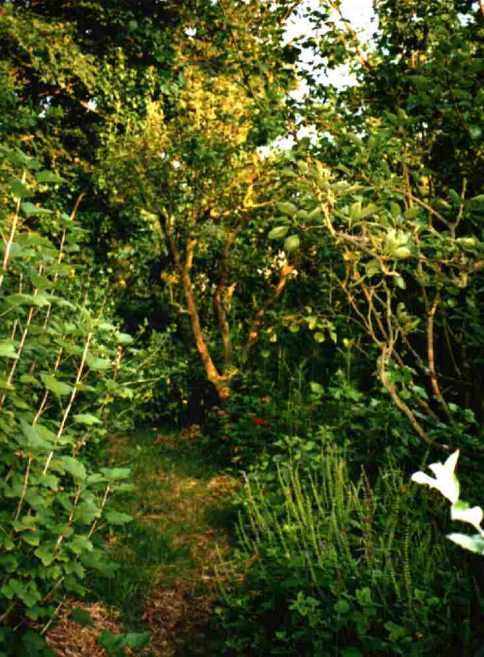
Quick answer: A food forest combines perennial edible plants in layers: tall trees, smaller trees, shrubs, herbaceous plants, groundcovers, vines and useful root-zone plants. But the seven layers are a planning model, not a requirement to squeeze every layer into one backyard. Choose climate-adapted fruit and nut crops first, leave generous light and root space, then add edible herbs and flowers in locations where they will thrive.
A food forest is often described as a self-sustaining edible woodland. In reality, establishing a productive landscape takes more than putting a fruit tree over strawberries and a vine. New trees need irrigation, young plants need weed protection, and fruits may require pruning, thinning and pest monitoring for years. A useful food forest design makes those tasks manageable as the canopy changes.
What is a food forest?
A food forest, sometimes called a forest garden, is a deliberately arranged planting of edible and beneficial plants designed to use vertical layers and ecological functions found in natural woodland. It is not necessarily a literal forest or a large orchard. South Dakota State University Extension describes a multi-layered system that can supply food and habitat while building soil organic matter and supporting water management.
Species selection is highly regional. A northern garden may grow apples, currants and hardy herbs; a tropical garden may choose citrus, bananas and suitable underplantings. Transplanting a tropical food-forest species list into a cold site, or planting water-loving species beneath drought-adapted trees, leads to poor survival.
The seven food forest layers and what they mean
| Layer | Illustrative plants | Key constraint |
|---|---|---|
| Canopy trees | Full-size nut or fruit trees suited to climate | Final shade and root footprint |
| Small tree / understory | Dwarf apple, plum or other appropriate smaller tree | Enough light under the canopy |
| Shrub layer | Currants, gooseberries or blueberries where soil fits | Soil pH, harvesting space and shade |
| Herbaceous layer | Chives, rhubarb, edible perennial greens | Seasonal dormancy and root competition |
| Groundcover | Strawberries or adapted low herbs | May compete with young tree roots |
| Vertical vines | Grapes or other climate-adapted climbing edibles | Sturdy independent trellis and pruning |
| Root zone | Edible roots grown in separate managed pockets | Digging can damage perennial roots |
The layers are conceptual: not every site has seven discrete plant strata, and a tiny garden need not force an underground crop beneath every tree. Where shade is deep, sun-loving vegetables may belong in a separate open raised bed.

Canopy and understory: plan light before planting
The first decision is which trees can actually mature on the site. Choose based on mature height and width, soil drainage, chill requirements or heat tolerance, pollination needs, disease resistance and available water. A dwarf apple on a suitable rootstock can be a practical small tree in a temperate food forest. A full-size walnut can dominate a small suburban property for decades.
Shade changes each year. A strawberry patch that is fully sunny in year one may receive too little light once the trees grow. Design sunny edges and access corridors now, rather than promising that edible groundcovers will yield heavily forever under a dense mature canopy.
Use GardenVoila’s dwarf apple tree guide for rootstock-related tree sizes, and the apple guild guide for preserving a maintained root area around a new tree.
How to choose shrub crops: soil and fruiting biology
Blueberries need a much more acidic soil than many vegetables and orchard species. Currants may tolerate some partial shade, depending on climate. Raspberries and blackberries require cane training and access to cut spent canes. A single forest-garden illustration cannot override these crop-specific requirements.
For an acidic-soil berry strip, use the blueberry soil and companion guide. For canes, see the raspberry guide and blackberry guide. It may be more efficient to keep a few berry shrubs in a separate accessible row than to wedge them under trees.
Herbs, roots and groundcover: don’t forget maintenance
Edible perennials such as chives and rhubarb can form a useful herbaceous layer in suitable climates. Yet rhubarb requires considerable space, and chives need regular cutting. Strawberries spread by runners and require light, airflow and renewal. Their roots can compete with young trees if planted directly against trunks.
Consider a broad mulch zone around newly planted trees, then grow optional groundcovers beyond it. The Utah State University Extension guidance on competition around fruit trees explains why weed and turf control helps young trees establish. That evidence supports keeping roots free from competition, even when a beautiful seven-layer diagram seems to imply bare ground is unacceptable.
Root crops requiring deep digging are better in annual patches where you will not damage woody roots. For many backyard food forests, keeping a conventional vegetable garden nearby provides more productivity than trying to fit potatoes beneath orchard trees.
Climbers: make trellises independent of young trees
Grapes, hardy kiwi or other food vines may be considered where climate and supports permit. Avoid letting a vigorous vine overwhelm a newly planted fruit tree. The structure should be built for the vine’s eventual weight, and harvesting or pruning should not threaten the tree canopy.
Grapes need full sun and a reliable pruning routine. A dedicated trellis along an edge is often safer than training the vine through edible tree branches. Our grape companion guide explains root and support constraints in more detail.
Nitrogen fixers, dynamic accumulators and other claims
Food-forest plans often include nitrogen-fixing legumes, mulch plants or species described as dynamic accumulators. Legumes can fix nitrogen through symbioses with suitable microbes, but not every nearby fruit tree receives a predictable nutrient boost from a living legume. Timing, soil nutrients, management of cut biomass and root competition all matter.
Similarly, a deep-rooted plant that accumulates minerals in leaves does not automatically increase fruit-tree yields. Assess whether it makes useful mulch, supplies flowers or is easily managed before adding it. Avoid species considered invasive in your area, even when a food-forest chart describes them as helpful.
Start with a modest plan, not a miniature jungle
Step 1: Observe sunlight and seasonal drainage. Note the areas shaded by structures or existing trees. Step 2: Choose one or two main fruit trees matched to climate. Check their mature widths and pollination needs. Step 3: Preserve weed-free and mulched root zones while they establish. Step 4: Add one shrub layer in a distinct soil zone. Step 5: Place herbs and insectary flowers along paths where you can reach them. Step 6: Build independent supports for vines only if you have room. Step 7: Plan irrigation, pruning, mulching and future thinning before filling all gaps.
Watch in practice: South Dakota State University Extension introduces edible landscaping and food forest layers, providing a useful visual context for the design principles discussed here.
Video: Food Forests, SDSU Extension.
An efficient backyard food forest may contain fewer species than a diagram but yield more usable produce. Begin with simple, healthy plantings and expand as the canopy grows. The GardenVoila permaculture garden guide covers the wider site-planning principles, while the garden planner can help visualize space.
Free printable: the Year-Round Garden & Preserving Planner
Planting dates for 24 crops, monthly tasks, blanching times, canning safety numbers and a winter storage chart in one 8-page PDF. Enter your email to download it instantly and get our seasonal garden newsletter.
No spam. Unsubscribe any time. We never sell your email.
Frequently asked questions
What are the seven layers of a food forest?
Canopy, understory tree, shrub, herbaceous, groundcover, vine and root layers. The model is flexible; not every site should contain all seven.
Can a food forest work in a small yard?
Yes, if plants are chosen for mature size and tree-root competition is managed. Dwarf trees and separate herbs can work better than a crowded stack of crops.
Is a food forest maintenance-free?
No. Young trees require irrigation, mulch and protection; fruits often need pruning, pest checks and harvesting.
What food forest plants grow under apple trees?
It depends on shade and root competition. Preserve mulch around young trunks and grow compatible flowers or herbs at a sunlit outer edge.
Sources
- SDSU Extension — Edible landscaping and food forests
- Utah State Extension — Managing vegetation around fruit trees
- GardenVoila — Permaculture design
Featured photo: Quercusrobur at English Wikipedia · Wikimedia Commons · CC BY-SA 3.0. Resized for web.


