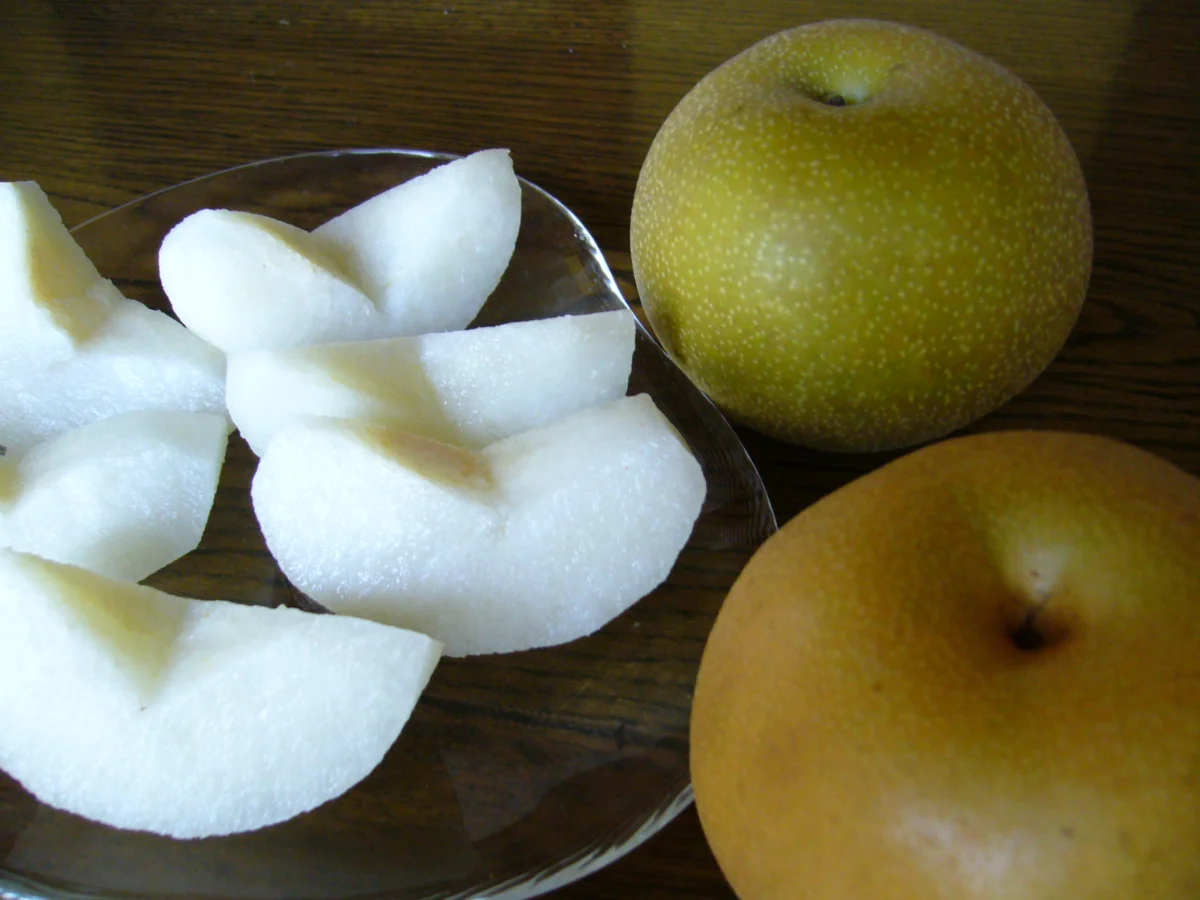
Hosui is a Japanese Asian pear (Pyrus pyrifolia) widely considered one of the best-tasting Asian pears. Its large, round, golden-brown russeted fruit has crisp, very juicy, fine-textured flesh with a rich, sweet, slightly tart flavor. Like all Asian pears, it ripens on the tree and is eaten crisp, usually from early to mid-August in California and late August to September in cooler regions. Hosui needs about 300 to 400 chill hours, grows in roughly zones 5 to 9 and needs a pollination partner such as Shinko, Chojuro, 20th Century or Bartlett. Thin the fruit heavily for large pears.
Hosui Asian pear overview
| Botanical name | Pyrus pyrifolia ‘Hosui’ |
|---|---|
| Type | Asian pear (nashi), russeted type |
| Origin | Japan, released in the early 1970s |
| Fruit | Large, round, brownish-orange to golden russet |
| Flavor and texture | Very sweet, slightly tart, juicy, crisp and fine-grained |
| Harvest | About early to mid-August in Central California; later in cooler areas |
| Chill hours | About 300 to 400 |
| Zones | About 5 to 9 |
| Pollination | Needs a partner: Shinko, Chojuro, 20th Century or Bartlett |
| Years to fruit | About 3 to 5 |
| Fire blight | Somewhat resistant |
What is a Hosui Asian pear?
Hosui is one of the most popular Asian pear varieties in Japan and among home growers worldwide. Asian pears, also called nashi, apple pears or sand pears, are a different species from European pears such as Bartlett: they are round rather than pear-shaped, crisp rather than buttery and ripen on the tree. Hosui belongs to the russeted, brown-skinned group, along with Chojuro and Shinko, as opposed to the smooth, yellow-green types such as 20th Century and Shinseiki. For an overview of Asian pears, see our nashi pear guide.
The nursery Four Winds Growers describes Hosui as the best-tasting Asian pear, with large, brownish-orange, russeted fruit and dense yet crispy, fine-textured flesh with a complex sweet flavor, harvested around August in Central California.
What does a Hosui pear taste like?
A ripe Hosui is juicy, sweet and refreshing, with a slight tartness that keeps it from tasting flat, and a crisp, apple-like crunch. The flesh is finer-grained and less gritty than many Asian pears, and its flavor is often described as having notes of butterscotch, caramel or honey, especially in fully ripe fruit. Hosui is considered sweeter and juicier than Chojuro and richer than the mild, watery 20th Century.
Where does Hosui grow best?
Hosui needs only about 300 to 400 winter chill hours, so it fruits well in mild-winter areas such as California, the Southeast and the Pacific Northwest, and it is also grown in colder regions to about zone 5. Four Winds Growers lists zones 5 to 10 and notes the tree is cold-hardy, drought-resistant and heat-tolerant, but should be protected below about -20°F. Asian pears bloom early, so a late spring frost can damage flowers in cold areas; avoid frost pockets. Check your zone with the growing zone finder and your frost dates with the frost date tool.
Does Hosui need a pollinator?
Yes. Hosui is not reliably self-fruitful, so plant another Asian pear or a compatible European pear that blooms at the same time within about 50 to 100 feet. Four Winds Growers lists Shinko, Chojuro, Bartlett and 20th Century as compatible pollinizers. Asian pears bloom early, so choose a European partner with an early bloom, such as Bartlett, if you are not planting a second Asian pear.
| Pollinizer | Type | Notes |
|---|---|---|
| Shinko | Asian, russeted | Late-ripening, good fire blight resistance |
| Chojuro | Asian, russeted | Butterscotch flavor, stores well |
| 20th Century (Nijisseiki) | Asian, yellow-green | Mild, very juicy; heavy bearer |
| Bartlett | European | Blooms early enough to overlap |
How do you plant a Hosui Asian pear tree?
- Choose full sun with good air circulation and well-drained soil.
- Plant a pollinizer nearby at the same time.
- Plant while dormant in winter or early spring. Use the planting hole size calculator, keep the graft union above the soil and water deeply.
- Space trees about 12 to 15 feet apart on semi-dwarf rootstock, such as OHxF 87, or closer if you prune to a small size.
- Mulch 2 to 4 inches deep, keeping it off the trunk.
How do you care for a Hosui pear tree?
Water
Water weekly during the first two summers and during dry spells after that. Asian pears need steady moisture while fruit is sizing, or the fruit stays small and may crack. Four Winds notes Hosui is drought-resistant once established, but crops are best with regular water.
Fertilizer
Feed lightly in early spring if growth is weak. Avoid heavy nitrogen, which produces soft growth susceptible to fire blight. See our fruit tree fertilizer guide.
Pruning
Train to a central leader or open center, spread young branches to encourage fruiting and prune lightly each winter, thinning crowded spurs and removing water sprouts. See how to prune a pear tree.
Fruit thinning
Thinning is essential for Asian pears. Hosui sets many more fruits than it can size. About two to four weeks after bloom, thin to one fruit per spur cluster, leaving the largest, best-shaped fruit, roughly 6 to 8 inches apart. Four Winds also recommends thinning to one per spur. Without thinning, Asian pears are small, and trees tend to bear heavily one year and lightly the next.
Fruit bagging
In Japan, growers often bag each young Asian pear to protect it from insects, birds and sunburn and to produce flawless skin. Home growers can use paper fruit bags or nylon footies after thinning; see our guide to worms in apples, as the same methods protect pears from codling moth.
When are Hosui pears ready to pick?
Unlike European pears, Asian pears ripen on the tree and should be picked ripe. Hosui is ready when the skin turns from greenish-brown to a warm golden-brown or orange russet, the fruit has reached full size, it separates from the spur with an upward twist and, most reliably, a sample tastes sweet and juicy. Hosui typically ripens from early to mid-August in California and in late August to September in cooler regions. Pick over a couple of weeks, as fruit ripens unevenly, and handle gently: despite their firm texture, Asian pears bruise easily. See when to pick pears for how Asian and European pears differ.
How long do Hosui pears keep?
Hosui stores reasonably well for an Asian pear, keeping several weeks in the refrigerator and up to a couple of months in cold storage near 32°F with high humidity, though it is not as long-keeping as Chojuro or Shinko. Wrap individual fruits in paper or store them in perforated plastic bags to prevent bruising and moisture loss.
How do you eat Hosui pears?
- Fresh: Chill, peel if you like, and slice; the skin is edible but slightly tough.
- Salads and slaws: Crisp slices stay firm and juicy.
- Korean and Japanese cooking: Grated Asian pear tenderizes and sweetens marinades such as bulgogi.
- Cheese boards: Pair with sharp cheeses.
- Juice: Asian pears make refreshing juice.
What problems affect Hosui pears?
| Problem | Sign | What to do |
|---|---|---|
| Fire blight | Blackened shoots and blossoms | Prune out 8 to 12 inches below damage in winter; see fire blight on pear trees |
| Codling moth | Worm holes, frass | Thin and bag fruit; sanitation |
| Small fruit | Overcropping | Thin to one fruit per spur |
| Frost damage | Brown blossoms after cold night | Avoid frost pockets |
| Birds and wasps | Pecked or hollowed fruit | Bag fruit; net the tree |
The Clemson fire blight fact sheet lists Hosui among Asian pears that are somewhat resistant to fire blight, but Four Winds notes it can still be affected, so watch for strikes after warm, wet springs.
Hosui vs other Asian pears
| Variety | Skin | Flavor | Season | Storage |
|---|---|---|---|---|
| Hosui | Golden-brown russet | Very sweet, juicy, rich | Mid-season | Fair |
| Chojuro | Brown russet | Butterscotch, firm | Mid-season | Very good |
| Shinko | Brown russet | Sweet, rich | Late | Very good |
| 20th Century | Yellow-green, smooth | Mild, very juicy | Mid-season | Fair |
| Shinseiki | Yellow, smooth | Mild, sweet | Early | Fair |
Where did the Hosui pear come from?
Hosui was bred in Japan, where Asian pears, called nashi, have been grown for centuries and are a prized gift fruit. Japanese breeders developed Hosui by crossing earlier nashi varieties and released it in the early 1970s; it quickly became one of Japan’s most widely grown pears, alongside Kosui. Asian pears were brought to the US in the 1800s, notably by Chinese immigrants during the California Gold Rush, and became popular with home growers in the late 20th century. The Wikipedia article on Pyrus pyrifolia covers the species’ history and cultivation.
Can you grow a Hosui pear in a container?
Yes, on a dwarfing or semi-dwarf rootstock and in a large container of 15 to 20 gallons or more. Container Asian pears fruit well if they get full sun, regular water and light feeding, and if a compatible pollinizer is nearby, either another potted Asian pear or a neighbor’s tree. Thin the fruit even more heavily on container trees, leaving perhaps 15 to 25 pears on a small tree, so each one sizes up. Protect container roots from hard freezes. The container garden planner and the grow bag volume calculator help size the pot.
How many pears does a Hosui tree produce?
Asian pears are among the most productive fruit trees. A mature semi-dwarf Hosui can easily set hundreds of fruits, which is why thinning matters so much. After thinning, a healthy mature tree may produce 100 to 200 large pears, or more on standard rootstock. Young trees usually begin bearing about 3 to 5 years after planting; Four Winds notes trees begin fruiting in their fourth or fifth year. Plan containers for the harvest with the harvest basket and crate calculator.
Hosui pear care calendar
| Season | Task |
|---|---|
| Winter | Plant; prune lightly while dormant; remove fire blight cankers |
| Early spring | Watch for frost at bloom; make sure the pollinizer is flowering |
| 2 to 4 weeks after bloom | Thin to one fruit per spur; bag fruit if desired |
| Summer | Water deeply in dry spells; remove water sprouts; net against birds |
| August to September | Taste-test and harvest ripe, crisp fruit |
| Fall | Clean up fallen fruit and leaves |
Is Hosui a good Asian pear for beginners?
Yes. Hosui is vigorous, productive, relatively low-chill and widely available on semi-dwarf rootstock, and its outstanding flavor makes the work of thinning worthwhile. The main things beginners need to plan for are a compatible pollinizer, heavy fruit thinning every spring and attention to fire blight in warm, wet climates. If you have room for two Asian pears, pairing Hosui with Shinko or Chojuro gives reliable pollination and a longer harvest, because they ripen at slightly different times and store differently.
Are Asian pears healthy?
Asian pears are low in calories, high in water and a good source of fiber, along with vitamin C, vitamin K and potassium. Most of the fiber is in the skin, so eat them unpeeled if you can. Their crisp texture and mild sweetness make them a refreshing snack, and they are often given to soothe sore throats in Korean and Chinese home remedies, typically steamed or simmered with honey.
For other trees and berries to grow alongside this one, see the home fruit tree guide.
What extension specialists say about Asian pear thinning and pollination
Penn State Extension’s guide to Asian pears in the home orchard describes Hosui as having large, yellowish-brown, russeted fruit with prominent lenticels and excellent quality, maturing in mid- to late August. The page is firm that Hosui fruit must be thinned to obtain adequate size. Its general thinning method is simple:
- About 2 to 3 weeks after bloom, shake branches to drop fruit that has stopped developing.
- Leave one fruit per cluster and space clusters about 8 inches (20 cm) apart.
- Cut fruit off with pruning shears rather than pulling it, because pulling can damage the fruit spur and stop it flowering next year.
For pollination, Penn State advises planting at least two Asian pear varieties and says common (European) pear varieties should not be relied on to pollinate Asian pears. Asian pears ripen on the tree and do not need a cold-storage period, with Olympic noted for the longest storage life. The biggest problem is fire blight, which affects the group heavily. Check your climate with our growing zone finder and read about harvest signs in our pear harvest guide.
Safety and legal note: Use a stable ladder and pruning shears with care, and prune out fire blight only in dry weather, disinfecting tools between cuts. Check local rules on regulated plant diseases and on moving fruit trees between regions. Rules vary by country and region.
Free printable: the Year-Round Garden & Preserving Planner
Planting dates for 24 crops, monthly tasks, blanching times, canning safety numbers and a winter storage chart in one 8-page PDF. Enter your email to download it instantly and get our seasonal garden newsletter.
No spam. Unsubscribe any time. We never sell your email.
Frequently asked questions
Is Hosui self-pollinating?
No. Plant another Asian pear such as Shinko or Chojuro, or Bartlett, nearby.
When do Hosui pears ripen?
Around early to mid-August in California and late August to September in cooler areas.
Do Hosui pears ripen off the tree?
No. Like all Asian pears, they ripen on the tree and should be picked ripe and crisp.
How many chill hours does Hosui need?
About 300 to 400, according to Four Winds Growers.
Why are my Asian pears small?
Usually overcropping. Thin to one fruit per spur after bloom.
Can you eat the skin of a Hosui pear?
Yes, though many people peel it because the russeted skin is slightly tough.
Reviewed October 2026. Sources: Four Winds Growers, Hosui Asian Pear Tree; Clemson Cooperative Extension, Fire Blight of Fruit Trees.
Additional sources: Penn State Extension, Asian Pears in the Home Orchard: Variety Selection