
Quick answer: The most useful onion companions are short leafy crops such as lettuce and spinach, along with carrots or cabbage in sufficiently separated rows. Onions have shallow roots, dislike weed competition and need sunlight for bulb growth. The classic claim that onion odor automatically repels cabbageworms or carrot flies is not reliable enough to replace pest monitoring.
“Onion companion planting” includes several different crops. Bulb onions, scallions, bunching onions and perennial walking onions do not share the same harvest method. A good mixed planting begins with what you’re growing and when it will be harvested—not with a list of plants supposedly attracted or repelled by onion smell.
Start with the onion plant itself
Common bulb onion is Allium cepa, and bulb formation responds strongly to day length. A short-day cultivar and a long-day cultivar may grow at different latitudes, even when every neighboring plant is identical. University of Minnesota Extension explains how day length, growing season and shallow roots affect growth and how to choose seeds, sets or transplants.
Bulb onions need well-drained, fertile soil with steady moisture during active growth. Excess nitrogen late in the growing season may interfere with ripening and storage. Because onion roots are relatively shallow and leaves narrow, weeds can win a competition for water and nutrients very quickly.
Onion companion planting table
| Potential neighbor | Useful reason | Practical caution |
|---|---|---|
| Lettuce | Low-growing crop with a relatively quick harvest | Leave room for bulb expansion and irrigation |
| Spinach | Cool-season vegetable that can finish before summer | Bolting and watering schedule differ by climate |
| Carrots | Another crop for a separate narrow row | Harvesting root crops can disturb bulbs |
| Cabbage | Cool-season planting schedule in some regions | Mature cabbage leaves can shade onion foliage |
| Tomatoes | May share a larger vegetable garden | Tomato canopy can shade onions and overlap harvest operations |
| Calendula and alyssum | Flowering resources in an adjacent border | Keep onion rows weed-free and open |
| Garlic and chives | Related crops convenient to harvest nearby | Share some pests and diseases; rotate the Allium family |
Lettuce, spinach and onions: easy uses of a cool-season bed
Low leafy crops can be productive in the same general bed as onions because they do not require large trellises. The best arrangement is defined rows, not lettuce packed around every onion bulb. Lettuce harvest can open space for onion growth later; spinach may finish as the season warms. Where bulb onions take months to mature, short greens are a useful timing companion.
Water both crops according to their needs while the greens are actively growing. Do not let a dense leafy mat prevent air movement and make hand-weeding the onions impossible. If spinach bolts during hot weather, pull it before it competes with onion bulbs.
Carrots and onions: a useful pairing with caveats
A familiar claim is that onions repel carrot flies and carrots repel onion flies. Intercropping can affect insect behavior in particular conditions, but it does not guarantee the protection of a mixed home garden. Carrots and onions also have different root-harvest patterns, and both require enough space below ground.
Place a small carrot row beside—not directly on top of—onion seedlings, and thin carrots when needed. Avoid using one crop’s foliage as an assumed pesticide. Identify local pests, plant healthy seed, and follow an appropriate rotation schedule.
Cabbage and onions: do they really grow well together?
Cabbage belongs to the brassica family, and onions to the allium family, so they can be part of a crop-diverse bed. Yet the main challenge is physical: a mature cabbage makes large outer leaves and can shade onion rows. Put onions on a sunlit edge or give them an independent row beyond the cabbage’s spread.
Onion scent alone has not been established as a universal control for imported cabbageworms, cabbage loopers or diamondback moths. Where caterpillars are common, exclusion netting over cabbage seedlings and direct scouting may work more predictably. See our cabbage companion planting guide.
Garlic, chives and other alliums: crop diversity versus rotation
Garlic and onions can be convenient culinary neighbors, but they are closely related and can share problems such as onion maggots and various fungal diseases. Grouping all alliums in one bed can simplify management in the current year while making rotation planning important for subsequent crops.
Chives form perennial clumps and are often best placed at a permanent edge. Garlic is dug at bulb harvest. Do not lift garlic in a way that tears through growing onions. Our garlic companion guide and chives guide explain those separate growth habits.
Bulb onions, scallions and walking onions are different crops
Most advice about onion bulb formation concerns storage or sweet onions, which develop large underground bulbs according to cultivar and day length. Scallions are often harvested earlier for tender green stems and small bases. Egyptian walking onions form small bulbils near the top of mature stalks and can behave as persistent perennial plants.
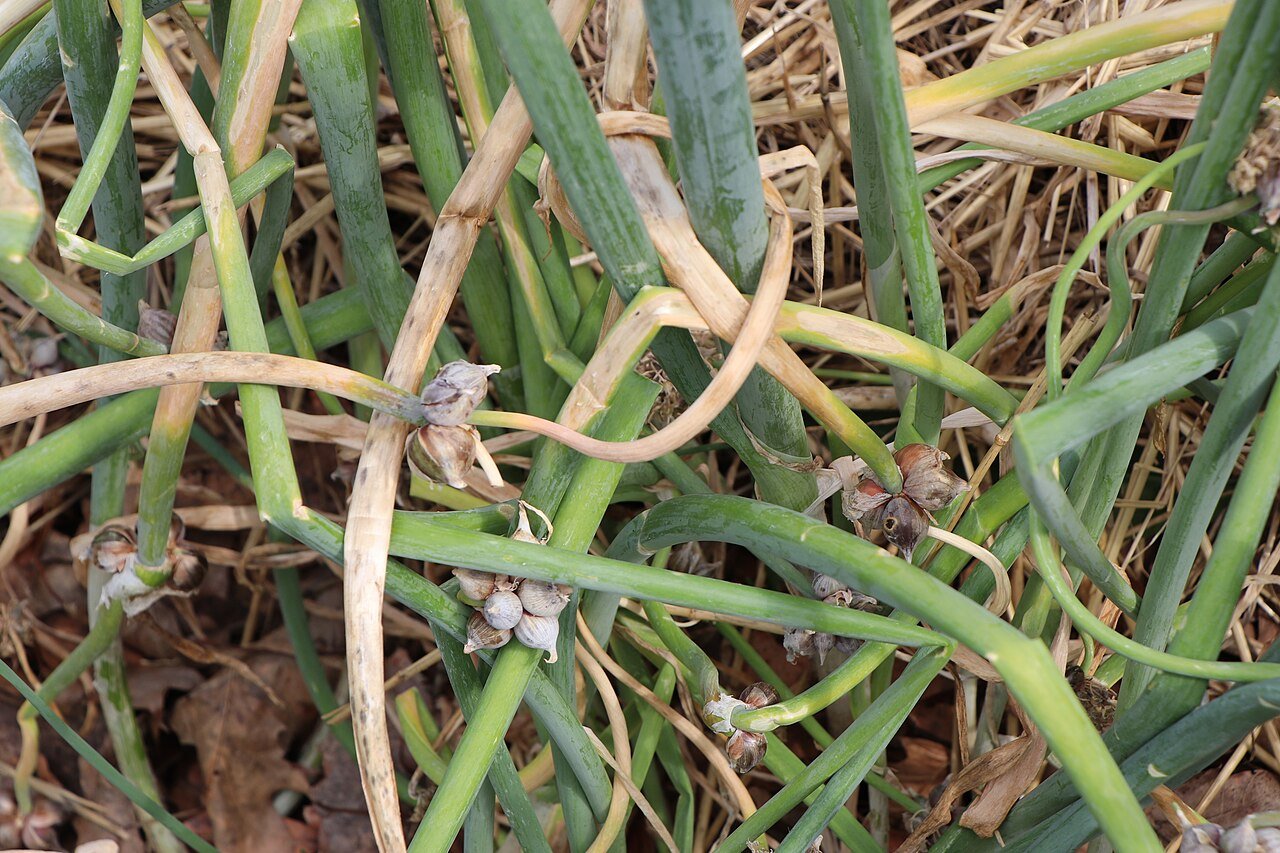
The photo in this section shows walking onions with bulbils on stalks—not ordinary harvested storage onions. It helps illustrate why the category “onions” should not be treated as one uniform growth habit. Keep perennial walking onions in an area where their mature stalks and spreading habit won’t interfere with an annual bulb bed.
Where not to plant onions
Under large squash leaves: mature vines can block light and make onion bulb harvest difficult. Against invasive mint: spreading roots and uneven moisture complicate weed management. In wet, poorly drained low ground: bulb rots may worsen regardless of the neighboring species. In heavily shaded beds: inadequate light can reduce bulb size. In a dense perennial root mat: harvesting onions requires disturbing the soil, which may injure neighboring roots.
A practical bed plan starts with day length and spacing
Choose a locally adapted long-day, intermediate-day or short-day cultivar, then set the planting season accordingly. For many bulb onions, thinning to several inches between plants is necessary, with row spacing suited to harvesting and irrigation. The Minnesota Extension guide describes typical onion spacing of approximately 3–4 inches between onions in rows, but planting systems vary.
Watch the growing technique: This onion-growing video covers day-length categories and seed, set and transplant choices, which matter more to bulb formation than any single companion plant.
Video: 3 Onion Growing Mistakes to Avoid, Epic Gardening.
For a four-by-eight-foot bed, put several rows of onions on the sunniest side, with lettuce or spinach rows separated enough to harvest independently. If cabbage is included, reserve a separate end of the bed for its mature leaf spread. Keep access to weed among onions and avoid planting flowers directly among tiny onion seedlings.
When tops yellow and fall at maturity, harvest and cure onions in a well-ventilated place according to cultivar. Adjust or stop irrigation as recommended for bulb maturity. The GardenVoila spacing calculator can help you test planting density before sowing, and the raised-bed planner can help preserve separate harvest paths.
Free printable: the Year-Round Garden & Preserving Planner
Planting dates for 24 crops, monthly tasks, blanching times, canning safety numbers and a winter storage chart in one 8-page PDF. Enter your email to download it instantly and get our seasonal garden newsletter.
No spam. Unsubscribe any time. We never sell your email.
Frequently asked questions
Can onions grow beside cabbage?
Yes, provided cabbage leaves do not shade the onion rows. Don’t rely on onion scent alone to prevent caterpillars.
Can onions and tomatoes grow in the same bed?
They can share a larger space, but tomatoes may shade onions and require different maintenance. Plant onion rows where they remain sunny.
What should I avoid planting next to onions?
Avoid aggressive spreading roots, tall shade, dense weeds and crops that prevent digging at bulb harvest. These are stronger practical reasons than universal lists of “enemy” plants.
Are onions and garlic bad together?
They can grow nearby, but share some diseases and pests, so manage alliums as a group for crop rotation.
Sources
- University of Minnesota Extension — Growing onions in home gardens
- University of Minnesota Extension — Companion planting evidence
Featured photo (bulb onion): Acabashi · Wikimedia Commons · CC BY-SA 4.0. Resized for web.


