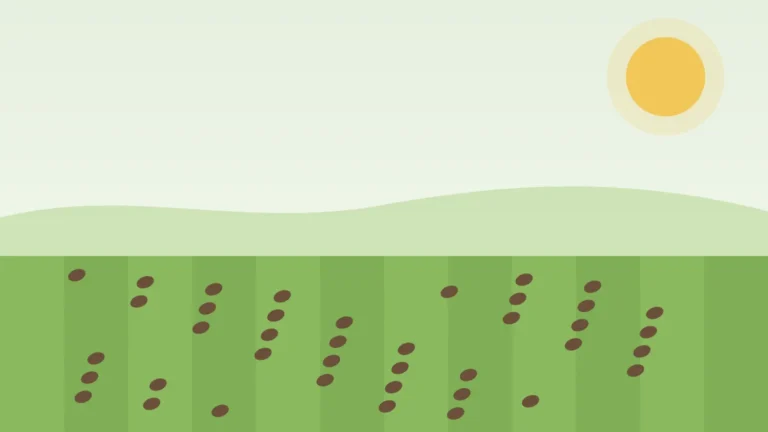
Overseeding means spreading grass seed over an existing lawn without tearing it up. It fills thin and bare spots, crowds out weeds and lets you introduce tougher, more disease-resistant grass varieties. Lawns naturally thin with age, so overseeding every few years keeps them dense. Success comes down to timing, good seed-to-soil contact and steady watering until the new grass is established.
When to overseed a lawn
- Cool-season lawns (tall fescue, Kentucky bluegrass, perennial ryegrass, fine fescue): late summer to early fall, roughly mid-August to mid-September in most northern areas. Warm soil speeds germination, cooler air favors grass over weeds, and seedlings have two growing seasons to establish before summer heat. Mid-spring is a distant second choice.
- Warm-season lawns (Bermuda, zoysia, centipede): late spring to early summer, once soil temperatures stay above about 65°F. St. Augustine is usually repaired with sod or plugs rather than seed.
- Winter color in the South: some gardeners overseed dormant Bermuda lawns with perennial ryegrass in October for a green winter lawn. It dies out as summer heats up.
Do not overseed in the same season you apply a crabgrass preventer, since most pre-emergent herbicides stop grass seed from germinating too.
Choose the right seed
- Match the grass you already have, or choose a blend suited to your sun, shade and traffic.
- Buy fresh seed from the current year with a high germination rate and low weed content; check the label.
- For drought tolerance in cool-season areas, tall fescue is a strong choice. Try the drought-tolerant lawn seed calculator to compare options.
- Use the overseeding rate on the bag, usually about half the rate for a new lawn. The seed quantity calculator scales it to your lawn’s size.
How to overseed a lawn, step by step
- Mow short. Cut the lawn lower than usual, about 1.5 to 2 inches, and bag the clippings so seed can reach the soil.
- Loosen the surface. Seed must touch soil, not sit on thatch. Core aerate (ideal), rake vigorously or use a power dethatcher. See when to aerate your lawn.
- Fix bare patches. Rake bare spots and add a little compost or topsoil.
- Spread the seed with a broadcast or drop spreader in two passes at right angles for even coverage.
- Feed. Apply a starter fertilizer to help seedlings root. See when to fertilize your lawn.
- Top-dress (optional). A thin, quarter-inch layer of compost or screened soil holds moisture around the seed.
- Water. This is the step that makes or breaks overseeding.
Watering new grass seed
- Until germination: keep the top inch of soil constantly moist with light watering once or twice a day, more in hot, windy weather. Do not let it dry out.
- Germination times: perennial ryegrass 5 to 10 days, tall fescue 7 to 14 days, Kentucky bluegrass 14 to 28 days.
- After the seedlings are up: water less often but more deeply to encourage roots.
Aftercare
- Keep foot traffic off the lawn for three to four weeks.
- Mow once new grass reaches your normal mowing height, with a sharp blade.
- Delay weed killers until the new grass has been mowed three or four times, or as the label directs.
- Give a follow-up feeding about six weeks after seeding, or in late fall.
Overseeding and weeds
A thick lawn is the best weed control there is. Clover, in particular, moves into thin, underfed lawns; see how to get rid of clover in your lawn. For the whole year’s schedule of mowing, feeding, aerating and seeding, use our lawn care calendar.
Common overseeding mistakes
- Skipping soil contact: seed sitting on thatch or long grass dries out. Mow low, rake or aerate first.
- Letting the seedbed dry out: new seed needs the top half inch kept moist, which usually means light watering once or twice daily for two to three weeks.
- Applying pre-emergent weed killer: it stops grass seed from sprouting too. Wait until you have mowed new grass several times.
- Seeding too late: cool-season seed needs about six weeks of growth before the first hard frost.
- Mowing too soon: wait until the new grass reaches about 3 to 4 inches, then mow with a sharp blade.
How long until the new grass fills in?
Perennial ryegrass sprouts in about a week, tall fescue in 7 to 14 days and Kentucky bluegrass in two to four weeks. Expect a thin green haze at first. The lawn usually looks noticeably thicker after six to eight weeks, and the new grass reaches full density by the following spring.
Overseeding warm-season lawns for winter color
In the South, dormant bermudagrass turns tan in winter. Some homeowners overseed it in fall with perennial or annual ryegrass for a green winter lawn. Sow when night temperatures drop into the 50s°F, usually four to six weeks before the first frost, after mowing the bermudagrass short. Keep the seed moist until it sprouts, then mow the ryegrass through winter. In spring, the ryegrass competes with the bermudagrass as it greens up, so lower the mowing height and cut back on water to help the warm-season grass take over again. Skip this on St. Augustine and centipedegrass lawns, which do not handle the competition well.
Why late summer beats spring
Iowa State University Extension calls mid-August through mid-September the best window to renovate a thin lawn. Its reasoning is practical: late-summer seeding germinates quickly in warm soil, fall warm days and cool nights speed growth, and fewer weed seeds germinate in late summer and fall, so there is less weed competition. Spring seeding has the opposite problem, because crabgrass and other weeds germinate alongside the new grass, and summer heat arrives before roots are deep.
Other universities give similar windows for their regions. Minnesota Extension lists seeding as early August to late September as the best timing for its cool-season lawns, with mid-November and May to early June as alternatives. Missouri Extension advises overseeding thin spots in September, preparing the seedbed in August, and overseeding thin spots early in March if you missed the previous fall. The Maryland calendar says that for tall fescue you should sow in spring only after about mid-April in central Maryland, and otherwise sow no later than mid-October, because seed takes about 2 weeks to germinate. Missouri warns that timing may vary by two weeks or more depending on region and weather. Our frost dates tool is a handy way to count back from your first fall frost.
Choosing the right seed for sun and shade
Iowa State matches seed to light conditions. For sunny areas it recommends Kentucky bluegrass, using a mix with at least two or three bluegrass cultivars. For partial shade it recommends a mix of Kentucky bluegrass, perennial ryegrass and fine-leaf fescues. For shade it recommends fine-leaf fescues such as creeping red, hard and chewings fescue. Always buy certified seed from your region, check the label for the percentage of weed seed and inert matter, and avoid mixing in grasses that are not suited to your climate.
Seed rates
Iowa State does not publish a rate in this guide, but the University of Illinois does, per 1,000 square feet (about 93 square meters). For fescue and ryegrass it gives 3 to 5 pounds for overseeding and 5 to 10 pounds for new lawns. For bluegrass it gives 1.5 pounds for overseeding and 3 pounds for new lawns. Bare spots should get the new-lawn rate. Always compare this with the rate printed on your seed bag.
Step-by-step preparation
- Mow low. Iowa State says to mow to 1.5 to 2 inches (4 to 5 cm) to reduce competition from the existing turf.
- Get seed into contact with soil. Seed on top of thatch or dense grass will not root. Iowa State describes three methods: a core aerator making 3 or 4 passes aiming for 20 to 40 holes per square foot, then applying seed with a drop seeder and dragging with chain-link fence or a drag mat; a vertical mower making 1 or 2 passes to cut into the upper quarter to half inch of soil, removing loosened debris, sowing with a drop seeder, and going over the area again to work in the seed; or a slit seeder, suited to large areas, which cuts small grooves and drops seed directly into them.
- Seed evenly. Split the seed in half and spread one half in each direction at right angles so there are no stripes.
- Water. See below.
Maryland also notes that aerating before overseeding creates holes for seed to fall into, improving seed-to-soil contact.
Watering is where most overseeding fails
Iowa State says to keep the seedbed moist with frequent, light watering, usually at least once a day. Illinois agrees that seed needs consistent moisture to germinate and says to water regularly for about two weeks, sometimes once or twice a day, adding that bluegrass can take about two to four weeks to germinate and may need a longer watering period. A dry spell after germination begins can kill the tiny seedlings, so do not skip days in the first weeks. Once the grass is up, move to less frequent, deeper watering. Our garden watering calculator can help you set run times.
Mowing and feeding new grass
After seeding, Iowa State says to keep mowing at 1.5 to 2 inches and mow often, then gradually raise the mowing height over the following weeks to a final height of 3 inches. About 6 weeks after germination it recommends applying 1 pound of actual nitrogen per 1,000 square feet. Avoid mowing when the grass is wet, and keep mower blades sharp so seedlings are cut and not pulled out.
Weed control: timing conflicts
Illinois points out that aeration and overseeding build a denser lawn that competes with weeds, and that improved drainage makes the lawn less prone to weeds. The Minnesota calendar warns against applying crabgrass pre-emergence herbicide in the fall, and Maryland recommends herbicide only as a last resort. This matters because many weed killers and pre-emergent products also stop grass seed from growing, so read the label before combining them with overseeding. Neither Iowa State nor Illinois gives herbicide guidance in these pages, so follow the product label for the waiting period before and after seeding.
How long until the lawn looks good?
Maryland says seed takes about two weeks to germinate for tall fescue, and Illinois says bluegrass can take two to four weeks. Expect the lawn to thicken over the first season, with a stronger result the following spring. Reseed any bare spots once the seedlings are up, and avoid heavy traffic until the new grass has been mowed a few times.
Safety and legal note: Read and follow the label of any herbicide, fertilizer or seed treatment, and keep children and pets off the area until the label allows. Rental machines such as vertical mowers and slit seeders are heavy and have sharp blades, so wear sturdy shoes and eye and ear protection. Rules on lawn chemicals and fertilizer vary by state and municipality.
Test the soil, and know when overseeding is not enough
The Missouri calendar recommends testing the soil in March and again in August if fertility is unknown, and applying lime only if a soil test shows a need (up to 50 pounds per 1,000 square feet only if soil pH is 5.8 or lower, with fall best). Testing before you spend money on seed and fertilizer avoids guesswork. The same guide describes a full renovation for lawns too far gone to repair: prepare the seedbed in August, kill the existing vegetation with glyphosate around mid-month, and then seed or sod in September while keeping the soil moist. Glyphosate is a non-selective herbicide that kills all plants it touches, so use it only per the label and only if the lawn is mostly weeds. For a lawn that is simply thin, overseeding is the lighter and cheaper option.
Missouri also gives target mowing heights once the new lawn is established: for example, 1.5 to 2.5 inches in spring and fall and 2 to 3.5 inches in summer for Kentucky bluegrass, and 2 to 3.5 inches in spring, 3 to 4 inches in summer for tall fescue. It adds that you should never remove more than one-third of the green leaf area in one mowing, which protects young turf from stress.
Sources and further reading
- Lawn Aeration and Overseeding, University of Illinois Extension
- Fall is Prime Time for Lawn Renovation, University of Illinois Extension
- Lawn Management through the Seasons, Penn State Extension
Free printable: the Year-Round Garden & Preserving Planner
Planting dates for 24 crops, monthly tasks, blanching times, canning safety numbers and a winter storage chart in one 8-page PDF. Enter your email to download it instantly and get our seasonal garden newsletter.
No spam. Unsubscribe any time. We never sell your email.
Frequently asked questions
When is the best time to overseed a lawn?
Late summer to early fall for cool-season grasses, and late spring to early summer for warm-season grasses.
Can I just throw grass seed on my lawn?
Seed scattered on thatch or hard soil mostly fails. Mow short and loosen the surface first so seed contacts the soil, then keep it moist.
How often should I water after overseeding?
Lightly once or twice a day to keep the top inch of soil moist until the seed germinates, then less often and more deeply.
Can I overseed and use weed killer at the same time?
Generally no. Most pre-emergent and broadleaf herbicides harm new grass. Wait until the new grass has been mowed several times.
Reviewed October 2026. Sources: Iowa State University Extension, overseeding your lawn, University of Illinois Extension, aeration and overseeding, University of Maryland Extension, lawn maintenance calendar, University of Minnesota Extension, lawn care calendar, University of Missouri Extension, cool-season lawn calendar