You bring home a bag of peaches and every one is as hard as a baseball. Or you picked a few early to beat the birds. Either way, you want fruit that is soft, fragrant and juicy, and you want it soon. The good news is that peaches ripen well off the tree, as long as they were mature when picked. The catch is that some popular tricks make things worse. This guide shows what works, what the postharvest research says, what to skip, and how to tell when a peach is truly ready.
Do peaches ripen after they are picked?
Yes, but only partly. After picking, a peach keeps softening, its aroma develops and its flesh becomes juicier. What it does not do is get noticeably sweeter, because peaches do not store much starch to turn into sugar. That is why a peach picked well before it was mature can soften but still taste bland. A peach that was nearly ripe on the tree will give much better results than one picked rock-hard and green.
The University of Delaware Extension’s article on ripening problems in peaches puts the rule plainly: peaches ripen off the tree if they are picked when the background color changes from green to yellow (yellow varieties) or green to white (white varieties), and peaches picked green will not ripen properly. So the first question is always whether your peaches were mature enough to ripen at all.
How to tell if a peach is ripe
- Ground color. Ignore the red blush. Look at the background color near the stem: green means not ready, while yellow or cream (for white peaches) means ripe or close. The UC Davis Postharvest Technology Center’s page on peach maturity and quality uses the same green-to-yellow ground color change as its main indicator.
- Smell. A ripe peach smells sweet and distinctly peachy at the stem end. No smell usually means no flavor.
- Feel. Cradle the fruit and press gently near the stem with your palm or thumb pad. It should give slightly. Avoid poking with a fingertip, which bruises. UC Davis reports that peaches are ready to eat at about 2 to 3 pounds-force of flesh firmness, which feels soft and juicy.
What actually makes a peach ripen?
Peaches are climacteric fruit: they produce ethylene, a plant hormone that drives softening and aroma development, and their breathing rate rises as they ripen. UC Davis reports that respiration rises from about 2 to 3 ml of carbon dioxide per kilogram per hour at 32°F to about 8 to 12 at 50°F and 32 to 55 at 68°F. In plain terms, ripening is slow when cold and fast when warm, which is why room temperature is your friend and the refrigerator is not.
UC Davis also notes that well-mature fruit usually ripens without added ethylene, and that treating less mature fruit with ethylene makes ripening more uniform but does not make it faster. That is worth knowing, because many articles promise that a paper bag or a banana will dramatically speed things up. The honest summary is that a bag helps a little by keeping the fruit warm and evening out ripening, but the biggest factor is simply leaving mature peaches at normal room temperature.
The best way to ripen peaches: a paper bag
A paper bag traps the ethylene gas that peaches naturally give off while still letting moisture escape. It is simple, and it keeps the fruit together where you can check it.
- Place firm peaches in a paper bag, one or two layers deep at most.
- Fold the top over loosely. Do not seal it.
- Leave the bag on the counter at normal room temperature, out of direct sun. Delaware Extension recommends about 68°F.
- Check every 12 hours. Most peaches ripen in about 1 to 3 days, depending on how mature they were.
Adding a ripe banana or apple to the bag adds a little extra ethylene and can even out ripening. Remove peaches as soon as they smell sweet and give slightly, because the window between ripe and overripe is short.
Other methods that work
- Counter ripening. Arrange peaches in a single layer, not touching, with the stem end down. This is slower than the bag, often 2 to 4 days, but it is the gentlest method and the least likely to bruise fruit.
- Bowl with ripe fruit. Put hard peaches in an open bowl next to bananas or apples. It is slower than a bag but needs no attention.
- Partial ripening, then use. If the peaches are only slightly firm, they are perfect for grilling, baking or cooking down for jam, where heat does the rest of the work. See our guide on how to make jam.
What not to do
| Method | Why to skip it |
|---|---|
| Refrigerating hard peaches | Cold can cause chilling injury, leaving the flesh dry, mealy or woolly. Chill only after ripening. |
| Microwave or oven | Heat softens and cooks the fruit; it does not ripen it or add flavor. |
| Sunny windowsill | Direct sun can heat the skin and cause uneven softening and spoilage. |
| Sealed plastic bag | Traps moisture and invites mold. |
Why do refrigerated peaches turn mealy?
This is the most common ripening problem, and Delaware Extension explains it well. Peaches, plums, cherries and apricots are susceptible to chilling injury when held between about 36 and 50°F, which it calls the danger zone. Symptoms include translucent, browned or leathery flesh, mealiness, and lost flavor, and they often appear when fruit is brought back to room temperature to ripen. UC Davis agrees that internal breakdown from chilling is the main limit on market life, with fruit stored at about 36 to 46°F the most susceptible.
A home refrigerator runs at roughly 37 to 40°F, right in the danger zone, so a hard peach left in the fridge for several days is the classic recipe for dry, woolly fruit. The fix is simple: ripen first at room temperature, then refrigerate for short-term storage. If you must hold unripe fruit for longer, Delaware recommends holding at about 68°F for one to two days after picking, then storing at 32°F, and giving the fruit one to two days back at 68°F before eating. That is a commercial method that needs a very cold, steady fridge, so most home gardeners are better off ripening and eating within a few days.

Ripeness timeline
| Stage | What you see and feel | What to do |
|---|---|---|
| Hard | Green undertone, no smell, very firm | Paper bag at room temperature |
| Almost ready | Yellow undertone, faint smell, slight give | Check every few hours |
| Ripe | Strong sweet smell, gives near stem | Eat now, or refrigerate |
| Overripe | Wrinkling, soft spots, fermented smell | Cook, blend or compost |
Why won’t my peaches ripen?
- They were picked too early. If the ground color is still green, they may never ripen properly. Cook them or make jam with added sugar.
- They were chilled. Fruit held in a cold truck or store fridge may already have chilling injury and will ripen mealy.
- The tree was stressed. Delaware lists leaf loss from disease, fruit or limb damage, drought, waterlogging, excessive fruit load and excess shading as factors that can impair ripening. If your own tree produces fruit that stays hard and bland, look at thinning, watering and pruning; see when to prune peach trees.
- Wrong variety expectation. Some white peaches and low-acid types stay firm and mild when ripe. See white peaches.
Storing ripe peaches
Ripe peaches keep a few days at room temperature. To hold them longer, move them to the refrigerator, where they usually last up to about five days, and bring them back to room temperature before eating for the best flavor. Wash just before eating, not before storing. For long-term storage, slice, toss with a little lemon juice and freeze on a tray before bagging.
Food safety: discard any peach with mold, a sour or fermented smell, or leaking juice. Do not just cut off the moldy part of soft fruit, since mold can spread beyond what you can see.
When do peaches ripen on the tree?
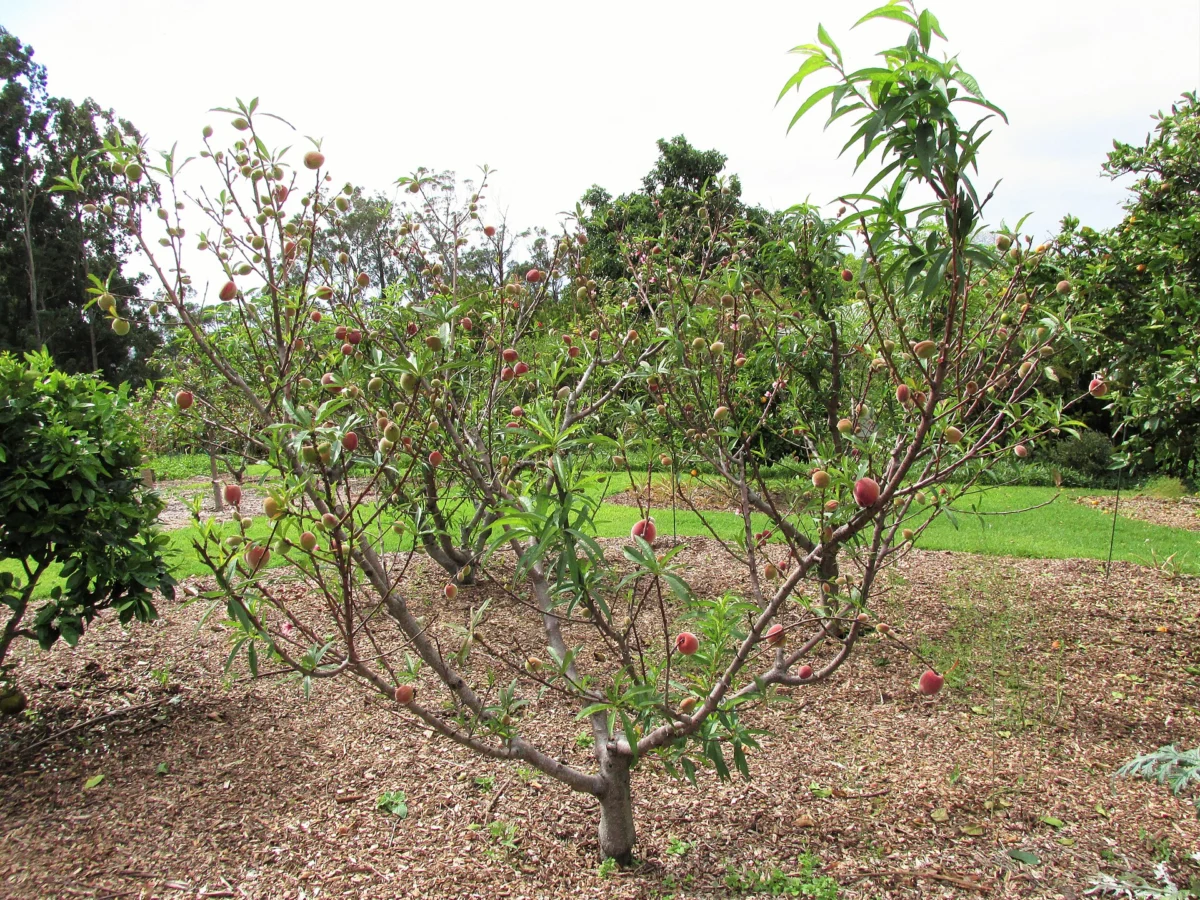
Peaches ripen from late spring in the warmest states to early fall in cooler ones, with July and August the main season across much of the country. Each variety has its own window, and a single tree can ripen over one to two weeks. If you grow your own, picking at the right moment matters more than any trick later. Read our peach tree care guide for harvest signs, use the harvest date calculator to estimate your window, and see freestone peaches if you plan to slice or preserve them.
Ripening peaches for different uses
How ripe you need a peach depends on what you plan to do with it. Matching the stage to the job saves fruit and improves the result.
- Eating fresh: wait for the full ripe stage, with a strong aroma and a slight give near the stem. Eat within a day or two.
- Slicing for salads or plates: use fruit that is just ripe, still a little firm, so slices hold their shape.
- Grilling or roasting: choose slightly firm peaches; the heat caramelizes the sugars and softens the flesh. Halve, remove the pit and cook cut side down.
- Baking, pies and cobblers: firm-ripe fruit holds up better than very soft fruit, which turns to mush and releases a lot of juice.
- Jam, sauce and smoothies: very ripe and even slightly overripe fruit is ideal, since flavor is concentrated and texture no longer matters. Cut away bruises and any spots of mold, and discard fruit with fermentation or leaking juice.
- Freezing: use fruit at the ripe stage and freeze it promptly, as underripe fruit freezes with less flavor.
If you have a mixed batch, sort it as soon as you get home. Put the hardest peaches in a bag, the nearly ripe ones in a single layer on the counter, and the ripe ones in the fridge or straight into whatever you are cooking. Check the counter fruit twice a day, because ripening is not even and a single overripe peach can bruise its neighbors and attract fruit flies.
Common mistakes
- Picking too early and expecting sweetness to arrive on the counter.
- Refrigerating fruit that is still hard.
- Stacking peaches in deep piles, which bruises the ones at the bottom.
- Forgetting the bag and returning to overripe fruit.
- Washing peaches before storing them, which encourages mold.
The best peaches start with good timing on the tree; see when to pick peaches for how to tell if a peach is ripe.
Safety and legal note: Throw away peaches that are moldy, fermented or leaking, and wash fruit before eating. If you can or freeze surplus fruit, use a tested recipe from the National Center for Home Food Preservation or your state extension service. Food safety and home-preserving rules vary by state and country.
Free printable: the Year-Round Garden & Preserving Planner
Planting dates for 24 crops, monthly tasks, blanching times, canning safety numbers and a winter storage chart in one 8-page PDF. Enter your email to download it instantly and get our seasonal garden newsletter.
No spam. Unsubscribe any time. We never sell your email.
Frequently asked questions
How long does it take to ripen peaches?
Usually 1 to 3 days in a paper bag and 2 to 4 days on the counter. Check often, since overripe fruit bruises easily.
Usually 1 to 3 days in a paper bag and 2 to 4 days on the counter. Check often, since overripe fruit bruises easily.
Can you ripen peaches without a paper bag?
Yes. A single layer on the counter or a bowl beside bananas works, just more slowly.
Yes. A single layer on the counter or a bowl beside bananas works, just more slowly.
Why are my peaches hard and mealy instead of juicy?
This is often chilling injury from cold storage before the fruit ripened, or fruit picked far too early. Ripen at room temperature first.
This is often chilling injury from cold storage before the fruit ripened, or fruit picked far too early. Ripen at room temperature first.
Do peaches ripen faster in the fridge?
No. Cold slows ripening. Use the fridge only to hold peaches that are already ripe.
No. Cold slows ripening. Use the fridge only to hold peaches that are already ripe.
Do bananas help peaches ripen?
A ripe banana adds ethylene and can even out ripening, but postharvest research suggests it does not dramatically speed it up. Warm room temperature matters more.
A ripe banana adds ethylene and can even out ripening, but postharvest research suggests it does not dramatically speed it up. Warm room temperature matters more.
Will green peaches ripen?
If the ground color is still fully green, they usually will not ripen properly. Cook them or use them in jam.
If the ground color is still fully green, they usually will not ripen properly. Cook them or use them in jam.
You’ll find related varieties, pruning calendars and pest guides in the fruit tree hub.
Reviewed October 2026. Sources: UC Davis Postharvest Technology Center, Peach: Maturity and Quality; University of Delaware Extension, Ripening Problems in Peaches.