
Few summer flowers are as generous as garden phlox. From midsummer into early fall, its big, domed clusters of pink, purple, lavender, red, salmon and white flowers fill the perennial border, many of them sweetly scented, and bees, butterflies and hummingbirds visit constantly. It is an old-fashioned cottage garden favorite that is still one of the backbone plants of the summer border.
Garden phlox does have one well-known weakness, powdery mildew, but choosing the right varieties and giving them the right spot solves most of the problem. This guide covers the different types of phlox, how to choose varieties, where and how to plant, care through the season, preventing powdery mildew and other problems, and design ideas for using phlox in your garden.
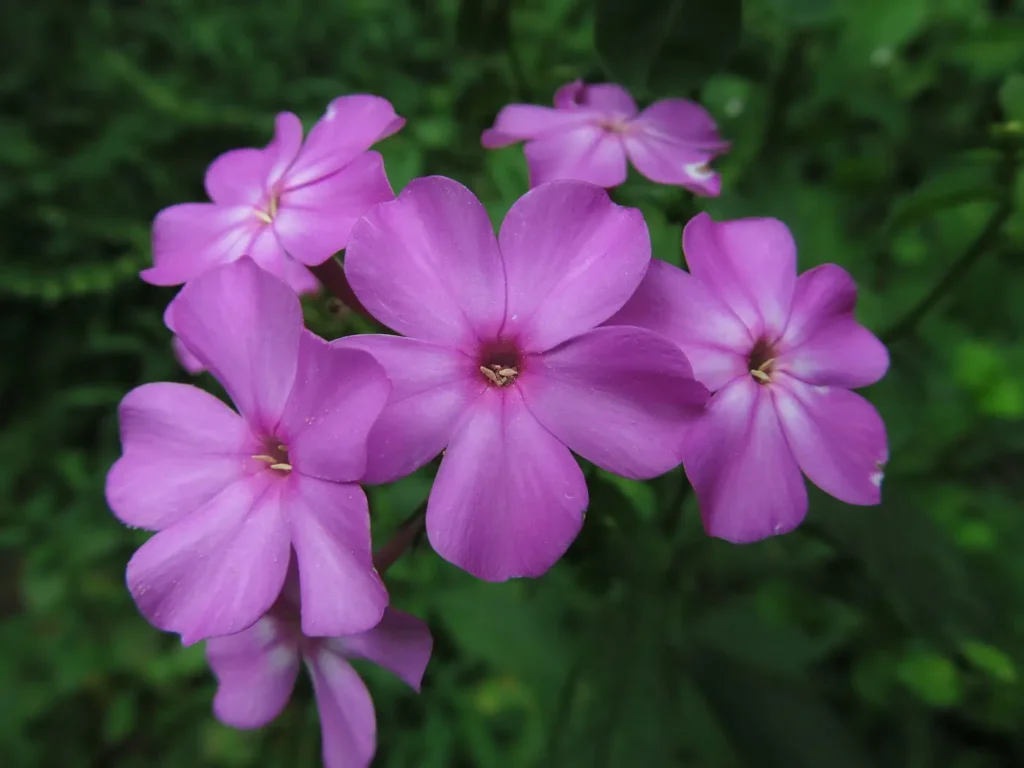
Garden phlox at a glance
| Feature | Details |
|---|---|
| Botanical name | Phlox paniculata (also called tall garden phlox or summer phlox) |
| Type | Herbaceous perennial, native to much of eastern North America |
| Height | Most 2 to 4 ft; some compact varieties shorter |
| Bloom time | Midsummer to early fall, often for six weeks or more |
| Flower colors | Pink, purple, lavender, red, salmon, white, often with a contrasting eye |
| Light | Full sun; tolerates light shade |
| Soil | Moist, rich, well-drained soil with plenty of organic matter |
| Wildlife | Attracts bees, butterflies and hummingbirds; deer often browse it |
| Main problem | Powdery mildew; choose resistant varieties |
University of Minnesota Extension describes tall garden phlox as providing a colorful summer display that can last six weeks or more, with most plants growing two to three feet tall and many sweetly perfumed.
Types of phlox
“Phlox” covers several garden plants that look and grow quite differently. Knowing which one you have, or want, makes care much easier.
| Type | Botanical name | Height | Bloom | Best use |
|---|---|---|---|---|
| Garden (tall, summer) phlox | Phlox paniculata | 2 to 4 ft | Midsummer to early fall | Sunny borders, cottage gardens |
| Spotted (meadow) phlox | Phlox maculata | 2 to 3 ft | Early to midsummer | Borders; often more mildew-resistant |
| Creeping (moss) phlox | Phlox subulata | 4 to 6 in | Spring | Ground cover, slopes, rock gardens, wall tops |
| Woodland phlox | Phlox divaricata | 10 to 15 in | Spring | Part shade, woodland gardens |
| Creeping woodland phlox | Phlox stolonifera | 6 to 10 in | Spring | Shade ground cover |
| Annual phlox | Phlox drummondii | 6 to 18 in | Late spring to summer | Bedding, containers, edging |
This guide focuses on tall garden phlox, but the sections below on creeping and woodland phlox cover the spring-blooming types too.
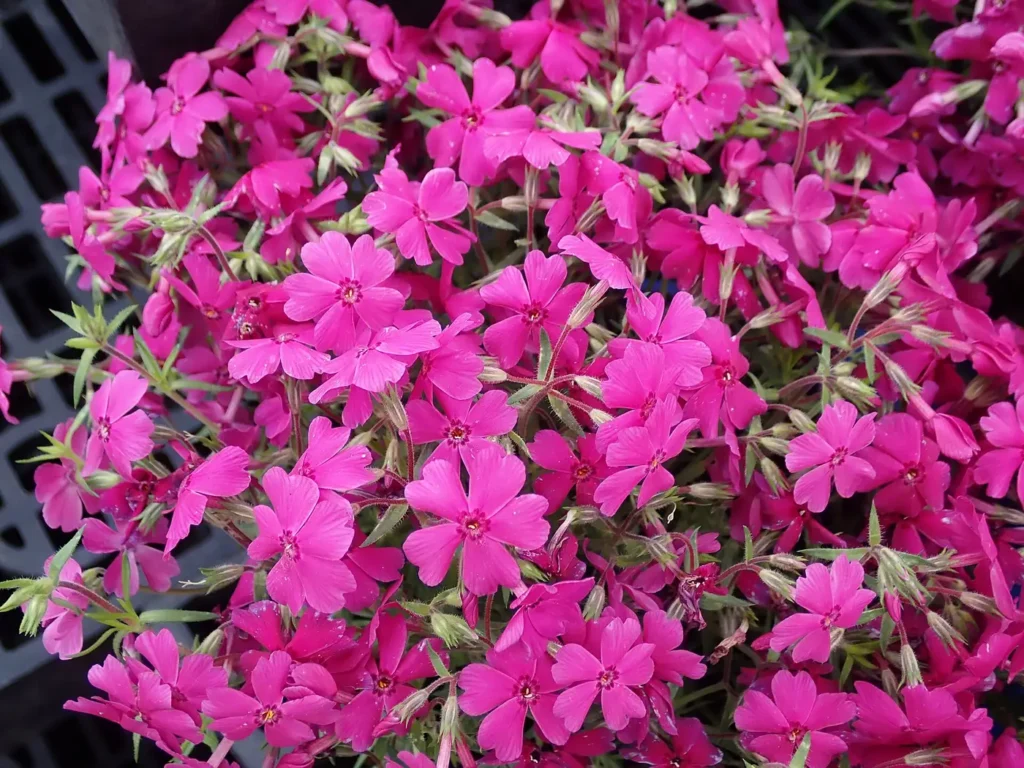
Choosing garden phlox varieties
The single most important decision is choosing varieties resistant to powdery mildew. University of Vermont Extension’s article on phlox and powdery mildew management recommends selecting resistant varieties when planting a new garden, and names several good choices:
| Variety | Flowers | Height | Notes |
|---|---|---|---|
| ‘David’ | White, fragrant | About 24 to 48 in | A classic for mildew resistance |
| ‘Goliath’ | Purple | About 26 to 30 in | Good mildew resistance |
| ‘Orange Perfection’ | Salmon-orange | About 36 in | Good mildew resistance |
| ‘Blue Flame’ | Light blue | About 12 to 20 in | Compact; good for smaller gardens |
Penn State’s arboretum highlights ‘Jeana’, a standout in trials and very popular with butterflies, and ‘Laura’, a mildew-resistant variety with pink-magenta to lavender flowers and a white eye. Resistance can vary by region, so a variety that stays clean in one climate may struggle in another. Ask your local Extension office or a good local nursery which varieties perform best near you.
Other things to consider
- Height: compact varieties suit the front or middle of a border; tall ones belong at the back.
- Fragrance: many phlox are scented, especially in the evening.
- Color: phlox colors range from soft pastels to vivid magenta; many have a contrasting eye.
- Heat tolerance: in hot, humid regions, look for varieties recommended locally for heat.
Where to plant garden phlox
- Sun: garden phlox needs sun to bloom well. Minnesota Extension advises full sun, though it tolerates light shade. Plants in shade flower less and are much more prone to mildew.
- Air circulation: choose an open spot, not a corner crowded against walls or other tall plants.
- Soil: moist but well-drained soil rich in organic matter. Minnesota Extension recommends incorporating generous amounts of organic matter before planting.
- Hardiness: garden phlox is hardy in a wide range of climates. Check your zone with the USDA Plant Hardiness Zone Map or our growing zone finder.
The sunlight requirement finder helps you check whether a spot gets enough sun.
How to plant garden phlox
Garden phlox is usually bought as potted plants and planted in spring or early fall.
- Prepare the soil: loosen it and work in 2 to 3 inches of compost. The compost calculator works out how much.
- Space plants well: leave about 18 to 24 inches between plants, or as the label recommends, so air moves freely. Crowding is one of the main causes of mildew.
- Dig a hole as deep as the pot and twice as wide.
- Plant at the same depth it grew in the pot, firm the soil and water thoroughly.
- Mulch with an inch or two of compost or shredded bark to keep the roots cool and moist.
The plant spacing calculator works out how many plants fit in a bed.
Caring for garden phlox
Watering
Phlox likes consistently moist soil. Water deeply during dry spells, at the base of the plant rather than over the leaves, ideally in the morning. Drought-stressed plants are more likely to suffer from powdery mildew, so steady moisture is good prevention. Our guide on how often to water explains how to check soil moisture.
Feeding
Top-dress with compost each spring. Phlox growing in rich soil rarely needs more, and too much nitrogen produces soft growth that is more prone to disease.
Thinning stems
In spring, when shoots are a few inches tall, remove the weakest stems so each clump has about four to six strong ones. This improves air circulation through the plant and helps prevent mildew, and the remaining stems are often sturdier with bigger flower heads.
Deadheading
Cutting off faded flower heads encourages side shoots to bloom, extending the season, and stops plants from self-seeding. Self-sown seedlings often revert to plain magenta and can crowd out the variety you planted.
Staking
Tall varieties can flop, especially in rich soil or after heavy rain. Penn State notes that staking may be needed for taller varieties. Put supports in place early, or cut stems back by a third in late spring for shorter, sturdier plants that flower slightly later.
Dividing
Every three to four years, or when the center of a clump dies out, divide plants in spring or early fall. Replant the healthiest outer sections in improved soil.
Fall cleanup
Cut plants down after frost and remove the stems and fallen leaves, especially if mildew was present, since infected debris carries the disease over winter. Do not add mildewed leaves to the compost.
Preventing powdery mildew on phlox
Powdery mildew appears as a white or gray powdery coating on the leaves, usually starting low on the plant in mid to late summer. Badly affected leaves yellow, brown and drop. It rarely kills phlox, but it spoils the look of the plant. Prevention works far better than cure:
| Step | Why it helps |
|---|---|
| Choose resistant varieties | The most effective single step |
| Plant in full sun | Mildew thrives on plants growing in shade |
| Space plants generously | Air movement keeps leaves drier |
| Thin stems in spring | Opens up each clump |
| Water consistently, at the base | Drought stress increases mildew; wet leaves spread other diseases |
| Clean up in fall | Removes infected leaves and stems |
| Move badly affected plants | A sunnier, airier spot often solves chronic problems |
UVM Extension also suggests relocating phlox in existing gardens if mildew is a constant problem, and talking to local nursery experts about how different varieties perform locally. Fungicides are an option in severe cases, but they work only as a preventive and must be reapplied; follow label directions carefully.
Other phlox problems
| Problem | Signs | What to do |
|---|---|---|
| Spider mites | Fine speckling and webbing, worse in hot, dry weather | Spray leaf undersides with water; keep plants watered |
| Phlox plant bugs | Pale speckling on leaves and distorted growth | Clean up stems in fall to remove overwintering eggs |
| Root rot | Wilting and decline in wet soil | Improve drainage; avoid waterlogged sites |
| Deer | Flower heads and tops eaten | Fencing or repellents; see our guide to keeping animals out |
| Floppy stems | Stems lean or collapse | Stake early or cut back in late spring |
| Magenta seedlings | Unwanted seedlings with plain flowers | Deadhead and pull seedlings |
Penn State lists powdery mildew, root rot, phlox bugs and spider mites among the issues phlox growers may face. The pest identifier and plant problem identifier help diagnose problems, and our guide to keeping animals out of your garden covers deer.
Phlox or dame’s rocket?
Dame’s rocket (Hesperis matronalis) is an invasive plant with similar purple, pink or white flowers in late spring, often seen along roadsides. The easiest way to tell them apart is to count the petals: phlox flowers have five petals, while dame’s rocket has four.
Creeping phlox and woodland phlox
Creeping phlox (Phlox subulata)
Creeping phlox forms dense, low mats of needle-like evergreen leaves covered in pink, purple, blue or white flowers in spring. It needs full sun and excellent drainage, and is perfect for slopes, rock gardens, wall tops and edging. Shear plants lightly after flowering to keep them compact. See our guide to rock gardens for planting ideas.
Woodland phlox (Phlox divaricata)
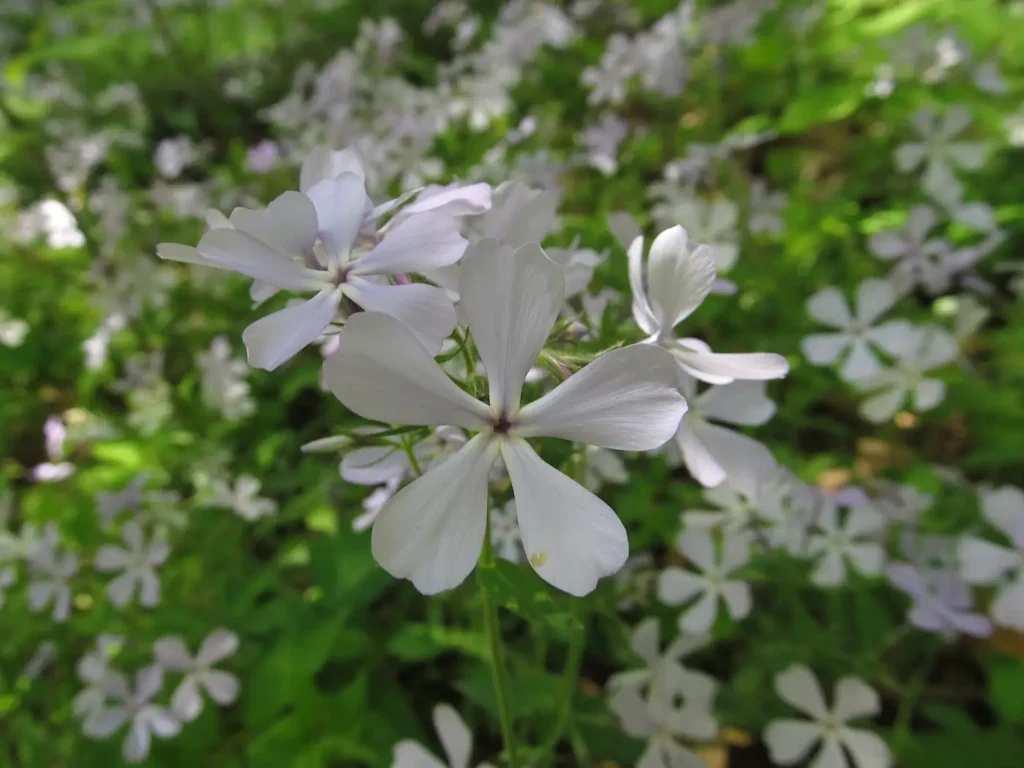
Woodland phlox is a native spring wildflower with loose clusters of fragrant, pale blue, lavender or white flowers. It thrives in part shade and moist, rich soil, making it a lovely partner for ferns, hostas and spring bulbs in a shade garden. See our guide to shade garden plants.
Designing with phlox
- In the summer border: plant groups of three to five in the middle or back of a sunny border.
- Good companions: coneflowers, bee balm, black-eyed Susans, daylilies, Russian sage, ornamental grasses and asters, which share phlox’s season and conditions.
- In a cottage garden: phlox is a cottage classic alongside roses, delphiniums and hollyhocks; see our cottage garden guide.
- For pollinators: phlox feeds butterflies, bees and hummingbirds. Penn State Extension’s guide to planting pollinator-friendly gardens recommends native plants like phlox, and our pollinator garden guide includes a sample bed.
- For cutting: phlox makes a fragrant cut flower; cut when about half the florets in a cluster are open.
- For evening fragrance: plant white varieties such as ‘David’ near a patio or path, where the scent and pale flowers are enjoyed at dusk.
Our guide to starting a flower garden covers bloom sequencing and color design in detail. Michigan State University Extension’s flower gardening guide (PDF) is a helpful reference for planning combinations.
A year of phlox care
| Season | Tasks |
|---|---|
| Early spring | Top-dress with compost; divide crowded clumps; set stakes for tall varieties |
| Late spring | Thin stems to four to six per clump; optionally cut back by a third for shorter plants; shear creeping phlox after flowering |
| Summer | Water deeply in dry spells; deadhead; watch for mildew and mites |
| Fall | Cut down after frost; remove stems and fallen leaves; plant or divide |
Common mistakes with garden phlox
- Planting mildew-prone varieties in a humid climate.
- Planting in shade, which reduces flowering and encourages mildew.
- Crowding plants against walls or other perennials.
- Letting plants dry out in summer.
- Composting mildewed leaves.
- Letting plants self-seed, so magenta seedlings take over named varieties.
Frequently asked questions
Is garden phlox a perennial?
Yes. Garden phlox (Phlox paniculata) is a long-lived herbaceous perennial that dies back in winter and regrows each spring.
Does garden phlox need full sun?
It blooms best in full sun and tolerates light shade. Plants in shade flower less and are more prone to powdery mildew.
How do I stop powdery mildew on phlox?
Choose resistant varieties, plant in full sun with plenty of space, thin stems in spring, water consistently at the base, and remove infected stems and leaves in fall.
When does garden phlox bloom?
From midsummer into early fall, often for six weeks or more, and longer with deadheading.
Should I deadhead phlox?
Yes. Deadheading encourages more flowers from side shoots and prevents self-seeded seedlings that often revert to plain magenta.
Is phlox deer resistant?
No. Deer often browse garden phlox. Fencing or repellents may be needed where deer are common.
What is the difference between garden phlox and creeping phlox?
Garden phlox is a tall summer-blooming border perennial. Creeping phlox is a low, mat-forming ground cover that blooms in spring.
How far apart should I plant phlox?
About 18 to 24 inches apart for garden phlox, or as the label recommends, to allow good air circulation.