Few sights mark spring like an apple tree in bloom. The flowers open pink in bud, fade to white and set the stage for the whole year’s crop. But blossoms are also the most vulnerable moment in the orchard: a late frost, a cold rainy week or a spray at the wrong time can cost you the harvest. This guide explains when apple trees bloom, what the flowers look like, how pollination works, how cold they can take, how to protect and assess them, what to do if your tree blooms but does not fruit, and how to thin the fruit afterwards.
Apple blossom quick facts
| Question | Short answer |
|---|---|
| When do apples bloom? | Mid to late spring in most climates, depending on region and variety |
| How long does a tree stay in flower? | Roughly one to two weeks; warm spells speed it up, cool weather stretches it |
| Flowers per cluster | Five or six, on short spurs; the center “king” bloom opens first |
| Frost danger in full bloom | University of Arizona Extension lists 29°F as the critical temperature for apple and pear at full bloom |
| Pollination | Most varieties need pollen from a different, compatible apple or crabapple, carried by bees |

When do apple trees bloom?
Apple trees bloom in spring, a couple of weeks or so after the buds swell. In mild regions that can be early spring and in cold ones late spring, and the exact date moves from year to year with the weather. Varieties are grouped as early, mid or late bloomers, and that grouping matters for pollination because two trees can only pollinate each other if their flowers are open at the same time. Warm weather speeds bloom, so in a hot spring the whole orchard may flower within a few days of each other, while a cool spring spreads bloom out and gives bees more time but also more risk of frost.
You can track your own bloom dates from year to year. Keep a note of the day the first flowers open and the day petals fall. After a few seasons you will know whether your site tends to bloom early, and how long you are exposed to frost. Our frost dates by ZIP code tool shows your average last spring frost, and the growing zone finder helps you pick suitable varieties. Our guide on when to plant apple trees explains the planting side.
What apple flowers look like
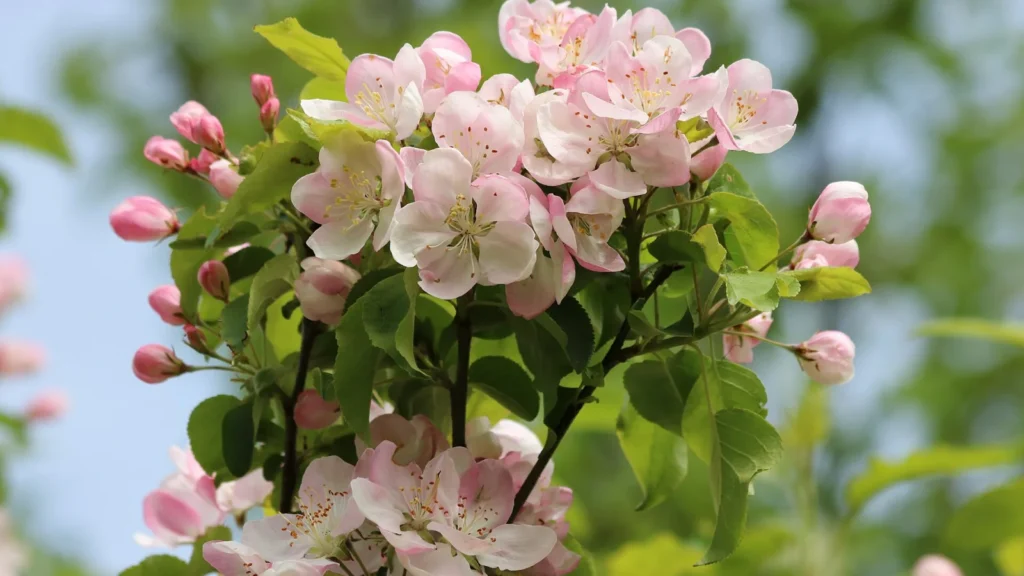
Apple flowers form in clusters of five or six on short spurs. Each blossom has five petals, usually pink in bud and white to pale pink when open, with a ring of yellow-tipped stamens around the central styles. The center blossom, called the king bloom, opens first and often produces the biggest fruit. The ovary sits below the petals in the floral cup, which is why the future apple swells from the base of the flower.
Stages of bloom
- Green tip and tight cluster: the buds break and the first leaves and flower clusters appear. Buds are most hardy at this stage.
- Pink: the flower buds show color but are still closed.
- King bloom and full bloom: the center flower opens, then the side blooms open over the next several days.
- Petal fall: petals drop, and the tiny fruitlets begin to swell.
Cold tolerance falls as the flowers open, which is why the same frost can be harmless at tight cluster and devastating at full bloom.
How apple pollination works
Most apple varieties are self-incompatible, meaning they need pollen from a different variety to set a good crop; the Wikipedia article on the apple summarizes the basics of cross-pollination and the role of honey bees and wild bees. Bees carry pollen from tree to tree, so you need both a compatible partner and active pollinators.
- Choose partners that bloom together. Pair varieties from the same or adjacent bloom groups, and keep the trees within about 50 feet of each other for good bee traffic.
- Use crabapples. Many crabapples are excellent pollinators and bloom for a long period; a tree in your yard or next door may be enough. See our guide to the crabapple tree.
- Beware triploids. Some varieties produce little viable pollen, so they need two other varieties, one to pollinate them and one to pollinate that one.
- Welcome bees. Plant flowers nearby and avoid anything that harms them.
If space is tight, consider a self-pollinating-style tree or a pair of dwarf trees; see self-pollinating apple trees, columnar apple trees and dwarf apple trees.

Frost and your apple blossoms
Open apple blossoms are damaged by temperatures at or just below freezing. The University of Arizona Extension’s publication on freeze and frost damage to fruit trees lists 29°F as the critical temperature at full bloom for apple and pear, compared with 27°F for apricot, peach, plum and sweet cherry and 28°F for sour cherry. For stone fruit after bloom, the critical temperature is 30°F. Duration matters as well as the number: a brief dip is less damaging than several hours below the threshold, and a damp, still night is riskier than a windy one.
How to reduce frost risk
- Check the forecast daily during bloom, and keep an outdoor thermometer, ideally one with an alarm, at flower height.
- Plant on a slope or open site, not in a low frost pocket where cold air settles.
- Choose later-blooming varieties if your area has frequent late frosts.
- Cover small trees with a frost cloth or blanket for the night, draped to the ground, and remove it in the morning. The Arizona publication notes that covering trees, with or without a heat source such as incandescent lights underneath, is a standard protection method.
- Water the soil the day before a frost. Moist soil holds and releases more heat than dry soil.
- Do not prune late. Pruning in spring stimulates growth and can push buds earlier.
Large trees are harder to protect, so site choice and variety choice matter most.
Check for frost damage
After a frost, do not assume the worst. The Arizona publication points out that freeze damage often affects only some flowers, usually the most developed ones or those low in the tree, and that warmer zones within the canopy may allow some fruit to survive temperatures that would otherwise be fatal. To check apples and pears, tear a flower open: the pistil is buried in the floral cup, so look at the center. A brown or black center means the flower has been killed. Check the king bloom and the side blooms separately. If side blooms are larger than the king bloom a few weeks after a frost, the king bloom was probably killed earlier. Wait a few days before judging, because damage takes time to show.
Why did my apple tree bloom but not fruit?
- Frost damage during bloom. Check pistils as described above.
- Poor pollination. Cold, wet or windy weather keeps bees in their hives, and some gardens simply have no compatible partner or few pollinators.
- Biennial bearing. Some trees give a huge crop one year and little or none the next, because heavy fruiting suppresses flower bud formation for the following year. Thinning helps.
- Too much nitrogen. This favors leaves over fruit. See our fruit tree fertilizer guide.
- Young age. Many trees do not fruit for 3 to 5 years, and some dwarfs fruit earlier.
- Natural fruit drop. Trees often shed some small fruitlets in late spring and again in early summer. A partial drop is normal and is the tree adjusting to what it can carry.
Protecting bees
Do not spray insecticides on trees in bloom. Many product labels prohibit applications to blooming plants when bees are present, and the label is the law. If you must treat, follow the label’s bee-protection instructions exactly, or wait until petals have fallen. Plant flowers nearby to feed pollinators before and after the apple bloom, and leave a shallow dish of water with stones for landing. If you are managing pests, start with cultural measures: see our guides to apple scab, cedar apple rust, plum curculio and worms in apples for timing that avoids bloom.
After bloom: thin the fruit
Once the petals drop and tiny apples form, a tree often sets more fruit than it can carry. Thin clusters to one apple per spur, spaced about 6 inches apart, a few weeks after bloom. Remove the smallest and any damaged fruit first, and consider keeping the king fruit, which is often the largest. Thinning gives larger apples, reduces limb breakage and helps the tree flower again next year, which breaks the biennial cycle. If you want more help with the harvest, see when apples are ready to pick and how to store apples.
Are apple blossoms edible?
Apple blossoms are sometimes used as a garnish or to make syrups, but only eat flowers you know have not been sprayed, and remember that every blossom you pick is a potential apple. If you want the flowers for the table, take a few from a crabapple or an extra tree, and leave the rest for fruit.
A bloom-time checklist
- Know your varieties’ bloom groups and confirm each tree has a compatible partner.
- Set a thermometer at flower height and check the forecast every day from tight cluster to petal fall.
- Have frost cloth, stakes and clips ready before you need them.
- Stop all spraying that could reach open flowers.
- After frost, check the center of several flowers on different branches.
- After petal fall, thin to one fruit per spur and record the date for next year.
How weather shapes the bloom
The weather during bloom affects fruit set in several ways at once. Cold slows pollen tube growth, so a flower that was visited by a bee on a chilly day may still fail to fertilize before it wilts. Rain washes pollen away and keeps bees at home, and wind makes it hard for them to land. A warm, calm, sunny week is ideal: bees fly freely, pollen germinates quickly and the flowers stay open long enough for fertilization. Because you cannot control the weather, the most reliable strategy is to give pollination more chances. Plant more than one compatible variety, keep a mix of early, mid and late bloomers if you have room, and welcome native bees such as mason bees, which fly in cooler weather than honey bees.
Helping pollination along
- Add a pollinator bouquet. A cut branch of a crabapple or another apple in a bucket of water, hung in the tree during bloom, can supply pollen when partners are scarce.
- Provide nesting sites. Bee hotels and undisturbed bare soil or hollow stems support native bees through the season.
- Time your mowing. Dandelions and clover in the grass below the tree feed bees early in spring; mow them down after petal fall rather than during bloom.
- Hand-pollinate a small tree. If bees are scarce, dab a soft brush from flower to flower on a compatible partner and then onto the target tree on a warm, dry morning.
Bloom through the life of a tree
A young apple tree may flower lightly in its first years, and it is usually wise to pick off the blossoms in the first spring so the tree puts its energy into roots and shoots. As the tree matures, bloom becomes heavier and more regular. A very old or stressed tree may bloom heavily out of habit while setting little fruit. If bloom suddenly changes, look at the tree’s overall health: a lack of vigor, canker, borers or poor drainage can all show up first as poor flowering. Consistent pruning, balanced feeding, mulch and deep watering in dry spells keep a tree on a steady cycle, with enough healthy spurs to carry flowers in the right places.
Safety and legal note: Do not spray insecticides on trees in bloom. Many product labels prohibit applications to blooming plants when bees are present, and the label is the law. If you must treat, follow the label’s bee-protection instructions exactly, or wait until petals have fallen. Rules vary by state and country. Only eat flowers you know are unsprayed, and use ladders carefully when covering tall trees.
Looking for the next tree to plant? Our guide to growing fruit trees at home compares options by climate and space. See also Golden Delicious apples and heirloom apples.
Free printable: the Year-Round Garden & Preserving Planner
Planting dates for 24 crops, monthly tasks, blanching times, canning safety numbers and a winter storage chart in one 8-page PDF. Enter your email to download it instantly and get our seasonal garden newsletter.
No spam. Unsubscribe any time. We never sell your email.
Frequently asked questions
How long do apple blossoms last?
Usually about one to two weeks per tree, depending on the weather.
Can an apple tree pollinate itself?
A few varieties set some fruit alone, but most do much better with a second compatible variety or a crabapple nearby.
At what temperature do apple blossoms freeze?
University of Arizona Extension lists 29°F as the critical temperature for apples at full bloom; tight buds tolerate colder weather.
How can I tell if frost killed my blossoms?
Tear a flower open; a brown or black center means it has been killed.
Can I protect blossoms from frost?
Covering small trees overnight with frost cloth and avoiding frost pockets helps. Large trees are harder to protect.
Reviewed October 2026. Bloom dates and frost risk vary by region.