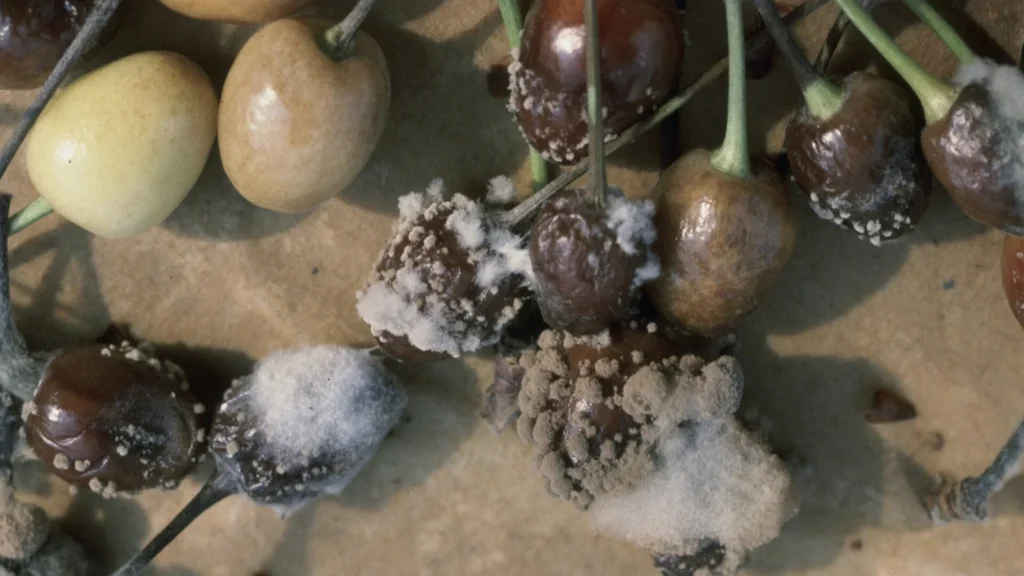
Brown rot is the most common and destructive disease of stone fruits, including peaches, nectarines, plums, apricots and cherries. Caused by Monilinia fungi, it blights blossoms and twigs in spring, then rots ripening fruit, which develops soft, brown, circular spots that spread rapidly and become covered in tan to gray powdery tufts of spores. Rotted fruit shrivels into hard, wrinkled “mummies” that hang on the tree or fall to the ground and carry the fungus to the next year. To manage brown rot, remove every mummy and infected twig during winter pruning, prune for an open canopy, thin fruit so it does not touch, control insects that wound fruit, harvest promptly and handle fruit gently, and, in wet regions, protect blossoms and ripening fruit with a fungicide labeled for brown rot.
Brown rot of stone fruit at a glance
| Stage | Symptoms | Timing |
|---|---|---|
| Blossom blight | Flowers wilt, turn brown and stick to twigs; gummy ooze; gray spore tufts in wet weather | Bloom |
| Twig canker | Sunken, brown, gummy cankers at the base of blighted flowers; twigs may die | Spring to early summer |
| Fruit rot | Small, round, brown spots that spread quickly; tan to gray spore tufts in rings | From about 2 to 3 weeks before harvest and in storage |
| Mummies | Shriveled, hard, black fruit on the tree or ground | Late summer through winter |
| Next spring | Mummies and cankers produce spores that infect blossoms | Bloom |
What causes brown rot?
Brown rot is caused mainly by Monilinia fructicola in North America and by M. laxa and M. fructigena in Europe and elsewhere. The Wikipedia article on Monilinia fructicola explains that the fungus survives the winter in mummified fruit and twig cankers. In spring, mummies on the ground can produce small, cup-shaped mushrooms (apothecia) that release spores, and mummies and cankers on the tree produce powdery spores, all of which infect blossoms during wet weather. Infected blossoms and later fruit produce millions more spores, spread by wind, rain and insects. The Penn State Extension guide to stone fruit brown rot notes that fruit becomes increasingly susceptible as it ripens and that wounds from insects, hail or cracking greatly increase infection.

How do you identify brown rot?
- Blighted blossoms that turn brown, wilt and cling to twigs instead of falling.
- Gummy cankers on twigs below infected flowers, sometimes girdling and killing shoots.
- Small, firm, brown spots on ripening fruit that spread to rot the whole fruit within a couple of days in warm weather.
- Tan to gray, powdery spore tufts in concentric rings on rotting fruit.
- Mummified fruit that hangs on the tree through winter or lies on the ground.
- Rot spreading between touching fruits in clusters.
Other fruit rots exist: rhizopus rot causes soft, watery rot with coarse black-capped mold in hot weather, and anthracnose and bitter rot cause sunken spots with pink or orange spores on some fruits. See our guides to anthracnose and gray mold, and use the plant problem identifier for other symptoms.
Which fruits get brown rot?
| Fruit | Susceptibility | Notes |
|---|---|---|
| Peaches and nectarines | Very high | Nectarines, with smooth skin, are often hit hardest |
| Apricots | Very high | Blossom blight is especially common because apricots bloom early in cool, wet weather |
| Sweet and sour cherries | High | Fruit can rot quickly in rain near harvest; blossom blight on sour cherries |
| Plums and prunes | High | Japanese plums and tightly clustered varieties are vulnerable |
| Almonds | Blossom and twig blight | Fruit rot uncommon |
| Apples and pears | Occasional | Mainly on damaged or overripe fruit, especially with M. fructigena |
How do you control brown rot without sprays?
- Remove all mummies. In winter, pick every shriveled fruit off the tree and rake up those on the ground. This is the single most important step, because mummies are the main source of spring infections.
- Prune out cankers and blighted twigs during dormant pruning and again in spring when blighted blossoms become visible, cutting several inches below the infected area. Disinfect pruners between cuts.
- Prune for an open canopy. An open-center or vase shape lets sunlight and air dry blossoms and fruit quickly after rain. See when to prune peach trees and how to prune a plum tree.
- Thin fruit so fruits do not touch, about 6 to 8 inches apart on peaches and 3 to 4 inches on plums. Touching fruit spreads rot.
- Control insects such as plum curculio, oriental fruit moth and stink bugs, whose wounds let the fungus in.
- Harvest promptly, handle fruit gently and cool it quickly. Remove any rotting fruit from the tree and ground during harvest.
- Clean up dropped fruit through the season.

When should you spray for brown rot?
In regions with wet springs and humid summers, cultural controls alone may not protect susceptible stone fruits. Protective fungicides labeled for brown rot are typically applied at two critical times:
- Bloom: from early bloom through petal fall, especially during wet weather, to prevent blossom blight. Apricots and sour cherries benefit most.
- Preharvest: starting about two to three weeks before harvest and repeated as the label allows, to protect ripening fruit, especially in rainy weather.
Options for home orchards include captan, sulfur, myclobutanil, propiconazole and some biological products; read each label for the crops, timing and pre-harvest interval. Some fungicides are not labeled for all stone fruits. Sulfur can injure some apricot varieties. Do not spray open blossoms when bees are active unless the label allows bloom applications and you spray in the evening. A dormant copper spray, often used for leaf curl and bacterial canker, does not control brown rot. See copper fungicide and peach leaf curl.
Label note: Use only fungicides labeled for brown rot on your specific stone fruit, follow the label rate, timing and pre-harvest interval, and wear the protective equipment listed. Do not spray open blossoms when bees are foraging unless the label allows it, and then only in the evening.
How do you handle fruit to prevent rot after harvest?
Brown rot can continue developing after harvest, sometimes rotting a bowl of peaches overnight. Pick fruit in the cool of the morning, handle it like eggs to avoid bruising, discard any fruit with spots, and cool it quickly in the refrigerator if you will not eat it within a day or two. Do not wash fruit until just before eating. Store fruits in a single layer rather than piled up. For ripening tips, see how to ripen peaches and when to pick peaches.
Which stone fruit varieties resist brown rot?
The UMass Extension fact sheet on brown rot of stone fruits emphasizes sanitation, pruning and timely protective sprays, since resistance among common varieties is limited.
No stone fruit is immune, but some varieties are less susceptible. Peaches with firmer skin and fruit that ripens in drier parts of the season often fare better than very soft, early varieties. Among plums, European types such as Stanley and Italian prune plums tend to have less rot than tightly clustered Japanese plums. Sour cherries such as Montmorency are prone to blossom blight in wet springs. Choosing varieties suited to your climate, especially ripening times that avoid your rainiest weeks, can reduce rot. Ask your local Extension office for varieties that perform well in your area, and see our types of plum trees guide.
Is brown rot dangerous to eat?
Do not eat rotted fruit. Discard any fruit with brown rot spots, along with fruit that has been touching it, since the rot spreads quickly. Brown rot is not known to make people sick, but rotting fruit can host other molds, some of which produce toxins. Healthy fruit from the same tree is fine to eat.
You can find guides to related pests and diseases in our plant pests and diseases hub.
Free printable: the Year-Round Garden & Preserving Planner
Planting dates for 24 crops, monthly tasks, blanching times, canning safety numbers and a winter storage chart in one 8-page PDF. Enter your email to download it instantly and get our seasonal garden newsletter.
No spam. Unsubscribe any time. We never sell your email.
Brown rot FAQ
What causes brown rot on peaches?
Monilinia fungi that overwinter in mummified fruit and twig cankers and spread in wet weather.
Should I remove mummified fruit?
Yes, remove every mummy from the tree and ground in winter; it is the most important control step.
Can you cut out brown rot and eat the rest?
It is safer to discard the whole fruit, because the fungus spreads beyond visible spots.
When do peaches get brown rot?
Blossoms in spring and fruit in the last few weeks before harvest, especially in wet weather.
Does brown rot affect apples?
Occasionally, mainly on damaged or overripe fruit.
Can brown rot kill a tree?
Not usually, but twig cankers and repeated blossom blight weaken trees and reduce yields.
How does weather affect brown rot?
Brown rot needs moisture. Blossom infections occur when flowers stay wet for several hours during rainy, foggy or drizzly periods at bloom, at temperatures from the 50s to the 70s°F, with warmer temperatures needing shorter wet periods. Fruit rot develops fastest in warm, humid weather in the weeks before harvest, when a rotting peach can be covered in spores within a day or two. Dry, sunny weather at bloom and harvest means much less brown rot, which is why the disease is a bigger problem in the humid East and South than in the dry West. Watching the forecast around bloom and the last few weeks before harvest tells you when protection matters most.
How do you clean up an orchard for brown rot?
- Late fall and winter: remove every mummy from trees and the ground; prune out dead twigs and cankers.
- Before bloom: check again for missed mummies and rake the orchard floor.
- After bloom: cut out blighted blossoms and twigs as soon as you see them.
- During thinning: remove damaged and diseased fruitlets.
- Harvest: remove all rotting fruit from trees and ground as you pick.
- After harvest: pick off any remaining fruit so it does not mummify on the tree.
Bag diseased fruit for the trash or bury it at least a foot deep away from the trees. Composting is risky unless your pile gets very hot. Keeping the area under trees mowed or mulched also makes it easier to spot and remove dropped fruit. The mulch calculator helps estimate how much mulch you need for the root zone.
Is brown rot worse on some trees in the same orchard?
Yes. Trees with dense canopies, poorly thinned crops, insect damage or a history of mummies left hanging usually suffer most, and early-ripening, soft-fleshed varieties and nectarines are often hit hardest. Focus pruning, thinning and protection on those trees first.
Can you grow stone fruit without spraying for brown rot?
In dry climates, often yes, with good sanitation, pruning and thinning. In humid regions, unsprayed peaches and nectarines frequently lose a large share of the crop in wet years, though plums, sour cherries and some apricots may still produce reasonable crops with careful cultural control. Choosing varieties that ripen during your driest weeks, planting in a sunny, breezy site, and being meticulous about mummy removal give the best chance of success without sprays.
Diligent sanitation each winter, combined with thinning and prompt harvest, gives most home orchards a good crop of clean peaches and plums in all but the wettest summers.
Can brown rot spread in the fruit bowl?
Yes. A single infected peach can spread rot to neighboring fruit within a day at room temperature. Check bowls of stone fruit daily, remove any with soft brown spots immediately, and keep fruit in a single layer with space between pieces.
Refrigerating fruit you will not eat within a day slows rot considerably.
Good luck with this season’s harvest of peaches, plums and cherries.
Clean up every mummy each winter, and the next season starts with far fewer spores.
Sources: Penn State Extension, Stone Fruit Disease: Brown Rot; UMass Extension, Brown Rot of Stone Fruits; Wikipedia, Monilinia fructicola.
The brown rot cycle and where to break it
University of Illinois Extension’s article on managing brown rot of peaches and other stone fruit describes the disease in three phases. In spring, warm moist weather causes flowers to wither and turn brown but stay on the tree, with infection spreading into shoots, where sunken cankers may ooze gum. Fruit becomes most susceptible about 2 to 3 weeks before harvest; small circular spots enlarge, and in warm wet weather fruit can rot within 2 to 3 days, producing tan-to-grey spore masses before shrivelling. Mummies, the shrivelled fruit that drop or stay on the tree, are a major source of spring inoculum.
- Sanitation: promptly pick up dropped and rotted fruit, remove mummies from trees, and prune out infected twigs and branches in dormancy.
- Airflow: open the canopy so the tree dries faster, and thin fruit so mature fruit does not touch.
- Wounds: control insects and birds, since wounds give the fungus entry points.
- Fungicides: they protect tissue but do not cure existing brown rot, and spraying after symptoms appear gives poor control. Begin when flower buds start to turn pink; named active ingredients are captan, myclobutanil and propiconazole. Check the product is labelled for your tree type and respect pre-harvest intervals.
- Handling: pick carefully and store fruit cool, because injured fruit is more prone to rot in storage.
See our fruit trees hub for related pest and disease guides.
Safety and legal note: Fungicides can be hazardous to skin, eyes and aquatic life, and each has a pre-harvest interval. Wear protective gear, avoid spraying in bloom when bees are active, and follow the label for your tree and country. Rules on pesticide use vary by country and region.
Reviewed October 2026. Sources: University of Illinois Extension, Manage brown rot of peaches and other stone fruit in the garden