Pink blueberries are blueberry varieties whose ripe fruit stays bright pink instead of turning blue. The best known is ‘Pink Lemonade’, released by the USDA Agricultural Research Service in 2005: a hybrid that is roughly half rabbiteye, with mild, sweet, glossy pink berries that ripen in mid to late season. Pink blueberries grow like other blueberries, in acidic soil around pH 4.5 to 5.5, and fruit best with another rabbiteye-type variety nearby for cross-pollination. This guide covers where pink blueberries came from, how they taste, where they grow, how to plant, pollinate, feed, prune and protect them, and how to harvest and use the berries.
Pink blueberry facts
| Trait | What to know |
|---|---|
| Main variety | ‘Pink Lemonade’ (hexaploid hybrid, roughly half rabbiteye) |
| Released | 2005 by the USDA Agricultural Research Service as ARS 96-138; renamed Pink Lemonade in 2007 |
| Breeder | M.K. Ehlenfeldt, USDA-ARS blueberry program at Chatsworth, New Jersey |
| Fruit | Medium-sized, glossy, bright pink, firm, with a mild, sweet, floral flavor |
| Season | Mid-late to late season; usually mid to late July in New Jersey |
| Size | Vigorous, upright, full bush, often about 4 to 5 feet in gardens |
| Climate | Suited to USDA zone 6 and milder; crops can be irregular after late spring frosts |
| Soil pH | About 4.5 to 5.5 |
| Pollination | Plant with another rabbiteye-type blueberry |
Are pink blueberries real?
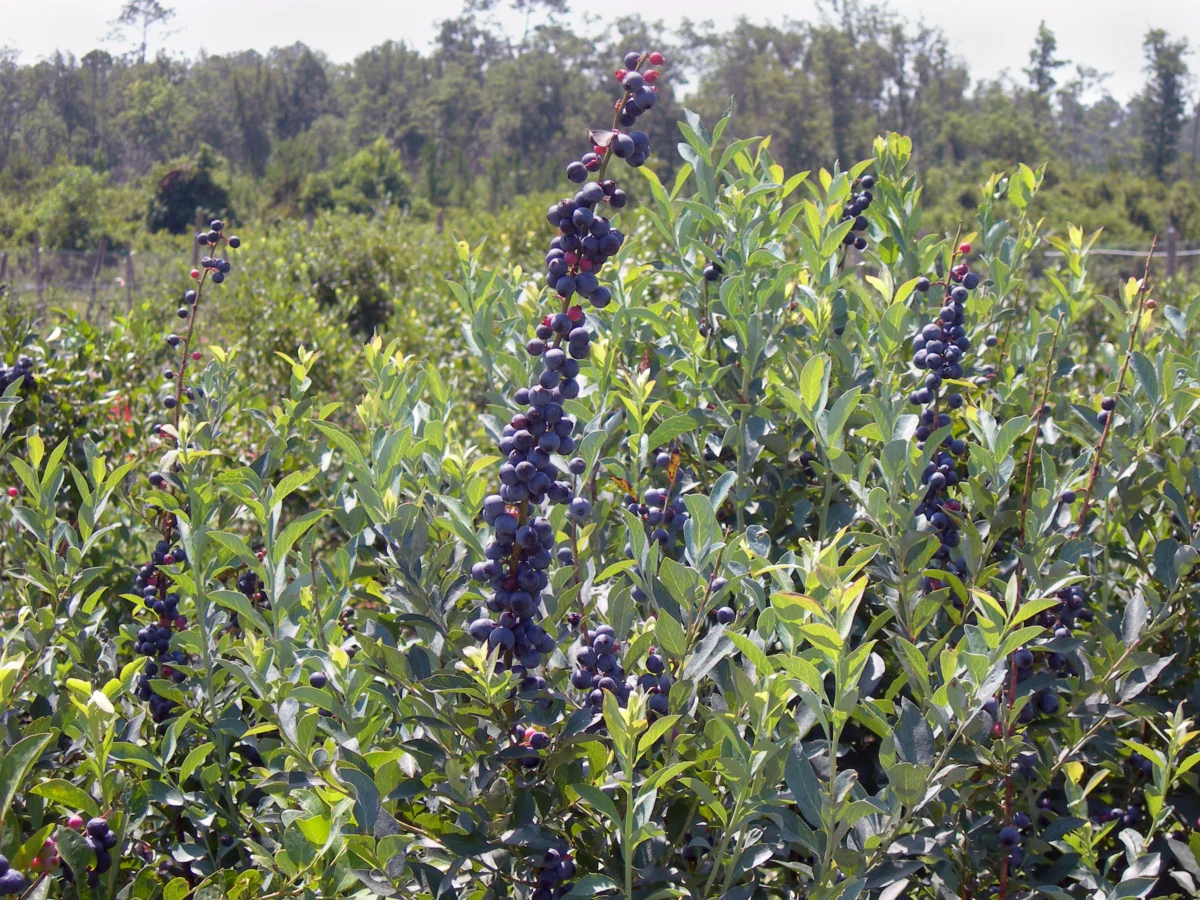
Yes. Pink blueberries are true blueberries (Vaccinium) whose ripe fruit lacks most of the blue-purple pigments found in standard blueberries. The USDA Agricultural Research Service’s Pink Lemonade germplasm release, dated March 2, 2005, describes it as a cross of the selection NJ 89-158-1 and the rabbiteye variety ‘Delite’, made by M.K. Ehlenfeldt at Chatsworth, New Jersey, in 1991, originally tested as ARS 96-138 and selected in 1996. It is a hexaploid, roughly half rabbiteye (V. ashei) and half synthetic highbush-type germplasm. The release notes the parentage includes an albino-fruited wild highbush selection and is partly related to an earlier pink variety, ‘Pink Champagne’. It was released for evaluation, breeding and possible commercialization, with interest focused on landscape use and specialty fruit markets.
A Fruit Growers News article on new blueberry varieties adds that Pink Lemonade was renamed in 2007 to build a market identity, and that the same year it won a best new shrub honor at the Far West Horticultural Show. An ARS press release calls it likely America’s most popular pink blueberry, and notes that it was not the first pink variety. Pink Lemonade was developed through conventional cross-breeding and is not genetically modified.
Do not confuse pink blueberries with unripe blue varieties. Ordinary blueberries pass through a pink or reddish stage before turning blue; picked at that stage, they are sour. A pink-fruited variety is fully ripe when it is evenly bright pink, slightly soft and comes off the cluster easily.
What do pink blueberries taste like?
Pink Lemonade berries are mild and sweet with low acidity, despite the lemonade name. The ARS release describes medium-sized, glossy fruit with a mild, pleasant flavor and good firmness, and Fruit Growers News calls the flavor mild, sweet and floral. Yields are moderate. Many growers describe the flavor as similar to a sweet blue blueberry with a lighter, fruitier finish. They are good fresh, in salads and baked goods, and the color makes them stand out in mixed fruit bowls and jams. Because the pigments that give ordinary blueberries their blue-purple color are mostly absent, pink berries do not stain jams, pancakes or fingers in the same way, though they also lose some of the deep color of a classic blueberry pie.
Where do pink blueberries grow best?
Because Pink Lemonade is about half rabbiteye, it prefers milder winters than northern highbush blueberries. The ARS release says plants are hardy in New Jersey but fruit production is irregular: late spring frosts can reduce or eliminate crops, while mild springs produce moderate crops, and cropping appears tied to how early flower buds lose their winter hardiness. It also says the ideal growing area is unknown, but the plant’s background suggests it may perform as well or better in milder climates, including rabbiteye growing areas. Flowering time is similar to other southern types and earlier than northern varieties such as Bluecrop. Fruit Growers News describes it as suited to USDA zone 6 and milder regions. Nurseries often list zones 5 to 8, but expect the most reliable crops in the warmer part of the range. Check your USDA hardiness zone with the growing zone finder and your last frost with the frost dates by ZIP code tool. Like other rabbiteye types it needs some winter chill, so it is not a choice for frost-free tropical areas.
Do pink blueberries need a pollinator?
Yes, for a good crop. The ARS release notes that rabbiteye germplasm has self-fertility problems, so planting another rabbiteye cultivar nearby is recommended, and suggests ‘Florida Rose’ may suit this role in some southern locations. Rabbiteye-type blueberries set much more and larger fruit when bees carry pollen between two different varieties that bloom at the same time. Our blueberry bush guide explains how the main blueberry types differ.
How to plant pink blueberry bushes
- Time it right. Plant in early spring or fall, depending on your climate; see when to plant blueberry bushes.
- Test and adjust soil pH. Blueberries need acidic soil, about pH 4.5 to 5.5. The University of Illinois Extension’s guide to growing blueberries suggests a target of 4.8 to 5.2 and gives sulfur rates to lower pH. Our guide to the best soil for blueberries covers mixes for beds and pots.
- Choose full sun and well-drained soil rich in organic matter.
- Space bushes about 4 to 5 feet apart. Use the plant spacing calculator to plan a row or hedge.
- Mulch 2 to 4 inches deep with pine bark or wood chips to keep shallow roots moist. The mulch calculator helps with quantities.
How do you care for pink blueberries?
- Water: keep soil evenly moist, about 1 to 2 inches of water a week in the growing season. Blueberry roots are shallow and dry out quickly. The garden watering calculator can help.
- Fertilizer: use an acid-forming fertilizer made for blueberries or azaleas in spring, in small doses. Illinois suggests waiting four weeks after planting before the first application of ammonium sulfate, and increasing slowly in later years.
- Pruning: remove flowers the first year (Illinois suggests the first two years) so roots establish. From about year four, cut out a few of the oldest canes each winter.
- Frost protection: because Pink Lemonade flowers early, cover bushes with frost cloth on nights when a freeze threatens in bloom.
- Birds: birds love pink berries as much as blue ones. Cover bushes with netting before fruit colors.
Pests and diseases
The ARS release notes limited observations suggesting some resistance to the blighting phase of mummy berry, a common blueberry disease, but that is not a guarantee. Watch for gray mold in wet weather, spotted-wing drosophila in summer, and root rot in poorly drained soil. Pick promptly, clean up fallen fruit and keep the canopy open. See our guide to spotted-wing drosophila, and try the plant problem identifier if you are unsure what you are seeing.
Can pink blueberries grow in containers?
Yes. A pink blueberry makes an attractive patio plant, with white spring flowers, pink fruit and orange-red fall leaves; Fruit Growers News notes shiny green leaves in spring and summer and reddish-brown twigs in winter. Use a container at least 18 to 24 inches wide filled with an acidic potting mix, and pair it with a second variety for pollination. Container plants need regular watering and winter protection; see our guide to the best soil for blueberries for container mixes.
Harvest and use
Pick Pink Lemonade berries when they are evenly bright pink, slightly soft and fall easily from the cluster, usually in mid to late summer. Do not rely on color alone, because the berries pass through a green-white stage first; wait a few days after the berries turn fully pink for the sugar to develop. Pick every few days, refrigerate promptly and do not wash until you eat them. Freeze extras on a tray and bag them. Pink berries are lovely in fruit salads, over yogurt and in light-colored jams and baked goods. If you plan to can jam, use a tested recipe; see how to make jam and water bath canning for beginners.
Other pink and unusual blueberries
A few newer pink-fruited blueberries are sold under trade names, often as patented varieties, so check the label for pollination partners and do not propagate patented plants. Some plants marketed with “pink” in the name have pink new leaves but ordinary blue fruit, so read the description carefully if pink berries are what you want. Other novelty blueberries from the same breeding program include Razz, which tastes noticeably like raspberry and was bred by Frederick V. Coville in 1934, rediscovered and released in 2011, and Sweetheart, released in 2010.
Common mistakes
- Planting a single bush and expecting heavy crops.
- Skipping a soil test and planting into alkaline soil.
- Planting in a frost pocket, where early blooms are lost to late freezes.
- Picking pale pink berries before they are ripe.
- Forgetting netting, then losing the crop to birds.
Rabbiteye, highbush and hybrid blueberries: why it matters
Blueberry varieties are often grouped by their parentage, and the group decides what climate they suit and which partners they need. Northern highbush types are the hardiest and crop best where winters are cold, southern highbush types are bred for mild winters with low chill, and rabbiteye types are vigorous, long-lived plants from the southern United States that tolerate heat and drought better but flower earlier and need a cross-pollination partner. Pink Lemonade sits in between: it is about half rabbiteye and half highbush-type material, so it inherits rabbiteye vigor and glossy, smooth-edged leaves but is also hardy enough to survive New Jersey winters. That mixed background explains its quirks, such as early flowering and irregular crops after late spring frosts.
When planning a planting, match your pollinators to the group. A rabbiteye or hybrid partner that blooms at the same time as Pink Lemonade is the best fit, and a nursery that sells blueberries in your region can usually recommend one. Plant the partner within about 50 feet so bees move pollen easily, and plant at least two or three of each variety if you want a heavy crop for jam and freezing.
A year with pink blueberries
- Late winter: test soil pH, prune out the oldest canes and apply sulfur or acid fertilizer if needed.
- Bloom: watch the forecast and cover bushes on freezing nights, and keep sprays away from open flowers.
- Late spring: mulch, water evenly and put up netting before the fruit colors.
- Summer: pick every few days, remove overripe fruit and check for fruit flies.
- Fall: clean up debris, enjoy the red foliage and renew mulch before winter.
With patience and the right soil, a few pink blueberry bushes give you a conversation-starting crop and a pretty ornamental shrub all year round.
Safety and legal note: Plant patents and trademarks protect many newer blueberry varieties, and propagating them by cuttings or division without a license is not allowed. Buy plants from licensed nurseries. If you use sulfur, fertilizer or any pesticide, follow the label, which is the law, wear gloves and eye protection and keep products away from children and pets. Rules vary by state and country.
For other trees and berries to grow alongside this one, see the home fruit tree guide.
Free printable: the Year-Round Garden & Preserving Planner
Planting dates for 24 crops, monthly tasks, blanching times, canning safety numbers and a winter storage chart in one 8-page PDF. Enter your email to download it instantly and get our seasonal garden newsletter.
No spam. Unsubscribe any time. We never sell your email.
Frequently asked questions
When are pink blueberries ripe?
When the berries are evenly bright pink, slightly soft and fall easily from the cluster, usually in mid to late summer.
Are pink blueberries genetically modified?
No. Pink Lemonade was developed through conventional cross-breeding by the USDA.
Do pink blueberries taste different?
They are mild and sweet with low acidity, a little lighter and fruitier than many blue varieties.
Will a pink blueberry pollinate a blue one?
It can, if both bloom at the same time. Rabbiteye-type partners are the best match for Pink Lemonade.
How big does a Pink Lemonade blueberry get?
About 4 to 5 feet tall and wide at maturity.
Reviewed October 2026. Sources: USDA Agricultural Research Service, Pink Lemonade germplasm release; Fruit Growers News; University of Illinois Extension. Variety performance varies by region; ask your extension office.