Pomegranates show up in stores almost overnight in the fall, and then they are gone. If you want the best fruit, it helps to know when the season really runs, how to pick a good one, and, if you live in a warm climate, how to grow your own. This guide covers pomegranate season in the United States, the main varieties, how to choose ripe fruit, how to open and store it, and how to grow and harvest a tree, using University of California sources.
When is pomegranate season?
In the United States, pomegranate season typically runs from about September through December, with peak availability in October and November. The University of California Master Gardeners of Placer County note that ripe fruit appears in early autumn, typically October and November, and that fruit generally ripens six to seven months after flowering, depending on the cultivar, with bloom time and summer weather shifting the date. Most of the domestic crop comes from California, and fruit from storage can stretch availability into January. Outside that window, supplies get thinner and prices tend to rise.
| Months | What to expect |
|---|---|
| Late summer (August) | Early varieties such as Granada begin to ripen in some California regions |
| Early fall (September) | First fruit of the main season appears; flavor can be tart |
| Peak (October to November) | Best selection, color and price; Wonderful ripens from late September through October |
| Early winter (December) | Still plentiful and fresh |
| Late winter to summer | Limited supply, mostly stored or imported fruit |
Timing shifts a little by variety, weather and region, so treat these as typical rather than exact.

Pomegranate varieties
The University of California Agriculture and Natural Resources overview of pomegranates describes the main commercial varieties in California:
- Wonderful: the most widely planted commercial variety. Large, glossy, deep purple-red fruit with good flavor, ripening late September to October.
- Granada: early maturing, ripening around mid-August, smaller than Wonderful but often commanding a premium price.
- Foothill Early: similar to Wonderful but ripening one to two weeks earlier.
- Ruby Red: similar in size to Wonderful and ripening at about the same time, though it stores less well.
- Spanish Sweet (Paper Shell): large, pale pink and sweet, grown mainly as a dooryard tree and no longer marketed commercially.
A University of California, Riverside article on picking the perfect pomegranate adds that Wonderful makes up over 90 percent of commercially grown pomegranates in the United States, that California leads the nation with an estimated 20,000 to 30,000 acres of Wonderful, mostly in Kern County, and that the USDA’s National Clonal Germplasm Repository conserves about 300 varieties, some with softer seeds, lower acidity and less astringent juice. In the UCR consumer study, Wonderful, Phoenicia and a variety called 857 rated highest overall, and coast-grown Wonderful scored lower on sweetness and was more acidic than fruit from warmer inland sites. The takeaway for home gardeners is that variety and climate shape flavor as much as ripeness does.
How to pick a ripe pomegranate
- Weight. Choose fruit that feels heavy for its size, which signals juicy arils.
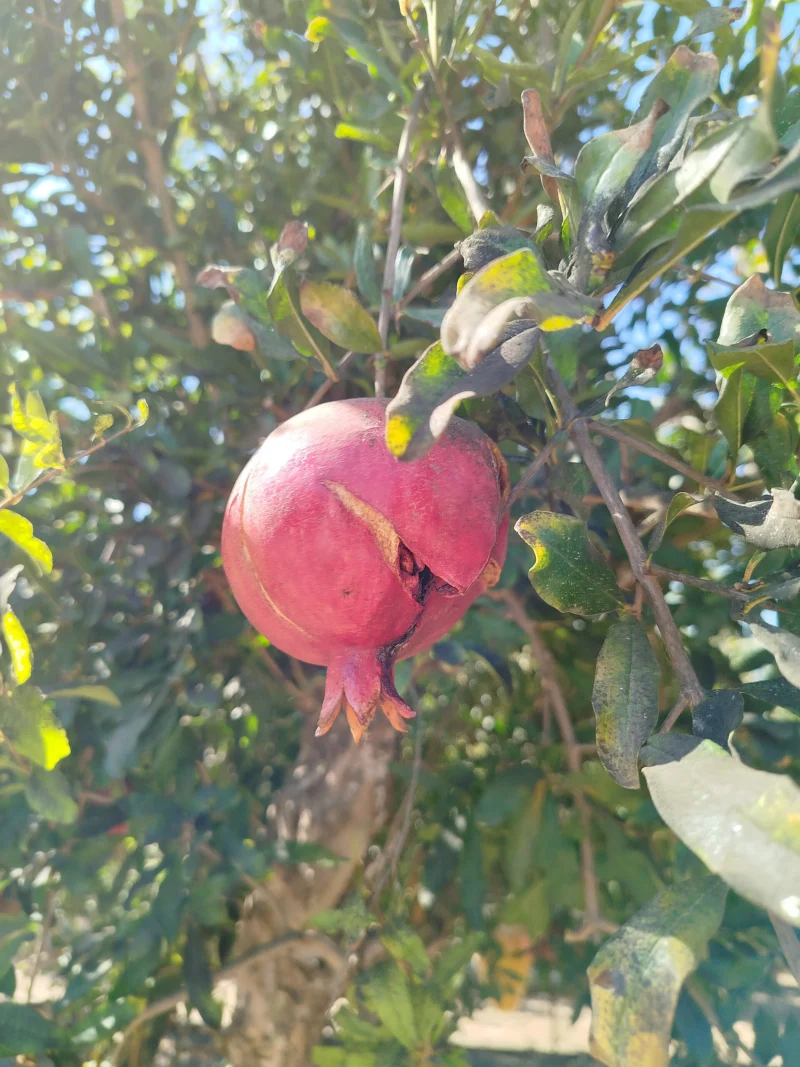
- Skin. Look for firm, taut skin with deep, even color. Color varies by variety, so a lighter red is not always unripe. The Placer County Master Gardeners note that unripe skin is hard and tight, while ripe skin softens enough to be scratched with a fingernail under gentle pressure.
- Shape. Ripe fruit often looks slightly angular or boxy as the arils swell inside, whereas unripe fruit is round.
- Crown. The petal-like crown curls slightly inward when ripe.
- Sound. Many growers tap the skin and listen for a metallic ring, a tip attributed to UC Davis.
- Avoid soft spots, mold, deep cracks that leak, or skin that is shriveled and leathery.
Pomegranates do not ripen after picking, so what you see at the store is what you get. The Master Gardeners add that fruit cannot be artificially ripened, but it transports and stores well.
How to open a pomegranate without the mess
- Cut off the crown end and score the skin along the ridges from top to bottom.
- Submerge the fruit in a bowl of water and break it into sections.
- Roll the arils out with your thumbs. The seeds sink and the white membrane floats.
- Skim off the membrane and drain the arils.
Pomegranate juice stains fabric and skin, so wear an apron and work over a bowl or sink.
Storing pomegranates
- Whole fruit: keeps a couple of weeks in a cool spot. The Master Gardeners report that refrigerated storage lasts several months, and advise choosing unsplit fruit for storage.
- Arils: refrigerate in a sealed container for several days, or freeze on a tray and then bag them for months.
- Juice: freeze in ice-cube trays for smoothies and sauces.
Can you grow your own?
Yes, if winters are not too harsh. Pomegranates grow best in USDA zones 7 to 10, and some varieties survive zone 6 with a sheltered spot. UC ANR says dormant trees tolerate cold to about 10°F, but are very frost-sensitive before full dormancy in late fall and after buds swell in early spring, and that trunks, especially on the south and west sides, can suffer frost damage. Painting trunks white may reduce bark injury from temperature swings. Hot, dry interior valleys produce the best fruit, while mild summers limit commercial production in coastal areas. Use the growing zone finder to check your zone, and the frost dates by ZIP code tool to plan around the first fall freeze.
| Factor | What to know |
|---|---|
| Sun | Full sun, 6 to 8 hours or more |
| Soil | Deep loam is best, but sandy and clay soils can work; tolerates mild alkalinity and slow drainage, though yield and quality decline with heavy alkali or poor drainage |
| Water | Drought tolerant once established, but best fruit with steady moisture |
| Pollination | Self-fertile, so one tree can fruit |
| Size | A shrub or small tree; trained trees can reach 15 to 20 feet |
| First fruit | Usually 2 to 3 years after planting |
| Ripening | Roughly 6 to 7 months after flowering |
The Wikipedia article on the pomegranate notes that the shrub is native to a region from Iran to northern India and has been cultivated since ancient times, which explains why it thrives in hot, dry summers and mild winters like those of the Mediterranean.
Care basics
- Planting. Plant in spring after frost risk is gone, and mulch with 2 to 3 inches of wood chips kept off the trunk. The mulch calculator shows how much you need, and the plant spacing calculator helps you plan the layout.
- Water evenly. Long dry spells followed by heavy watering or rain are the main cause of split fruit. A drip system keeps moisture steady. The garden watering calculator can help you plan amounts.
- Prune lightly in late winter, removing dead wood and suckers and keeping a few main trunks.
- Containers. Dwarf varieties do well in pots that can be moved indoors for winter.
- Frost protection. Cover young trees in the shoulder seasons, when they are most vulnerable.
Why pomegranates split
Splitting is the most common harvest headache. It happens when the fruit swells faster than the rind can stretch, usually after a dry spell followed by rain or heavy irrigation. The Master Gardeners note that some growers wait for the first few fruits to split, taste-test them and then harvest the rest as needed, ideally picking most fruit just before it splits. Rain can spoil split fruit on the tree, although both split and unsplit fruit are edible. UC Riverside researchers are interested in earlier-ripening varieties that would reduce losses from fall rain splitting, as well as from pests and disease. At home, steady irrigation, a thick mulch layer and picking promptly after the first splits all help.
When to harvest
Harvest when the skin has developed its full color, feels firm and gives a metallic sound when tapped, and before heavy rain or the first hard freeze. Cut the fruit from the tree with pruners, clipping close to the base rather than pulling, so the branch is not torn and the stub does not damage neighboring fruit. Because the fruit does not ripen after picking, leave it on the tree until it is ready, and keep a close eye on weather forecasts as the season ends.
Using the harvest
Fresh arils add color and tartness to salads, grain bowls, yogurt and roasted vegetables. Juice them for drinks or reduce the juice into pomegranate molasses for sauces and marinades. Pomegranates contain antioxidants, potassium and vitamins, as the UCR article notes, but they are best enjoyed as part of a varied diet rather than as a cure for anything. If you take prescription medicines, ask your pharmacist whether large amounts of pomegranate juice could interact with them.
Common mistakes
- Picking early, expecting fruit to ripen on the counter.
- Watering irregularly and then wondering why the fruit split.
- Planting in a cold, shady or poorly drained spot.
- Leaving ripe fruit to hang through a hard freeze or heavy rain.
- Choosing a variety that ripens too late for the local climate.
Buying pomegranates: a store checklist
Because fruit does not ripen after picking, a few seconds of inspection in the produce aisle pays off. Pick up two or three fruits and compare. The heaviest is usually the juiciest, and fruit with deep, even color and a slightly flattened, angular shape is often at its peak. Skin with small scratches or scuffs is fine, because the rind is thick and protects the arils. Walk away from fruit that is soft, moldy or leaking, or that has dried, leathery patches. If you are buying for juice, choose a variety known for juiciness, and if you are buying for fresh arils, ask whether the fruit is a sweeter variety, since tart juice varieties can make a sharp topping.
Buy only what you will use within a couple of weeks if the fruit will sit on the counter, and keep the rest in the refrigerator crisper. Pre-packed arils are convenient but cost more per pound and have a shorter shelf life than whole fruit, so check the date on the pack.
A simple seasonal plan for home growers
- Late winter: prune out dead wood and suckers while the tree is dormant, and order new trees.
- Spring: plant after the last frost, mulch and start regular watering as growth begins. Orange blooms appear in spring.
- Summer: water evenly, especially as fruit sizes up, and avoid heavy feeding that pushes soft growth.
- Early fall: watch for color, firmness and a metallic sound, and keep a forecast handy for rain.
- Harvest: clip fruit close to the base, and sort split or damaged fruit for immediate use.
- Late fall: clean up fallen fruit, mulch the root zone and cover young trees if a hard freeze threatens.
Record your own bloom and harvest dates, and which fruit split, for a few seasons. In a year or two you will know exactly when your tree is ready, and you can plan irrigation and picking around it instead of guessing.
Safety and legal note: Wear gloves and eye protection when pruning, and follow the label on any pesticide or fertilizer, which is the law. Pomegranate juice stains fabric and skin, so protect clothing when opening the fruit. Rules on nursery stock and pest control vary by state and country.
Looking for the next tree to plant? Our guide to growing fruit trees at home compares options by climate and space.
Free printable: the Year-Round Garden & Preserving Planner
Planting dates for 24 crops, monthly tasks, blanching times, canning safety numbers and a winter storage chart in one 8-page PDF. Enter your email to download it instantly and get our seasonal garden newsletter.
No spam. Unsubscribe any time. We never sell your email.
Frequently asked questions
Do pomegranates ripen after you pick them?
No. They are picked ripe, so choose heavy, firm fruit with good color.
Why did my pomegranates crack on the tree?
Usually from uneven watering or heavy rain after a dry spell. Fruit that has split may still be fine to eat if picked quickly, but it spoils fast.
How many pomegranates does one tree give?
A young tree gives a few. Mature trees in a warm climate can yield many dozen, depending on variety and care.
When is the best time to buy pomegranates?
October and November, when selection and flavor are at their peak.
How long do whole pomegranates keep?
Several weeks in a cool spot and often months in the refrigerator if the fruit is unsplit.
Reviewed October 2026. Timing and hardiness vary by region and variety.