Walk into a grocery store in fall and you might see Bartlett, Anjou, Bosc and Comice side by side, and then wonder what the difference is. Thousands of pear varieties exist worldwide, but a small group covers nearly everything you will meet in stores and home orchards. This guide compares 12 common types for eating, baking and growing, explains the one split that matters most (European versus Asian pears), and gives practical advice from university extension services on fire blight, pollination, ripening and choosing a tree for your yard.
European vs Asian pears
European pears are the classic teardrop shape. They are usually picked mature but hard and finish ripening off the tree, becoming soft, buttery and juicy. Asian pears are round, often russeted, and are picked ripe and eaten crisp, more like an apple. Asian pears are sometimes sold as apple pears for that reason. A third group, hybrids such as Kieffer, are firm and gritty and mostly used for cooking and canning.
The UConn Home and Garden Education Center’s pear fact sheet describes European pears as the most popular group, with trees cold hardy to as low as -40°F in some cases and fruit harvested green and stored until ripe, while Asian pears are Chinese and Japanese types and crosses between them that are rounder, crisp and juicy, with a texture closer to an apple, and are allowed to ripen on the tree. The Wikipedia article on the pear notes that the genus Pyrus includes about 30 species and that thousands of cultivars have been named, which is why a short list of dependable varieties is so useful.
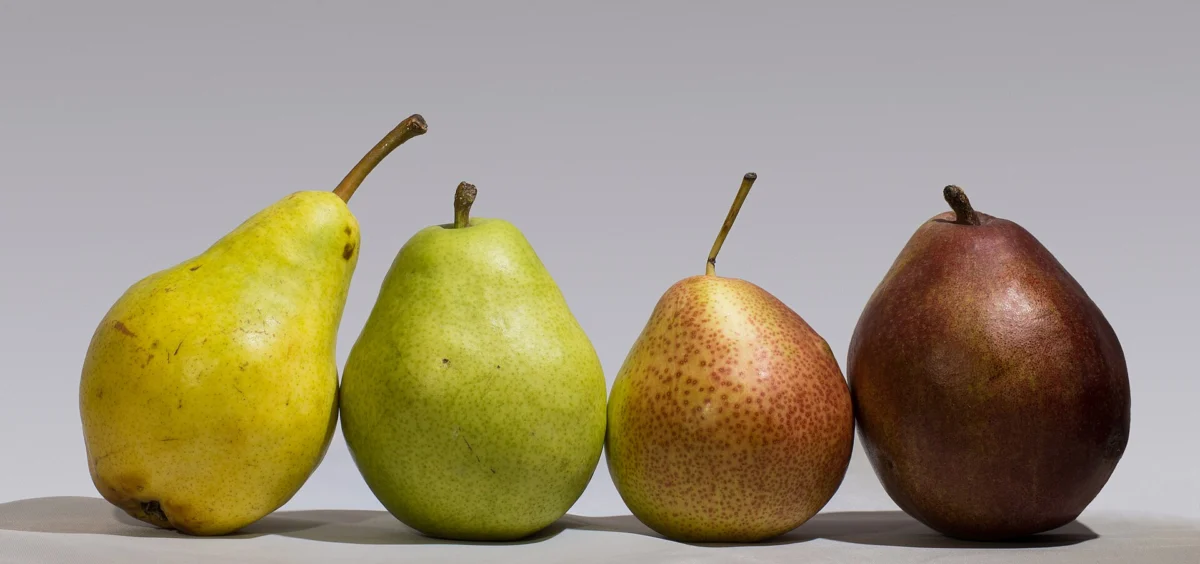
12 common pear varieties compared
| Variety | Type | Flavor and texture | Best use | Typical zones |
|---|---|---|---|---|
| Bartlett | European | Juicy, sweet with a classic pear flavor | Fresh eating, canning | 5 to 8 |
| Red Bartlett | European | Same as Bartlett with red skin | Fresh eating | 5 to 8 |
| D’Anjou | European | Firm, mild and sweet with a hint of citrus | Baking, poaching, salads | 5 to 8 |
| Bosc | European | Dense, crisp, spicy-sweet, russeted skin | Baking, poaching | 5 to 8 |
| Comice | European | Very juicy, buttery and sweet | Fresh eating, cheese boards | 5 to 8 |
| Seckel | European | Small, firm and very sweet | Snacking, pickling | 4 to 8 |
| Forelle | European | Small, crisp, tart-sweet with red freckles | Fresh eating, salads | 5 to 8 |
| Concorde | European | Sweet with a vanilla note; a Conference and Comice cross | Fresh eating, baking | 5 to 8 |
| Kieffer | Hybrid | Firm, gritty, mild | Canning, preserves | 4 to 9 |
| Hosui | Asian | Crisp, juicy, russeted golden skin | Fresh eating | 5 to 9 |
| Shinseiki | Asian | Crisp, mild, yellow-green skin | Fresh eating | 5 to 9 |
| Korean Giant | Asian | Very large, crisp and sweet | Fresh eating | 5 to 9 |
Zone ranges are typical and vary by rootstock and region, so check them with the growing zone finder before buying a tree.
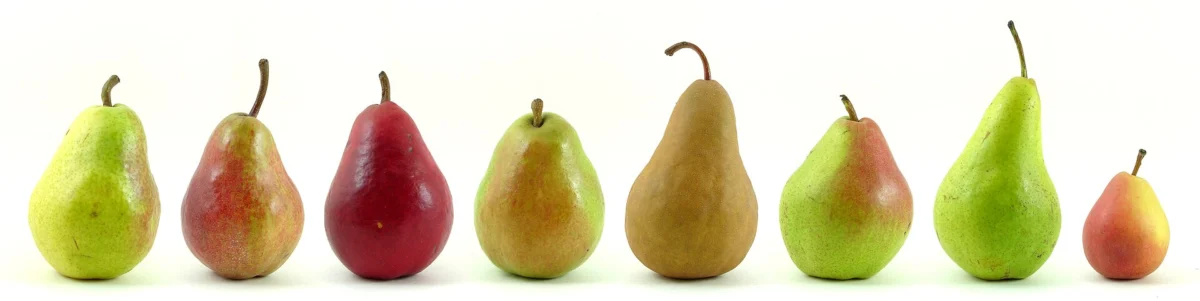
Which pear for which job?
- Eating fresh: Bartlett, Comice, Seckel and Forelle for soft or snackable fruit, Asian pears for crunch.
- Baking and poaching: Bosc and D’Anjou hold their shape under heat. Bartlett cooks down into a smooth sauce.
- Canning: Bartlett is the traditional choice, and Kieffer works well in preserves. UConn describes Kieffer as gritty and used mainly for preserves, perry or pear brandy.
- Salads and cheese: Forelle, D’Anjou and Comice pair well with cheese, and crisp Asian pears add crunch.
A closer look at the main types
Bartlett
Bartlett is the best-known European pear, with a juicy, aromatic flavor and the classic pear shape. Green Bartlett turns yellow as it ripens, while Red Bartlett keeps a deep red skin. The UConn fact sheet notes that it is susceptible to fire blight, and the University of Georgia’s home garden pears publication says it is not adapted to the Southeast and should not be planted in Georgia, so check how it performs locally. See our guide to Bartlett pears.
D’Anjou and Bosc
D’Anjou is a firm, egg-shaped pear with a mild, sweet flavor that keeps its shape when baked or poached. Bosc has a long neck, russeted brown skin and dense, crisp, spicy flesh. UConn describes Beurre Bosc as a productive, regular bearer that ripens in mid to late September in its region, a good choice for baking and poaching.
Comice
Comice is round, juicy and buttery, often called the best dessert pear, and it is a favorite for gift boxes and cheese boards. It needs a gentle hand because the thin flesh bruises easily.
Seckel
Seckel is a small, very sweet pear that UConn says was discovered near Philadelphia around 1800. It is resistant to fire blight, which makes it a popular choice for home gardens. See our guide to Seckel pears.
Forelle and Concorde
Forelle is a small, crisp pear with red freckles over green-gold skin and a tart-sweet taste. Concorde, a cross between Conference and Comice, is sweet with a vanilla note and keeps its shape when baked.
Kieffer
Kieffer is a hybrid prized for its tree rather than its fruit. It is highly tolerant of fire blight in many regions, although the Georgia publication notes it can be blight-prone in wet years, and the fruit is firm and gritty unless it is cooked or preserved.
Asian pears: Hosui, Shinseiki and Korean Giant
Asian pears are crisp, juicy and round. Hosui has golden-brown russeted skin, Shinseiki is yellow-green and mild, and Korean Giant is very large and sweet. Georgia lists Shinko, Chojuro, Hosui and Kosui as Asian types for trial planting, noting that Asian pears may be subject to fire blight in some areas. UConn names Shinko and Shin Li as hardy, blight-resistant Asian pears. See our guides to Hosui and nashi pears.
How to ripen and test European pears
European pears ripen from the inside out, so skin color is not a reliable guide for most of them. Instead, press gently near the stem with your thumb. If the neck gives slightly, the pear is ready. Leave hard pears on the counter at room temperature and check daily. Once ripe, move them to the refrigerator to slow things down. Asian pears are different: buy them firm and eat them crisp.
If you grow your own, picking time matters. The University of Georgia advises picking before full ripeness: fruit picked too early is undersized and lacks sweetness, while fruit picked too late turns gritty and may develop core breakdown. It suggests checking the lenticels, the small dots on the skin, which start white and turn brown and shallow as the fruit matures. Brown lenticels with lighter green skin between them indicate the fruit is ready to pick. See when to pick pears for more.
Choosing a pear tree for your yard
Pollination
Most pears set better fruit with a second compatible variety that blooms at the same time. UConn says most pears need two varieties to cross-pollinate and set fruit, that Bartlett and Seckel do not cross-pollinate (so a third variety is needed if you grow those two) and that Asian pears can pollinate European pears if their bloom periods overlap, although many Asian pears bloom earlier. Georgia notes that some varieties, including Waite and Magness, produce sterile pollen and need a compatible partner such as Orient, and that varieties sharing a pollination letter generally bloom together. Check bloom groups on the nursery tag.
Fire blight
This bacterial disease can kill branches and trees. UConn lists Seckel, Kieffer, Maxine, Harrow Delight, Magness, Moonglow, Shinko and Shin Li as resistant, and Georgia lists Orient, Carrick, Waite, Baldwin and Warren as resistant. Ask local extension staff what does best nearby. If you see blackened shoot tips curled like a shepherd’s crook, cut well below the infection (UConn says 12 inches, Georgia at least 6 inches) in dry weather and disinfect tools between cuts. See our guides to fire blight and Moonglow pears.
Size, site and soil
Standard trees can reach 20 feet or more (UConn notes mature heights of 33 to 56 feet for old standard trees with a tall, narrow crown), semi-dwarf roughly 12 to 15 feet and dwarf about 8 to 10 feet. Georgia suggests spacing standard trees 20 feet apart. Use the plant spacing calculator to plan the planting. Pears want full sun and well-drained soil, and the soil should not be overly fertile. They tolerate heavier soil better than apples or peaches do, but not standing water, and Georgia gives an ideal soil pH of 5.9 to 6.5.
Pruning and feeding
Prune much like an apple tree, but because pears grow more upright, keep the center open for air and sunlight. Georgia suggests cutting a new whip to 24 to 30 inches at planting, removing limbs lower than 18 inches after the first season, keeping four to six scaffold limbs and tying lower scaffolds to about a 45-degree angle after the second season. See how to prune a pear tree. Healthy bearing trees should put on about 6 inches of shoot growth a year, so feed lightly and avoid heavy nitrogen, which promotes soft growth and fire blight; see our fruit tree fertilizer guide.
Do not confuse these with Bradford or Callery pear
Bradford pear is an ornamental street tree, not an eating pear, and it is invasive. Selling or planting Callery pear is now banned or being phased out in several states, and more states are following. If a nursery offers an ornamental pear, ask for the botanical name and choose a fruiting variety from the table above instead. Check your state’s current rules before planting.
Common mistakes
- Planting a single tree where there is no compatible pollinator.
- Choosing a blight-prone variety in a warm, humid area.
- Waiting for European pears to ripen on the tree, when they finish ripening better off it.
- Overfeeding with nitrogen.
- Buying an ornamental pear by mistake.
Buying and storing pears at the store
Most store pears are sold hard, and that is deliberate. European pears bruise easily once ripe, so growers pick them mature but firm and ship them cold. At home, ripen them at room temperature, ideally in a paper bag with a banana or apple to concentrate the ripening gas, and check the neck each day. Pears that are firm at the neck are not ready, and pears that give at the base are already past their best. Asian pears need no ripening; choose fruit that is firm, heavy for its size and free from soft spots, and keep them in the refrigerator, where many varieties hold for weeks.
- Bartlett and Comice ripen quickly, often within four to seven days at room temperature.
- Bosc and D’Anjou may take a week or longer, and they stay firm even when ripe, so they suit baking.
- Seckel and Forelle are small and can be eaten while still crisp.
- Cut pears brown quickly, so toss slices in lemon juice if you are not serving them straight away.
Cooking with different pears
Choosing the right variety changes the dish. Poached Bosc or D’Anjou keep clean edges and absorb wine or spices well, while Bartlett collapses into a smooth, fragrant sauce that is perfect for purees and butters. Raw Forelle and Asian pear slices add crunch to salads and slaws. For canning or preserving, use firm but ripe fruit and follow a tested recipe, because pears are low in acid and safe processing times depend on jar size and altitude; see our guide to water bath canning for beginners. For softer fruit you want to use quickly, a batch of pear jam is an easy option.
Planning a small pear planting
If you have room for only a few trees, mix a dependable European pear that suits your climate with an Asian pear and a blight-resistant pollinator. A common home orchard might include one Bartlett-type tree for canning, one Seckel or Moonglow for resistance and one Hosui or Shinko for fresh, crisp fruit, spaced as the spacing calculator suggests. Ask your local nursery or extension office which combination blooms together in your area, and plant at least two compatible trees within about 50 feet of each other so bees can carry pollen between them. Plan for three to five years before the first real crop on a semi-dwarf tree.
Safety and legal note: Check your state or country’s rules on planting ornamental or invasive pears and on importing nursery stock. If you spray any fungicide, bactericide or insecticide, follow the label, which is the law, and protect bees during bloom. Use a stable ladder and eye protection when pruning. Rules vary by state and country.
For other trees and berries to grow alongside this one, see the home fruit tree guide.
Free printable: the Year-Round Garden & Preserving Planner
Planting dates for 24 crops, monthly tasks, blanching times, canning safety numbers and a winter storage chart in one 8-page PDF. Enter your email to download it instantly and get our seasonal garden newsletter.
No spam. Unsubscribe any time. We never sell your email.
Frequently asked questions
What is the sweetest type of pear?
Comice and Seckel are among the sweetest, and ripe Bartlett and Concorde are also very sweet. Sweetness depends heavily on ripeness.
Which pear is best for baking?
Bosc and D’Anjou hold their shape best. Use slightly underripe fruit for pies and tarts.
Are Asian pears the same as regular pears?
They are related but different: rounder, crisper and ripened on the tree. Many gardeners grow both.
Can I grow a pear tree from a seed?
You can, but seedlings rarely resemble the parent fruit and can take many years to bear. Buy a grafted tree of a named variety instead.
Which pears resist fire blight?
Seckel, Kieffer, Moonglow, Magness, Orient and several others are listed as resistant by extension services, but check what works locally.
Reviewed October 2026. Variety traits and hardiness vary by region, so confirm with your state extension service.