Hard apple cider is fermented apple juice, usually about 5 to 8 percent alcohol. To make it at home, start with fresh-pressed or store-bought apple juice that contains no preservatives such as potassium sorbate, sanitize your equipment, treat raw juice with Campden tablets if you wish and wait 24 hours, then add a cider, wine or ale yeast. Ferment under an airlock at about 60 to 75°F for 2 to 4 weeks until bubbling stops and the specific gravity is around 1.000, then rack off the sediment, let it clear and bottle it still or lightly carbonated. Adults in the US may legally make limited amounts of cider at home for personal use, subject to state and local laws.
Hard cider basics
| Step | What to do | Key numbers |
|---|---|---|
| Juice | Fresh-pressed cider or preservative-free juice | About 1 gallon to start |
| Sanitize | Clean and sanitize everything that touches the juice | No-rinse brewing sanitizer |
| Optional sulfite | Campden tablet in raw juice | About 1 tablet per gallon; wait 24 to 36 hours |
| Measure | Hydrometer reading | Typical starting gravity about 1.045 to 1.060 |
| Yeast | Cider, champagne, white wine or ale yeast | One packet treats 1 to 5 gallons |
| Ferment | Airlock, dark place | About 60 to 75°F; 2 to 4 weeks |
| Finish | Dry cider | Final gravity about 0.998 to 1.000 |
| Clear and age | Rack off sediment | Weeks to months |
| Bottle | Still, or primed for sparkling | About ½ to 1 teaspoon sugar per 12-ounce bottle for light carbonation |
Legal and safety note: In the United States, federal regulations allow an adult to produce wine, including cider, for personal or family use without a permit, up to 100 gallons a year for a household with one adult and 200 gallons for a household with two or more adults, as set out in TTB regulation 27 CFR 24.75. It may not be sold. You must be of legal drinking age, and state and local laws may be stricter, so check yours. Never serve alcohol to minors, and do not drink and drive.
What is the difference between cider, hard cider and apple juice?
In the US, “cider” or “sweet cider” usually means fresh, unfiltered apple juice, cloudy and unfermented. “Hard cider” is the fermented, alcoholic version, which in Britain and most of the world is simply called cider. Apple juice is filtered and usually pasteurized. All three start as pressed apples; the difference is whether yeast has converted the sugar into alcohol and carbon dioxide.
What apples make the best hard cider?
Any sweet, sound apples will ferment into cider, but the best ciders blend different types. The homebrewing magazine Brew Your Own groups cider apples into four classes:
| Class | Profile | Examples |
|---|---|---|
| Sweet | High sugar, low acid and tannin | Golden Delicious, Gala, Fuji, Baldwin |
| Sharp | High acid, low sugar and tannin | Granny Smith, Northern Spy, Newtown Pippin, crabapples |
| Bittersweet | High sugar and tannin, low acid | Dabinett, Yarlington Mill, Harrison, Hewe’s Virginia Crab |
| Bittersharp | High tannin and acid | Kingston Black, Porter’s Perfection |
BYO notes that sweet culinary apples make acceptable but simple cider, while cider varieties add acidity, tannin and complexity, and that crabapples can add tartness if you cannot find traditional cider apples. A good starting blend is mostly sweet apples with some sharp ones for brightness and a few bittersweets or crabapples for body. Old heirloom apples such as Roxbury Russet and Golden Russet are prized for cider.

What equipment do you need to make hard cider?
- Fermenter: A 1-gallon glass jug or a larger food-grade bucket or carboy.
- Airlock and stopper: Lets carbon dioxide escape and keeps air and insects out.
- Sanitizer: A no-rinse brewing sanitizer.
- Hydrometer and test jar: Measures sugar and lets you estimate alcohol.
- Siphon or racking cane and tubing.
- Yeast: Cider, champagne, white wine or ale yeast.
- Bottles and caps or corks: Use thick-walled bottles rated for pressure if you carbonate.
- Optional: Campden tablets, yeast nutrient, pectic enzyme, a fruit press.
How do you make hard cider step by step?
- Get the juice. Press your own apples, buy fresh cider from an orchard or use store-bought juice. BYO notes store-bought juice works if it contains no sorbate, which prevents fermentation; ascorbic acid (vitamin C) is fine.
- Sanitize everything that will touch the juice: fermenter, funnel, airlock, spoon, hydrometer.
- Treat raw juice (optional). Fresh, unpasteurized cider contains wild yeasts and bacteria. To favor your chosen yeast, BYO suggests adding about one crushed Campden tablet per gallon and waiting 24 to 36 hours before adding yeast. Alternatively, ferment wild for a traditional but less predictable result.
- Measure the starting gravity with a hydrometer. Most apple juice reads about 1.045 to 1.060, which ferments to roughly 5.5 to 7.5 percent alcohol when fully dry. BYO notes most unfortified ciders land around 5 to 6.5 percent.
- Add yeast. Sprinkle or pitch the yeast according to the packet. Add yeast nutrient for stronger ciders.
- Ferment. Fit the airlock and keep the fermenter at about 60 to 75°F, out of direct sun. Bubbling begins within a day or two and slows over 2 to 4 weeks.
- Check the final gravity. When bubbling stops and two readings a few days apart are the same, usually around 0.998 to 1.000, fermentation is complete.
- Rack. Siphon the cider off the yeast sediment into a clean, sanitized container, leaving little headspace, and let it clear for a few weeks to a few months.
- Bottle. Bottle still, or prime for gentle carbonation.
How do you calculate the alcohol content of cider?
Take a hydrometer reading before fermentation (original gravity, OG) and after (final gravity, FG). A common formula is ABV = (OG − FG) × 131.25. For example, juice at 1.055 that finishes at 1.000 gives about (0.055) × 131.25, or roughly 7.2 percent alcohol. Because cider usually ferments completely dry, the potential alcohol scale on the hydrometer gives a good estimate. To make a stronger cider, dissolve extra sugar or honey in some of the juice before fermenting; BYO’s recipes range from about 8 to 12 percent with added sugar.
Which yeast is best for hard cider?
| Yeast | Result |
|---|---|
| Champagne yeast | Very dry, crisp, clean; ferments in cool temperatures |
| Cider yeast | Bred to keep apple aroma; often slightly fruity |
| White wine yeast | Clean and fruity; tolerates higher alcohol |
| English ale yeast | Rounder, fruitier, may leave slight sweetness; best under about 10 percent |
| Wild yeast | Traditional, complex but unpredictable |
BYO suggests ale and lager yeasts for ciders under 10 percent and wine or mead yeasts above that, and recommends keeping wild fermentations above about 60°F and being ready to add a commercial yeast if fermentation stalls.
How do you make sparkling or sweet cider?
- Sparkling: Add a measured amount of priming sugar at bottling, about ½ to 1 teaspoon of sugar per 12-ounce bottle, or BYO’s suggestion of ⅓ to ½ cup of dextrose per 5 gallons for light carbonation. Use thick-walled bottles rated for pressure and store them at room temperature for 1 to 2 weeks to carbonate, then refrigerate.
- Sweet: Fully fermented cider is dry. To sweeten, add non-fermentable sweeteners, or stabilize the cider with potassium sorbate and sulfite before back-sweetening. Sorbate-treated cider will not carbonate in the bottle; BYO suggests force-carbonating in a keg instead.
Never add sugar to unstabilized cider and then cap it without a measured priming amount: too much sugar can over-carbonate and burst bottles.
How long does homemade hard cider take?
Primary fermentation usually takes 2 to 4 weeks, sometimes up to 6 weeks in cool conditions. BYO notes clarification can take 2 to 6 months. Many ciders taste good after a month or two in the bottle, and most improve with a few more months of aging, as harsh flavors mellow. Still or lightly sparkling cider keeps for a year or two in a cool, dark place.
Common hard cider problems
| Problem | Likely cause | Fix |
|---|---|---|
| No fermentation | Preservatives in juice, too cold, dead yeast | Use sorbate-free juice; warm to 60 to 70°F; add fresh yeast |
| Rotten-egg smell | Stressed yeast producing sulfur | Add yeast nutrient; keep temperature steady; it often fades with aging |
| Vinegar taste | Acetic bacteria from air exposure | Sanitize; use an airlock; minimize headspace |
| Very dry, thin cider | Normal full fermentation | Blend in sweeter apples; back-sweeten safely |
| Cloudy cider | Pectin haze or suspended yeast | Add pectic enzyme; give it more time; cold-crash |
| Gushing or exploding bottles | Too much priming sugar or unfinished fermentation | Measure priming sugar; bottle only when gravity is stable |
Can you make hard cider from your own apple trees?
Yes, and homegrown apples often make the best cider. Let apples ripen fully on the tree for maximum sugar; see when apples are ready to pick. Small, scabby or misshapen apples that are not good enough for the fruit bowl are fine for cider, but cut out any rot, mold or worm damage, which can spoil the flavor; our guide to worms in apples explains common culprits. A crabapple or two adds acidity and tannin. If you are storing apples before pressing, a week or two of “sweating” in a cool place softens them and concentrates sugar; see how to store apples. Plan roughly 15 to 20 pounds of apples per gallon of juice, depending on the variety and press. The harvest basket and crate calculator helps you plan for a pressing day.
How do you press apples for cider?
- Wash the apples and cut out any rotten parts.
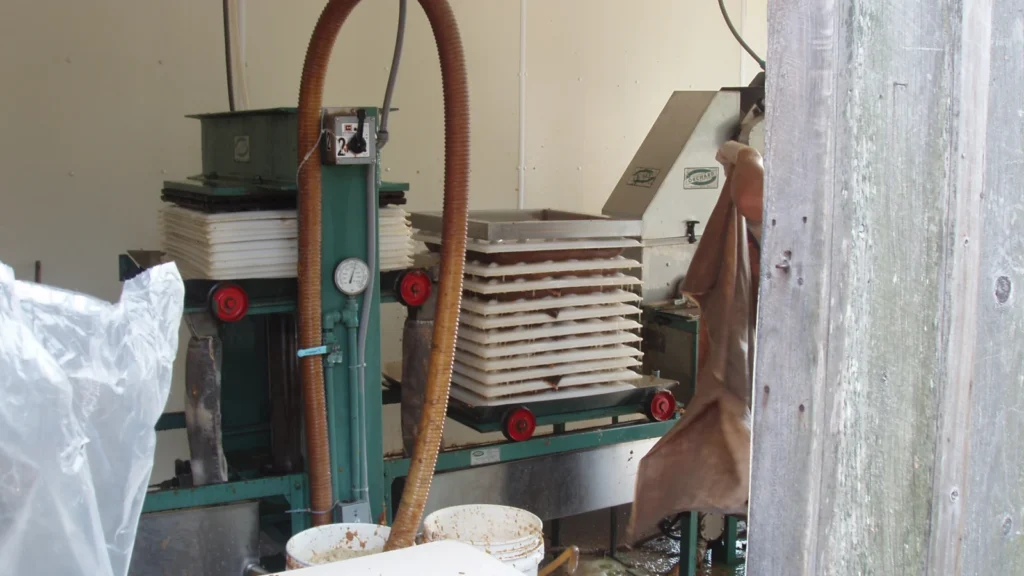
- Grind or chop them into a coarse pulp, called pomace, with a fruit grinder, a sanitized garden shredder reserved for food, or a food processor for small batches.
- Press the pomace in a cloth bag in a rack-and-cloth or basket press until the juice stops flowing.
- Strain the juice into a sanitized fermenter.
- Compost the leftover pomace or feed it to livestock where appropriate.
Fresh-pressed juice should be fermented or refrigerated promptly. Raw, unpasteurized juice can carry harmful bacteria such as E. coli if apples are dirty or dropped onto manure-contaminated ground, so use clean, picked fruit for juice you plan to drink unfermented.
What is the history of cider?
Cider has been made for centuries in England, France and Spain, and it was the everyday drink of colonial America, where orchards of seedling apples supplied farm cider presses. The Wikipedia article on cider traces its long history. Cider declined in the US after Prohibition but has had a strong revival, with craft cideries planting traditional cider apple varieties again.
Start with a single gallon to learn the process, keep notes on the apples, yeast and gravity readings, and scale up once you have a cider you love.
Whether you start with store-bought juice or apples from your own trees, homemade hard cider is one of the simplest and most rewarding ways to use a harvest, and every batch teaches you something new.
This article is part of our fruit trees guide, which groups all our fruit growing advice by crop.
Preserving more of your harvest? Our food preserving guide helps you choose the right method for each crop.
Cider safety: what extension food-safety specialists say
The University of Maine Cooperative Extension bulletin Food Safety Facts: Safe Home Made Cider (#4191) warns that outbreaks have been linked to fresh, unpasteurised cider contaminated with pathogens such as E. coli O157:H7. The risk is low but real, and children, older adults and people with weakened immune systems face greater risk of complications. The bulletin advises boiling unpasteurised cider or drinking pasteurised cider, and notes commercial cider in Maine must be heat-treated to 155°F (68°C) for 10 seconds unless labelled unpasteurised. Homemade cider is the maker’s responsibility. Fermenting into hard cider does not remove the need for good fruit and sanitation.
- Apples: pick mature, dry apples before they drop; avoid fallen, spoiled, mouldy or pest-damaged fruit; blend in tart apples to raise acidity; wash apples just before grinding.
- Patulin: this toxin forms when mould grows on or in apples and is heat-stable, surviving pasteurisation, so discard rotten fruit.
- Sanitation: clean, then sanitise equipment after each day’s use with about 1 tablespoon of bleach per gallon of clean lukewarm water, and air-dry.
- Storage: keep cider at 40°F (4°C) or lower, do not leave it at room temperature for more than two hours, and use food-grade plastic or stainless steel rather than porous crockery.
Safety and legal note: Fermenting vessels can burst: use airlocks and never seal a fermenting container tightly. Alcohol laws govern home production, sharing and sale, and often limit quantities. Home brewing legality and age limits vary by country and region.
Free printable: the Year-Round Garden & Preserving Planner
Planting dates for 24 crops, monthly tasks, blanching times, canning safety numbers and a winter storage chart in one 8-page PDF. Enter your email to download it instantly and get our seasonal garden newsletter.
No spam. Unsubscribe any time. We never sell your email.
Frequently asked questions
How long does it take to make hard cider?
About 2 to 4 weeks to ferment, plus several weeks to months to clear and age.
Can you make hard cider from store-bought apple juice?
Yes, as long as it contains no potassium sorbate or sodium benzoate. Ascorbic acid is fine.
What alcohol percentage is homemade cider?
Usually about 5 to 7.5 percent from apple juice alone, more if you add sugar.
Is it legal to make hard cider at home?
Federal US rules allow adults to make up to 100 gallons a year (200 for households with two or more adults) for personal use, not for sale. State and local laws vary.
What is the best yeast for cider?
Champagne yeast for a dry, crisp cider; cider or ale yeast for more fruit and body.
Why does my cider smell like eggs?
Stressed yeast can produce sulfur. Add yeast nutrient, keep the temperature steady and give it time.
Further reading: Brew Your Own, Home Cidermaking Techniques; Alcohol and Tobacco Tax and Trade Bureau, 27 CFR 24.75.
Reviewed October 2026. Sources: University of Maine Cooperative Extension, Food Safety Facts: Safe Home Made Cider (#4191)