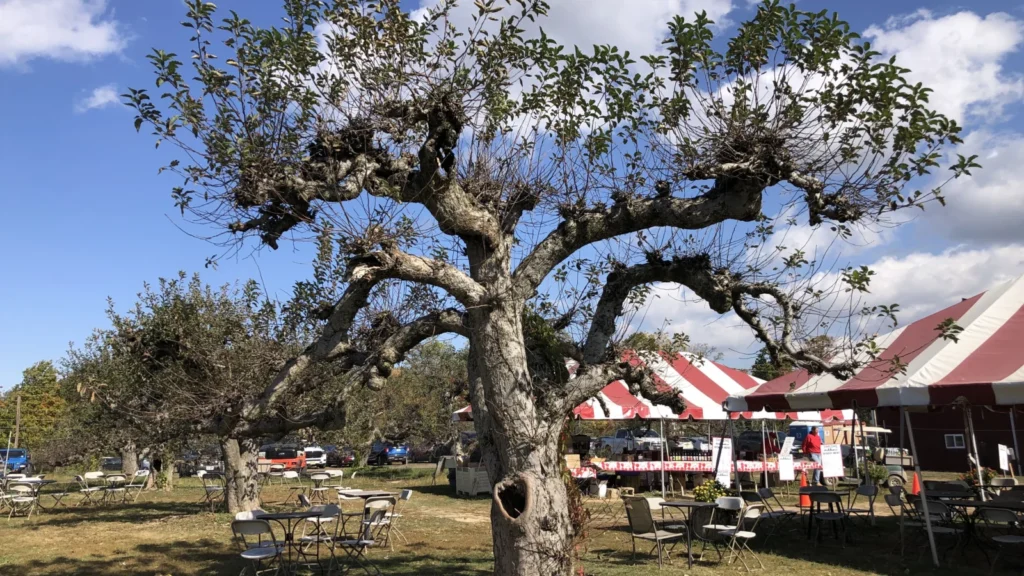
A badly pruned apple tree is one that has been topped, cut back too hard, stripped of its inner branches or left with stubs, and it usually responds with a thicket of vertical water sprouts and few apples. You can fix it, but not in one winter: remove dead and broken wood first, then take out no more than about 25 to 30 percent of the live canopy each year, spread over two to three dormant seasons, using thinning cuts rather than more heading cuts. Retrain some of the water sprouts into new fruiting branches and remove the rest.
Badly pruned apple tree: quick recovery plan
| When | What to do | Why |
|---|---|---|
| Year 1, late winter | Remove dead, diseased and broken wood; remove root suckers; choose the main scaffold limbs; take out up to about a third of the excess growth | Starts restoring structure without shocking the tree |
| Year 1, early summer | Rub or pull off soft new water sprouts you do not want | Summer removal slows regrowth |
| Year 2, late winter | Lower height by cutting tall leaders back to outward-facing side branches; thin crowded water sprouts, keep a few well-placed ones | Brings fruit within reach and opens the canopy |
| Year 3, late winter | Finish thinning; bend kept sprouts toward horizontal to form fruiting wood | Returns the tree to normal annual pruning |
| Every year after | Light, regular pruning of about 10 to 20 percent | Prevents the cycle of neglect and hard cutting |
What does a badly pruned apple tree look like?
Bad pruning shows up in a few recognizable patterns. Each one changes how the tree grows, so identify which mistakes you are dealing with before you cut again.
- Topping or “hat-racking”: Main limbs cut off straight across at one height, leaving thick stubs. The next summer, dozens of upright shoots sprout from just below each cut.
- Over-pruning: Far more than a third of the canopy removed in one winter. The tree reacts with vigorous leafy growth and little or no fruit for a year or two.
- Lion-tailing: All inner branches stripped so leaves remain only at the ends of long, bare limbs. The limbs become whippy, sunburned and prone to breaking under fruit.
- Stubs and flush cuts: Branches cut several inches away from the trunk, or cut flush into the trunk, removing the branch collar. Both heal poorly and invite decay.
- All heading, no thinning: Every shoot shortened by the same amount, so each cut produces two or three new shoots and the canopy turns into a dense broom.

Why does hard pruning cause water sprouts?
An apple tree keeps a balance between its roots and its top. When a large part of the canopy is removed, the root system still pushes the same energy upward, and dormant buds on the trunk and big limbs burst into fast, vertical shoots called water sprouts. A K-State Research and Extension guide by horticulturist Ward Upham, shared by the Garden Professors, explains that severe pruning often triggers water sprouts and upright suckers, and recommends removing no more than about 30 percent of the tree in one year. The harder you cut, the more sprouts you get, which is why a second round of heavy pruning the following winter usually makes things worse.
Water sprouts are mostly leafy and vegetative. They shade the center of the tree, they rarely fruit in their first years and, left alone, they become a new crowded canopy on top of the old one.
Can a badly pruned apple tree be saved?
Almost always, if the trunk and main limbs are sound. Apple trees are tough and tolerate corrective pruning well when it is spread out. The Iowa State University guide to pruning neglected apple trees notes that complete renovation may take two or three years and that up to 4 to 5 feet of height can come off in one year when cuts are made back to outward-growing laterals. Trees with large trunk cavities, extensive decay, or splits through the main crotch may not be worth restoring; in that case you can save the variety by grafting scion wood onto a new rootstock and planting a replacement.
When should you prune a badly pruned apple tree?
Do the main corrective work in late winter or early spring while the tree is dormant, roughly late February to early April in most of the northern US, after the worst cold has passed but before buds open. Dormant pruning lets you see the branch structure and gives cuts the whole growing season to close. Our guide on when to prune apple trees explains timing by region. A second, lighter round in early summer, when water sprouts are still soft, removes unwanted shoots with much less regrowth than winter cuts.
How do you fix a badly pruned apple tree step by step?
- Remove the three Ds. Cut out all dead, diseased and damaged wood first. This does not count toward your yearly limit. If fire blight or canker is present, cut well below the visible damage and disinfect your tools between cuts.
- Remove root suckers growing from the base or below the graft union. These come from the rootstock, not the fruiting variety.
- Choose the framework. Pick a central leader or an open center and about four to six well-spaced main scaffold limbs with wide crotch angles. Mark them with tape so you do not remove them by mistake.
- Fix stubs. Cut old stubs back to just outside the branch collar, or to a healthy side branch, so the wound can close.
- Thin, do not head. Remove whole branches back to their point of origin: crossing limbs, inward-growing limbs, branches growing straight down and competing leaders. Thinning cuts open the canopy without triggering a flush of new shoots.
- Lower the height gradually. Shorten tall upright limbs by cutting them back to an outward-facing side branch at least a third the diameter of the limb you are cutting. Never leave a flat-topped stub.
- Deal with water sprouts. Remove most of them at their base. Keep a few well-placed ones about 12 inches apart along bare limbs to become future fruiting branches.
- Stop at the limit. When you have removed about a quarter to a third of the living canopy, stop. Leave the rest for next winter.
How do you turn water sprouts into fruiting branches?
Water sprouts grow straight up and stay vegetative. Bending them toward horizontal slows their growth and encourages flower buds. In late spring or early summer, choose a vigorous sprout growing from the upper side of a bare limb, and gently bend it outward to about 45 to 60 degrees from vertical. Hold it with a clothespin, string tied to a lower branch or a small weight. After one season it will hold its new angle, and within a year or two it should start forming fruiting spurs. Remove any sprout that competes with it.
What should you avoid after a bad pruning job?
- Do not top the tree again to “even it out”. More heading cuts mean more water sprouts.
- Do not fertilize with nitrogen the year after heavy pruning. The tree already has excess vigor; extra nitrogen fuels more sprouts. See our fruit tree fertilizer guide for when feeding helps.
- Do not paint or seal wounds. Upham advises leaving cuts unpainted, and the Missouri Botanical Garden likewise recommends spreading renovation over several years. Wound dressings do not prevent decay and can slow healing. Clean cuts at the branch collar close on their own.
- Do not remove everything at once. Over-pruning a second time sets the tree back further.
How do you protect a badly pruned tree from sunscald?
Removing a lot of canopy suddenly exposes bark that has been shaded for years. On the south and southwest sides of the trunk and large limbs, winter sun followed by freezing nights can kill patches of bark. Leaving some shading branches in place the first year helps. Many extension services also suggest painting exposed trunks with white interior latex paint diluted about half and half with water, or wrapping young trunks with a light-colored tree guard in winter.
How long until a badly pruned apple tree fruits again?
Expect light crops for one to two years after the first corrective pruning, and better crops in the second or third year as the tree returns to balance and the kept branches form spurs. Fruiting usually recovers faster when you prune moderately each year rather than hard every few years. Thinning the crop in early summer and keeping the tree watered in drought help too. When apples return, our guide on when apples are ready to pick explains how to time the harvest.
What tools do you need?
| Cut size | Tool |
|---|---|
| Up to about ¾ inch | Bypass hand pruners |
| About ¾ to 1½ inches | Bypass loppers |
| Over about 1½ inches | Pruning saw, using the three-cut method for heavy limbs |
| High branches | Pole pruner or pole saw from the ground |
Our guide to loppers explains which type cuts cleanest. For very tall or hazardous trees, especially near power lines, hire a certified arborist rather than climbing with a saw.
How do you avoid bad pruning in the future?
Prune a little every winter instead of a lot every few years. Aim to remove about 10 to 20 percent of the canopy annually, focusing on thinning cuts, and keep the tree at a height you can manage. If you are starting over with a smaller tree, a dwarf or columnar apple tree needs far less pruning, and disease-resistant varieties such as the Liberty apple reduce the need to cut out infected wood. If you plan to plant a replacement, see when to plant apple trees.
For other trees and berries to grow alongside this one, see the home fruit tree guide.
A recovery timeline from extension orchardists
Iowa State Extension’s guide to pruning neglected apple trees says full renovation can take 2 to 3 years and that up to 4 to 5 feet of top growth can be removed in a single year. If more height must come off, spread the cuts over 2 or 3 years. Its order of cuts is a useful checklist for repairing an over-pruned or topped tree:
- Remove dead, diseased and broken branches.
- Lower the height by cutting large upright scaffold branches back to outward-facing laterals.
- Remove interior problem branches: weak crossing limbs, closely parallel branches, inward-growing limbs, strong upright shoots and water sprouts.
- Remove low-hanging branches.
- Thin weak, spindly growth only as needed so light reaches the centre of the canopy when leaves are out.
- After renovation, prune moderately every year.
Water sprouts are described as rapidly growing vegetative shoots on larger branches or the trunk, and they often appear just below a pruning cut, which is why heavy pruning produces so many. Prune in late winter to early spring (roughly late February through early April in Iowa). The payoff is real: pruning should increase fruit size, improve colour and raise sugar content, while better spray coverage and faster drying after rain reduce insect and disease problems. Neglected trees typically produce small, poorly coloured, misshapen fruit with low sugar, and structurally sound old trees can still yield good fruit once properly renovated.
Use our fruit trees hub for related care guides.
Safety and legal note: Pruning at height is a leading cause of garden injuries. Use a stable ladder or hire a certified arborist for large limbs, wear eye protection and gloves, and stay clear of power lines. Clean and disinfect tools between trees to avoid spreading disease. Rules on tree work, protected trees and green-waste disposal vary by country and region.
Free printable: the Year-Round Garden & Preserving Planner
Planting dates for 24 crops, monthly tasks, blanching times, canning safety numbers and a winter storage chart in one 8-page PDF. Enter your email to download it instantly and get our seasonal garden newsletter.
No spam. Unsubscribe any time. We never sell your email.
Frequently asked questions
How much can you cut off an overgrown apple tree in one year?
Remove no more than about 25 to 30 percent of the living canopy in one year. Dead and broken wood does not count toward that limit.
Should I cut off all the water sprouts?
Remove most of them, but keep a few well-spaced ones on bare limbs and bend them toward horizontal to become new fruiting branches.
Will a topped apple tree ever produce fruit again?
Yes, usually within two to three years if you restore the structure gradually and stop heading back every shoot.
Is it too late to fix a tree that was pruned badly years ago?
No. Even old trees respond to gradual corrective pruning, as long as the trunk and main limbs are sound.
Should I seal pruning cuts on an apple tree?
No. Wound paint does not stop decay. Make clean cuts just outside the branch collar and let them close naturally.
Why does my apple tree have lots of leaves but no apples after pruning?
Hard pruning pushes the tree into leafy growth. Prune more lightly, skip nitrogen fertilizer and the tree will return to fruiting.
Reviewed October 2026. Sources: Iowa State University Extension, How to Prune Neglected Apple Trees; Ward Upham, K-State Research and Extension, Pruning Overgrown Apple Trees; Missouri Botanical Garden, How do I prune an overgrown apple tree?