Apple trees are more forgiving than peaches, but timing still matters. Prune at the right time and you get stronger structure, better light and larger fruit. Prune at the wrong time and you can invite disease, lose a crop or send the tree into a cycle of vertical water sprouts. This guide explains when to prune apple trees, why late winter works, how much to remove, which cuts to make, how to train a young tree, how to rejuvenate an old one, and how to handle fire blight and other special cases, using advice from Oregon State and Utah State extension publications.
The short answer
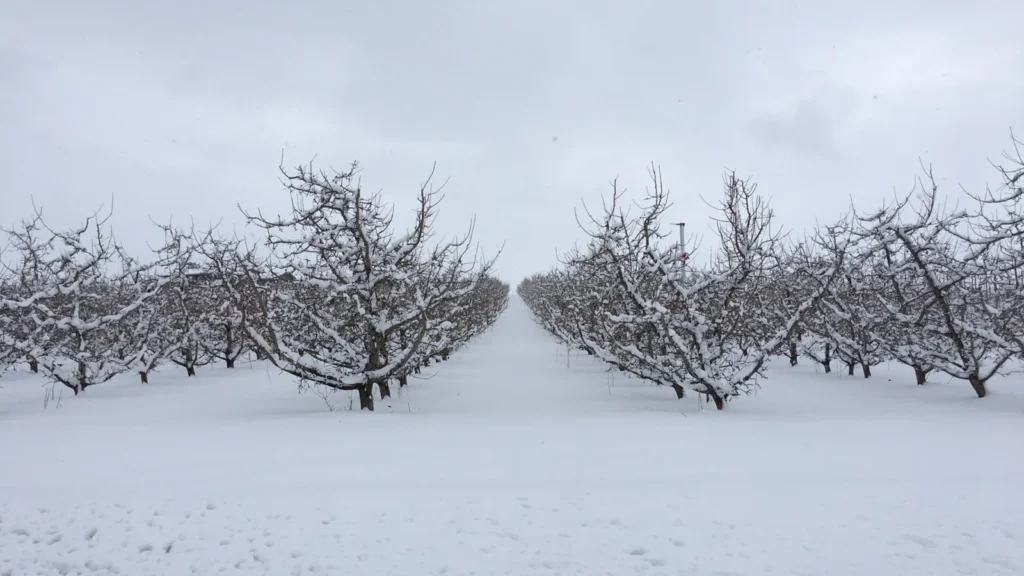
Prune apple trees in late winter or early spring while they are dormant, before the buds swell. Oregon State University Extension recommends pruning in late winter, just before spring, when the risk of cold damage to fresh cuts has mostly passed. Light summer pruning is useful for removing water sprouts and controlling size. Avoid heavy pruning in fall.

Why late winter works
- You can see the tree’s structure clearly without leaves.
- Wounds heal quickly as growth starts in spring.
- Disease pressure is lower in cool, dry weather than in warm, wet weather.
- Dormant pruning increases vigor in the buds you leave and is the main tool for shaping the tree, according to Utah State University Extension, which recommends pruning after the coldest part of winter but before bud swell.
Wait until the hardest cold has passed in your area, especially for young trees. Check the frost dates by ZIP code tool for your last frost and the growing zone finder for your climate.
Timing by season
| Season | What to do |
|---|---|
| Late winter to early spring | Main pruning: structure, thinning, removing dead wood. Do this before buds swell |
| Late spring to early summer | Rub or tear off succulent water sprouts, which causes less regrowth than cutting them off in winter |
| Summer | Light pruning to reduce vigor and size; remove diseased or damaged limbs as soon as you see them |
| Fall and early winter | Avoid. Cuts heal slowly and new growth can freeze |
Oregon State adds a useful habit: during the growing season, tie flagging tape on underperforming branches, then prune them out the following winter. That way you decide with the leaves on, when poor growth is easiest to spot.
Why prune at all?
The Oregon State University Extension guide to pruning apple trees lists the main reasons: controlling height so fruit stays reachable, building strong limb structure, removing damaged or diseased wood, opening the canopy for airflow that lowers disease risk, and encouraging spur growth, because most apples fruit on spurs. Fruit on well-lit wood is larger, redder and sweeter than fruit in shade, and an open canopy dries faster after rain, which cuts down on apple scab and other fungal problems. See our guides to apple scab and cedar apple rust.
Know your tree first
Modern apple varieties are mostly spur-bearing, while many older types are tip-bearing, meaning they fruit at the ends of last year’s shoots. Oregon State advises identifying your variety before pruning so you do not remove the fruiting wood. If you do not know yours, watch where the tree sets fruit for a season before making big cuts. Dwarf trees need lighter, more frequent pruning than standard trees; see dwarf apple trees and heirloom apples.

How much to remove
A good rule is to remove no more than about a quarter to a third of a mature tree’s branches in one year. Heavy pruning causes a flush of vertical shoots called water sprouts, which shade the canopy and produce little fruit. Utah State also notes that on young trees few cuts are needed in the first three years, since excessive pruning delays flowering. A light hand early is repaid with earlier fruit.
Understanding the cuts
The Utah State University publication on training and pruning apple trees explains two basic cuts:
- Heading cuts remove the top of a branch back to a bud or side branch. They stimulate vigorous growth just below the cut, so avoid them on the tops of trees and on laterals you want to shorten.
- Thinning cuts remove a whole shoot back to its junction with a lateral or scaffold. They are less invigorating and are preferred for shortening laterals. Make each cut cleanly at the branch collar, the slightly swollen ring where the branch meets its parent.
As a rule, use thinning cuts to open the tree and heading cuts sparingly, for example to shorten the leader of a young whip or to stimulate branching where you need it.
How to prune an apple tree, step by step
- Start with the three Ds. Remove dead, diseased and damaged wood.
- Remove water sprouts and suckers. These are straight, fast shoots from branches or the base.
- Open the canopy. Remove branches that cross, rub or grow inward so light reaches the fruit.
- Keep a central leader. Most apples are trained to one strong upright trunk with tiers of well-spaced side branches at wide angles.
- Use thinning cuts. Remove a whole branch back to its origin instead of just shortening it, which makes bushy regrowth.
- Step back often. Stop when the canopy is open enough to throw a bird through, as the old saying goes.
Training a young tree
Expect little fruit for the first four to five years, as Oregon State notes, and focus on the framework. Utah State describes the central leader system in detail: train toward a cone or pyramid shape with horizontal scaffolds so light reaches the canopy and most fruit stays low.
- Start with a whip. A heading cut on an unbranched whip at 30 to 36 inches above the ground encourages the first scaffolds.
- Set the first scaffold about 18 inches above the ground, and space later scaffolds around the trunk, 6 to 8 inches apart vertically. Reaching the ideal spacing can take more than one year.
- Add a second tier 2 to 3 feet above the first, with its lowest branch at least 24 inches above the top branch of the lower tier and with shorter branches.
- Control competition. On young trees, remove or bend to horizontal any competing branch larger than half the leader’s diameter, and keep lateral scaffolds no thicker than half the leader.
- Remove early fruit on the leader, because its weight can bend the leader and reduce its dominance.
- Cap the height. Once the leader reaches your target, cut it back to a lateral branch and repeat each year to maintain the height. Excess leader growth can be headed back by about a quarter.
Branch angles
Aim for a branch angle of about 60 degrees between the leader and its laterals. Narrow angles trap bark and may split under a heavy crop; wide, drooping angles are weak and produce water sprouts. Utah State advises spreading scaffolds to roughly 60 degrees from the leader but never below horizontal, doing so in early spring just after bud break when the wood is most flexible. Use weights, stick spreaders, clothespins or string and keep them on for at least one growing season. Horizontal to slightly upward branches are very fruitful, while upright shoots have little fruiting potential.
Pruning a mature tree
Branches are most productive for about three to five years after bearing begins, then decline. Oregon State suggests removing older, less productive branches to stimulate new growth and maintain a steady crop. Utah State describes a renewal technique using stub cuts: leave a stub with its lower side longer than its upper side, which encourages a new shoot from the underside and forms a wide, strong crotch. Keep one shoot while it is still succulent and remove the others. This works well to replace a well-placed limb that has a poor angle, damage or disease, or to create new fruiting wood.
Fixing a badly pruned tree
If a tree has been topped or heavily cut back, do not try to fix it in one year. Over two to three winters, remove the weakest water sprouts, keep a few well-placed ones to rebuild branches, and thin gradually. Taking off more than about a third in a year will trigger even more sprouting. Our full guide to fixing a badly pruned apple tree walks through the recovery plan.
Pruning for fire blight
Fire blight is a bacterial disease that blackens shoot tips into a shepherd’s crook. Utah State recommends cutting at least 8 to 12 inches below the lowest visible infection, and disinfecting tools between cuts with a 10 percent bleach solution, one part bleach to nine parts water. Wait for hot, dry conditions to prune out infection in summer, since wet weather spreads the bacteria. Dispose of cuttings away from the orchard. Our fire blight guide covers symptoms and management, and the same principles apply to apples.
Tools and care
- Sharp bypass pruners for twigs up to about a half inch.
- Loppers for branches between about 3/4 and 1 1/2 inches; see our guide to loppers for how to choose them.
- A pruning saw for larger limbs, using the three-cut method to avoid tearing bark.
- Rubbing alcohol or diluted bleach to disinfect blades.
- A stable ladder or a pole pruner for high limbs. Never prune near power lines.
You do not need pruning paint; clean cuts heal on their own. After pruning, remove the cuttings, mulch the tree (see the mulch calculator) and feed lightly if growth is weak; see our fruit tree fertilizer guide.
Common mistakes
- Pruning in late fall, when cuts heal slowly and new growth freezes.
- Removing too much at once, which produces a thicket of water sprouts.
- Leaving stubs or cutting flush with the trunk instead of at the branch collar.
- Topping a tree to reduce its height, which ruins its structure.
- Pruning wet and spreading disease on dirty tools.
- Ignoring training until the tree is large, when correcting it needs big cuts.
A yearly pruning routine
General principles of pruning apply to apples as to any woody plant: cut to a bud, branch or collar, remove what is dead or competing first, and never take more than the tree can recover from. A practical yearly routine looks like this:
- Midsummer: walk the tree with flagging tape and mark weak, shaded or diseased branches, and rub off water sprouts while they are soft.
- Late winter: remove the marked branches, then check for crossing limbs, narrow crotches and a leader that has outgrown its height limit.
- Early spring: spread young scaffolds just after bud break and tie or weight them to roughly 60 degrees.
- After bloom: thin fruit to one apple per cluster and watch for new water sprouts.
- Fall: clean up fallen leaves and fruit, and leave the pruning saw in the shed until winter is nearly over.
Photograph the tree each winter from the same spot, before and after pruning. After a few years the pictures show how your cuts shaped the tree and make it much easier to decide what to remove next.
Safety and legal note: Use a stable ladder and eye protection, and keep clear of power lines. If you prune out fire blight, cut in dry weather well below the infection and dispose of the cuttings. Check local burn bans and yard-waste rules before burning prunings. If you use any fungicide or insecticide, the label is the law. Rules vary by state and country.
Short on space? Columnar apple trees grow as a single narrow stem and need only light pruning. Planting new trees? See when to plant apple trees. This article is part of our fruit trees guide, which groups all our fruit growing advice by crop.
Free printable: the Year-Round Garden & Preserving Planner
Planting dates for 24 crops, monthly tasks, blanching times, canning safety numbers and a winter storage chart in one 8-page PDF. Enter your email to download it instantly and get our seasonal garden newsletter.
No spam. Unsubscribe any time. We never sell your email.
Frequently asked questions
Can I prune apple trees in summer?
Yes, lightly, to remove water sprouts and control size. Avoid heavy summer pruning.
Can I prune apple trees in fall?
It is best to wait. Fall cuts heal slowly and can stimulate growth that freezes.
Do apple trees need pruning every year?
Light annual pruning keeps trees productive. Skipping several years leads to a crowded canopy and smaller fruit.
Do I need pruning paint?
No. Clean cuts heal on their own.
How much can I cut in one year?
Aim for no more than about a quarter to a third of a mature tree’s branches.
Reviewed October 2026. Pruning timing varies by region and variety. See also Golden Delicious apples.