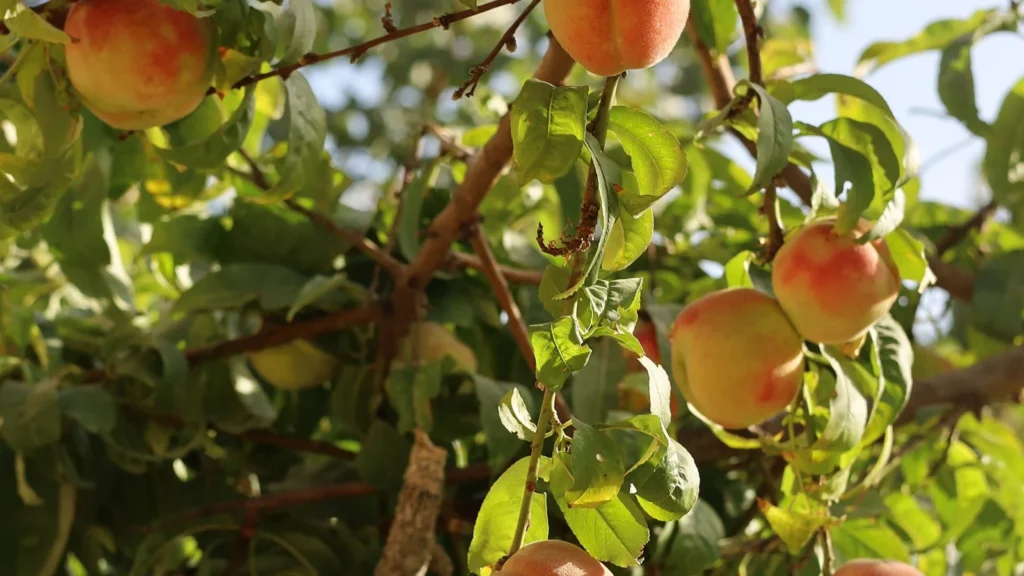
Contender is a cold-hardy, yellow-fleshed freestone peach released by North Carolina State University in 1989. Its high chill requirement of about 1,050 hours keeps it from blooming during false springs, so it crops reliably where late frosts ruin other peaches, and it has moderate resistance to bacterial spot. This guide covers what Contender tastes like, where it grows, how big the tree gets, whether it needs a pollinator and how to plant, prune and harvest it.
Contender peach overview
| Species | Prunus persica (peach) |
|---|---|
| Origin | NC State University: a ‘Winblo’ × NCX64 cross made in 1974, selected in 1977 and released in 1989 |
| Fruit | Large, yellow flesh with a red blush; freestone |
| Flavor | Sweet, juicy and melting; flesh resists browning after cutting |
| Chill hours | About 1,050 |
| Hardiness | Usually sold for zones 4 to 8; best results in zones 5 to 7 |
| Ripening | Mid-July to mid-August, depending on location |
| Pollination | Self-fertile; one tree crops on its own |
| Disease resistance | Moderate resistance to bacterial spot; still susceptible to peach leaf curl and brown rot |
| Years to fruit | Usually 2 to 4 years after planting |
Why Contender handles cold and late frost
Contender’s strength is its high chill requirement. A peach tree must collect a set number of hours between about 32 and 45°F in winter before it can bloom. A low-chill peach satisfies that quickly and blooms during the first warm spell, then loses its flowers to the next frost. Contender needs about 1,050 hours, so it waits longer, blooms later and is far less likely to lose its crop. In NC State variety trials in western North Carolina, Contender was rated very cold hardy, with large, high-quality freestone fruit and a harvest window of about July 29 to August 16.
The same trait limits it in the warm South. In areas with mild winters, such as Florida, south Texas and coastal Southern California, Contender may not receive enough chill to bloom and fruit well. Choose a low-chill variety there instead. Check your zone on the USDA Plant Hardiness Zone Map or with the growing zone finder and your frost dates with frost dates by ZIP code.

What do Contender peaches taste like?
Contender peaches are large, sweet and very juicy, with yellow melting flesh and little fuzz. Because the stone separates cleanly and the flesh is slow to brown after cutting, they are excellent for eating fresh, canning, freezing, pies and cobblers. NC State notes the flesh has no red pigment near the pit. If you are deciding between freestone and clingstone types, our guide to freestone peaches explains the difference.
Is Contender peach self-pollinating?
Yes. Like most peaches, Contender is self-fertile, so a single tree sets a full crop with the help of bees. Planting a second peach variety is not required, though it can spread out the harvest. Avoid insecticide sprays during bloom to protect pollinators.
How big does a Contender peach tree get?
A full-grown standard Contender peach tree reaches about 15 to 20 feet tall and wide if left unpruned. Most home growers keep it at 10 to 15 feet with yearly pruning, which keeps fruit within reach of a short ladder. Trees on semi-dwarf rootstocks stay around 10 to 15 feet without heavy pruning. Allow about 15 to 20 feet between standard trees, or about 12 to 15 feet for semi-dwarf trees; the plant spacing calculator helps lay out a small orchard.
Contender compared with other cold-hardy peaches
| Variety | Ripening order | Stone | Known for |
|---|---|---|---|
| Redhaven | Early | Semi-freestone | The standard early yellow peach |
| Reliance | Early to mid | Freestone | Very cold-hardy flower buds; softer flesh |
| Contender | Mid-season | Freestone | High chill, late-frost tolerance, large fruit, bacterial spot resistance |
| Elberta | Late | Freestone | Classic canning peach |
NC State bred Contender to ripen between Loring and Elberta, and in its western North Carolina trial mature trees yielded about 186 pounds of fruit each. If you already grow an early peach, see our Redhaven peach tree guide; pairing an early and a mid-season variety extends your harvest by several weeks.
How to plant a Contender peach tree
- Pick a sunny, well-drained site. Peaches need at least 8 hours of sun and soil that never stays soggy. A gentle slope helps cold air drain away on frosty nights.
- Plant in late winter or early spring. Plant bare-root trees while dormant, as soon as the soil can be worked.
- Dig a wide hole. Make it about twice the width of the roots and no deeper. The tree planting hole size calculator gives exact dimensions.
- Keep the graft above ground. The graft union, the bump near the base of the trunk, must sit 2 to 3 inches above the soil.
- Water, mulch and head back. Water deeply, mulch the root zone and cut the young tree back to about 24 to 30 inches to start an open-center shape.
Caring for a Contender peach tree
Pruning
Train Contender to an open center, or vase, with three or four main scaffold branches. Prune each year in late winter, just as the buds swell, and remove about a third of last season’s growth so new fruiting wood keeps coming. Our guide on when to prune peach trees walks through each cut.
Thinning fruit
Contender sets heavy crops. About four to six weeks after bloom, thin the young peaches to one every 6 to 8 inches along each branch. Thinning gives larger, sweeter fruit and prevents broken limbs.
Watering and feeding
Give young trees about an inch of water a week and established trees deep watering during dry spells, especially in the month before harvest. The garden watering calculator converts this to gallons. Feed in early spring according to tree age; our fruit tree fertilizer guide gives amounts.
Pests and diseases
Contender’s bacterial spot resistance is moderate, not complete, and it is still susceptible to peach leaf curl, brown rot and the usual peach insects. A dormant copper spray in fall after leaf drop, or in late winter before bud swell, prevents leaf curl. Our guide to peach tree leaves explains how to read leaf symptoms, and the main peach tree care guide covers pests through the season.

When to harvest Contender peaches
Contender usually ripens from mid-July in the South to mid-August in northern states. Pick when the background color behind the red blush turns from green to golden yellow and the fruit gives slightly near the stem. Ripe peaches twist off easily. Fruit picked a little early finishes softening on the counter; see how to ripen peaches for the method. Use the harvest date calculator to plan around your bloom date.
Spray and safety note: If you use copper or any other fungicide, follow the product label for rates, timing and protective equipment; using a pesticide against its label is illegal (EPA: pesticide labels). Never spray while trees are in bloom and bees are working. Peach pits, leaves and stems contain compounds that are toxic to pets and livestock, so clear fallen fruit and wilted prunings from areas where animals graze.
You’ll find related varieties, pruning calendars and pest guides in the fruit tree hub.
The breeding story behind Contender
NC State’s Contender cultivar profile traces the variety to a peach breeding programme that began at the university in 1951. The cross was made in 1974 by Correll between ‘Winblo’ and the selection NCX64, the seedling was chosen in 1977 at the Sandhills Research Station near Jackson Springs, North Carolina, and NC State released it publicly in 1989. It went on to become the industry standard and the top commercial cultivar in North Carolina, is planted commercially from Michigan to South Carolina, and is used as a parent in breeding programmes and as an elite comparison in production research. It received the 2014 American Society for Horticultural Science Outstanding Fruit Cultivar Award.
What the profile says about the fruit and the tree
- Fruit: large, yellow-fleshed freestone with no red pigment in the flesh and very high resistance to browning after cutting. NC State describes it as valued for both fresh and processing markets.
- Ripening: between ‘Loring’ and ‘Elberta’, producing from mid-July to mid-August depending on location.
- Yield: high.
- Chill: about 1,050 hours, which lowers the risk of freeze damage at bloom.
- Disease: moderate resistance to bacterial spot, with minimal foliage and fruit symptoms under severe disease pressure.
- Vigor: very vigorous. The profile says it requires heavy pruning and thinning in late winter and spring.
That last point matters for backyard growers. A tree that is happy and productive will overgrow a small yard quickly, so plan to prune it hard each year and thin the fruit well, rather than treating it as a plant that looks after itself.
Understanding chill hours (and why Contender is a poor fit for warm climates)
The University of Florida’s peach guide for Florida defines chilling as hours between 32 and 45 degrees F (0 to 7 degrees C), with temperatures from 40 to 50 degrees F counting most. Unseasonable warmth above 60 degrees F from November through February can cancel some of the chilling a tree has already collected. UF’s advice is to choose cultivars whose chilling requirement is below the local average so the need is met in most years.
Florida’s numbers show how much a 1,050 hour cultivar asks for. North Florida gets roughly 350 to 600 chill hours, north-central Florida 200 to 350 and central Florida 100 to 200. UF’s Florida varieties need between 100 hours (UFSun) and 525 (Gulfcrest). Contender, at about 1,050, would fall far short anywhere in that range. If you live in a mild-winter region, check your local chill hours before buying and choose a variety your extension service recommends.
How cold can the blossoms take?
UF reports that open peach blossoms tolerate freezes to about 26 to 28 degrees F (-3 to -2 degrees C), and unopened blossoms to about 20 degrees F (-7 degrees C). Contender’s high chill requirement delays bloom, so fewer flowers are open when a spring freeze arrives. If a hard freeze is forecast while the tree is in full bloom, cover it or, in an orchard, use overhead irrigation to protect young fruit, as UF notes. Our frost date tool lets you check your average last frost.
Thinning for bigger fruit
UF advises thinning at the earliest stage after the danger of frost has passed to increase fruit size, and adds that supplemental irrigation during the final fruit swell also improves size. Crop load, tree age, soil and climate all play a role. A high-yielding variety like Contender benefits most, since an unthinned tree makes many small peaches and may break limbs.
How long will the tree last?
In the humid Southeast, UF says pests and diseases typically limit peach tree life to 7 to 10 years. Plan to replace trees on a rolling schedule: plant a new one every few years so there is always a young tree coming into bearing. Good sanitation, annual pruning and thinning, and picking up mummified fruit all help.
Buying checklist
- Confirm that your winter provides roughly 1,050 chill hours.
- Buy a one-year, branched whip with a healthy graft union from a nursery near you.
- Ask the nursery for the cultivar name on the tag and keep it for your records.
- Choose a site with cold-air drainage and good air movement to reduce disease.
- Plan for an annual routine: prune in late winter, thin in spring, net before ripening, rake up fallen fruit.
Safety and legal note: Always follow the label on any fungicide or insecticide, including copper and dormant oil, and do not spray open blossoms. Wear gloves and eye protection when pruning and spraying. Pesticide registration and nursery import rules differ by country and region, so check local requirements before moving trees across borders.
Free printable: the Year-Round Garden & Preserving Planner
Planting dates for 24 crops, monthly tasks, blanching times, canning safety numbers and a winter storage chart in one 8-page PDF. Enter your email to download it instantly and get our seasonal garden newsletter.
No spam. Unsubscribe any time. We never sell your email.
Frequently asked questions
What zones does a Contender peach tree grow in?
Nurseries typically list zones 4 to 8, with the most reliable crops in zones 5 to 7. It needs about 1,050 winter chill hours, so it does poorly in mild-winter areas.
How long does a Contender peach tree take to bear fruit?
Most trees bear their first crop 2 to 4 years after planting. Remove fruit in the first year so the tree builds strong roots and branches.
Is Contender a freestone or clingstone peach?
Contender is a freestone peach, so the flesh pulls away cleanly from the pit when ripe.
Is Contender resistant to disease?
It has moderate resistance to bacterial spot, but it still needs protection from peach leaf curl and brown rot in wet climates.
Does Contender need heavy pruning?
Yes. NC State describes it as very vigorous, requiring heavy pruning and thinning in late winter and spring.
When does Contender bloom?
NC State does not give a date, but its high chilling requirement delays bloom and reduces freeze risk to the flowers.
Is Contender good for canning?
Yes. The flesh resists browning and has no red pigment near the stone, and NC State says it suits both fresh and processing markets.
Reviewed October 2026. Sources: NC State, Peach cultivar: Contender; UF/IFAS, Peaches for Florida; NC State Extension, Evaluating peach cultivars for western North Carolina. Ripening dates and hardiness vary by site and year.