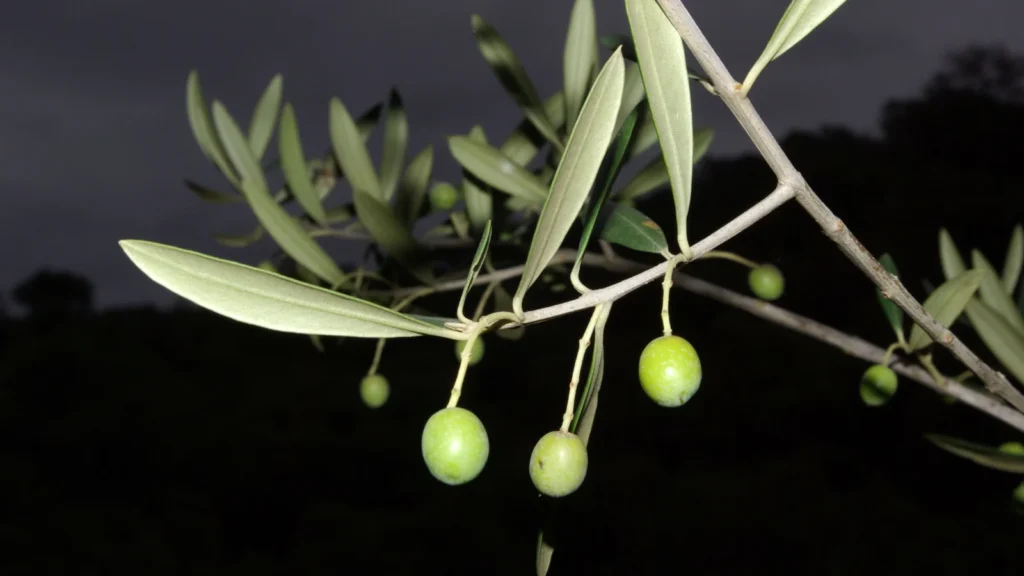
A fruitless olive tree is an olive (Olea europaea) variety selected to produce little or no fruit, so it gives the silvery, Mediterranean look of an olive without messy, staining fruit drop. The best-known types are ‘Swan Hill’, ‘Majestic Beauty’, ‘Wilsonii’ and the shrubby ‘Little Ollie’. Most grow 15 to 30 feet tall, tolerate drought and heat, and shed far less pollen than fruiting olives, which is why some Southwest cities allow them where fruiting olives are restricted. This guide compares the varieties, explains how to plant and care for them, covers cold hardiness, pruning and olive knot, and answers the common question of whether they are truly fruitless.
Fruitless olive varieties compared
| Botanical name | Olea europaea, non-fruiting cultivars |
|---|---|
| Main varieties | ‘Swan Hill’, ‘Majestic Beauty’, ‘Wilsonii’, ‘Little Ollie’ (shrub) |
| Height | About 15 to 30 feet for tree forms; ‘Little Ollie’ about 4 to 6 feet |
| Hardiness | Usually zones 8 to 11 |
| Water | Low once established |
| Fruit | None to very little, depending on variety and weather |
| Pollen | Much lower than fruiting olives; ‘Swan Hill’ is noted for very little pollen |
What makes an olive tree fruitless?
Fruitless olives are cultivars whose flowers are mostly sterile or produce very little viable pollen. The Southern Nevada Water Authority plant guide describes ‘Majestic Beauty’ as having sterile flowers, and the UC Marin Master Gardeners olive guide lists ‘Swan Hill’ as a non-fruiting olive and notes that fruitless and dwarf varieties are generally available. “Fruitless” is a nursery term rather than a guarantee: some varieties set an occasional olive, especially in warm springs, but nothing like the heavy crop of a fruiting tree such as the Arbequina olive. By comparison, UC Marin says a fruiting olive bears by year 4 or 5 and can produce up to 40 pounds of olives per tree, usually in alternate years, with fruit ripening in late fall.

Which fruitless olive variety should you choose?
| Variety | Size | Fruit and pollen | Best use |
|---|---|---|---|
| ‘Swan Hill’ | About 20 to 30 feet tall and wide | Nearly fruitless; very low pollen | Shade tree in allergy-sensitive areas |
| ‘Majestic Beauty’ | About 20 to 30 feet tall, 15 to 25 feet wide | Sterile flowers, very little fruit | Street and patio tree with an upright, airy canopy |
| ‘Wilsonii’ | About 20 to 25 feet | Few or no fruit | Multi-trunk specimen tree |
| ‘Little Ollie’ | About 4 to 6 feet | Rarely flowers or fruits | Hedges, containers, foundation shrub |
UC Marin warns that olives grow at least 20 to 25 feet tall, so allow ample room. If space is tight, choose ‘Little Ollie’ or plan to prune a tree form regularly.
Why plant a fruitless olive?
- No fruit stains. Fallen olives stain patios, cars and pool decks and attract pests; fruitless types avoid most of that mess.
- Less pollen. Fruiting olives are a major spring allergen in the Southwest. Fruitless cultivars release far less.
- Drought tolerance. Established olives need little water, which makes them popular in xeriscapes.
- Evergreen structure. Silvery leaves and gnarled trunks look good all year.
- No olive fruit fly host. UC Marin lists olive fruit fly as a pest of fruiting olives and advises removing all fruit; a tree that rarely fruits gives the fly very little to work with.
Pollen ordinance note: Some local governments in the US Southwest restrict pollen-producing olives. The University of Arizona notes that Pima County codes prohibit selling mulberry and pollen-producing olive trees. Rules differ by city and county, and some list only specific cultivars as allowed, so check your local code and buy a labeled, named fruitless variety from a reputable nursery.
Where do fruitless olives grow, and how cold can they get?
Most fruitless olives grow in USDA zones 8 to 11. Check yours with the growing zone finder. Cold is the main limit. University of California research on olive freeze damage reports critical temperatures at or below about 20°F, varying with conditions, and notes that hardiness increases as trees are exposed to cooling through autumn and winter (see the UC Cooperative Extension olive freeze damage fact sheet). In California freezes, trees of tender varieties were damaged at 22 to 23°F, with leaf drop, bark splits and olive knot, and some had to be cut back to within 2 feet of the ground.
The same publication gives two useful tips. First, irrigate adequately but not excessively before cold: well-watered trees recovered faster in spring, but heavily watered trees showed more initial defoliation. Second, delay pruning until the extent of freeze damage is clear, since pruning before a freeze caused more damage than pruning after it. Most named fruitless cultivars have limited cold data, so treat the low 20s as the danger zone, and protect young trees with frost cloth. Use the frost dates by ZIP code tool to see when freezing weather can arrive.
How to plant a fruitless olive tree
- Choose full sun and well-drained soil. Olives tolerate poor, rocky and alkaline soil but rot in soggy ground. UC Marin suggests planting on a mound in poorly drained areas.
- Give it room. Plant tree forms at least 10 to 15 feet from walls, pools and paving to allow for the mature canopy and roots.
- Dig a wide, shallow hole. UC Marin says to dig as deep as the root ball and twice as wide, keeping the crown above the soil line. The plant spacing calculator helps you lay out several trees.
- Plant at nursery depth, water deeply and mulch, keeping mulch about 3 inches from the trunk. The mulch calculator tells you how much to buy.
- Stake only if needed. Large boxed trees may need temporary support; see our guide on how to stake a tree.
How do you care for a fruitless olive?
Watering
Young trees need more water than mature ones. UC Marin advises watering deeply and less often, wetting the soil to a depth of 2 feet, and says mature trees generally need watering about once a month. Overwatering increases pruning needs and the risk of pests and diseases. As a practical schedule, water deeply once or twice a week during the first summer, then gradually less often. Established trees usually need only deep watering every two to four weeks in hot, dry weather. Estimate amounts with the garden watering calculator, and see overwatering vs underwatering for warning signs.
Fertilizing
Fertilizer is rarely needed. UC Marin says mature trees do not need fertilizer; for young trees it suggests about 1 ounce of organic urea or blood meal under each drip emitter monthly. A light spring feeding is enough in poor soil.
Pruning
UC Marin says to remove suckers after planting, prune annually, and, when the tree is about 3 feet tall, reduce scaffold branches to 3 to 5. For fruitless trees, prune in late winter or early spring to remove crossing branches, thin the canopy and lift the crown, but consider olive knot (below) before pruning in wet weather. Thinning the canopy lets wind pass through and reduces storm breakage. Use sharp, clean tools; see our guide to loppers.
Protecting the trunk
UC Marin notes that borers and sunburn can be reduced by painting the lower two-thirds of the trunk with a 50/50 mix of water and white interior latex paint, which is especially useful for young trees in hot, sunny sites.
Common fruitless olive problems
| Problem | Cause | What to do |
|---|---|---|
| Yellowing, dropping leaves | Overwatering or poor drainage | Water less often, more deeply |
| Knobby galls on twigs | Olive knot | See below |
| Yellow-haloed leaf spots | Peacock spot | UC Marin suggests copper fungicide in late fall before rains; follow the label |
| Branch dieback after freeze | Cold below the variety’s tolerance | Prune dead wood after new growth begins |
| Root rot or wilt | Overwatering or Verticillium | Improve drainage; avoid overwatering |
| Leaning young tree | Wind or loose root ball | Stake loosely for one season |
Olive knot
The University of California IPM program explains that olive knot is caused by a bacterium that infects only olive and forms galls on twigs and stems, most often at leaf nodes. Galls can girdle and kill twigs. Rain splashes the bacterium short distances, and infected pruning tools and nursery stock move it farther. Leaf scars stay susceptible for up to 7 days after leaf drop, and pruning wounds for at least 14 days, so avoid pruning during the winter and spring rainy season. UC IPM recommends buying disease-free stock, removing galls in the dry season, and sterilizing tools with a 10 percent bleach solution within and between trees. It also says that effective copper products are not registered for backyard trees, so for home gardeners sanitation and cultural practices are the right approach. Frost and hail wounds raise the risk, and one-year-old plants are more susceptible than three-year-old plants.
Landscape uses for fruitless olives
Fruitless olives are versatile. Plant a single ‘Swan Hill’ or ‘Majestic Beauty’ as a shade tree beside a patio, line a driveway with evenly spaced trees, or use several multi-trunk ‘Wilsonii’ as a screen. ‘Little Ollie’ can be sheared into a low hedge or planted in a large container by an entry. Combine olives with other drought-tolerant plants such as lavender, rosemary and ornamental grasses, and keep irrigation lines on a separate, low-water zone so the olives are not overwatered by lawn sprinklers. Give each tree room to reach its mature width, and avoid planting directly over septic lines, under power lines or against foundations.
Are fruitless olive trees messy?
Much less than fruiting olives, but not mess-free. They still drop some old leaves through the year, and a few varieties set occasional fruit. Do not plant any olive right next to a pool skimmer if you want zero debris.
Can you stop a fruiting olive from fruiting?
If you already have a fruiting olive, you can reduce fruit with plant growth regulator sprays applied at bloom, or by pruning off flower clusters on small trees. These sprays must be timed precisely and applied exactly as the product label says, often by a licensed applicator. Check with your state extension service before using one. Replacing the tree with a fruitless cultivar is the only reliable long-term fix, and it also removes the pollen.
Can you grow a fruitless olive in a pot?
Yes. ‘Little Ollie’ is ideal for containers, and young tree forms can live in large pots for several years. Use a large pot with drainage holes, a fast-draining mix, and water only when the top few inches are dry. Container trees are more exposed to cold than trees in the ground, so move them to a protected spot if temperatures drop into the low 20s.
Safety and legal note: Olive pollen restrictions and tree ordinances vary by city, county, state and country, and some jurisdictions ban or limit olive sales or plantings; check before you buy. If you use bleach, copper, paint or a growth-regulator spray, the label is the law: follow the rate and safety directions. Olive pollen is a common allergen, so people with allergies should ask a doctor before planting any olive near the home.
Free printable: the Year-Round Garden & Preserving Planner
Planting dates for 24 crops, monthly tasks, blanching times, canning safety numbers and a winter storage chart in one 8-page PDF. Enter your email to download it instantly and get our seasonal garden newsletter.
No spam. Unsubscribe any time. We never sell your email.
Frequently asked questions
Do fruitless olive trees produce pollen?
Very little. Fruitless cultivars such as ‘Swan Hill’ release much less pollen than fruiting olives, which is why they are often allowed where fruiting olives are restricted.
Very little. Fruitless cultivars such as ‘Swan Hill’ release much less pollen than fruiting olives, which is why they are often allowed where fruiting olives are restricted.
How tall does a fruitless olive tree get?
Most tree forms reach about 20 to 30 feet. ‘Little Ollie’ stays a shrub about 4 to 6 feet tall.
Most tree forms reach about 20 to 30 feet. ‘Little Ollie’ stays a shrub about 4 to 6 feet tall.
Do fruitless olive trees ever make olives?
Occasionally. Some varieties set a few fruit in certain years, but far fewer than fruiting olives.
Occasionally. Some varieties set a few fruit in certain years, but far fewer than fruiting olives.
Are fruitless olive trees fast growing?
They grow at a moderate rate, usually about 1 to 2 feet a year when young with regular water.
They grow at a moderate rate, usually about 1 to 2 feet a year when young with regular water.
Can a fruitless olive grow in a pot?
Yes. ‘Little Ollie’ is ideal for containers, and young tree forms can live in large pots for several years.
Yes. ‘Little Ollie’ is ideal for containers, and young tree forms can live in large pots for several years.
How cold can a fruitless olive tree tolerate?
Damage begins at or below about 20°F, though tender varieties can be hurt in the low 20s. Hardiness is better when trees have cooled gradually in autumn.
Damage begins at or below about 20°F, though tender varieties can be hurt in the low 20s. Hardiness is better when trees have cooled gradually in autumn.
This article is part of our fruit trees guide, which groups all our fruit growing advice by crop.
Reviewed October 2026. Sources: UC Marin Master Gardeners, Olive; UC IPM, Olive Knot; UC Cooperative Extension, olive freeze damage; Southern Nevada Water Authority, Majestic Beauty olive; University of Arizona, Pollen and Allergies. Local rules change; check your city and county before planting.