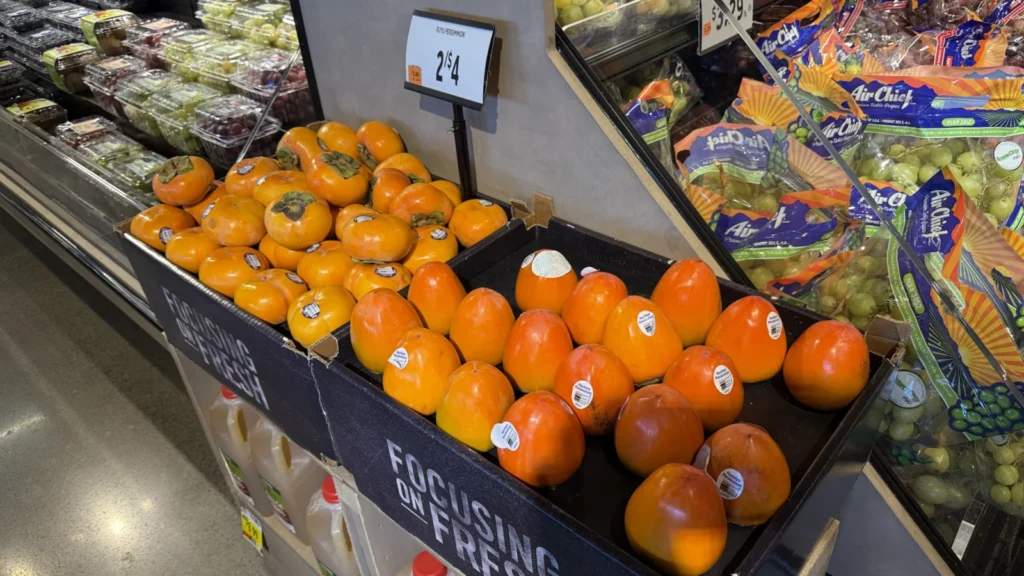
The main difference between Hachiya and Fuyu persimmons is astringency. Hachiya is an astringent persimmon: its acorn-shaped fruit is mouth-puckeringly bitter until it becomes completely soft and jelly-like, when it turns intensely sweet. Fuyu is a non-astringent persimmon: its squat, tomato-shaped fruit can be eaten crisp like an apple or soft, and is sweet either way. Use Fuyu for slicing into salads and eating fresh, and Hachiya for scooping, baking pulp and drying into hoshigaki. Both are Asian persimmons (Diospyros kaki) that ripen in fall and set fruit without a pollinizer.
Hachiya vs Fuyu side by side
| Trait | Hachiya | Fuyu |
|---|---|---|
| Type | Astringent (pollination-constant) | Non-astringent (pollination-constant) |
| Shape | Tall, acorn or heart-shaped, pointed tip | Squat, flat, tomato-shaped |
| Skin color | Deep orange-red | Orange |
| When to eat | Only when completely soft | Firm and crisp, or soft |
| Texture | Jelly-like, smooth | Crisp like an apple, or soft |
| Flavor | Very sweet, rich, honeyed when ripe | Sweet, mild, cinnamon-pear notes |
| Best uses | Baking pulp, puddings, smoothies, hoshigaki | Fresh eating, salads, cheese boards |
| Storage | Short once soft | Weeks when firm |
| Pollinizer needed? | No | No |
Why is a Hachiya persimmon astringent?
Astringency is caused by soluble tannins in the flesh. When you bite an unripe Hachiya, these tannins bind to proteins in your saliva and mouth, creating a dry, furry, chalky feeling that can linger for minutes. The University of Florida IFAS persimmon guide explains that astringent fruit must soften or be treated before eating, while non-astringent fruit loses its astringency while still firm. As a Hachiya ripens to full softness, the tannins become insoluble and the astringency disappears, leaving a rich, sweet pulp.
Fuyu belongs to the pollination-constant non-astringent group: whether or not it has seeds, its tannins become insoluble early, so the fruit is sweet even when crunchy. For the full classification, see our guide to persimmon varieties.

How can you tell Hachiya and Fuyu apart?
- Shape: Hachiya is elongated and pointed, like an acorn or a heart; Fuyu is flat and round, like a small tomato.
- Bottom: Hachiya tapers to a point; Fuyu has a flat or slightly sunken base.
- Color: Hachiya often has a deeper orange-red tone; Fuyu is bright orange.
- Feel at the store: Ripe Hachiya is soft like a water balloon; Fuyu is sold firm.
If in doubt, cut a firm fruit and taste a tiny slice: astringency shows immediately.
How do you eat a Hachiya persimmon?
- Wait until the fruit is extremely soft, almost liquid inside, with translucent, slightly wrinkled skin. It should feel like a water balloon.
- Chill it if you like.
- Cut off the top with the calyx and scoop out the pulp with a spoon, or cut it in half.
- Use the pulp straight away or freeze it for baking.
Hachiya pulp is the classic base for persimmon bread, cookies, puddings and smoothies. Frozen whole Hachiyas, eaten partly thawed, taste like sorbet.
How do you eat a Fuyu persimmon?
Rinse it, cut off the calyx and slice it into wedges or rounds, with or without the thin skin. Fuyu is crisp, sweet and mild, with notes often compared to pear, apricot and cinnamon. It is excellent in salads with greens, nuts and goat cheese, on cheese boards, in salsas and simply as a snack. You can also let Fuyu soften on the counter for a sweeter, jam-like texture.
How do you ripen Hachiya persimmons faster?
Hachiyas picked firm can take one to three weeks to soften at room temperature. To speed things up:
- Ethylene: Seal them in a paper bag with a ripe apple or banana. The Texas A&M AgriLife Extension office in Bexar County notes that placing a red apple with persimmons helps them ripen.
- Freezing: Freeze the fruit for 24 hours, then thaw; the flesh softens and loses astringency. UF/IFAS lists this method.
- Rice: Cover the fruit in uncooked dry rice for 3 to 5 days, another UF/IFAS method.
- Warmth: Keep them at about 60 to 70°F, the ripening range given by the Texas A&M article.
Which is sweeter, Hachiya or Fuyu?
A fully ripe Hachiya is usually sweeter and richer than a Fuyu, with a deep, honeyed flavor. Fuyu is sweet but milder, and its appeal is that you can enjoy it crisp. Sweetness also depends on ripeness: a Fuyu left to soften becomes sweeter, while an under-ripe Hachiya is inedible no matter how sweet it will become.
Which is better for baking?
Hachiya. Its soft, jelly-like pulp blends smoothly into batters and puddings and gives baked goods moisture and color. Fuyu can be pureed when fully soft, but it is usually better used fresh, roasted or sliced into tarts where its firmer texture holds. If a recipe calls for persimmon pulp, it almost always means soft Hachiya or another astringent variety.
Which persimmon tree should you grow?
| Consideration | Hachiya | Fuyu |
|---|---|---|
| Tree size | Large, upright, vigorous; often 20 to 25 feet | Smaller, spreading; often 15 to 20 feet |
| Ornamental value | Excellent fall color, fruit hangs into winter | Good fall color |
| Harvest style | Pick firm, ripen indoors | Pick firm and eat |
| Use | Baking, drying | Fresh eating |
| Crop management | Moderate | UF/IFAS notes Fuyu usually needs thinning for large fruit |
Many gardeners grow one of each: Fuyu for eating fresh and Hachiya for baking and drying. Both are generally grown in zones 7 to 10. Check your zone with the growing zone finder. If you want something different, try Chocolate, whose pollinated fruit is brown-fleshed and spicy, or the extra-sweet astringent Saijo.
Do Hachiya and Fuyu need a pollinator?
No. Both are pollination-constant types that set seedless fruit without pollination, so a single tree of either will fruit. Pollination does not change their astringency or flesh color, although seeds may form if another persimmon with male flowers grows nearby. The Texas A&M article notes Fuyu can pollinate other varieties.
How do you grow Hachiya and Fuyu persimmons?
- Site: Full sun, well-drained soil, shelter from strong wind.
- Planting: Plant young trees in late winter or early spring, taking care of the long taproot. Use the planting hole size calculator.
- Water: Keep soil evenly moist the first two years and during summer droughts to reduce fruit drop.
- Fertilizer: Feed lightly; too much nitrogen causes fruit drop. See our fruit tree fertilizer guide.
- Pruning: Train to a central leader or open center; prune lightly in late winter.
- Thinning: Thin heavy crops, especially on Fuyu.
When do you harvest Hachiya and Fuyu?
Both ripen in fall, roughly October to December depending on climate. UF/IFAS gives a mid-November to early December harvest for Fuyu in Florida. Pick Fuyu when it is fully orange and still firm; it is ready to eat. Pick Hachiya when fully colored, either firm or just softening, and finish ripening indoors. Clip fruit with pruners, leaving the calyx attached, and handle gently to avoid bruising.
How do you store them?
Firm Fuyu keeps for several weeks at cool room temperature and longer in the refrigerator. UF/IFAS notes that non-astringent types can be stored up to 30 days at room temperature. Hachiya stores well while firm but must be eaten or frozen within a few days of becoming soft. The Texas A&M article gives 32 to 34°F for one to four months of cold storage, with astringent types keeping longer, and notes that frozen, peeled fruit or pulp keeps for a year or more.
Are Hachiya and Fuyu persimmons healthy?
Both are rich in fiber, vitamin A from beta-carotene and vitamin C, and contain antioxidant compounds. Nutrient values are listed in the USDA’s FoodData Central database. Avoid eating large amounts of unripe astringent persimmons on an empty stomach; their tannins can, in rare cases, form hard masses in the stomach.
Where do the names Hachiya and Fuyu come from?
Both are old Japanese varieties. Hachiya is named after Hachiya village in Gifu Prefecture, which is famous for its dried persimmons, and Fuyu is generally translated as “winter,” a nod to its late-season ripening. Persimmons were domesticated in China and spread to Japan and Korea centuries ago, then reached the US in the 1800s, as described in the Wikipedia article on persimmons. Today Hachiya and Fuyu are the two persimmons most often found in American supermarkets.
Which other persimmons are like Fuyu?
If you like crisp, non-astringent persimmons, look for Jiro, which is very similar to Fuyu with a squarer shape; Giant Fuyu (Hana Fuyu), which has larger fruit but can be slow to lose astringency; and Izu, an early-ripening non-astringent type. All can be eaten firm. Pollinated Chocolate persimmons are also non-astringent when they contain seeds.
Which other persimmons are like Hachiya?
Astringent varieties similar to Hachiya include Saijo, one of the sweetest; Tanenashi, a seedless, cone-shaped variety that crops heavily; and Tamopan, with very large, flattened fruit. The native American persimmon is also astringent until fully ripe. All must be eaten soft or treated to remove astringency.
Can you substitute Fuyu for Hachiya in recipes?
Sometimes. For baking recipes that call for persimmon pulp, a very soft, ripe Fuyu pureed in a blender can stand in for Hachiya, though the result may be a little less rich and smooth. For salads and fresh dishes that need crisp slices, you cannot substitute Hachiya, because a firm Hachiya is too astringent to eat. As a rule: soft recipes can use either when fully ripe; crisp recipes need Fuyu.
Simple ways to use Hachiya and Fuyu
| Dish | Best persimmon | How |
|---|---|---|
| Persimmon bread or cookies | Hachiya | Use soft pulp in place of mashed banana |
| Persimmon pudding | Hachiya or American persimmon | Bake pulp with eggs, milk, flour and spices |
| Salad | Fuyu | Thin slices with greens, nuts, cheese and vinaigrette |
| Cheese board | Fuyu | Wedges with soft cheese and crackers |
| Smoothie | Either, when soft | Blend pulp with yogurt and a little ginger |
| Hoshigaki | Hachiya | Peel, hang and massage over several weeks |
| Frozen treat | Hachiya | Freeze whole; eat partly thawed with a spoon |
How do you make hoshigaki from Hachiya?
Hachiya is one of the traditional varieties for hoshigaki, Japanese hand-massaged dried persimmons. Peel firm, fully colored fruit, leaving the stem and calyx attached, hang it by string in a dry, airy place, and gently massage each fruit every few days once a skin forms. After about three to six weeks, the fruit becomes chewy and develops a natural white sugar bloom. Drying removes all astringency. See our guide to the Saijo persimmon for step-by-step instructions.
Whichever you choose, both trees bring brilliant orange and red fall leaves and bright fruit that hangs on bare branches into early winter, so they earn their place in the garden even before the harvest. If space allows only one, choose by how you like to eat persimmons: crisp slices (Fuyu) or spoonable, baking-ready pulp (Hachiya).
How many persimmons does one tree produce?
A mature, healthy Fuyu or Hachiya tree can produce a large crop, often a hundred or more fruits in a good year, and some old trees bear several hundred. Young trees bear lightly and may drop much of their early fruit. Thinning heavy crops, steady summer watering and light feeding help keep yields regular from year to year.
Planning more fruit? Browse every variety, planting and care article in our complete fruit tree growing guide.
Astringent versus non-astringent: what the university guidance says
The University of California’s persimmon overview explains that ‘Hachiya’, the large acorn-shaped type, is very astringent while firm and must ripen to a very soft, mushy consistency before it becomes flavourful and sweet. ‘Fuyu’, rounded and about baseball-sized, is non-astringent and can be eaten while firm, though the flavour is better slightly softened. ‘Coffee Cake’ is non-astringent only if pollinated by a different variety. Many varieties are self-fertile and produce few seeds. Harvest runs from late October through November, with ‘Izu’ ripening earlier than most.
| Type | Hardiness (UC) | Eating |
|---|---|---|
| American persimmon | Zones 5 to 9; ‘Meader’ ripens even in cool summers | Soft before eating |
| ‘Fuyu’, ‘Jiro’ | Zones 6 to 10 | Firm or soft |
| ‘Nikita’s Gift’ (hybrid) | Cold tolerant | Must be soft before eating |
| ‘Hachiya’ | Warm climates | Only when very soft |
The page also cautions that eating large amounts of persimmon can cause a persimmon bezoar, a gut blockage from hardened fibre. Check your climate with our growing zone finder.
Safety and legal note: Eat astringent persimmons only when fully soft, and eat large amounts of any persimmon in moderation; seek medical advice if you have digestive blockages or take regular medication. Rules vary by country and region.
Free printable: the Year-Round Garden & Preserving Planner
Planting dates for 24 crops, monthly tasks, blanching times, canning safety numbers and a winter storage chart in one 8-page PDF. Enter your email to download it instantly and get our seasonal garden newsletter.
No spam. Unsubscribe any time. We never sell your email.
Frequently asked questions
Can you eat a Hachiya persimmon when it is hard?
No. A firm Hachiya is extremely astringent. Wait until it is completely soft and jelly-like.
Can you eat a Fuyu persimmon when it is hard?
Yes. Fuyu is non-astringent and is usually eaten firm and crisp.
Which persimmon is better for baking?
Hachiya, because its soft pulp blends smoothly into batters and puddings.
Do you peel persimmons?
Fuyu skin is thin and edible. Hachiya pulp is usually scooped out, leaving the skin.
Why did my persimmon make my mouth dry?
You ate an astringent persimmon, probably a Hachiya, before it was fully soft.
Do Fuyu and Hachiya need two trees?
No. Both set seedless fruit on their own.
References used in this guide: University of Florida IFAS, The Persimmon in Florida; Texas A&M AgriLife Extension, Bexar County, Oriental Persimmons in the Fall; USDA, FoodData Central.
Reviewed October 2026. Sources: University of California Backyard Gardener, Persimmon Overview