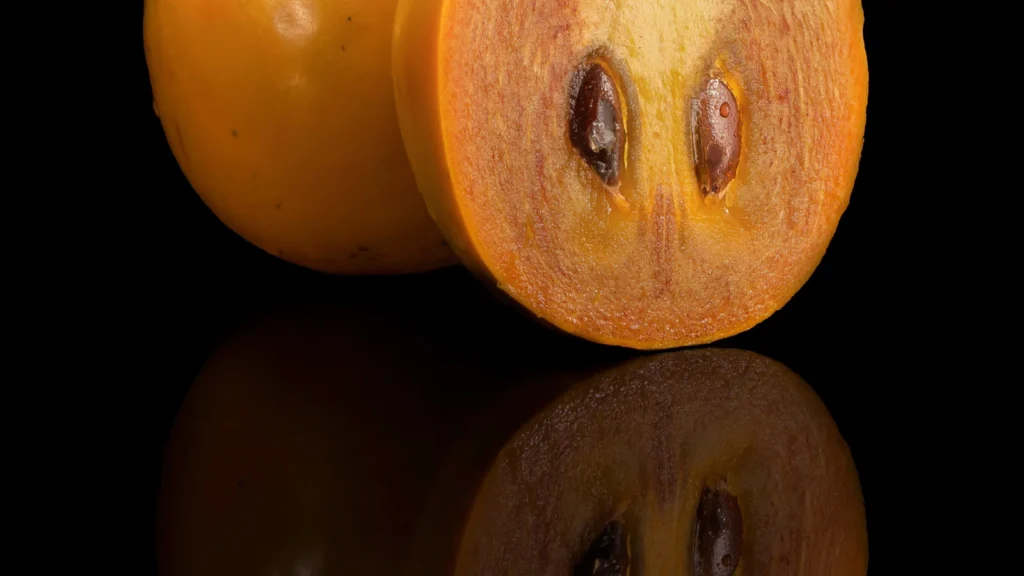
The Chocolate persimmon is an Asian persimmon (Diospyros kaki), known in Japan as ‘Tsuru Noko’, whose flesh turns cinnamon-brown with dark speckles when the fruit is pollinated and contains seeds. Seeded fruit is non-astringent and can be eaten while still firm, with a sweet, spicy flavor some describe as brown sugar or cinnamon. Unpollinated, seedless fruit stays orange inside and is astringent until fully soft. The name refers to the color of the flesh, not a chocolate taste. Chocolate ripens in fall, is grown in about zones 7 to 10 and is also a good pollinizer for other persimmons.
Chocolate persimmon facts
| Botanical name | Diospyros kaki ‘Chocolate’ (Tsuru Noko) |
|---|---|
| Type | Pollination variant |
| Seeded fruit | Brown, speckled flesh; non-astringent; eat firm or soft |
| Seedless fruit | Orange flesh; astringent until fully soft |
| Fruit | Small to medium, oval to round, deep orange to red-orange skin |
| Flavor | Very sweet, with spicy, brown-sugar notes |
| Season | Fall into early winter |
| Zones | About 7 to 10 |
| Pollination role | Produces male flowers; good pollinator for other persimmons |
What is a Chocolate persimmon?
Chocolate is an old Japanese persimmon variety grown for its unusual brown flesh. The produce reference Specialty Produce describes small to medium, oval to slightly flattened fruit with glossy, dark orange to almost red skin, and notes that its original Japanese name is ‘Tsuru Noko’ and that it is also called “goma,” meaning black sesame seed, for the dark specks in pollinated flesh. Brown-fleshed persimmons were probably introduced to the US by the USDA in the late 1800s.
Chocolate belongs to the pollination-variant group of persimmons, which behaves differently from the better-known Fuyu and Hachiya. For an overview of all the types, see our guide to persimmon varieties.

Why is the Chocolate persimmon brown inside?
When a pollination-variant persimmon is pollinated and forms seeds, the developing seeds release compounds that cause the tannins in the surrounding flesh to become insoluble and turn brown. This darkened, speckled flesh is no longer astringent. The University of Florida IFAS persimmon guide explains that variant types develop dark, streaked flesh around the seeds when seeded, while constant types do not, and that variant types grown without a pollinator are usually seedless and astringent. In Chocolate, the browning can spread through most of the fruit when several seeds form, giving the cinnamon-brown flesh it is named for.
What does a Chocolate persimmon taste like?
Seeded Chocolate persimmons are very sweet and rich, with a spicy, brown-sugar or cinnamon flavor and a texture that ranges from crisp when firm to soft and jam-like when fully ripe. They do not taste like chocolate. Seedless fruit has orange flesh and is astringent while firm; it becomes sweet once it softens completely, like a Hachiya, but lacks the spicy notes of seeded fruit.
How do you know if a Chocolate persimmon is safe to eat firm?
Cut one open. If the flesh is brown or heavily speckled with brown and you see seeds, it is non-astringent and ready to eat while firm. If the flesh is clear orange with no seeds, it is astringent: set it aside to soften completely, or treat it to remove astringency. Fruit from the same tree can vary, because some flowers are pollinated and others are not. A taste of a small slice also tells you quickly; astringent fruit makes your mouth feel dry and furry.
Does a Chocolate persimmon need a pollinator?
To get the brown, non-astringent fruit, yes. Chocolate is unusual among Asian persimmons because it produces male flowers as well as female flowers, so a mature tree can partly pollinate itself, and the Texas A&M AgriLife Extension office in Bexar County describes it as a good pollinator. Pollination is more reliable, and more fruit turns brown, when another persimmon that produces male flowers, or a second Chocolate, blooms nearby. Without pollination, the tree still fruits, but the fruit is mostly seedless and astringent.
Where does the Chocolate persimmon grow?
Chocolate grows in climates suited to Asian persimmons, roughly zones 7 to 10, with hot summers to ripen the fruit and mild to cold winters. It does well in California, the Southeast, Texas and the warmer parts of the Pacific Northwest. Check your zone with the growing zone finder and your frost dates with the frost date tool. Young trees are more cold-sensitive than mature ones, so protect them during their first winters in borderline areas.
How do you plant a Chocolate persimmon tree?
- Choose full sun and well-drained soil. Persimmons tolerate clay but not standing water.
- Plant young trees. Persimmons have a long taproot and transplant poorly when large, so start with a young container or bare-root tree.
- Plant in late winter or early spring while dormant. Use the planting hole size calculator, plant at nursery depth and water deeply.
- Space trees about 15 to 20 feet apart, closer for dwarf rootstocks.
- Mulch 2 to 4 inches deep, keeping mulch off the trunk; the mulch calculator tells you how much.
How do you care for a Chocolate persimmon?
Water
Water weekly during the first two summers and during dry spells after that. Steady moisture in summer reduces fruit drop.
Fertilizer
Persimmons need little fertilizer. Too much nitrogen causes vigorous growth and fruit drop. Feed lightly in early spring if growth is weak; see our fruit tree fertilizer guide.
Pruning
Train young trees to a modified central leader or open center with well-spaced scaffolds. On mature trees, prune lightly in late winter to thin crowded branches and remove dead wood. Persimmon wood can be brittle, so keep branches from becoming too long and heavily loaded.
Thinning
Thin heavy crops in early summer to reduce limb breakage and alternate bearing and to increase fruit size.
When are Chocolate persimmons ready to harvest?
Chocolate persimmons ripen in fall, usually October to November, and may hang into early winter. Pick when the fruit is fully colored deep orange to red-orange. Clip the stem with pruners, leaving the calyx attached. Seeded, brown-fleshed fruit can be eaten right away while firm. Seedless fruit should be left to soften at room temperature for several days to a few weeks until jelly-soft. Specialty Produce notes that fruit can be ripened at room temperature or refrigerated for a crisper texture.
How do you use Chocolate persimmons?
- Eat seeded fruit fresh, sliced like an apple.
- Add slices to salads with greens, nuts and cheese.
- Use soft fruit pulp in breads, cookies, puddings and smoothies.
- Top yogurt or ice cream with diced fruit and a sprinkle of cinnamon.
- Freeze peeled fruit or pulp for winter baking.
Chocolate vs Fuyu vs Hachiya
| Trait | Chocolate | Fuyu | Hachiya |
|---|---|---|---|
| Type | Pollination variant | Non-astringent | Astringent |
| Eat firm? | Yes, if seeded | Yes | No |
| Flesh | Brown when seeded, orange when seedless | Orange | Orange |
| Flavor | Sweet, spicy, brown sugar | Sweet, mild | Very sweet when soft |
| Shape | Oval to round | Squat, tomato-like | Acorn-shaped |
| Pollinator needed? | For brown fruit, helpful | No | No |
See Hachiya vs Fuyu for more on those two.
What problems affect Chocolate persimmons?
Persimmons have few serious pests. The most common issues are fruit drop on young or drought-stressed trees, birds and mammals eating ripe fruit, scale insects and occasional leaf spots. Pick fruit promptly once colored, net small trees and water during dry spells. Use the pest identifier for insects you do not recognize.
How do you remove astringency from seedless Chocolate persimmons?
If your fruit has orange, seedless flesh, you can still enjoy it. The simplest method is to let it ripen at room temperature until completely soft. To speed things up, the University of Florida IFAS persimmon guide lists freezing the fruit for 24 hours, covering it in uncooked dry rice for 3 to 5 days and exposing it to ethylene, which you can do by sealing persimmons in a bag with ripe apples or bananas. Drying the fruit also removes astringency. Once soft or treated, the fruit is sweet and smooth.
How do you store Chocolate persimmons?
Firm, seeded Chocolate persimmons keep for a week or two at cool room temperature and several weeks in the refrigerator. Soft fruit should be refrigerated and eaten within a few days. For longer storage, peel and freeze the fruit whole or as pulp, which keeps for many months and is ideal for baking. Handle fruit gently, as bruises turn brown and soft quickly.
Can you grow a Chocolate persimmon in a container?
A young Chocolate persimmon can live in a large container of 15 to 20 gallons or more for several years. Use a well-drained mix, water regularly and feed lightly in spring. In a pot, the tree stays smaller and fruits less, but you can move it to a sheltered spot during cold snaps. Because persimmons form a long taproot, choose a deep container and avoid disturbing the roots. The container garden planner can help you size it.
Can you grow a Chocolate persimmon from seed?
Persimmon seeds germinate after a period of cold, moist stratification, but the seedling will not be a Chocolate persimmon, and it may take many years to fruit. Seedlings can serve as rootstocks for grafting. For true Chocolate fruit, buy a grafted tree, which usually starts bearing in about 3 to 5 years.
Chocolate persimmon care calendar
| Season | Task |
|---|---|
| Late winter | Plant new trees; prune lightly while dormant |
| Spring | Feed lightly if growth is weak; watch for late frosts on new leaves |
| Early summer | Thin heavy fruit set; water during dry spells |
| Summer | Keep soil evenly moist to reduce fruit drop |
| Fall | Harvest when fully colored; protect fruit from birds |
| Winter | Enjoy the bare tree with remaining fruit; clean up fallen fruit |
Is the Chocolate persimmon a good landscape tree?
Yes. Like other Asian persimmons, it has large, glossy leaves that turn orange and red in fall, and the bright fruit often hangs on the branches after the leaves drop, making the tree ornamental well into winter. It grows into a small to medium tree, typically 15 to 25 feet tall, with relatively few pest problems. Plant it where falling fruit will not stain paving, or harvest it promptly.
Which persimmons pair well with Chocolate?
Because Chocolate produces male flowers, it is often planted as a pollinizer for pollination-variant persimmons and for varieties that hold fruit better when pollinated. In turn, planting it with another persimmon that bears male flowers increases the share of brown, non-astringent Chocolate fruit. The Texas A&M AgriLife Extension office in Bexar County lists Chocolate alongside Fuyu, Eureka, Tamopan, Tanenashi and Hachiya as recommended persimmons for Texas, describing it as a moderate producer and a good pollinator. A Fuyu and a Chocolate together give you two very different fruits and a long fall harvest.
How much fruit does a Chocolate persimmon produce?
Chocolate is described as a moderate producer. A mature tree in good health can bear dozens to a hundred or more fruits in a good year, depending on its size, pollination and growing conditions. Yields usually rise steadily from the first light crops around year three to five, and thinning heavy sets keeps fruit size up and reduces the tendency to bear heavily one year and lightly the next.
For other trees and berries to grow alongside this one, see the home fruit tree guide.
Free printable: the Year-Round Garden & Preserving Planner
Planting dates for 24 crops, monthly tasks, blanching times, canning safety numbers and a winter storage chart in one 8-page PDF. Enter your email to download it instantly and get our seasonal garden newsletter.
No spam. Unsubscribe any time. We never sell your email.
Frequently asked questions
Does a Chocolate persimmon taste like chocolate?
No. The name refers to the brown flesh of pollinated fruit, which tastes sweet and spicy, like brown sugar or cinnamon.
Can you eat Chocolate persimmons when hard?
Yes, if the flesh is brown and seeded. Orange, seedless fruit is astringent until soft.
Is Chocolate persimmon astringent?
Seedless fruit is astringent until fully soft; seeded, brown-fleshed fruit is not.
What is the Japanese name for Chocolate persimmon?
‘Tsuru Noko’. It is also called “goma” for its sesame-like specks.
Does Chocolate persimmon need another tree?
It can partly pollinate itself because it produces male flowers, but another persimmon nearby gives more brown, non-astringent fruit.
When do Chocolate persimmons ripen?
In fall, usually October and November.
Reviewed October 2026. Sources: University of Florida IFAS, The Persimmon in Florida; Specialty Produce, Chocolate Persimmons; Texas A&M AgriLife Extension, Oriental Persimmons in the Fall.