An apple tree takes about 2 to 8 years to bear its first fruit after planting, depending mostly on its rootstock: dwarf trees usually fruit in 2 to 3 years, semi-dwarf trees in about 3 to 5 years and full-size standard trees in about 5 to 8 years. An apple grown from seed takes much longer, typically 7 to 10 years or more, and its fruit will not match the parent. Most trees reach full production a few years after their first crop and, with good care, keep bearing for decades.
How long does an apple tree take to grow? Quick answer by tree type
| Tree type | Mature height | First fruit after planting | Typical yield when mature | Productive life |
|---|---|---|---|---|
| Columnar | About 8 to 10 feet, 2 feet wide | Often 1 to 2 years | A few pounds to about 6 pounds | About 15 to 20 years |
| Dwarf (e.g. M.9, M.26, B.9 rootstock) | About 8 to 12 feet | About 2 to 3 years | About 2 to 3 bushels | About 15 to 25 years |
| Semi-dwarf (e.g. MM.106, MM.111) | About 12 to 18 feet | About 3 to 5 years | Several bushels | About 20 to 30+ years |
| Standard (seedling rootstock) | 20 feet or more | About 5 to 8 years | Up to about 10 bushels | Often 50 years or more |
| Grown from seed (ungrafted) | 20 feet or more | About 7 to 10+ years | Varies; fruit unlike the parent | Decades |
The fruiting ages and yields come from the University of Minnesota Extension apple growing guide, which notes that trees on dwarfing rootstock often bear 2 to 3 years after planting and produce 2 to 3 bushels, while trees on seedling or standard rootstock can take up to 8 years to start and may produce up to 10 bushels. Lifespans are typical ranges; care, climate and disease change them a lot.
Why does rootstock decide how fast an apple tree fruits?
Almost every apple tree sold at a nursery is two plants joined together: a fruiting variety, such as Honeycrisp or Liberty, grafted onto a rootstock chosen for its size and vigor. The rootstock controls how big the tree gets and how soon it starts flowering. Dwarfing rootstocks such as M.9, M.26 and B.9 restrict growth and push the tree into fruiting quickly. UMN Extension reports that M.26 trees grow about 8 to 10 feet tall and sometimes fruit within three years, while MM.111 reaches about 80 percent of standard height. Standard seedling rootstocks build a large, deep-rooted, long-lived tree but take much longer to bear.
The trade-off is support and lifespan. Dwarf trees have brittle, shallow roots, often need a permanent stake or trellis and generally have shorter productive lives. Our guide on how to stake a tree explains support for young trees.
What are the growth stages of an apple tree?
Year 1: establishment
After planting, the tree spends its energy growing roots. Top growth may look modest, often a foot or so of new shoots. Water regularly, keep weeds and grass away from the trunk and remove any flowers so the tree does not waste energy on fruit. See when to plant apple trees for planting timing and steps, and Penn State Extension for advice on watering and pruning bare-root trees at planting.
Years 2 to 3: framework and first flowers
The tree grows faster, often 1 to 2 feet or more of new shoot growth per year, and you begin training its scaffold branches. Dwarf trees may bloom and set a few fruit. Thin early crops heavily so branches are not bent or broken.
Years 3 to 5: first real crops
Dwarf trees come into steady bearing, semi-dwarf trees start fruiting and standard trees continue building size. Fruiting spurs, the short, stubby twigs that carry flower buds, develop along the branches.
Years 5 to 10: full production
Most dwarf and semi-dwarf trees reach full production in this period, and standard trees begin bearing in earnest. Annual pruning and fruit thinning keep crops regular.
Mature years
A well-managed tree produces for many years. Standard trees can bear for half a century or longer; old, neglected trees can often be brought back with gradual corrective pruning, as described in our guide to fixing a badly pruned apple tree.
How long does an apple tree take to grow from seed?
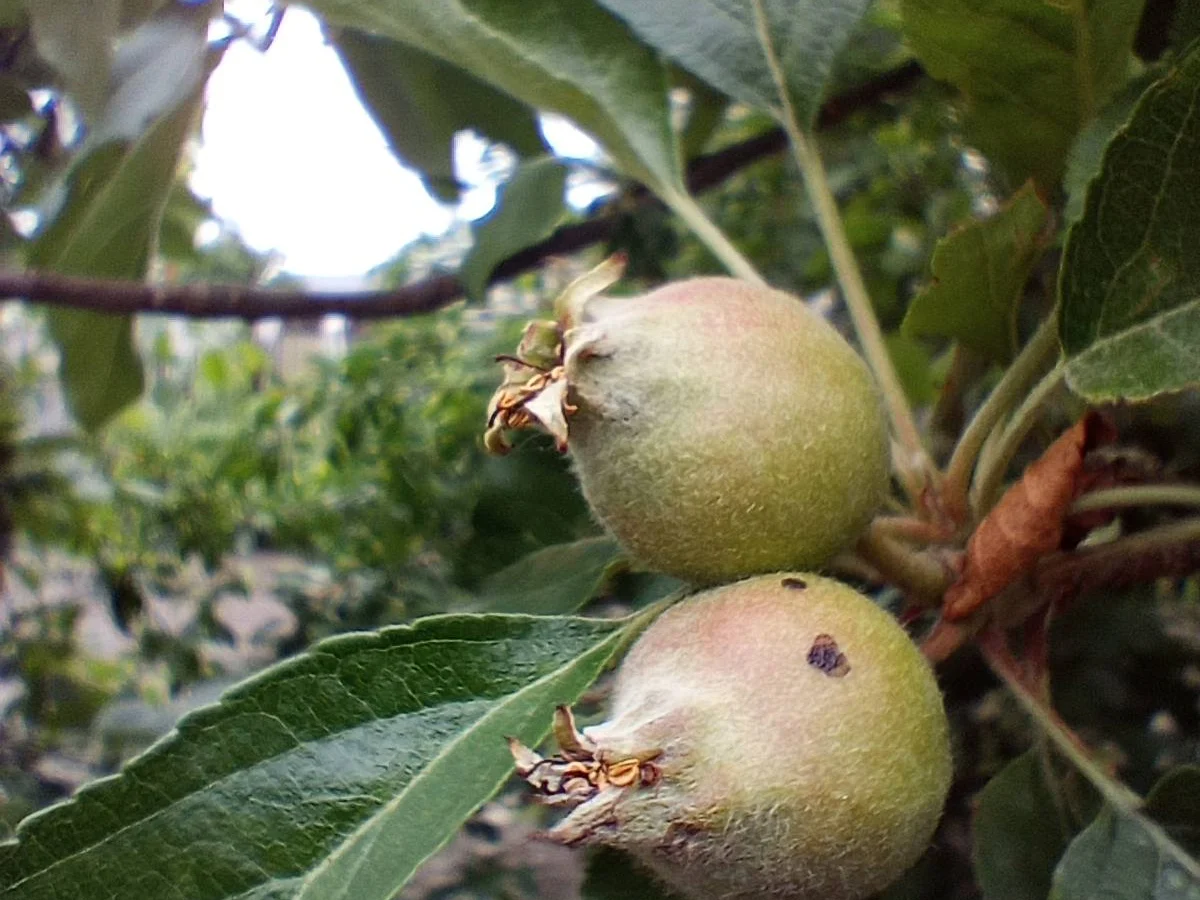
An apple grown from seed usually takes about 7 to 10 years to flower and fruit, and sometimes longer, according to the Raintree Nursery guide to apple tree growth. Apple seeds also do not grow true to type: every seed is a genetic mix of its parent and the unknown tree that supplied the pollen, and UMN Extension notes that each seed produces a genetically different plant. Most seedling apples are small, sour or bland, which is why named varieties are propagated by grafting. A seedling makes a good rootstock or a fun experiment, but for a predictable harvest, buy a grafted tree. The process for stone fruit is similar; see how to grow a cherry tree from seed.
Does a bare-root or potted apple tree fruit sooner?
Nursery trees are usually one or two years old when sold, so a tree you plant has a head start. Bare-root trees are dug while dormant and shipped without soil; they establish quickly if planted early in spring. Potted trees can be planted over a longer season and may be a little older and larger. Neither is reliably faster to fruit; rootstock, care and site matter far more. Planting a larger, older tree can save a year, but very large trees often suffer more transplant shock.
How fast does an apple tree grow each year?
Young, healthy apple trees typically add about 1 to 2 feet of shoot growth per year, sometimes more on vigorous rootstocks in good soil. Growth slows once the tree starts bearing heavy crops, because energy shifts from shoots to fruit. Very fast, leafy growth with no flowers is a sign of too much nitrogen or too much pruning, not of a healthy, productive tree.
Why is my apple tree not producing fruit?
| Cause | Sign | Fix |
|---|---|---|
| Too young | Healthy tree, no flowers | Wait; check the rootstock’s expected age to bear |
| No pollinator | Flowers but no fruit set | Plant a different apple or crabapple that blooms at the same time within about 100 feet |
| Too much nitrogen | Long, leafy shoots, dark leaves, few flowers | Stop high-nitrogen fertilizer and lawn feed near the tree |
| Heavy pruning | Many water sprouts, few spurs | Prune lightly with thinning cuts |
| Too much shade | Sparse flowers, weak growth | Apples need at least 6 to 8 hours of sun |
| Spring frost | Flowers bloom then brown and drop | Choose later-blooming varieties; avoid frost pockets |
| Biennial bearing | Heavy crop one year, none the next | Thin fruit hard in heavy years |
| Pests or disease | Spotted leaves, damaged fruit | Use resistant varieties and good sanitation |
Pollination is the most common reason for a young tree that flowers but does not fruit. UMN Extension explains that apples need pollen from a different variety, and a crabapple within about 100 feet can serve as the pollen source. Our guide to apple flowers covers bloom and frost protection, and the plant problem identifier helps diagnose other issues.
How can you get an apple tree to fruit faster?
- Choose a dwarf or columnar tree. Dwarf rootstocks and columnar apple trees bear years sooner than standards.
- Plant two compatible varieties that bloom together, or plant near a crabapple.
- Give it full sun and well-drained soil with a pH around 6.0 to 7.0. Use the sunlight requirement finder to check your site.
- Water during dry spells in the first three years, especially in summer.
- Feed moderately. A light spring application is enough for most young trees; see our fruit tree fertilizer guide.
- Prune lightly and spread branches. Branches trained toward horizontal, at about 45 to 60 degrees, form flower buds sooner than upright ones. Avoid heavy heading cuts in the first years; see when to prune apple trees.
- Control weeds and grass within a wide circle around the trunk, which compete for water and nitrogen. Mulch helps; use the mulch calculator.
How much fruit does an apple tree produce?
Yield depends on tree size, variety, age and care. UMN Extension estimates up to about 10 bushels from a mature standard tree and about 2 to 3 bushels from a dwarf. A bushel of apples weighs roughly 40 to 45 pounds. A columnar tree may produce only a few pounds. For planning storage and containers at harvest time, the harvest basket and crate calculator helps, and our guide on when apples are ready to pick explains the timing.
How long do apple trees live?
Apple trees on standard rootstocks commonly live and produce for 50 years or more, and some heirloom trees are well over a century old. Dwarf trees usually have shorter productive lives, often around 15 to 25 years, because their small root systems are less resilient. Disease, poor drainage, trunk damage from mowers or rodents and severe winters shorten any tree’s life, while good pruning, a protected trunk and suitable varieties lengthen it. Hardy heirlooms such as the Wolf River apple have survived for generations on northern farms.
Which apple trees grow fastest for beginners?
For the quickest first harvest, choose a disease-resistant variety on a dwarf or semi-dwarf rootstock that suits your zone. Check your zone with the growing zone finder. Reliable choices include scab-resistant varieties such as Liberty, dependable pollinizers such as Golden Delicious, and very hardy heirlooms for cold climates. Plant at least two varieties for pollination.
Apple tree timeline: what to expect from planting to harvest
| Age after planting | Dwarf tree | Semi-dwarf tree | Standard tree |
|---|---|---|---|
| Year 1 | Rooting in; remove any flowers | Rooting in; remove any flowers | Rooting in; train the leader |
| Year 2 | First blossoms; thin to a handful of fruit | Branch framework forms | Branch framework forms |
| Year 3 | First small crop | First blossoms possible | Still mostly growing |
| Years 4 to 5 | Regular crops | First real crops | First blossoms possible |
| Years 6 to 8 | Full production | Approaching full production | First real crops |
| Years 8 to 12+ | Steady crops | Full production | Building toward full production |
These are typical patterns for healthy trees in a suitable climate. A tree that is stressed by drought, poor drainage, shade or competition from lawn grass can lag a year or more behind.
Does climate change how long an apple tree takes to grow?
Yes. Apples need a cold winter to break dormancy evenly, measured in chill hours, and most varieties need several hundred to more than a thousand hours between about 32 and 45°F. In warm-winter areas, high-chill varieties bloom weakly and erratically, which delays and reduces crops; low-chill varieties such as ‘Anna’ and ‘Dorsett Golden’ were bred for those regions. In very cold northern areas, a short growing season and winter injury slow growth, so hardy varieties and rootstocks matter. A long, warm growing season with enough rain or irrigation produces the fastest growth. Use the growing season length calculator to see how many frost-free days you have, and check variety descriptions for chill hours and hardiness before you buy.
Grafted tree vs seedling: which grows faster?
| Trait | Grafted nursery tree | Seedling from an apple seed |
|---|---|---|
| Time to first fruit | About 2 to 8 years, depending on rootstock | About 7 to 10+ years |
| Fruit quality | Same as the named variety | Unpredictable, usually inferior |
| Tree size | Controlled by rootstock | Full size, 20 feet or more |
| Cost | Higher | Almost free |
| Best for | Reliable home harvests | Experiments, rootstock, wildlife plantings |
A middle path is to grow a seedling for a year or two and then graft a named variety onto it. The grafted top begins fruiting much sooner than the seedling would on its own, though usually not as quickly as a tree on a dwarfing rootstock.
How long does an apple tree in a container take to fruit?
Apples on dwarf rootstocks and columnar apples grow well in large containers and often fruit in their second or third year. Use a pot at least 16 to 20 inches deep and wide, a well-drained potting mix and steady watering, because containers dry out fast in summer. Container trees stay small and produce modest crops, usually a few pounds a year, and their roots need protection from hard freezes in cold regions. The container garden planner and the grow bag volume calculator help you size the pot. You will still need a second variety nearby for pollination.
What slows an apple tree down in its first years?
The most common setbacks are avoidable. Lawn grass growing right up to the trunk competes strongly for water and nitrogen, so keep a mulched circle about 3 feet across. Mower and string-trimmer damage to the bark can stunt or kill young trees; a trunk guard prevents it. Rabbits and voles gnaw bark in winter, and deer browse new shoots, so wire guards and fencing pay off. Planting too deep, so the graft union is buried, can let the fruiting variety root and override the dwarfing rootstock, producing a bigger tree that fruits later. Finally, letting a young tree carry too many apples too early can stunt it and start a cycle of biennial bearing, so thin early crops hard.
Looking for the next tree to plant? Our guide to growing fruit trees at home compares options by climate and space.
Free printable: the Year-Round Garden & Preserving Planner
Planting dates for 24 crops, monthly tasks, blanching times, canning safety numbers and a winter storage chart in one 8-page PDF. Enter your email to download it instantly and get our seasonal garden newsletter.
No spam. Unsubscribe any time. We never sell your email.
Frequently asked questions
How long does it take an apple tree to bear fruit?
About 2 to 3 years for dwarf trees, 3 to 5 years for semi-dwarf trees and 5 to 8 years for standard trees after planting.
How long does an apple tree take to grow from seed?
Usually 7 to 10 years or more to fruit, and the apples will differ from the parent.
How fast does an apple tree grow per year?
Young trees typically grow about 1 to 2 feet a year, slowing once they bear heavy crops.
Do you need two apple trees to get fruit?
Usually yes. Most apples need pollen from a different variety or a crabapple blooming nearby.
How long do apple trees live?
Standard trees often produce for 50 years or more; dwarf trees usually for about 15 to 25 years.
Should I remove the first apples on a young tree?
Yes, in the first year or two. Removing early fruit helps the tree build roots and branches for bigger crops later.
Reviewed October 2026. Sources: University of Minnesota Extension, Growing Apples; Raintree Nursery, How Long Does It Take for an Apple Tree to Grow?; Penn State Extension, Spring Fruit Tree Planting Tips.