A nectarine is not a separate fruit from a peach. It is a peach with smooth skin, caused by a single gene, and it grows on a tree that looks and behaves almost exactly like a peach tree. That means everything you know about peaches applies, with a few extra cautions: thin skin makes nectarines more prone to cracking, insect damage and brown rot. This guide covers how to choose, plant, water, feed, prune, thin and harvest a nectarine tree, how to handle chill hours and spring frosts, and how to deal with the problems that catch most beginners, with advice from university extension sources.
Nectarine tree quick facts
| Factor | What to know |
|---|---|
| Hardiness | Typically USDA zones 5 to 9; UConn lists hardy nectarines for zones 5 to 8, and notes flower buds can die below -10°F and whole trees at -20°F or lower |
| Chill hours | Roughly 250 to 1,000 hours below 45°F, depending on variety; UC Master Gardeners give 600 to 900 hours as typical |
| Sun | Full sun, 6 to 8 hours or more |
| Pollination | Most varieties are self-fertile |
| Size | Standard 15 to 20 feet, dwarf about half that; pruning can hold a tree at 10 to 13 feet |
| Yield | UConn suggests 30 to 60 pounds from a mature dwarf and 60 to 100 pounds from a standard tree |
| First fruit | Usually 2 to 4 years after planting |

Nectarine or peach: what is the difference?
The University of California Master Gardeners’ publication Peaches and Nectarines: Sun-Kissed Cousins explains that both are Prunus persica. Nectarines have smooth, glossy skin without the fine fuzz that covers peaches, and both come in two types: clingstone, where the pit is hard to separate and the fruit is usually processed, and freestone, where the pit separates easily and the fruit is better for eating fresh. The Wikipedia article on the nectarine adds that the smooth skin is the result of a recessive gene, and that nectarines can even appear on peach trees as bud sports, which is why the two fruits are so similar to grow. Nectarines tend to be a little firmer, more aromatic and more acidic than peaches, and the bare skin leaves them more exposed to insects, rot and splitting.
Choosing a variety
Match chill hours to your winters, as you would for peaches. Cold-winter gardens need varieties rated for their zone, preferably later-blooming ones in frost-prone areas, while mild-winter gardens should look for low-chill types. UConn’s fact sheet suggests hardy nectarines for zones 5 to 8, including Mericrest, Hardired (tolerant of bacterial spot and brown rot), Stark Crimson Snow and Stark Sunglo, and notes Nectacrest as a dwarf freestone nectarine that ripens in early September. UC lists Fantasia and Double Delight as nectarine varieties and Necta Zee as a miniature nectarine for small spaces and pots. You can also choose between yellow-fleshed nectarines, which are tangy, and white-fleshed ones, which are sweeter and lower in acid (compare our guide to white peaches), and between freestone and clingstone fruit; see freestone peaches.
Check the tag or ask a local nursery or your state extension service which varieties perform best nearby, and use the growing zone finder to confirm your zone. If space is limited, consider a dwarf peach or nectarine tree.
Where and how to plant
The UConn Home and Garden Education Center fact sheet on peaches and nectarines says these trees need deep, well-drained soil enriched with organic matter, with about 90 percent of the roots in the top 18 inches, a soil pH of 6.0 to 6.5 and no fertilizer in the planting hole. It also suggests a north-facing slope in full sun, which warms more slowly in spring, delays bloom and reduces frost risk, and advises avoiding low-lying frost pockets.
- Plant at the right time. Bare-root trees go in during late winter or early spring while dormant; container trees can go in whenever the soil is workable.
- Choose a sunny, well-drained spot away from frost pockets. Standing water causes root rot.
- Space the trees. UConn suggests 15 to 25 feet apart depending on mature size; UC says 10 to 20 feet. Use the plant spacing calculator for your rootstock.
- Dig a hole about twice as wide as the roots, keeping the graft union 2 to 3 inches above the soil.
- Water in deeply and mulch 2 to 4 inches, keeping mulch off the trunk. The mulch calculator helps with quantities.
Check your frost dates before planting, and see our general guide to soil for fruit trees. Most nectarines are self-fruitful, but UConn notes that planting two or more cultivars extends the harvest.
Watering and feeding
Water young trees deeply, about an inch a week in the first season, as UC recommends. Established trees can be watered every two to three weeks in summer, wetting the soil 18 to 24 inches deep. Keep moisture steady as fruit swells, because swings between dry and wet soil are a leading cause of split fruit. Our garden watering calculator can help.
Fertilize once each spring. UConn says the amount depends on canopy diameter and the length of new growth, with mature trees producing 12 to 18 inches of new growth a year; too little growth means more fertilizer, and too much means less. Feed lightly in early spring and stop by midsummer so new growth can harden before winter. See our fruit tree fertilizer guide.
Pruning
Nectarines fruit on last year’s growth, so pruning is both shaping and crop management. Train the tree to an open-center vase shape, as for a peach. After planting, cut the whip back to about 30 inches and remove side branches, as UConn describes, so it develops into an open, bowl-shaped tree. For the next two to three years remove broken, diseased, dead or low limbs and upright shoots growing inward. Shoots 12 to 24 inches long have the best ratio of leaf buds to fruit buds, and UConn recommends removing no more than half the old wood, a figure UC repeats when it suggests removing about 50 percent of last year’s wood to thin the crop and encourage new shoots.
Timing matters. UConn advises pruning while dormant, because growing-season pruning can delay ripening or sunburn exposed fruit, although water sprouts can be removed any time. UC suggests both winter pruning and a summer touch-up in late June or early July to remove strong shoots from the inner canopy and improve light and airflow. Our guide to when to prune peach trees gives detailed timing for the closely related peach, and the same rules apply to nectarines.
Thinning the fruit
Thin the fruit when it is about marble-sized so the nectarines end up about 6 inches apart; UConn describes this as roughly one fruit per 50 leaves. Remove the smallest, damaged and crowded fruit first. Heavy crops mean small, sour fruit, broken limbs and poor flowering the next year, and thinning also cuts the spread of brown rot, since fruit that touch each other rot together.
Frost, chill and cold protection
Nectarine flower buds are tender. UConn notes they can die below -10°F, and trees can be killed at -20°F or lower, so in the Northeast gardeners should choose hardy cultivars and later-blooming types such as Intrepid. In the South, the problem reverses: trees need a set number of chill hours to leave dormancy, and low-chill varieties are essential. Early bloom followed by a freeze is the most common cause of crop failure; see our guide to protecting fruit blossoms in apple flowers for covering and monitoring tips that work for nectarines too.
Problems to expect
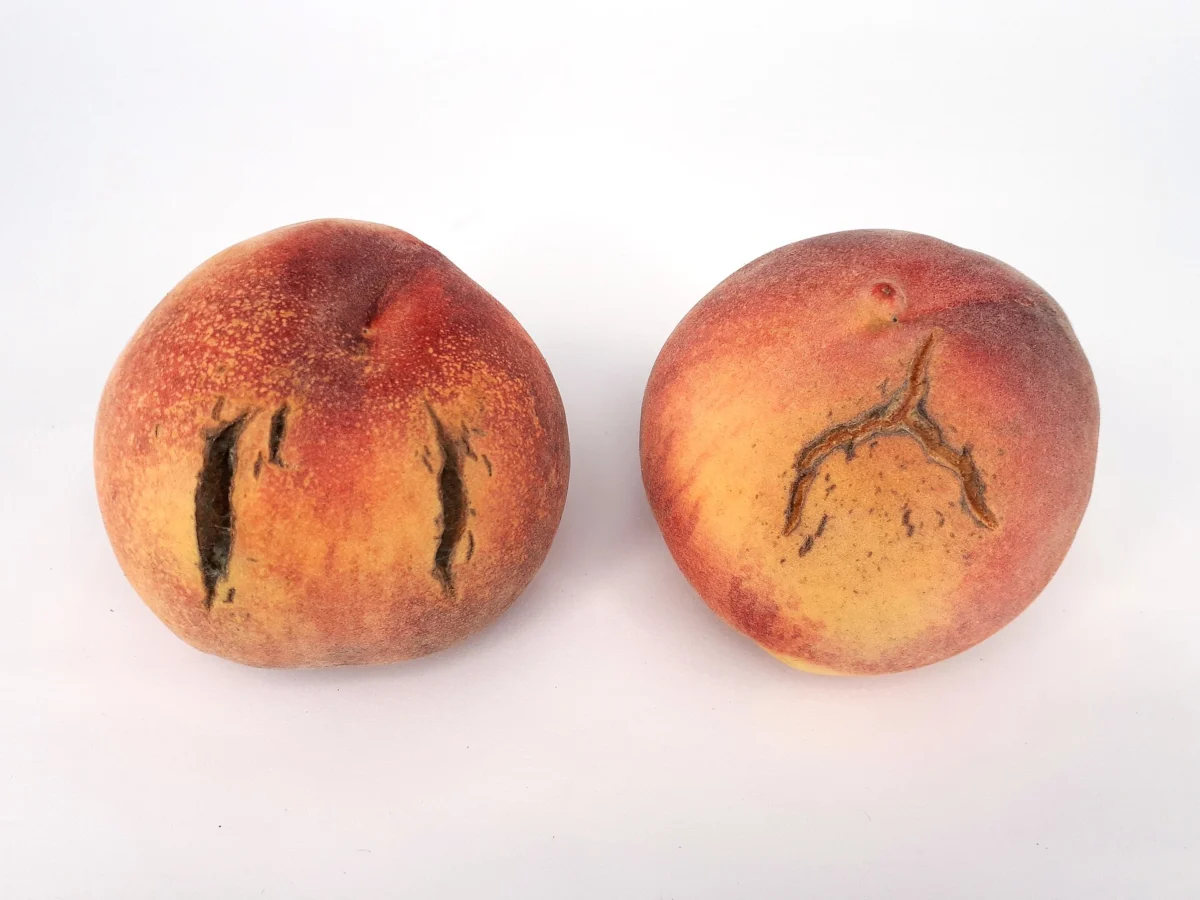
- Cracked fruit. Caused by uneven watering, heavy rain near ripening or overly heavy crops. Mulch and steady irrigation help.
- Brown rot. Fuzzy gray mold on ripening fruit. UC suggests fungicide during bloom, typically 1 to 3 sprays, with more during rainy periods, and prompt clean-up of fallen fruit. Thin crowded fruit, pick promptly and remove mummies. See brown rot on stone fruit.
- Peach leaf curl. Puckered, reddened leaves in spring. UC advises spraying twice, on December 1 and February 1 in its region, because symptoms appear in spring when little can be done. Prevention has to happen before buds open. Disease-resistant cultivars such as Curlfree help. See peach leaf curl and copper fungicide.
- Insects. Plum curculio, peach tree borers, fruit moths and aphids can damage fruit, trunks and leaves. UC suggests dormant oil before bud break for aphids, mites and San Jose scale. Inspect the lower trunk and fruit through the season. See plum curculio and scale insects.
- Spotted-wing drosophila. A fruit fly that attacks ripening soft fruit; see spotted-wing drosophila.
- Birds and deer. Use tight, secured netting and trunk guards. See bird scare tape.
Not sure what you are seeing? Try the plant problem identifier.
Harvest and storage
Nectarines are ready when the background color turns from green to yellow or cream, the fruit smells sweet and the flesh gives slightly near the stem. UConn describes ripening fruit as shifting from green to yellow-orange under a reddish blush, softening, filling out and developing a peachy aroma, and expect several pickings for full sun-ripened flavor. Ripe fruit can be refrigerated for one to two weeks. Nectarines ripen off the tree like peaches, though they will not get much sweeter. For ripening steps, see how to ripen peaches, which works for nectarines too, and our peach tree guide covers shared basics in more depth. If you have a glut, see how to make jam and water bath canning for beginners.
Growing a nectarine in a pot
Miniature nectarines such as Necta Zee are bred for containers. Use a pot of at least 15 to 20 gallons with excellent drainage, a quality potting mix and a sunny, sheltered spot. Water more often than an in-ground tree, feed lightly, and protect the pot from hard freezes by moving it against a wall or into an unheated garage. Prune for shape and thin the fruit just as you would a full-sized tree, and expect a smaller crop.
Common mistakes
- Planting in a frost pocket or a low, wet spot.
- Skipping fruit thinning and then losing limbs to the load.
- Missing the dormant spray window for leaf curl.
- Watering irregularly as fruit ripens, which causes splitting.
- Leaving mummified fruit and fallen fruit under the tree.
- Picking too early. Nectarines picked hard stay sour and mealy.
A nectarine care calendar
- Winter: apply dormant oil or the leaf curl spray your region recommends, and prune on a dry day when the worst cold has passed.
- Early spring: plant new trees, feed lightly and watch the forecast through bloom, covering small trees if a freeze is likely.
- Late spring: thin fruit to about 6 inches apart when it reaches marble size, and set up netting.
- Summer: water evenly, remove strong shoots from the inner canopy for light, and pick fruit as it ripens.
- Fall: clean up fallen fruit and leaves, which carry brown rot and leaf curl over to next year, and mulch the root zone.
Keep a simple notebook of bloom date, harvest date and problems each year. Within three or four seasons you will know exactly when your tree needs sprays, how hard to thin and which variety performs best in your garden.
Safety and legal note: Use fungicides or insecticides only if they are labeled for nectarines or stone fruit, and follow the label for rate, timing and protective gear. The label is the law, and rules vary by state and country. Avoid spraying open blossoms when bees are active. Nectarine pits contain compounds that can be harmful if crushed and eaten, so keep them away from children and pets. Wildlife control is regulated, so favor fencing, guards and netting over traps.
For other trees and berries to grow alongside this one, see the home fruit tree guide.
Free printable: the Year-Round Garden & Preserving Planner
Planting dates for 24 crops, monthly tasks, blanching times, canning safety numbers and a winter storage chart in one 8-page PDF. Enter your email to download it instantly and get our seasonal garden newsletter.
No spam. Unsubscribe any time. We never sell your email.
Frequently asked questions
Is a nectarine a cross between a peach and a plum?
No. It is a peach variant with smooth skin, and it is not a hybrid with plums.
Do I need two nectarine trees?
Usually not. Most nectarines are self-fertile, so a single tree can fruit, though a second variety can extend the harvest.
Why are my nectarines splitting?
Usually inconsistent watering or heavy rain as the fruit ripens. Mulch and regular watering reduce the problem.
Are nectarines harder to grow than peaches?
Slightly, because the thin skin is more vulnerable to pests, rot and cracking.
How far apart should I thin nectarines?
About 6 inches apart when the fruit is marble-sized.
Reviewed October 2026. Varieties and conditions differ by region.