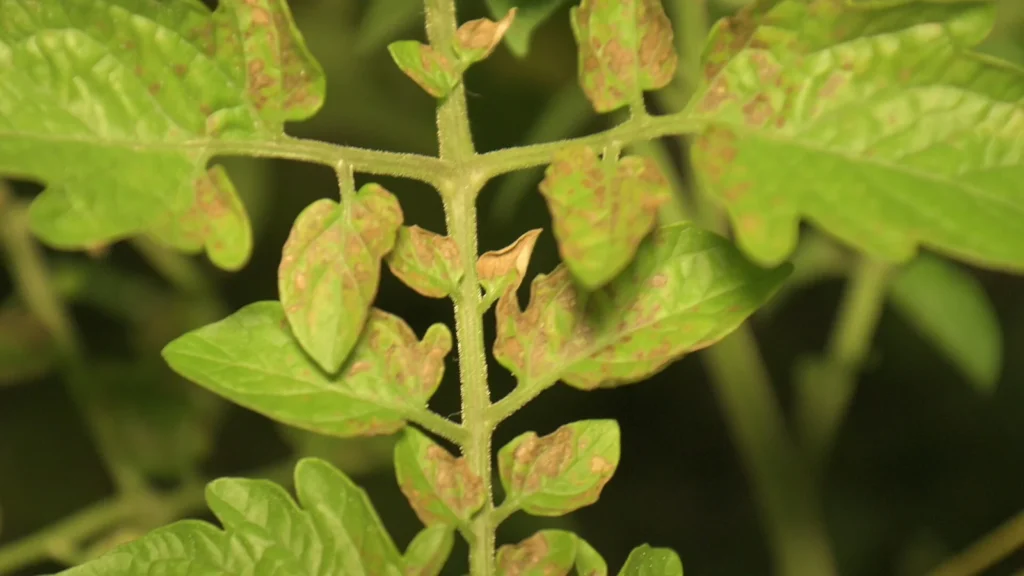
Septoria leaf spot is a common fungal disease of tomatoes, caused by Septoria lycopersici, that produces many small, round spots, about 1/16 to 1/4 inch across, with gray or tan centers and dark brown borders, often with tiny black specks in the centers. It starts on the lowest leaves after the first fruit sets, then moves upward; badly affected leaves turn yellow, brown and drop, and plants can lose most of their foliage in wet summers, exposing fruit to sunscald. It does not usually infect the fruit itself. Control it by removing spotted lower leaves, mulching to prevent soil splash, watering at the base, spacing and staking plants for air flow, rotating crops, cleaning up debris and, if needed, applying a fungicide labeled for Septoria leaf spot at the first signs.
Septoria leaf spot at a glance
| Feature | Details |
|---|---|
| Cause | Fungus Septoria lycopersici |
| Spots | Small (1/16 to 1/4 inch), round, gray or tan centers, dark brown margins, sometimes yellow halos |
| Key clue | Tiny black dots (pycnidia) in the center of each spot, visible with a hand lens |
| Where it starts | Lowest leaves, usually after fruit set |
| Favored by | Warm (60 to 80°F), wet, humid weather; overhead watering; crowded plants |
| Hosts | Tomatoes mainly; also eggplant, potato and nightshade weeds occasionally |
| Spread | Splashing water, hands, tools, insects; survives on debris and weeds |
What is Septoria leaf spot?
Septoria leaf spot is one of the most common and destructive foliar diseases of tomatoes in home gardens, especially in the humid eastern and central United States. The Wikipedia article on Septoria lycopersici describes how the fungus produces spores inside the tiny black fruiting bodies in each spot, which are released when wet and splashed to other leaves. The West Virginia University Extension fact sheet on Septoria leaf spot notes that the fungus survives the winter on infected tomato debris and on weeds such as horsenettle and nightshade, and that rotation and sanitation are key to reducing it.

How do you identify Septoria leaf spot?
- Many small, circular spots on the lower leaves, often dozens per leaf.
- Gray or tan centers with dark brown edges, sometimes surrounded by yellow tissue.
- Tiny black specks in the spot centers when viewed with a magnifying glass.
- Yellowing leaves that brown, wither and drop, beginning at the bottom of the plant.
- Spots on stems and leaf stalks in severe cases; fruit is rarely affected.
Septoria spots are smaller and more numerous than early blight spots and lack the target-like rings. Late blight causes large greasy patches rather than small round spots. See early blight and late blight for comparison, or use the plant problem identifier.
How does Septoria leaf spot spread?
The fungus overwinters on infected tomato leaves and stems left in the garden, on nightshade-family weeds, and possibly on stakes and cages. In late spring and summer, rain or overhead watering splashes spores from the soil onto the lowest leaves. Infection needs wet leaves for several hours and moderate temperatures. Spots appear about a week later, and the black fruiting bodies in them release more spores when wet, which splash upward and to neighboring plants. Gardeners can also spread spores on hands, tools and clothing when working among wet plants. That is why the disease is worst in rainy summers and in gardens with overhead sprinklers.
How do you treat Septoria leaf spot?
- Remove infected leaves at the first sign, cutting them off on a dry day and bagging them. Disinfect pruners between plants.
- Mulch with straw, shredded leaves or plastic to keep soil from splashing onto leaves.
- Prune lower foliage so no leaves touch the soil, and thin dense growth for air flow.
- Water at the soil with drip or soaker hoses, early in the day. Use the garden watering calculator.
- Avoid working among wet plants, which spreads spores.
- Apply a protective fungicide labeled for Septoria leaf spot on tomatoes, such as chlorothalonil, copper or a Bacillus-based biological, starting at the first spots and repeating every 7 to 10 days in wet weather. Fungicides protect new growth but do not heal spotted leaves. See copper fungicide.

How do you prevent Septoria leaf spot?
- Rotate crops: avoid planting tomatoes, potatoes or eggplant in the same spot for at least three years.
- Clean up all tomato debris in fall, and remove nightshade weeds such as horsenettle, jimsonweed and black nightshade.
- Disinfect stakes and cages at the end of the season.
- Space plants 24 to 36 inches apart and stake or cage them; use the plant spacing calculator.
- Mulch at planting to block soil splash from the start.
- Grow tolerant varieties: Iron Lady, Mountain Merit, Defiant PHR and some cherry tomatoes show good tolerance.
- Start with clean transplants; do not buy plants with spotted leaves.
Label note: If you use a fungicide, choose one labeled for Septoria leaf spot on tomatoes, follow the label rate, spray interval and pre-harvest interval, and wear the protective equipment listed. Disinfect tools with 70 percent alcohol or dilute bleach, then rinse to prevent corrosion.
Can tomatoes still produce with Septoria leaf spot?
Yes. Septoria does not infect fruit, and many plants continue to produce well if the disease is slowed by removing lower leaves, mulching and protecting new growth. The main risk is loss of leaves: plants that lose much of their foliage ripen fruit poorly and expose it to sunscald, which causes pale, papery patches on the sunny side. Light shade cloth during heat waves and picking fruit at first color to ripen indoors can help. Keep plants well fed and watered so they continue to produce new leaves at the top. For general tomato care, see how to grow tomatoes and common tomato problems.
Septoria leaf spot on other plants
The University of Maine Cooperative Extension fact sheet on Septoria leaf spot of tomato emphasizes sanitation, rotation and keeping leaves dry as the primary defenses.
Other Septoria species cause leaf spots on many plants, including parsley, celery, blackberries, raspberries, dogwoods, chrysanthemums and black-eyed Susans (Rudbeckia), where they cause dark leaf spots in late summer. Each species is specific to its host, so the Septoria on your Rudbeckia will not infect your tomatoes. The same cultural practices apply: remove infected leaves, improve air flow, water at the base and clean up debris.
Is it safe to compost Septoria-infected leaves?
Only in a hot compost pile that reaches at least 140°F throughout for several days. In typical backyard piles, the fungus can survive and return to the garden in finished compost. Bagging infected leaves for the trash, or burying them deeply away from the vegetable garden, is safer.
When does Septoria leaf spot appear?
Symptoms usually appear in early to midsummer, often soon after the first fruit sets, and increase rapidly during periods of warm, rainy or humid weather. In dry summers, the disease may barely develop. Begin checking the lowest leaves weekly once plants start flowering and act at the first spots. In regions where Septoria is a problem every year, starting mulch, pruning and protective sprays before symptoms appear gives the best results.
For other garden pests and plant diseases, browse our complete plant pests and diseases library.
Free printable: the Year-Round Garden & Preserving Planner
Planting dates for 24 crops, monthly tasks, blanching times, canning safety numbers and a winter storage chart in one 8-page PDF. Enter your email to download it instantly and get our seasonal garden newsletter.
No spam. Unsubscribe any time. We never sell your email.
Septoria leaf spot FAQ
What does Septoria leaf spot look like?
Many small round spots with gray or tan centers and dark borders on the lower leaves of tomatoes.
Can Septoria leaf spot be cured?
Infected leaves cannot be cured, but removing them and protecting new growth slows the disease.
Does Septoria affect tomato fruit?
Rarely; it mainly damages leaves, though fruit can sunscald when leaves drop.
Is Septoria leaf spot the same as early blight?
No; Septoria spots are smaller and more numerous and lack concentric rings.
How long does Septoria survive in soil?
It survives on undecomposed debris, usually at least a year, which is why three-year rotations help.
Does baking soda work on Septoria?
There is little evidence; cultural controls and labeled fungicides are more reliable.
Which tomatoes are most affected by Septoria?
All common tomato varieties can get Septoria leaf spot, and heirlooms with dense, sprawling foliage are often hit hard because their leaves stay wet longer. Determinate varieties that set a heavy crop at once may decline quickly late in the season when plants are stressed. Indeterminate plants that keep producing new foliage at the top can stay productive longer, as long as the disease is slowed at the bottom. Varieties with good field tolerance include Iron Lady, which was bred for resistance to late blight, early blight and Septoria, along with Mountain Merit, Defiant PHR and some vigorous cherry tomatoes. Combining a tolerant variety with mulch, pruning and drip irrigation gives the best results.
How do you clean tomato cages and stakes?
Septoria spores can survive on wooden stakes, string and cages that held infected plants. At the end of the season, remove all plant material, scrub cages and stakes with soapy water, then dip or wipe them with a solution of one part household bleach to nine parts water, leave for ten minutes, rinse and dry before storing. Replace old twine and soft ties each year. Clean tools the same way. This simple step removes a source of early-season infection next year.
Does crop rotation really help with Septoria?
Yes. Because the fungus survives mainly on infected debris in and on the soil, moving tomatoes to a bed where no tomatoes, potatoes or eggplant have grown for at least three years gives the debris time to break down and the fungus time to die off. In small gardens where full rotation is not possible, thorough cleanup, a thick mulch barrier and growing tomatoes in large containers with fresh potting mix are good alternatives. Use the crop rotation checker to plan beds over several years.
What is the best mulch for preventing Septoria?
Any mulch that covers the soil and stops raindrops from splashing soil onto leaves helps. Straw is popular and inexpensive; make sure it is weed-free. Shredded leaves, untreated grass clippings in thin layers, and wood chips also work. Black plastic or landscape fabric warms the soil and forms a complete splash barrier, though it must be paired with drip irrigation underneath. Apply mulch right after planting, before the first rains, about 2 to 3 inches deep for organic materials. The mulch calculator helps estimate quantities.
How quickly does Septoria leaf spot spread?
In warm, wet weather, new spots can appear about a week after infection, and each spot releases spores within another week or so. During a rainy spell, the disease can move from the bottom third of a plant to the top in two to three weeks. In dry weather it slows dramatically. That is why removing the first spotted leaves and keeping foliage dry make such a difference: they cut the number of spores available to start each new round of infection.
With steady attention through the season, most home gardeners can keep Septoria leaf spot in check and enjoy a full tomato harvest, even in humid regions where the disease is common every summer.
Should you remove the whole tomato plant?
Usually not. Unlike late blight, Septoria leaf spot rarely kills plants quickly, and removing infected lower leaves while protecting the upper canopy often keeps plants productive until frost. Pull plants only if they are almost completely defoliated late in the season and fruit is no longer ripening well; then bag the debris and plan a rotation for next year. Healthy upper growth, steady watering and good nutrition let most plants keep producing despite some lower-leaf losses.
Next season, start with mulch, staking and drip irrigation from planting day, and Septoria will have far fewer chances to take hold.
Sources: West Virginia University Extension, Septoria Leaf Spot; University of Maine Cooperative Extension, Septoria Leaf Spot of Tomato; Wikipedia, Septoria lycopersici.
Septoria on tomato: what the Wisconsin guidance says
The University of Wisconsin’s Septoria leaf spot page describes spots about 1/4 inch across with a whitish centre and dark border, appearing first at the base of the plant on lower leaves and stems. Spots on one leaf can merge and destroy tissue, and the disease can defoliate lower leaves and kill the plant. Symptoms usually start as canopies close, because dense foliage holds humidity and keeps leaves wet longer. The fungus Septoria lycopersici survives in plant debris and on infected plants.
- Rotate vegetables to a different part of the garden each year to avoid areas where infested debris remains.
- Mulch with about one inch of high-quality mulch, but do not overmulch, since wet soils can raise humidity. See our mulch calculator.
- Airflow: thin plants or remove selected branches and increase spacing; use resistant varieties where possible.
- Fungicides labelled for vegetables containing copper or chlorothalonil work only if applied very early, ideally before symptoms, and repeated through the season. Once symptoms appear, control is difficult.
- Destroy infested plants by burning (where local rules allow) or burying them.
Safety and legal note: Burning garden waste is banned or restricted in many areas, so check local rules. Follow fungicide labels, including the pre-harvest interval, and wear protective gear. Rules vary by country and region.
Reviewed October 2026. Sources: University of Wisconsin Extension, Septoria Leaf Spot