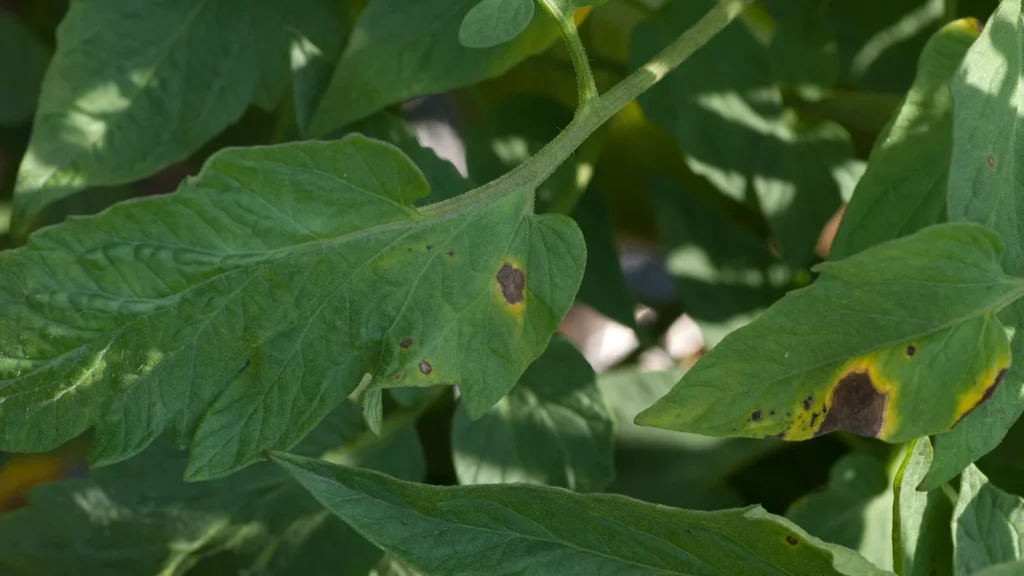
Early blight is a common fungal disease of tomatoes and potatoes, caused by Alternaria species, that produces brown leaf spots with dark concentric rings like a target, often surrounded by a yellow halo. It starts on the oldest, lowest leaves and moves up the plant, causing leaves to yellow, die and drop, which exposes fruit to sunscald and reduces yields. It can also cause dark, sunken lesions on stems and on the stem end of fruit. To manage early blight, mulch the soil, remove infected lower leaves, stake or cage plants and prune for air flow, water at the base in the morning, rotate crops, choose resistant or tolerant varieties, and, where the disease is a regular problem, use a protective fungicide labeled for early blight starting at the first symptoms.
Early blight identification guide
| Plant part | Symptoms |
|---|---|
| Lower leaves | Brown to black spots, 1/4 to 1/2 inch, with concentric rings (target spots) and a yellow halo; leaves yellow and drop |
| Upper leaves | Spots appear later as the disease moves up the plant |
| Stems | Dark, sunken, ringed lesions; on seedlings, collar rot at the soil line |
| Fruit | Dark, leathery, sunken spots with rings near the stem end |
| Potato tubers | Dark, slightly sunken lesions with corky flesh beneath |
What causes early blight?
Early blight is caused mainly by the fungi Alternaria solani and Alternaria linariae (also called A. tomatophila). The Wikipedia article on Alternaria solani describes how the fungus survives on infected plant debris in the soil and on seed, and how spores are splashed by rain and irrigation and carried by wind to lower leaves. The University of Minnesota Extension guide to early blight of tomato explains that the disease develops in warm temperatures with long periods of leaf wetness from rain, dew or overhead watering, and that plants stressed by heavy fruit loads, poor nutrition or drought are more susceptible.

How do you tell early blight from other tomato leaf diseases?
| Disease | Spots | Timing and spread |
|---|---|---|
| Early blight | Larger brown spots with concentric rings and yellow halo | Starts on lowest leaves in midsummer; moves up gradually |
| Septoria leaf spot | Many small, round spots with gray-white centers and dark borders; tiny black dots in centers | Starts low; can defoliate plants quickly in wet weather |
| Late blight | Large, greasy, gray-green to brown patches; white fuzz under leaves in humidity; firm brown fruit rot | Spreads very fast in cool, wet weather; can kill plants in days |
| Bacterial spot or speck | Small, dark, greasy-looking spots, sometimes with yellow halos; raised specks on fruit | Favored by warm, wet weather |
See our guides to Septoria leaf spot and late blight, and the plant problem identifier, if you are unsure.
How does early blight spread?
The fungus overwinters on infected leaves, stems and fruit left in the garden, on volunteer tomato and potato plants, on nightshade weeds and sometimes on seed. In early summer, rain and overhead watering splash spores from the soil onto the lowest leaves, where they infect when leaves stay wet for several hours at temperatures between about 60 and 85°F. New spores form on the spots within days and spread to higher leaves and neighboring plants on wind and water. That is why the disease typically climbs the plant from the bottom up and gets worse in wet, humid summers and on plants with crowded, dense foliage.
How do you treat early blight?
- Remove infected lower leaves as soon as you see spots, cutting them off cleanly and bagging them. Disinfect pruners between plants.
- Mulch the soil with straw, shredded leaves or plastic to stop soil splashing onto leaves.
- Prune the bottom 12 inches of foliage on staked or caged tomatoes once plants are established, so lower leaves do not touch the soil.
- Water at the base with drip or soaker hoses, in the morning, and avoid wetting leaves. Use the garden watering calculator to water deeply and consistently.
- Feed plants adequately; well-nourished plants resist early blight better. A balanced side-dressing when fruit sets helps; see the garden fertilizer calculator.
- Use a protective fungicide if early blight is a recurring problem: products labeled for early blight on tomatoes, such as chlorothalonil, copper, or biological fungicides containing Bacillus species, applied at the first symptoms and repeated every 7 to 10 days, especially in wet weather. Fungicides protect healthy leaves but do not cure infected ones. See copper fungicide for details on copper.

Which tomato varieties resist early blight?
No tomato is fully immune, but several varieties have good tolerance, including Mountain Magic, Mountain Merit, Defiant PHR, Iron Lady, Jasper, Matt’s Wild Cherry, Plum Regal, Juliet and Old Brooks. Seed catalogs often mark early blight tolerance with “EB” or “AB.” Determinate varieties that set a heavy crop all at once can be more susceptible late in the season, when plants are stressed. Combining a tolerant variety with good cultural practices usually keeps early blight to a manageable level without sprays.
Label note: Use only fungicides labeled for early blight on tomatoes or potatoes, follow the label rate, interval and pre-harvest interval, wear the protective equipment listed, and do not apply copper or other fungicides near ponds or streams. Disinfect tools with 70 percent alcohol or a dilute bleach solution, and rinse metal tools afterward to prevent corrosion.
How do you prevent early blight next year?
- Rotate crops: do not grow tomatoes, potatoes, peppers or eggplant in the same spot more than once every three years.
- Clean up all tomato and potato debris at the end of the season, and remove volunteer plants and nightshade weeds.
- Start with healthy transplants and disease-free seed; check seedlings for spots and stem lesions before planting.
- Space plants generously, about 24 to 36 inches apart for staked tomatoes, for good air flow; use the plant spacing calculator.
- Stake or cage tomatoes to keep foliage off the ground.
- Mulch at planting to block soil splash from the start.
- Disinfect stakes and cages at the end of the season with a dilute bleach solution.
Early blight on potatoes
The Penn State Extension guide to tomato diseases and disorders in the home garden recommends rotation, sanitation and mulching as the foundation for managing early blight and other leaf diseases of tomatoes and potatoes.
On potatoes, early blight causes the same target spots on leaves, usually starting on older leaves around flowering. Severe infections reduce yields by killing foliage early, and tubers can develop dark, sunken, corky lesions, especially if they are damaged during harvest. Use certified disease-free seed potatoes, rotate, keep plants well fed and watered, hill soil over tubers, and harvest carefully when skins have set. Let tubers cure before storage. For other potato pests, see Colorado potato beetle.
Can you eat tomatoes from plants with early blight?
Yes. Early blight does not make fruit unsafe to eat. Cut away any spots on fruit, and use damaged fruit promptly, since lesions can let in rot organisms. Leaves lost to early blight leave fruit exposed to sunscald, which causes pale, papery patches on the sunny side; picking fruit at first color and ripening indoors helps. For more tomato issues, see common tomato problems and how to grow tomatoes.
Should you compost early blight leaves?
Only in a hot compost pile that reaches at least 140°F throughout for several days. Most home piles do not heat evenly, so it is safer to bag infected leaves and stems for the trash, or bury them well away from the vegetable garden. The fungus survives on undecomposed plant debris for a year or more.
You can find guides to related pests and diseases in our plant pests and diseases hub.
Free printable: the Year-Round Garden & Preserving Planner
Planting dates for 24 crops, monthly tasks, blanching times, canning safety numbers and a winter storage chart in one 8-page PDF. Enter your email to download it instantly and get our seasonal garden newsletter.
No spam. Unsubscribe any time. We never sell your email.
Early blight FAQ
What does early blight look like?
Brown spots with dark concentric rings and yellow halos on the lower leaves of tomatoes and potatoes.
Can early blight be cured?
Infected leaves cannot be cured, but removing them and protecting new growth slows the disease.
Is early blight in the soil?
The fungus survives on infected debris in the soil, which is why rotation and mulch help.
Does baking soda help early blight?
Bicarbonate sprays have limited effect on early blight; cultural controls and labeled fungicides work better.
Will early blight kill my tomato plant?
It rarely kills plants outright but can strip leaves and reduce yields if unmanaged.
Should I remove all leaves with early blight?
Remove infected lower leaves, but keep enough foliage to feed the plant and shade fruit.
What weather favors early blight?
Early blight thrives in warm, humid weather with frequent rain or heavy dew, especially when daytime temperatures are in the 70s and 80s°F and leaves stay wet overnight. It is common across the eastern and central US and in humid regions worldwide, and less of a problem in dry western climates where leaves dry quickly. In wet summers, expect it to appear by midsummer on the lower leaves of most tomatoes, so start preventive steps such as mulching and lower-leaf pruning at planting time rather than waiting for symptoms.
Does pruning tomatoes help prevent early blight?
Yes, within reason. Removing the lowest leaves so that no foliage touches the ground, and thinning a few interior suckers on indeterminate tomatoes, improves air flow and lets leaves dry faster after rain. Do not over-prune: tomatoes need plenty of leaves to feed the fruit and to shade it from sunscald. Prune on a dry day with clean tools, and disinfect them between plants to avoid spreading spores. See how to prune tomato plants for detailed guidance.
Is early blight the same as blight on potatoes in Ireland?
No. The Irish potato famine of the 1840s was caused by late blight, a different and much more aggressive disease caused by the water mold Phytophthora infestans. Early blight is caused by a true fungus, progresses more slowly and rarely destroys whole crops in home gardens. The names reflect when each disease was first typically seen in the season, not how serious it is.
How much early blight is too much?
A few spotted lower leaves are common in humid summers and have little effect on yield. Act when spots start appearing on the middle of the plant or when more than about a quarter of the foliage is affected, because by then yields and fruit quality begin to suffer. Regular checks every week from midsummer let you remove early infections before they climb.
Does calcium or Epsom salt help with early blight?
No. Early blight is a fungal disease, not a nutrient deficiency. Calcium is linked to blossom end rot, not blight, and Epsom salt (magnesium sulfate) only helps where soil tests show a magnesium shortage. Balanced feeding based on a soil test keeps plants vigorous, which helps them tolerate early blight, but no fertilizer prevents the disease on its own. Test your soil before adding amendments, and focus on mulching, spacing and sanitation for disease control.
In most years, mulch, careful watering and prompt removal of the first spotted leaves are enough to keep early blight from seriously reducing your harvest.
Can early blight spread to peppers and eggplant?
Eggplant can be affected by Alternaria leaf spots, and potatoes share early blight with tomatoes, but peppers are rarely seriously affected. Keeping all nightshade-family crops on a rotation together, and cleaning up their debris, reduces the disease for all of them.
Keep records of which beds and varieties had early blight each year; over a few seasons, that information makes rotation planning and variety choice much easier and more effective.
Sources: University of Minnesota Extension, Early Blight of Tomato; Penn State Extension, Tomato Diseases and Disorders in the Home Garden; Wikipedia, Alternaria solani.
Early blight: conditions, rotation and mulch
University of Minnesota Extension’s early blight in tomato and potato says the first sign is small dark spots on older, lower leaves, round, brown and up to half an inch wide, larger ones showing target-like concentric rings with yellowing around them. Seedling stems can rot at or just above the soil line, and fruit spots are dark, leathery and ridged near the stem. The disease develops at about 59 to 80°F (15 to 27°C), with an optimum of 82 to 86°F, and spreads most in wet weather, heavy dew or relative humidity of 90 percent or higher. Leaf spots can form in as little as five days.
- Rotate: in home gardens wait two years before planting tomatoes or peppers in the same spot.
- Mulch: cover the soil under plants with fabric, straw, plastic or dried leaves to block spore splash. Use our mulch calculator.
- Resistant varieties: look for "EB" in seed catalogues; resistance means tolerance, not immunity.
- Airflow: space, stake, trellis and prune so foliage dries.
- Residue: remove infected leaves; pruning up to one-third of the leaves is acceptable if caught early, but not more. The pathogen overwinters in debris and soil and can ride on seed or transplants.
- Fungicides: most home gardeners do not need them since tomatoes tolerate considerable early blight.
Safety and legal note: Wash hands and tools after handling infected plants to avoid spreading spores. If using fungicides, follow the label, pre-harvest interval and protective-equipment instructions. Rules on pesticide use vary by country and region.
Reviewed October 2026. Sources: University of Minnesota Extension, Early blight in tomato and potato