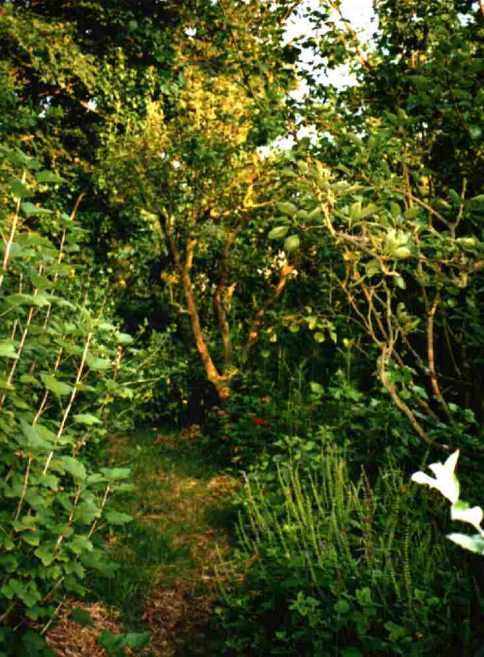
A hazelnut tree (Corylus), also called a filbert or cobnut, is a multi-stemmed shrub or small tree that grows about 10 to 15 feet (3 to 4.5 m) tall and produces edible nuts in leafy husks in late summer and fall. Hazelnuts are wind-pollinated and self-incompatible, so you need two or three compatible varieties. Plants start bearing in about 3 to 4 years and reach full production at 7 to 8 years. If you live in the eastern half of North America, choose varieties with resistance to eastern filbert blight, because the disease kills susceptible European types.
Hazelnut growing requirements at a glance
| Main species | European hazelnut (Corylus avellana), American hazelnut (C. americana), beaked hazelnut (C. cornuta) and hybrids |
|---|---|
| Other names | Filbert, cobnut |
| Size | About 10 to 15 feet (3 to 4.5 m) tall; shrub forms 10 to 15 feet wide |
| Hardiness | American, beaked, large filbert and Arbor Day hybrids to zone 3; Turkish filbert to zone 4; European types mostly zones 4 or 5 to 8 |
| Pollination | Wind-pollinated; plant 2 to 3 compatible varieties |
| Spacing | 15 to 20 feet (4.5 to 6 m) in an orchard planting |
| First nuts | About 3 to 4 years; full crop at 7 to 8 years |
| Harvest | Late September through October |
| Main disease | Eastern filbert blight |
What is a hazelnut tree?
Hazelnuts belong to the birch family (Betulaceae). They are naturally bushy, sending up many stems from the base, but they can be trained to a single trunk with a little yearly work. “Filbert” usually refers to the European hazelnut and its large-nutted varieties grown commercially in Oregon, Turkey, Italy and Spain; “hazelnut” is the general name for the whole group. American and beaked hazelnuts are native North American shrubs with smaller nuts and much greater cold tolerance. Hybrids between the native shrubs and European types aim to combine hardiness with bigger nuts and more reliable yields.
Because hazelnuts are shrubs by nature, they suit hedgerows, windbreaks and wildlife plantings as well as nut orchards. The nuts feed squirrels, jays and deer, so a hazelnut hedge also works as a wildlife planting if you are happy to share the harvest.
Which hazelnut species should you grow?
The best species depends almost entirely on your winter low temperature and on whether eastern filbert blight is present in your area.
European hazelnut (Corylus avellana)
This is the species behind nearly all commercial nuts. It has the largest, best-flavored nuts, but it blooms earliest, so late frosts can wipe out the crop even in places where the plant itself survives winter. Utah State University (USU) Extension notes that most European cultivars have not been widely tested in the Intermountain West, which is a polite way of saying that results there are uncertain. European types are the ones that most need blight-resistant cultivars in the East and Midwest.
American and beaked hazelnuts
These native shrubs are hardy to zone 3 and appear to be immune or highly tolerant of eastern filbert blight. The nuts are smaller and the shells thicker, and seed-grown plants vary a lot from one to the next. USU recommends planting two or three seed-grown plants of American, beaked, large filbert or Arbor Day hybrid types to get adequate cross-pollination.
Turkish filbert (C. colurna)
Turkish filbert is a true single-trunk tree that can be trained as a handsome shade tree. USU lists it as hardy to zone 4, and it appears immune to blight. It needs another seed-grown Turkish filbert as a pollen source.
Hybrids
Hybrid hazelnuts, bred by crossing American or beaked types with European ones, are being developed in the Midwest and Northeast. Preliminary Minnesota research cited by USU found that hybrids selected for nut production yielded roughly 4 to 12 pounds (1.8 to 5.4 kg) per plant a year, averaging about 7 pounds (3.2 kg). Seed-grown plants usually produce less than selected, named clones.
Where do hazelnut trees grow best?
Choose a site with full sun to light shade and well-drained, fertile, loamy soil. USU says hazelnuts prefer moist, well-drained loam but tolerate many soil types as long as drainage is good. Wet ground is the real problem, because overwatering and poor drainage encourage Phytophthora root rot. A gentle slope or a raised planting row helps if your soil is heavy.
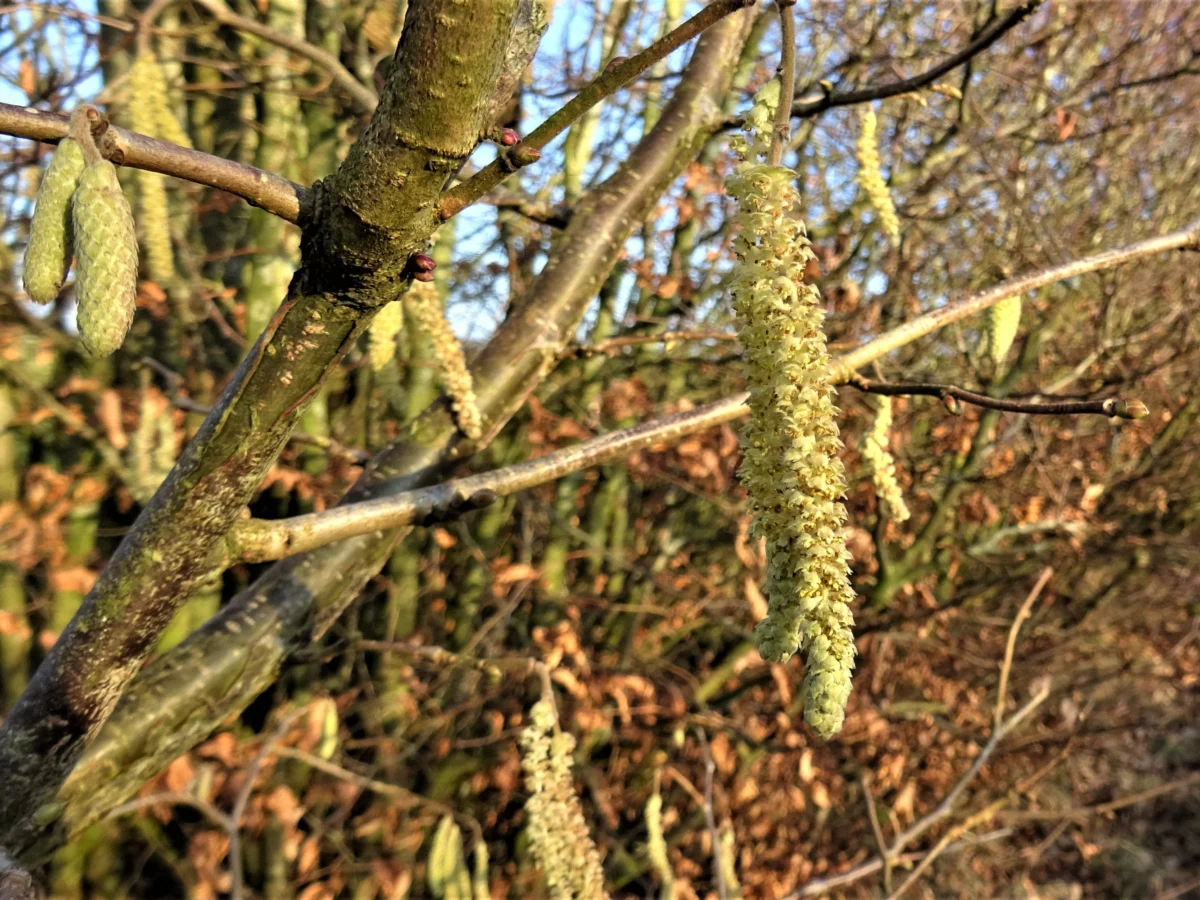
Because hazelnuts flower in late winter, avoid frost pockets at the bottom of slopes where cold air settles. Hard freezes during bloom can damage the male catkins and the tiny red female flowers even on hardy plants. Check your USDA hardiness zone with the growing zone finder, and look up your local frost dates with the frost dates by ZIP code tool.
Test your soil before planting. A university soil lab will report pH, organic matter and nutrient levels, and it saves you from guessing about fertilizer later. Hazelnuts do best in slightly acidic to neutral soil, around pH 6.0 to 7.0.
Do you need two hazelnut trees?
Yes. Hazelnuts are wind-pollinated and self-incompatible: a variety cannot pollinate itself, and not every pair of varieties is compatible. Pollen is shed from long catkins in late winter, usually between January and March depending on climate, and the wind carries it to the tiny female flowers on another plant. This is why planting spacing and bloom timing both matter. Plant at least two or three compatible varieties within about 50 feet (15 m) of each other, and ideally upwind of one another.
USU Extension lists several tested pairings for European cultivars:
- Barcelona with Casina
- Butler with Ennis
- Jefferson with Eta or Theta
- Santiam with Gamma or Yamhill
- Yamhill with Santiam or Gamma
It also names Eta, Gamma and Hall’s Giant as good general pollinizers. If you buy named varieties, always ask the nursery which pollinizers they recommend for that exact cultivar, and write the names down before you plant so you remember which tree is which.
Which hazelnut varieties resist eastern filbert blight?
Eastern filbert blight (EFB) is a fungal disease, caused by Anisogramma anomala, that is native to eastern North America. It makes rows of black, football-shaped cankers on branches and can kill European hazelnuts within a few years. The safest prevention is planting resistant varieties.
Oregon State University’s blight program lists two groups of resistant cultivars on its resistant cultivars page:
- Quantitative resistance: Lewis, Clark, Gem and Sacajawea. Sacajawea and Gem show the shortest cankers; Clark and Lewis are noted for good vigor.
- Single dominant resistance gene from ‘Gasaway’: Santiam, Yamhill, Dorris, Wepster, McDonald, PollyO and Jefferson. Cankers may still develop but are smaller and may heal over.
The OSU page also warns that the Gasaway gene can be overcome by other EFB strains, including new strains found near Woodburn and Silverton, Oregon. Cankers that keep growing should be removed. OSU’s Jefferson fact sheet reports very high resistance from the Gasaway gene, trunk size 30 to 40 percent smaller than Barcelona, nuts averaging 3.7 g with 45 percent kernel fill, and nuts that mature around mid-October in Oregon.
USU also names Eta, Gamma, Jefferson, Red Dragon, Santiam, Theta and Yamhill as disease-resistant European options, and calls Barcelona and Ennis very susceptible. In the eastern United States, skip Barcelona and other susceptible types entirely.
How to plant hazelnut trees
- Prepare the site. Control perennial weeds before planting, and do not plant into turf. If you must plant in lawn, remove sod 2 to 3 feet around each plant and mulch.
- Space plants. Allow 15 to 20 feet (4.5 to 6 m) between plants in an orchard, or plant closer if you want a hedgerow. Use the plant spacing calculator to plan a row.
- Time it right. Plant bare-root plants in early spring while they are dormant. Store them above freezing and below 40°F (4°C) with the roots kept moist until planting, as USU advises. Potted plants can go in during spring or fall.
- Dig the hole. Make it about twice as wide as the root system and only as deep as the root collar. Mix compost into the backfill at roughly 1 part compost to 3 parts soil.
- Water and mulch. Water deeply after planting, then mulch 2 to 3 inches (5 to 8 cm) deep over the root zone, keeping mulch off the trunks to reduce rodent damage. The mulch calculator tells you how much to buy.
How do you care for hazelnuts?
Watering
New plants need supplemental irrigation for at least their first two years. USU recommends deep, infrequent watering and letting the root zone dry moderately between waterings, because frequent shallow watering encourages root rot and weak roots. Established plants in clay or loam may need water only once or twice a month during the hottest weather, wetting the soil about 2 feet deep; sandy soils may need two or three times a month. Water matters most in summer when the nuts are filling. The garden watering calculator can help you convert that into minutes.
Fertilizing
Fertilize only in spring, when growth begins, and base the decision on a soil test and how the plant looks. USU notes that healthy plants with adequate yields usually need no fertilizer at all. Too much nitrogen gives lush shoots, not nuts. See our fruit tree fertilizer guide for timing and rates.
Weed control
Young hazelnuts compete poorly with grass and weeds. Hand weeding, shallow cultivation and a deep mulch ring usually do the job. Keep any herbicide and mulch off trunks and branches.
Pruning
Prune in late winter, when the catkins are visible but before growth starts. Shrub-form plants need little maintenance; USU recommends renewal pruning by removing about 15 to 20 percent of the oldest growth each year. For a bush form, keep four to six strong stems and remove the oldest stem every few years. Tree form is practical only for European and Turkish types: select 3 to 5 strong scaffold branches and prune moderately each year to reduce alternate bearing. Remove suckers from the base every year if you want a single trunk. Sharp bypass loppers make this job easy; our loppers guide explains which type to buy.
Common hazelnut pests and diseases
USU lists aphids, leafrollers, leaf- and nut-feeding insects, spider mites and scale as the pests to watch for. Squirrels, jays and deer are often a bigger problem than insects in home plantings, because they take the crop as soon as it ripens. Bud mites can cause swollen, “blasted” buds on susceptible varieties; OSU’s Jefferson sheet notes that Jefferson shows high tolerance, so no chemical control should be necessary there.
Among diseases, root rots (especially Phytophthora) and powdery mildew are the main concerns in the Intermountain West, and USU points out that eastern filbert blight has not been reported in Utah. For aphids, see our guide on how to get rid of aphids; for mildew, see powdery mildew. OSU also reports that Jefferson can develop bacterial blight after cool, wet springs and recommends copper sprays on young trees, so check the label of any copper product and follow it exactly.
How do you manage eastern filbert blight?
Scout in winter, when leafless branches show the cankers clearly. Prune out infected branches 2 to 3 feet (60 to 90 cm) below the visible cankers, then remove and destroy the cut wood. OSU advises growers to avoid planting into or beside heavily infected orchards, and notes that wild hazels nearby can carry the fungus.
When are hazelnuts ready to harvest?
Hazelnuts ripen from late September through October, depending on variety and climate. They are ready when the husks begin to turn yellow-brown and the nuts loosen and start to fall. Most nuts drop on their own, so collect from the ground several times a week to beat squirrels and jays. Seed-grown plants may need hand-picking once the husks turn brown. Mowing or clearing the ground under the plant before harvest makes collecting far easier.
How do you dry and store hazelnuts?
Dry nuts soon after harvest. USU recommends drying in the shell at 95 to 105°F (35 to 40°C) for 72 to 96 hours, and warns that temperatures above 110°F (43°C) can reduce flavor. At home, spread nuts one layer deep on screens in a warm, dry, airy room with a fan, and stir them daily. They are done when the kernel is crisp and snaps instead of bending. Store dried nuts in the shell in a cool, dry place in mesh bags, or shell them and refrigerate or freeze the kernels. Moldy or shriveled nuts should be thrown out.
How many nuts can you expect?
Be realistic. Plants begin bearing in 3 to 4 years and reach full production in 7 to 8 years. Yields vary with the year, the variety and the weather at bloom. Selected hybrids average around 7 pounds (3.2 kg) per plant, and OSU’s Jefferson trial recorded 13.2 kg of marketable nuts per tree cumulatively over its third through seventh leaf under regular irrigation. Home plantings in cold or frost-prone areas will often crop less than that, and some years may fail entirely when a hard freeze hits during bloom.
Hazelnut vs filbert vs almond
Hazelnut and filbert are the same genus, with “filbert” usually meaning the large-nutted European type. Almonds are unrelated: they belong to Prunus, closer to peaches and cherries, and need a warm, dry climate. If you are choosing a nut tree for a mild, dry area, see our guide to almond trees.
Common hazelnut mistakes
- Planting a single variety. Without a compatible pollinizer you will get catkins and no nuts.
- Choosing Barcelona or another susceptible type in the East. Eastern filbert blight will eventually kill it.
- Overwatering. Wet feet invite Phytophthora root rot.
- Planting in a frost pocket. Late-winter bloom is easily damaged.
- Forgetting the squirrels. Pick up fallen nuts promptly or protect the crop.
Safety and legal note: If you use a copper spray or any other pesticide, the label is the law: follow the rate, timing and protective equipment it lists, and keep products away from children and pets. Rules on buying and moving nursery stock, especially hazelnuts in blight-regulated areas, vary by state and country, so check with your local extension office before ordering plants from another region.
Free printable: the Year-Round Garden & Preserving Planner
Planting dates for 24 crops, monthly tasks, blanching times, canning safety numbers and a winter storage chart in one 8-page PDF. Enter your email to download it instantly and get our seasonal garden newsletter.
No spam. Unsubscribe any time. We never sell your email.
Frequently asked questions
How long does it take a hazelnut tree to produce nuts?
Usually 3 to 4 years after planting, with full production at about 7 to 8 years.
Usually 3 to 4 years after planting, with full production at about 7 to 8 years.
Is a filbert the same as a hazelnut?
Yes. Filbert is another name for hazelnut, usually used for the large-nutted European species and its varieties.
Yes. Filbert is another name for hazelnut, usually used for the large-nutted European species and its varieties.
Can one hazelnut tree produce nuts?
Rarely. Hazelnuts need pollen from a compatible variety, so plant at least two or three.
Rarely. Hazelnuts need pollen from a compatible variety, so plant at least two or three.
How big does a hazelnut tree get?
Most grow about 10 to 15 feet tall and wide, as a multi-stem shrub or a small single-trunk tree.
Most grow about 10 to 15 feet tall and wide, as a multi-stem shrub or a small single-trunk tree.
Are hazelnut trees messy?
They drop catkins in late winter and husks and leaves in fall, but they are much tidier than large nut trees such as walnuts.
They drop catkins in late winter and husks and leaves in fall, but they are much tidier than large nut trees such as walnuts.
Which hazelnut is best for eastern filbert blight?
Oregon State University lists Lewis, Clark, Gem and Sacajawea (quantitative resistance) and Santiam, Yamhill, Dorris, Wepster, McDonald, PollyO and Jefferson (Gasaway gene). Native American and beaked hazelnuts also tolerate the disease.
Oregon State University lists Lewis, Clark, Gem and Sacajawea (quantitative resistance) and Santiam, Yamhill, Dorris, Wepster, McDonald, PollyO and Jefferson (Gasaway gene). Native American and beaked hazelnuts also tolerate the disease.
When should I prune hazelnuts?
In late winter, before growth starts. Remove suckers, old stems and any blight cankers, cutting infected branches 2 to 3 feet below the canker.
In late winter, before growth starts. Remove suckers, old stems and any blight cankers, cutting infected branches 2 to 3 feet below the canker.
For other trees and berries to grow alongside this one, see the home fruit tree guide.
Reviewed October 2026. References used in this guide: Utah State University Extension, Hazelnuts in the Home Orchard; Oregon State University, Plant Resistant Cultivars (eastern filbert blight); Oregon State University Extension, ‘Jefferson’ hazelnut (EM 9028).