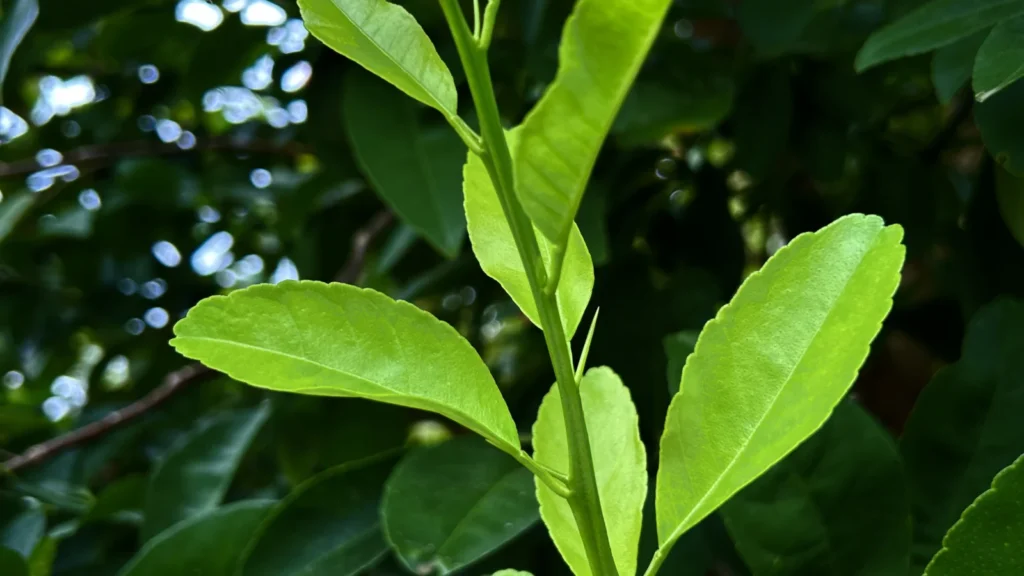
Lime trees are small evergreen citrus trees grown for their sour green fruit. The two main kinds are the Persian or Tahiti lime (Citrus × latifolia), the large seedless lime sold in supermarkets, and the Key or Mexican lime (Citrus aurantiifolia), which is smaller, seedier and more aromatic. Lime trees need full sun, well-drained soil and a nearly frost-free climate, or a container that can come indoors. Grafted trees fruit in about 2 to 3 years, and limes are picked green once they reach full size.
This guide is about lime trees, the citrus fruit. If you came here for lime used to raise soil pH, see our guide to garden lime and how to use it.
Lime tree growing requirements
| Main types | Persian/Tahiti lime, Key/Mexican lime, makrut (kaffir) lime |
|---|---|
| Natural height | Tahiti lime about 20 feet; usually pruned to 6 to 8 feet |
| Cold damage (Tahiti) | Leaves below about 28°F, wood about 26°F, severe below 24°F |
| Cold tolerance (Key lime) | Lower than Tahiti lime |
| Light | Full sun, at least 6 to 8 hours |
| Pollination | Self-fruitful; Persian limes are usually seedless |
| Harvest | Pick green when full size (Tahiti about 1¾ inches across) |
| Storage | About 10 days in the refrigerator |
What are the main types of lime trees?
| Type | Fruit | Seeds | Cold tolerance | Best use |
|---|---|---|---|---|
| Persian / Tahiti / Bearss lime | Large, about 2 inches, thick skin | Usually none | Moderate | Juice, cooking, drinks |
| Key / Mexican / West Indian lime | Small, about 1 to 1.5 inches, thin skin, very aromatic | Several | Low | Key lime pie, cocktails |
| Makrut (kaffir) lime | Bumpy, little juice | Several | Moderate | Leaves and zest in Southeast Asian cooking |
Most home gardeners grow the Tahiti lime, which the University of Florida Tahiti lime guide describes as more cold-tolerant and disease-resistant than Key lime. Key lime fruit has the stronger aroma that defines Key lime pie, but the tree is more sensitive to cold and to some citrus diseases.

Where can lime trees grow?
Limes are among the least cold-hardy citrus. UF/IFAS reports that Tahiti lime leaves are damaged below about 28°F, wood is damaged near 26°F and severe damage occurs below about 24°F; Key lime is even more tender. Outdoors, that limits lime trees to the warmest citrus areas, such as south Florida, coastal and southern California, south Texas and Hawaii. Check your USDA hardiness zone with the growing zone finder and your frost dates with the frost date tool. Everywhere else, grow a lime in a container and bring it indoors before nights drop below about 40°F.
How to plant a lime tree
- Choose full sun on the warmest, most sheltered side of the house. UF recommends planting about 15 to 20 feet from buildings and other trees.
- Make sure the soil drains well. Citrus roots rot in wet soil. On poorly drained ground, plant on a low mound.
- Dig a hole about two to three times as wide as the root ball and no deeper. Use the planting hole size calculator.
- Keep the graft union above the soil and plant at the same depth as in the pot.
- Water deeply, then mulch, keeping mulch a foot away from the trunk to discourage foot rot.
How do you grow a lime tree in a pot?
Container limes are the most practical choice in cold climates. Start with a grafted, dwarf tree in a pot at least 15 to 20 gallons with drainage holes and a fast-draining citrus potting mix. Water when the top inch or two is dry, feed with a citrus fertilizer from spring to late summer, and give the tree the sunniest window or a grow light in winter. Size the container with the grow bag volume calculator or plan a patio grouping with the container garden planner. Our mandarin tree guide covers similar container care for another compact citrus.
How do you water and fertilize lime trees?
Water new trees two or three times a week for the first few weeks, then weekly during dry weather. Established trees in the ground need deep watering during long dry spells, especially while flowering and setting fruit. Let the soil surface dry between waterings; constantly wet soil causes yellow leaves and root problems. The garden watering calculator helps estimate how much water a tree needs.
Feed with a citrus fertilizer that contains nitrogen, potassium and micronutrients such as magnesium, manganese and zinc. Young trees benefit from small, frequent feedings during the growing season; mature trees need fewer. See our fruit tree fertilizer guide for timing.
When do lime trees produce fruit?
Grafted lime trees usually start bearing in about 2 to 3 years. Limes bloom mainly in spring, but in warm climates they flower and fruit through much of the year. Tahiti limes are self-fruitful, so a single tree crops on its own.
When do you pick limes?
Limes are picked green, once they reach full size, are glossy and feel slightly soft when squeezed. UF/IFAS advises harvesting Tahiti limes when they are about 1¾ inches in diameter. Limes left on the tree turn yellow; they are still edible and often juicier, but they lose acidity and store less well. Clip the fruit rather than pulling it, and refrigerate it; limes keep about 10 days in the fridge.
Common lime tree problems
| Symptom | Likely cause | What to do |
|---|---|---|
| Yellow leaves, green veins | Micronutrient deficiency or high pH | Use a citrus fertilizer with micronutrients |
| Leaf drop indoors | Low light, sudden move, overwatering | Increase light; let soil dry slightly |
| Silvery, twisted new leaves | Citrus leafminer | Tolerate on older trees; protect new flushes |
| Blotchy yellow leaves, small lopsided fruit | Possible citrus greening (HLB) | Contact your extension office or state agriculture department |
Citrus quarantine note: Citrus greening (huanglongbing), spread by the Asian citrus psyllid, has no cure and is under state and federal quarantine in parts of Florida, Texas, California, Louisiana, Georgia and other areas. Do not move citrus trees, cuttings or budwood out of a quarantined area, and buy trees only from licensed nurseries. See your state agriculture department or the Texas Department of Agriculture citrus greening FAQ for an example of the rules.
For other symptoms, try the plant problem identifier or the pest identifier.
This article is part of our fruit trees guide, which groups all our fruit growing advice by crop.
How much fertilizer do lime trees need each year?
The University of Florida’s Tahiti lime publication gives a schedule that scales with tree age. In year one, feed every two to three months, starting at about 0.25 lb (110 g) of fertilizer per application and rising toward 1 lb (450 g). Years two and three call for roughly 0.5 to 1.0 lb per application; year four 1.0 to 1.5 lb; year five 1.5 to 2.0 lb, with mature trees getting three to four applications a year and never more than 12 lb (5.4 kg) per tree per year. UF also suggests foliar sprays of minor elements (copper, zinc, manganese and boron) three to four times a year from spring through summer for the first four to five years, and iron chelates in late spring and summer on alkaline soils, where lime leaves show yellow tissue with green veins.
North Carolina State Extension’s plant database, which describes the Persian lime as hardy in USDA zones 9a to 11b, makes a simpler recommendation: fertilize three to four times a year and water regularly, especially in drought. Its notes also say the tree prefers sandy or loamy soil with a pH of 6.0 or higher, and that it does poorly in heavy clay or poorly draining ground.
Watering schedule for new and established trees
UF’s advice is specific. Water at planting, then every other day for about a week, then once or twice a week for the first couple of months. During a dry spell of five days or more, water trees under three years old twice a week. Once the rainy season starts, cut back or stop irrigating. From year four on, irrigate during prolonged dry periods, and avoid drought stress from bloom through fruit development, because that is when a lack of water costs you the crop.
Spacing, mulch and trunk care
- Distance: plant 15 to 20 feet (4.5 to 6 m) from buildings and other trees. NC State lists a mature spread of 8 to 20 feet and recommends 12 to 24 feet of space.
- Grass-free ring: keep a 2 to 5 foot (0.6 to 1.5 m) circle around the trunk free of lawn so mowers and string trimmers cannot wound the bark. NC State specifically warns about mower and weed-whacker damage.
- Mulch: spread a 2 to 6 inch (5 to 15 cm) layer, kept 8 to 12 inches (20 to 30 cm) from the trunk. Use the mulch calculator on this site to work out how much you need.
- Planting hole: UF recommends a hole three to four times the diameter of the container and about three times its depth.
- Wet sites: where the water table is within about 7 feet of the surface, plant on a mound 2 to 3 feet (60 to 90 cm) high and 4 to 10 feet (1.2 to 3 m) across.
- Buying a tree: nursery trees usually come in 3-gallon containers and stand 2 to 4 feet tall. Avoid root-bound plants and large trees in small pots.
Pruning limes lightly
Lime trees need minimal pruning. Cut to shape the canopy, remove dead or diseased wood, let light and spray reach the centre, and limit size. UF suggests holding height around 6 to 8 feet (1.8 to 2.4 m) to cut wind damage and make spraying and picking easier. NC State agrees that pruning should be limited to shaping, removing dead wood and controlling size.
Fruit, yields and harvest handling
A Tahiti lime is typically 2¼ to 2¾ inches (5.5 to 7 cm) long, weighs about 1.9 ounces (54 g), has 10 to 12 segments and is seedless in solid plantings. UF reports acid around 5 to 6 percent and juice making up 45 to 55 percent of fruit volume. Fruit takes about 90 to 120 days from bloom to maturity. Pick when about 1¾ inches (45 mm) across and dark to medium green, since smaller fruit has little juice. Harvest in the afternoon and handle gently to reduce stylar-end breakdown, which is most likely from July to September. Stored in a polyethylene bag in the refrigerator, limes keep about 10 days.
UF’s expected yields for well-maintained trees climb quickly: roughly 8 to 10 lb (4 kg) in year one, 10 to 20 lb in year two, 20 to 30 lb in year three, 60 to 90 lb in year four, 130 to 180 lb in year five and 200 to 250 lb in year six. Unpruned trees 12 to 15 years old commonly bear 450 to 550 lb. Unfertilized or unwatered trees produce substantially less.
Pests and diseases in more detail
| Problem | What UF/IFAS says |
|---|---|
| Citrus leafminer | Apply 0.5 to 1 percent horticultural oil when new leaves are 0.5 to 1 inch long. Trees three years or older tolerate the damage. |
| Citrus red mite | Control with sulfur. Never apply sulfur and oil within three weeks of each other. |
| Scale insects | Florida red scale and snow scale respond to 0.5 to 1 percent horticultural oil, snow scale after several applications. |
| Citrus canker | Moderately susceptible. Plant in full sun with good airflow, avoid wetting foliage, and use copper on new growth. |
| Greasy spot and melanose | One or two copper or copper-plus-oil sprays, mainly during the rainy season (May to September). |
| Red alga | One or two copper sprays from mid to late summer. |
| Postbloom fruit drop | Avoid copper and overhead watering during bloom. |
| Foot rot | Avoid trunk wounds, keep the trunk dry and keep mulch away from it. |
| Citrus greening | No cure. Remove infected trees and buy certified nursery stock. |
NC State adds that Persian lime can cause contact dermatitis in some people, so wear gloves and avoid sun on wet skin after handling juice or peel.
Practical uses of limes
The juice goes into drinks, syrups, jams, jellies, baking, sorbets, ice cream, pie, sauces and marinades for meat and fish, and whole slices make a garnish. The rind oil is used in flavourings and cosmetics. The flowers are fragrant and attract bees; NC State notes the tree blooms year-round, with the heaviest bloom from late winter to early spring.
Safety and legal note: Horticultural oil, sulfur and copper products must be used exactly as the label directs. Never mix sulfur and oil within three weeks. Pesticide rules differ by country and state, and citrus movement is restricted in quarantine areas, so check with your local agriculture authority before buying or moving trees.
Free printable: the Year-Round Garden & Preserving Planner
Planting dates for 24 crops, monthly tasks, blanching times, canning safety numbers and a winter storage chart in one 8-page PDF. Enter your email to download it instantly and get our seasonal garden newsletter.
No spam. Unsubscribe any time. We never sell your email.
Frequently asked questions
How tall do lime trees get?
Tahiti limes can reach about 20 feet but are usually pruned to 6 to 8 feet. Dwarf trees in pots stay about 4 to 6 feet.
Do you need two lime trees to get fruit?
No. Lime trees are self-fruitful, so one tree is enough.
Why are my limes turning yellow?
Limes naturally turn yellow if left on the tree past maturity. Pick them green and full-size for the best acidity.
Is a Key lime tree harder to grow than a Persian lime?
Usually yes. Key lime is less cold-hardy and more disease-prone, so Persian (Tahiti) lime is the easier choice for most gardens.
Can a lime tree live indoors?
Yes, in winter, if it gets bright light. Most container limes do best outdoors in summer and indoors when nights fall below about 40°F.
How much fruit will a young lime tree give me?
UF/IFAS expects about 8 to 10 lb in year one and 20 to 30 lb in year three on well-maintained trees, rising to 130 to 180 lb by year five.
What temperature kills a lime tree?
Tahiti lime leaves are damaged below 28°F (-2°C), wood below about 26°F (-3°C), and severe damage or death can follow below 24°F (-4°C).
Should I prune my lime tree hard?
No. Prune lightly to shape it, remove dead wood and keep it near 6 to 8 feet tall.
Fact-checked against: University of Florida IFAS, Tahiti Lime Growing in the Florida Home Landscape; Texas Department of Agriculture, Citrus Greening FAQ; NC State Extension, Citrus x latifolia. Quarantine areas change; check your state agriculture department.