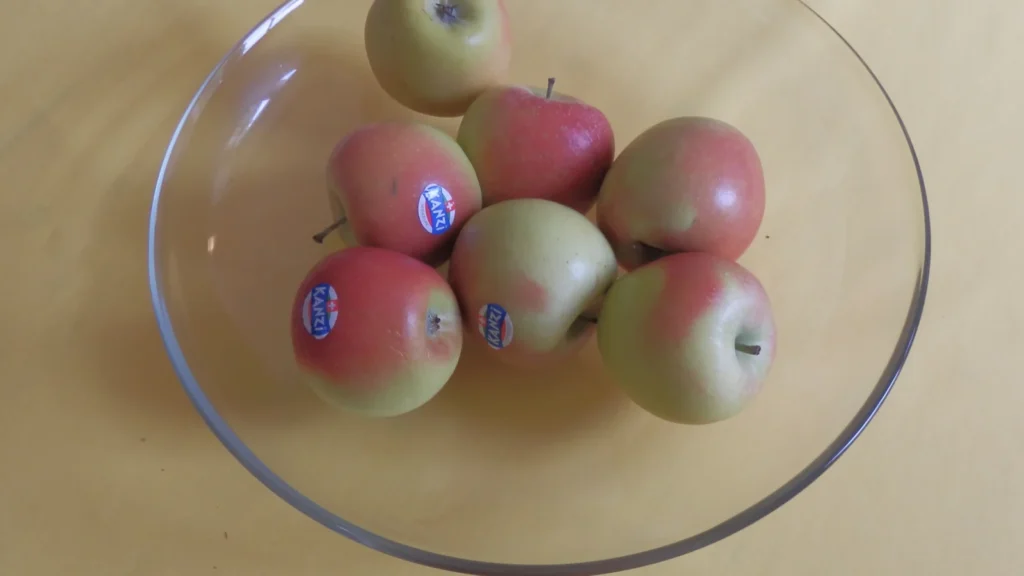
Kanzi is a modern apple variety from Belgium, a cross of Gala and Braeburn sold under the trademark Kanzi, with the registered cultivar name ‘Nicoter’. It has a red-blushed skin over a yellow-green background and firm, crisp, very juicy flesh with a balanced sweet-tart, slightly tangy flavor. The name is Swahili for “hidden treasure”. Kanzi reached European stores in 2006 and US stores in 2014. It is a patented, licensed “club” variety grown only by authorized orchards, so trees are generally not sold to home gardeners; similar apples you can grow include Gala, Braeburn and other Gala-type varieties.
Kanzi apple in brief
| Cultivar name | ‘Nicoter’ (sold as Kanzi®) |
|---|---|
| Parentage | Gala × Braeburn |
| Origin | Belgium; developed by Better3Fruits and marketed by Greenstar Kanzi Europe |
| In stores | Europe from 2006; United States from 2014 |
| Name meaning | “Hidden treasure” in Swahili |
| Look | Medium, round to slightly conical; red blush and stripes over yellow-green |
| Texture | Firm, crisp, very juicy |
| Flavor | Balanced sweet-tart, slightly tangy |
| Best use | Fresh eating, salads, lunch boxes |
| Availability for home growers | Generally no; licensed club variety |
What is a Kanzi apple?
Kanzi is a dessert apple bred from a cross between two of the world’s most popular apples, Gala and Braeburn. According to the Wikipedia entry on the Kanzi apple, it was developed in Belgium by the breeding company Better3Fruits together with Greenstar Kanzi Europe, first reached European markets in 2006 and arrived in limited quantities in the United States in 2014. Kanzi is the trademark brand name; the variety itself is registered as ‘Nicoter’.
Kanzi is one of a growing number of “club” apples, along with varieties such as Jazz (from the same Braeburn × Gala parentage), Envy and SweeTango. Club apples are patented and trademarked, grown under license by selected orchards and marketed under strict quality standards, which is why you see them by brand name in stores.

What does a Kanzi apple taste like?
Kanzi combines the sweetness of Gala with the tangy sharpness and crunch of Braeburn. Wikipedia describes it as slightly sharp rather than sweet, firm, fairly crisp and quite juicy, and notes that tasters preferred it to the Jazz apple, which shares its parentage but has a harder texture. Most people describe Kanzi as refreshing and well balanced, neither cloyingly sweet nor sour, with a clean finish. It is primarily an eating apple, at its best fresh and chilled.
Kanzi vs Jazz vs Gala vs Braeburn
| Apple | Parentage | Texture | Flavor | Home-grower availability |
|---|---|---|---|---|
| Kanzi (‘Nicoter’) | Gala × Braeburn | Firm, crisp, very juicy | Balanced sweet-tart, tangy | Generally not available |
| Jazz (‘Scifresh’) | Braeburn × Royal Gala | Very hard, dense, crunchy | Tangy-sweet | Generally not available |
| Gala | Kidd’s Orange Red × Golden Delicious | Crisp, fine-grained | Sweet, mild | Widely available |
| Braeburn | Chance seedling (New Zealand) | Firm, crisp | Tart-sweet, spicy | Widely available |
If you like Kanzi, you will likely enjoy growing Gala and Braeburn, its parents, which are available from many nurseries.
Can you buy a Kanzi apple tree?
Generally, no. Kanzi is protected by a plant patent and trademark, and the variety is licensed to selected commercial orchards that agree to grow and market it under the brand’s rules. The breeders do not usually release trees to retail nurseries for home gardeners. You may occasionally see trees advertised online under the Kanzi name; treat these with caution, as they may be mislabeled or unlicensed.
Plant patent and trademark note: The ‘Nicoter’ apple tree is covered by a US plant patent, USPP17,201, and Kanzi is a registered trademark. Propagating ‘Nicoter’ by grafting or budding, including from store-bought fruit’s trees or scion wood, without a license is not allowed, and selling fruit under the Kanzi name requires authorization. Seeds from Kanzi apples will not produce Kanzi trees, so growing seedlings is legal but will give you a different, unknown apple.
What apple trees are similar to Kanzi for home gardens?
- Gala: One parent; sweet, crisp and early. Widely sold on dwarf and semi-dwarf rootstocks.
- Braeburn: The other parent; tangy, crisp and a good keeper. Needs a long growing season and suits warmer regions.
- Honeycrisp: Very crisp and juicy, sweet-tart; hardy for northern gardens.
- Fuji: Sweet, dense and crisp; late-ripening and a long keeper.
- Disease-resistant options: If scab is a problem where you live, consider resistant varieties such as the Liberty apple.
Most of these need a pollination partner; see self-pollinating apple trees. For tree sizes, see dwarf apple trees.
Can you grow a Kanzi apple tree from seed?
You can grow an apple tree from a Kanzi seed, and it is legal, but it will not be a Kanzi. Every apple seed is a genetic mix of its parent and whatever tree supplied the pollen, so the seedling will produce a new, unknown apple, usually less tasty, and only after 7 to 10 years or more. See how to grow an apple tree from seed for the method if you want to try.
When are Kanzi apples in season?
In the Northern Hemisphere, Kanzi apples are harvested in autumn and stored in controlled-atmosphere facilities, so they are available in stores from fall through spring and summer. Southern Hemisphere production fills gaps at other times of year. Because they are picked at maturity and stored under ideal conditions, store-bought Kanzi apples are usually crisp for many months after harvest.
How do you choose and store Kanzi apples?
- Choose: Look for firm fruit with bright red blush and no soft spots or bruises. A yellow, rather than green, background color indicates full ripeness.
- Store: Keep apples in a plastic bag in the refrigerator crisper. Apples stay crisp much longer at about 32 to 40°F than at room temperature.
- Separate: Store apples away from vegetables such as lettuce and carrots, which can be affected by the ethylene apples release.
For more on keeping apples fresh, see how to store apples.
How do you use Kanzi apples?
- Eat fresh, chilled and sliced.
- Add to salads; the juicy, tangy flesh pairs well with greens, cheese and nuts.
- Use in slaws and grain bowls.
- Serve with cheese boards.
- Bake in tarts where you want slices that hold their shape and a tangy flavor.
Kanzi browns relatively slowly after cutting, which makes it handy for lunch boxes and platters.
Why are new apple varieties sold as club apples?
Developing a new apple takes decades of crossing and testing. Club and managed varieties let breeders and growers recover that investment by controlling where the variety is planted, how much is grown and how the fruit is graded and marketed. The model aims to keep quality high and prevent oversupply, but it also means many of the newest apples are not available to home gardeners until their patents expire, typically about 20 years after the patent application is filed.
Where do Kanzi’s parents, Gala and Braeburn, come from?
Gala was bred in New Zealand in the 1930s by J. H. Kidd from a cross of Kidd’s Orange Red and Golden Delicious, and became one of the most widely grown apples in the world thanks to its sweet, mild flavor and attractive striped skin. Braeburn was discovered as a chance seedling in New Zealand in the 1950s, probably from Lady Hamilton, and is valued for its firm texture, tangy-spicy flavor and long storage life. Both parents ripen in autumn and store well, traits that carried over to Kanzi. Crossing them aimed to combine Gala’s sweetness and color with Braeburn’s crunch and acidity.
How do you grow Gala or Braeburn at home?
Since Kanzi trees are not available to home gardeners, growing its parents is the closest you can get. Both are widely sold on dwarf and semi-dwarf rootstocks.
- Gala: Hardy in roughly zones 5 to 8, ripens in late summer, sweet and crisp. It tends to set heavy crops, so thin fruit to one per cluster for good size.
- Braeburn: Best in roughly zones 6 to 8 with a long, warm growing season, ripening in mid to late fall. It stores for months and develops the tangy flavor Kanzi inherited.
- Pollination: Gala and Braeburn bloom at overlapping times and can pollinate each other, so planting both gives you a Kanzi-style pair in one backyard.
- Care: Full sun, well-drained soil, annual pruning and fruit thinning. Plant in early spring; see when to plant apple trees.
Check your zone with the growing zone finder before choosing.
Other club apples you may see in stores
| Brand | Notes |
|---|---|
| Jazz | Braeburn × Royal Gala from New Zealand; very hard and crunchy |
| Envy | Braeburn × Royal Gala; sweet, slow to brown |
| SweeTango | Honeycrisp × Zestar! from the University of Minnesota; very crisp |
| Pink Lady (Cripps Pink) | Lady Williams × Golden Delicious from Australia; tart-sweet |
| Cosmic Crisp | Enterprise × Honeycrisp from Washington State University; initially licensed to Washington growers |
Licensing arrangements differ; some of these are now available to home gardeners, others are not. Check with a reputable nursery before buying any tree sold under a brand name.
Are Kanzi apples healthy?
Like other apples, Kanzi provides fiber, especially in the skin, vitamin C and antioxidant polyphenols, with few calories. Nutrient values for raw apples are listed in the USDA’s FoodData Central database. Eating the apple with its skin gives the most fiber and nutrients.
Simple ways to enjoy Kanzi apples
- Apple and cheese plate: Thin slices with aged cheddar or Gouda, walnuts and honey.
- Crunchy slaw: Matchsticks of Kanzi with cabbage, carrot, lemon juice and yogurt dressing.
- Breakfast: Diced into yogurt or oatmeal with cinnamon.
- Tart: Thin slices on puff pastry, brushed with butter and sugar, baked until golden; the tangy flavor balances the sweetness.
How do you tell if a Kanzi apple is ripe and fresh?
Store-bought Kanzi apples are harvested ripe and kept in cold, controlled storage, so they are ready to eat when you buy them. Choose fruit that feels heavy and firm, with glossy skin and a yellow rather than green background color under the red blush. Avoid apples with wrinkled skin, soft patches or bruises, which signal age or rough handling. At home, keep them cold; an apple loses as much crispness in a day at room temperature as in a week or more in the refrigerator. If an apple tastes mealy or flat, it has probably been stored too long or too warm.
Will Kanzi trees ever be available to home gardeners?
Possibly, eventually. US plant patents last about 20 years from filing, after which a variety can legally be propagated by anyone, although trademarks such as the Kanzi name can continue indefinitely. Some former club and patented apples, such as older Pink Lady selections, have become more widely available over time. Until then, Gala and Braeburn remain the best substitutes.
In short, Kanzi is a treat to buy and enjoy fresh, while its parents, Gala and Braeburn, are the practical choice if you want to grow a similar apple in your own garden.
Look for it in stores from autumn through spring, and compare it side by side with Jazz and Envy to find the crisp, tangy apple you like best.
If you enjoy Kanzi, compare it with other modern and heirloom varieties in our guide to heirloom apples, and learn the best ways to keep fruit crisp in how to store apples.
This article is part of our fruit trees guide, which groups all our fruit growing advice by crop.
Free printable: the Year-Round Garden & Preserving Planner
Planting dates for 24 crops, monthly tasks, blanching times, canning safety numbers and a winter storage chart in one 8-page PDF. Enter your email to download it instantly and get our seasonal garden newsletter.
No spam. Unsubscribe any time. We never sell your email.
Frequently asked questions
What two apples make a Kanzi?
Kanzi is a cross between Gala and Braeburn.
Is Kanzi sweet or tart?
Balanced: sweet with a noticeable tangy sharpness, from its Braeburn parent.
Can I plant a Kanzi apple tree?
Generally no. It is a patented, licensed club variety not sold to home gardeners.
Is Kanzi the same as Jazz?
No. Both come from Braeburn and Gala parents, but they are different varieties; Jazz is harder and denser.
Where was Kanzi developed?
In Belgium, by Better3Fruits with Greenstar Kanzi Europe.
What does Kanzi mean?
“Hidden treasure” in Swahili.
References used in this guide: Kanzi (apple); Google Patents, USPP17201 Apple tree named Nicoter; Specialty Produce, Kanzi Apples.