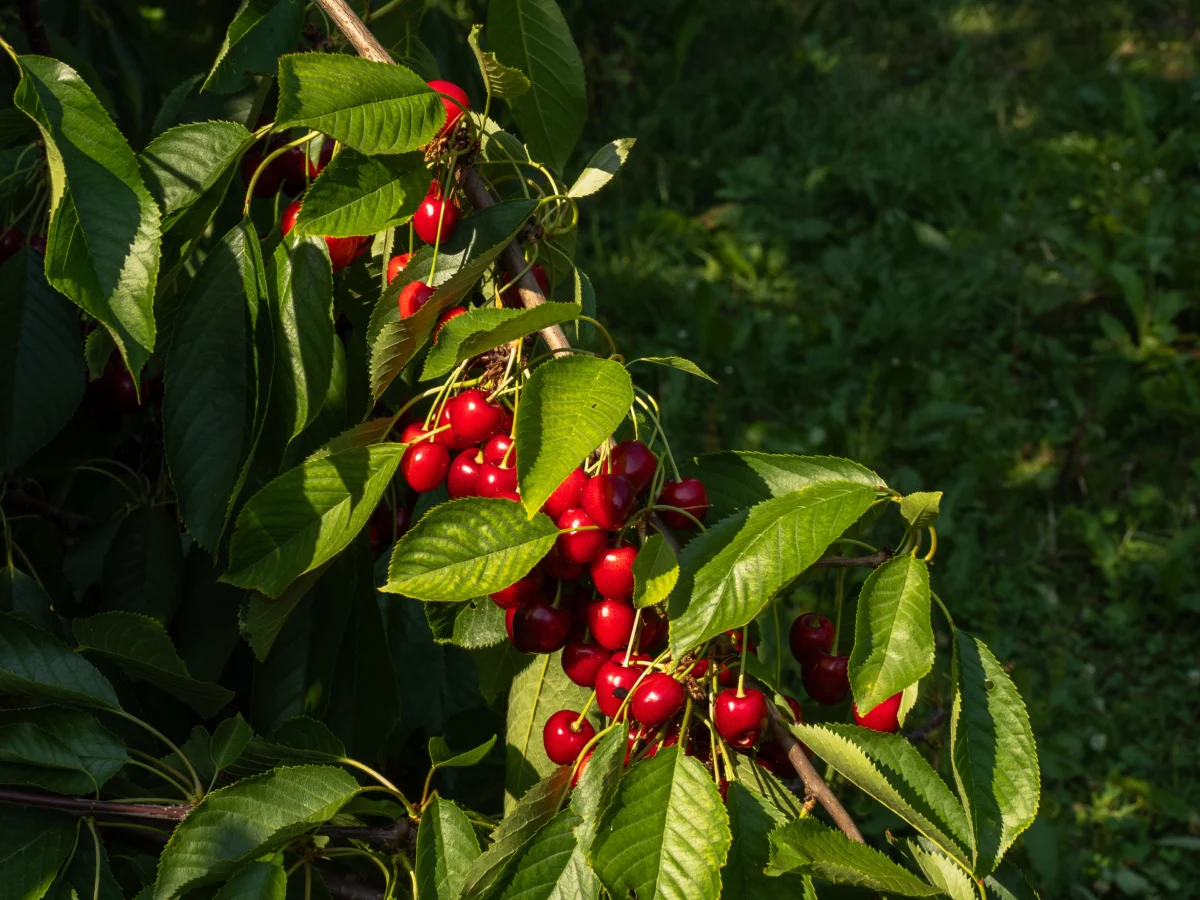
The Stella cherry tree is a sweet cherry from Canada and the first named self-fertile sweet cherry, so a single tree can produce a crop. It bears large, dark red, heart-shaped cherries about a week before Bing, in June or early July, grows in roughly zones 5 to 8 and is also a widely used pollinizer for other sweet cherries. Its main weakness is fruit cracking after rain near harvest. This guide covers where Stella came from, how self-fertility works, how to choose a rootstock, plant, water, prune and protect the tree, how it compares with Lapins and Sweetheart, and how to harvest the fruit.
Stella cherry essentials
| Trait | What to know |
|---|---|
| Botanical name | Prunus avium ‘Stella’ |
| Origin | Summerland Research Station, British Columbia; crossed 1956, named 1968 |
| Parents | ‘Lambert’ x ‘JI 2420’ (a self-fertile John Innes selection) |
| Pollination | Self-fertile; pollinizes many other sweet cherries |
| Fruit | Large, dark red, heart-shaped, sweet |
| Harvest | About a week before Bing; June to early July |
| Zones | About 5 to 8 |
| Size | About 20 to 30 feet on standard rootstock; 8 to 15 feet on dwarfing rootstock; Compact Stella about half the size |
What is a Stella cherry?
Stella was bred at the Summerland Research Station in British Columbia by K. O. (Karlis) Lapins. According to the Wikipedia article on the Stella cherry, the John Innes Institute in Norwich, England, had developed three self-fertile seedlings; one was crossed with Lambert in 1956 at Summerland, and the hybrid was named Stella in 1968. A compact version, Compact Stella, was created by irradiating dormant Stella scions in 1964 and named in 1973; it is a semi-dwarf of about half the parent’s size and keeps the self-fertility. Stella has received the Royal Horticultural Society’s Award of Garden Merit.
The story behind it is worth knowing. A profile of Lapins from the specialty retailer ChefShop, The Lapins Cherry Origin, describes how Lapins, born in Latvia in 1909, came to British Columbia as a wartime refugee, became Summerland’s plant breeder in 1953 and spent about three decades working on self-fertile sweet cherries. Before Stella, nearly all sweet cherries needed a second, compatible variety to set fruit. Stella carried the self-fertility trait into later varieties, notably Lapins (a cross of Stella and Van, released in 1983) and Sweetheart.
Is the Stella cherry self-pollinating?
Yes. Stella is self-fertile, so one tree can fruit on its own, which makes it a good choice for small gardens with room for only one cherry. Oregon State University Extension’s cherry fact sheet notes that sweet cherries, except Stella and some Stella crosses, are self-incompatible and need cross-pollination by bees. Stella is also a popular “universal” pollinizer because its pollen is compatible with most sweet cherries that bloom at the same time. It is often recommended for varieties that cannot pollinate themselves, such as the Rainier cherry. Check a compatibility chart before relying on it for any single variety: Wikipedia notes that in some regions Stella does not pollinate the Bing variety.
Even self-fertile trees benefit from bees. Plant flowers nearby, avoid spraying during bloom and, if you can, grow a second compatible sweet cherry; crops are often heavier with cross-pollination.
Where does Stella grow best?
Stella grows in roughly zones 5 to 8 and needs a cold winter to flower well. Like all sweet cherries, it blooms early, so a late spring frost can wipe out the crop; avoid frost pockets and plant on a slope or high ground where cold air drains away. Check your USDA hardiness zone with the growing zone finder and your last frost date with the frost dates by ZIP code tool. Sweet cherries also dislike very humid summers, which encourage disease, and they perform best where summers are warm and relatively dry.
How do you plant a Stella cherry tree?
- Pick a rootstock. Standard rootstocks make a large, long-lived tree (Wikipedia gives a vase-shaped tree of about 20 to 30 feet tall with a spread of about 15 feet). Dwarfing rootstocks such as Gisela types keep it small enough to net and pick from the ground.
- Choose full sun and deep, well-drained soil. Cherries are very sensitive to waterlogged roots. See the best soil for fruit trees.
- Plant while dormant in late winter or early spring. Keep the graft union above the soil. Use the plant spacing calculator to plan distances.
- Water and mulch, keeping mulch off the trunk. The mulch calculator helps with quantities. Young trees on dwarfing rootstock often need a stake.
How do you care for a Stella cherry?
Watering
Water deeply during dry spells, but keep watering steady as fruit ripens. Sudden heavy watering or rain on nearly ripe fruit causes cracking. Mulch, drip irrigation and even soil moisture are the best defenses. The garden watering calculator helps you plan amounts.
Pruning
Prune in late summer after harvest or in late winter, keeping an open center or central leader. Remove dead, crossing and inward-growing branches. Timing varies by region and cherry pruning in wet weather can spread bacterial canker, so prune on a dry day; see when to prune cherry trees and our cherry tree guide for training. For size control, see dwarf cherry trees.
Feeding
Fertilize lightly in early spring only if growth is weak; see our fruit tree fertilizer guide. Too much nitrogen gives lush growth and soft fruit.
Birds and pests
- Birds: net against birds as fruit starts to color, with netting secured at the base. See bird scare tape.
- Spotted-wing drosophila and cherry fruit fly: maggots in ripe fruit. See spotted-wing drosophila.
- Brown rot: worst in warm, wet weather near harvest. See brown rot on stone fruit.
When are Stella cherries ready to pick?
Stella ripens about a week before Bing, usually in June in warm areas and early July in cooler ones. Pick when cherries are fully dark red, firm, sweet and come off with the stem attached. Taste-test a few: cherries do not ripen further after picking. Harvest quickly if rain is forecast, because ripe Stella fruit cracks easily. Oregon State notes that sweet cherries are best picked with stems on, handled gently and cooled promptly. Refrigerate unwashed fruit and eat within a few days, or pit and freeze extras on a tray. See our guides to making jam and freezing produce for preserving a big crop.
Stella vs other self-fertile sweet cherries
| Variety | Color | Season | Notes |
|---|---|---|---|
| Stella | Dark red | Early-mid | First self-fertile sweet cherry; prone to cracking |
| Lapins | Dark red | Late (about two weeks after Bing) | Better crack resistance; a Stella x Van cross |
| Sweetheart | Bright red | Very late | Extends the season |
| Rainier (not self-fertile) | Yellow-red | Mid | Needs a pollinizer such as Stella |
The ChefShop profile adds that Lapins has improved crack resistance and later ripening than its parents, withstands harvest-time rain better than Bing and is also a universal pollinizer. If cracking is your main worry, Lapins may suit a wet climate better than Stella, while Stella gives you cherries a week or two earlier.
For tart cherries, which are all self-fertile and hardier, see our cherry fruit tree guide.
Common mistakes
- Planting in a frost pocket, then losing the crop to a bloom-time freeze.
- Watering irregularly as fruit ripens, causing splits.
- Pruning in wet weather and inviting bacterial canker.
- Skipping netting and sharing the crop with birds.
- Assuming Stella pollinates every cherry. Check compatibility.
Growing Stella in a small yard or container
Stella’s self-fertility is its biggest advantage for small gardens. Choose a dwarfing rootstock, or Compact Stella, which stays at roughly half the size of the parent tree, so you can net, prune and pick without a tall ladder. A dwarf tree in a large container of at least 20 to 25 gallons with excellent drainage is possible, but container trees need frequent watering, a sheltered site and winter protection for the roots. Place the pot in full sun, feed lightly, and move it against a wall or into an unheated garage if a hard freeze threatens. Container trees yield less than in-ground trees, but a few pounds of homegrown cherries from a patio tree is a good reward.
If you have a sunny wall, consider training a fan-shaped tree against it. The wall stores heat, speeds ripening and gives a handy anchor for netting and frost protection. Fan training takes patience in the first years, but once established, the tree is easy to prune and pick.
Preventing cracked cherries
Cracking is the main complaint about Stella. When rain falls on nearly ripe fruit, water enters through the skin and the fruit swells until it splits, inviting brown rot. You cannot stop the weather, but you can stack the odds:
- Keep soil moisture even with mulch and slow drip irrigation, so the tree is not shocked by a sudden soaking.
- Improve airflow with open-center pruning so fruit dries quickly after rain.
- Cover small trees with a rain cover or tunnel for the ripening window, if rain is common where you live.
- Pick early when forecasts show heavy rain, even if the fruit is a little less sweet.
- Choose a later, crack-resistant variety such as Lapins if your area gets rain every June.
Do not pick wet fruit, and discard cracked cherries promptly, because they attract fruit flies and rot.
A yearly care calendar
- Late winter: plant bare-root trees, check stakes and guards, and plan pruning for a dry spell.
- Bloom: watch frost forecasts, welcome bees and avoid spraying.
- Late spring: net the tree before fruit colors, keep water even and monitor for fruit flies.
- Early summer: harvest at peak sweetness, remove all fruit and prune in dry weather if your region recommends summer pruning.
- Fall: clean up fallen leaves, check for cankers and borers and mulch.
- Winter: protect young trunks from sunscald and rodents, and avoid pruning in wet weather.
Keep notes on bloom and harvest dates, and which fruit cracked. After a few seasons you will know how to time watering, netting and picking for your own site and weather.
Buying a Stella tree
- Ask the nursery which rootstock the tree is on and how large it will grow, since two Stella trees can differ in size by a factor of two or more.
- Choose a tree with a straight trunk, a clean graft union and healthy, well-branched roots, and avoid any with wounds or oozing gum.
- Bare-root trees planted in late winter or early spring usually establish well and cost less than container trees.
- If you want a long season, pair Stella with a later self-fertile variety such as Lapins or Sweetheart, so you pick fruit over several weeks.
- Check whether your area restricts bringing in fruit trees from other regions; some places do so to protect against pests and disease.
With sensible site choice and even watering, a Stella tree will usually give its first good crop within four or five years, and then provide fruit for decades.
Safety and legal note: Plant patents: Stella itself is an older variety, but many newer cherry varieties and some rootstocks are protected by US plant patents or trademarks. Propagating a protected plant by grafting, budding or cuttings without a license is not allowed. Buy trees from licensed nurseries, and check the label before propagating any fruit tree. Cherry pits, stems and leaves contain compounds that can be harmful if crushed and eaten, so keep them away from children and pets. If you spray, follow the pesticide label, which is the law. Rules vary by state and country.
Looking for the next tree to plant? Our guide to growing fruit trees at home compares options by climate and space.
Free printable: the Year-Round Garden & Preserving Planner
Planting dates for 24 crops, monthly tasks, blanching times, canning safety numbers and a winter storage chart in one 8-page PDF. Enter your email to download it instantly and get our seasonal garden newsletter.
No spam. Unsubscribe any time. We never sell your email.
Frequently asked questions
Does a Stella cherry tree need a pollinator?
No. Stella is self-fertile and fruits on its own, though a second tree can improve the crop.
Can a Stella cherry pollinate a Bing?
Stella pollinizes many sweet cherries, but in some regions it does not pollinate Bing; plant a second recommended pollinizer to be safe.
How long until a Stella cherry tree bears fruit?
Usually 3 to 5 years after planting, sooner on dwarfing rootstock.
Why are my Stella cherries splitting?
Rain or heavy watering on ripe fruit makes cherries absorb water and crack. Water evenly and pick before forecast rain.
How big does a Stella cherry tree get?
About 20 to 30 feet on standard rootstock, or about 8 to 15 feet on dwarfing rootstock. Compact Stella is about half the size.
Reviewed October 2026. Sources: Wikipedia, Stella cherry; Oregon State University Extension; US Patent and Trademark Office, Plant patents.